Memory.11: Wolf (Sekiro)
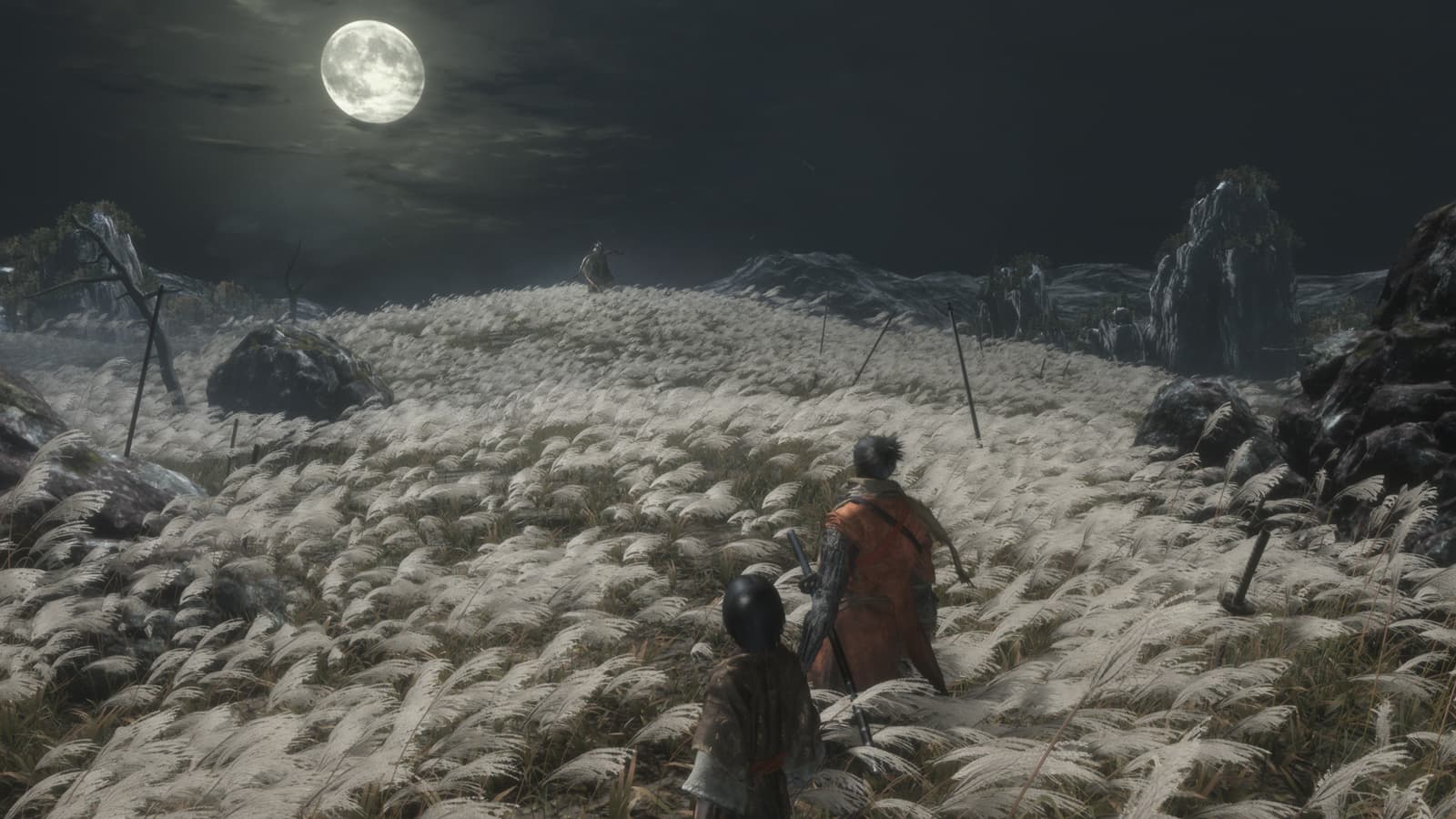 © FromSoftware
Introduction: The “Nothingness” of a Blood-Stained Battlefield and the Primal Landscape of Life
The narrative of Sekiro: Shadows Die Twice, crafted by FromSoftware, revolves around the supernatural phenomenon of immortality (Dragon’s Heritage). However, its essential theme lies in the existential question of “how an entity born as a mere tool acquires a human ego and comes to choose its own destiny by its own will,” as well as a return to the cosmic harmony of the “flux of life and death.” In this article, we will comprehensively and thoroughly examine the life of the protagonist, “Wolf (Sekiro),” from his upbringing to the temptation of Shura he faces, and the four endings he ultimately reaches. This will be achieved by intersecting the fragmented texts told within the game, the Japanese Buddhist view of life and death (Realm of Asura, Karma, Six Realms of Samsara), and the Shinto view of life and death (Kegare (Defilement) and Stagnation).
Wolf’s story begins in a place symbolic of death: the gruesome ruins of a battlefield. Amidst a bloody war for the conquest of Ashina, he, a war orphan, was discovered by Great Shinobi Owl, who was scavenging the battlefield. What is noteworthy as a fact explicitly stated in the game is that, despite being a starving child, he did not seek food or help, but merely stared expressionlessly at the “blade left by an enemy.” Seeing him grasp the blade with his bare hands, remaining perfectly still even as he bled, Owl recognized in him a “rare aptitude for a Shinobi.”
The philosophical consideration derived from this fact is that Wolf’s initial state was thoroughly an “empty vessel.” Lacking even a thirst for survival and captivated by a blade, a symbol of death, he was devoid of the foundation of self-existence. The Sculptor (Sekijo), who later becomes his predecessor and a cautionary tale, also has a past of being picked up by the brilliant physician Dogen after collapsing on a battlefield. However, according to Emma’s recollection, the young Sekijo was constantly glaring at a “rice ball,” and Dogen, finding this troublesome, took him home.
The contrast in the upbringing of these two is extremely important. While Sekijo possessed an attachment to food—a primal thirst and emotion for “life”—Wolf had a faint attachment to life, merely accepting death (the blade) in silence. This difference in their primal landscapes foreshadows the decisive divergence in their ultimate fates: Sekijo later becomes trapped by Karma and transforms into the Demon of Hatred, while Wolf ultimately achieves liberation from attachment and transcends his destiny. A Shinobi is a “tool” to execute their master’s orders. Devoid of emotion, they simply cut down what must be cut. However, as this “existence as a tool” intersects with the power of immortality—a force deviating from the laws of nature—its raison d’être undergoes a fundamental transformation.
2. The Curse of the “Iron Code” and the Awakening of the Ego
At the root of Wolf’s behavioral principles lies the “Shinobi Code (Iron Code)” instilled in him by his adoptive father, Owl. This code functioned as an absolute program to control the tool known as Wolf, serving as a yoke that intentionally hindered the formation of his ego.
2.1 Owl’s Brainwashing and the Deception Hidden in the Code
In the memories at the Hirata Estate and the reunion scene with Owl at Ashina Castle, the structure of this code and its contradictions are clearly presented. In the memory of the Hirata Estate, Owl says, “Wolf, do not forget the Iron Code. The master is absolute!” and orders him to protect Kuro. However, upon their reunion at the Ashina Castle keep three years later, Owl clarifies the hierarchy, stating, “The code is absolute. One, the parent is absolute. Two, the master is absolute,” and orders Wolf to obey him, the parent, and abandon Kuro, the master.
From the fact of this “transition of dialogue” explicitly shown in the game, a profound consideration regarding Owl’s intentions can be derived. Reversing the Japanese historical context that values loyalty (absolute allegiance to a lord), this code, which places the “parent (= Owl himself)” above the “master (= Kuro),” is not a universal norm of a Shinobi group, but the product of extremely selfish brainwashing designed to achieve Owl’s personal ambitions. At the time of the Hirata Estate, Owl faked his own death and made Wolf function as a “pawn to protect the master,” thereby attempting to eliminate the troublesome bandits and Lady Butterfly. Then, in the phase at Ashina Castle, when the situation had settled and preparations to monopolize the power of the Dragon’s Heritage were complete, he presented the true first rule, the “absoluteness of the parent,” for the first time, attempting to rob Kuro from Wolf. This is nothing but a representation of pure psychological domination (mind control).
2.2 The Decision at Ashina Castle: A Leap from Heteronomy to Autonomy
In the middle of the story, at the Ashina Castle keep, Wolf stands at his greatest crossroads. Will he “obey the parent (Owl) and abandon the master (Kuro),” or will he “break the code (parent) and protect the master”? The moment Wolf makes the choice to “break the code” here is the decisive turning point where he sheds his skin from a “tool” to a “human (individual).”
At first glance, the act of protecting the master seems to follow the duty of a Shinobi (the second rule). However, its significance changes dramatically in that it was chosen as a result of destroying the “first rule that makes the parent absolute” by his own clear will. This is no longer an action driven by a heteronomous program, but a sublimation into a decision based on autonomous “love” or “mercy.” Denying the parental figure who was his lifesaver and absolute ruler is a spiritual patricide (the overcoming of the Oedipus complex), signifying the moment a strong “ego” first resided in the empty vessel known as Wolf.
3. The Sculptor (Sekijo) as a Mirror Image: The Boundary Between Shura and Hatred
In discussing Wolf’s ultimate destination, one cannot avoid the existence of the Sculptor (Sekijo), who is his predecessor, a cautionary tale, and his own “shadow.” The two share numerous commonalities: both have lost their left arms, wield special Shinobi Prosthetics, and are orphans picked up from battlefields. In the game, by sharing the sake Wolf brings back with the Sculptor, a strange, friendship-like relationship built on mutual respect is forged. At the same time, however, the Sculptor’s existence multi-layeredly fulfills the role of a mirror image, confronting Wolf with the “cruel fate of a Shinobi.”
Below is a summary of the commonalities and contrasts that exist between Wolf and the Sculptor.
| Comparison Item | Sculptor (Sekijo) | Wolf (Sekiro) |
|---|---|---|
| Primal Landscape of Origin | Glaring at a “rice ball (life)” on the battlefield | Staring at a “blade (death)” on the battlefield |
| Circumstances of the Prosthetic Arm | Left arm severed by Isshin Ashina to stop his transformation into Shura | Left arm severed by Genichiro Ashina to protect his master (Kuro) |
| Behavioral Principles | Wildness as a leaping monkey and an inclination towards slaughter | Self-restraint through the Iron Code and loyalty to his master |
| Destination of Karma | Absorbs the flames of hatred and transforms into a demon | Branches into four destinies depending on the player’s choices |
3.1 The Shadow of Shura and the Karma of Slaughter
From a Buddhist perspective, a Shinobi who continues to take countless lives on the battlefields of Ashina inevitably accumulates “Karma.” In the Buddhist worldview, those who spend their days in conflict and slaughter are said to fall into the “Realm of Asura,” one of the Six Realms of Samsara. Sword Saint Isshin Ashina, while sharing Monkey Booze, speaks of the former Sculptor as follows: “Those who go on killing will eventually become Shura. They even forget why they were killing, and come to find joy only in the act of killing itself. The shadow of Shura was in his eyes, too. That is why I cut him down.”
From the fact of Isshin Ashina’s testimony, the philosophical definition of “Shura” in this work becomes clear. Shura refers to a state of ego collapse, deviating from “battles with a purpose” such as protecting a country or a master, and being swallowed by the “pleasure of the act of slaughter itself.” Isshin Ashina severed the Sculptor’s left arm just before he completely transformed into a monster of Shura, forcibly cutting off his path of martial arts to anchor him as a human in the present world.
3.2 The Demon of Hatred: Another Fate
A highly suggestive fact is that the Sculptor, who had his path to Shura severed and supposedly sought peace of mind by continuously carving Buddhas, transforms into a grotesque monster known as the “Demon of Hatred” towards the end of the story. A deep consideration of this phenomenon highlights that “Shura” and the “Demon of Hatred” in the worldview of this game are similar yet distinct concepts.
While Shura is the “joy of slaughter that sprouts within oneself (intrinsic malice),” the flames of hatred are a physical and magical causality resulting from the “nowhere-to-go grudges and sorrows of those who died on the battlefield (extrinsic thoughts)” swirling in search of a vessel. The Sculptor himself is clearly aware of its omens, warning Wolf, “When war breaks out, corpses will pile up like mountains, hatred will swirl like flames, and a demon will surely be born,” and “You (Wolf) wouldn’t want to meet a demon either, would you?”
The Sculptor had not lost sight of his purpose for fighting, and did not become a Shura who finds joy in killing itself. However, the vessel of Karma he bore from past battlefields was far too massive. The “void” in his heart, created by suppressing his inner Shura, became the optimal receptacle to absorb the flames of hatred from the battlefield that had nowhere else to go. After the subjugation, the old woman (informant) left at the ruins of the battlefield says, “He (the Sculptor) kept carving Buddhas all along. To be burned by the flames of hatred, become a demon, and suffer—that is his Karma (causality). You ended it and sent him off. He is grateful, too.” The old woman also strongly warns Wolf against becoming the next vessel of hatred, saying, “The hatred has lost its place to accumulate. If the war continues, the world will become even worse. That is why you must not take his place.”
3.3 The Unconscious Defense Mechanism Told by the Buddha Statues in the Dilapidated Temple
The countless Buddha statues the Sculptor continues to carve in the Dilapidated Temple serve as environmental storytelling that meticulously visualizes his inner structure. In the game’s depiction, the majority of the Buddha statues he carves bear an “expression of wrath,” and “four-armed” Buddha statues, including broken ones, are scattered about. Even more interestingly, the Demon of Hatred that Wolf ends up fighting takes on a grotesque form close to having “six arms” (including arms of flame).
Considering the historical context of Japanese Buddhist art, multi-faced and multi-armed Buddha statues, such as the six-armed Asura statues and the Eleven-Faced Kannon, exist as symbols that thoroughly save sentient beings transmigrating through the Six Realms of Samsara (Hell, Hungry Ghost Realm, Realm of Animals, Realm of Asura, Human, Deva), or as designs possessing the power to subjugate Shura itself. In fact, a statue resembling the Eleven-Faced Kannon also exists in the Dilapidated Temple, and its pedestal shows signs of objects having been placed there countless times. It is presumed that behind the Sculptor’s unconscious, continuous carving of multi-armed Buddhas, an obsessive-compulsive defense mechanism was at work, attempting to suppress the Karma of Shura (the chains of the Six Realms of Samsara) writhing within him through religious representations.
Furthermore, there is the fact that the arranged Buddha statues are lined up leaving an unnatural empty space, as if averting their eyes from something (a space to place a left arm, or the Shinobi Prosthetic). This eloquently speaks to the mental deadlock of the Sculptor, who, while averting his eyes from his own loss (the proof of his sins) and blood-stained past, could never escape the gravitational pull of his traumatic Karma.
4. The Stagnation of Immortality and the Transcendence of Life and Death: A View of life and death Where Shinto and Buddhism Intersect
Another massive philosophical and cultural theme Wolf faces is the “Stagnation of the Dragon’s Heritage,” which lies at the intersection of the Shinto concept of “Kegare (Defilement)” and the Buddhist concept of “attachment (craving).” In the worldview of this game, the blood of the “Dragon’s Heritage” that brings immortality is by no means depicted as a sacred and pure blessing, but rather as a “Stagnation” that dams up the natural cycle of life and death.
4.1 Water Deity Worship in Shinto and “Stagnation”
In the Shinto view of nature found in the ancient strata of Japan, water is “pure precisely because it flows,” and if it stops, it “stagnates and rots (Kegare (Defilement)).” The phenomenon where the water flowing down from the Fountainhead Palace becomes Rejuvenating Waters in downstream Ashina, giving rise to the hideous immortality known as the Infested, aligns with this logic of “Stagnation = Kegare (Defilement).” The “Immortal Severance” that Kuro desires is a wish seeking an extremely self-sacrificing and cosmic harmony: to fundamentally sever this unnatural Stagnation residing within himself and return all things to their rightful cycle of flux (the laws of nature).
4.2 The Craving for the Nation Symbolized by the Black Mortal Blade “Open Gate”
While Wolf acts to fulfill this wish for harmony, standing in direct opposition to this is Genichiro Ashina. Genichiro Ashina seeks heretical powers (Rejuvenating Waters and the Dragon’s Heritage) by any means necessary to protect his perishing homeland, Ashina. The item text for the other Mortal Blade he wields, the Black Mortal Blade “Open Gate,” clearly states: “A blade that opens the gate to the underworld. Black turns to form life. It requires Dragon’s blood, and brings back (the target) from the underworld of the deceased.”
In the final battle, Genichiro Ashina severs his own head, offering his life and the blood of the Dragon’s Heritage (the blade wound inflicted on Kuro) as a sacrifice to incarnate Sword Saint Isshin Ashina in his prime from the underworld into the present world. At the root of this action is an intense attachment to the present world: to “ensure the survival of the country.” In Buddhism, attachment (craving) is the root cause of all suffering. Unable to accept the principle of “Impermanence (Shogyo Mujo)“—the ruin of Ashina—Genichiro Ashina clung to a ghost of the past (Isshin Ashina), offering even his own life and humanity as a sacrifice.
In contrast, Wolf’s journey takes on the aspect of spiritual asceticism directed towards “liberation from attachment.” Initially, he fights to “protect (possess) his master,” but ultimately, to fulfill Kuro’s wish to “live and die as a human (or return the Dragon’s Heritage),” he is required to be prepared to let go of even his attachment to his master himself. In this contrast, while Genichiro Ashina meets his ruin as the epitome of attachment, Wolf draws closer to the state of detachment.
5. The Four Destinations Awaiting at the End of Causality
Wolf’s story branches into four endings depending on the player’s choices and the depth of their exploration. These endings are not mere multiple endings of a game, but four exquisite philosophical destinations that show where a Shinobi who broke the code (or a Shinobi who succumbed to the code) ultimately arrives. Below, their structures and the dynamics of causality are organized and demonstrated.
| Ending Name | Conditions for Choice and Execution | Wolf’s Philosophical Destination | Destination of Causality and Historical Meaning |
|---|---|---|---|
| Shura | Obey the code (side with Owl) and abandon the master. | Self-abandonment as a tool and ego collapse through immersion in the pleasure of slaughter. | The rampage of causality. The birth of a true Shura that surpasses even the flames of hatred and destroys the country. |
| Immortal Severance | Break the code and fulfill Kuro’s wish (Immortal Severance). | Completion of the mission. However, losing his master, he regresses into a new “Sculptor.” | The chain of causality. Inheriting Karma, an endless prison of Samsara waiting for the next generation’s Shinobi. |
| Purification | Break the code and sacrifice himself to make Kuro human. | Ultimate self-sacrifice by individual will and the completion of deep affection for his master. | The extinction of causality. Purifying the Stagnation with his own life and disappearing into the darkness of history. |
| Return | Break the code and return the Dragon’s Heritage to its western homeland with the Divine Child of Rejuvenation. | Restoration of the laws of life and death and sublimation to a new dimension (a seeker of truth). | The transcendence of causality. Leaving the framework of Ashina for a journey of cosmic harmony. |
5.1 [Shura]: The Complete Collapse of Ego and Immersion in Slaughter
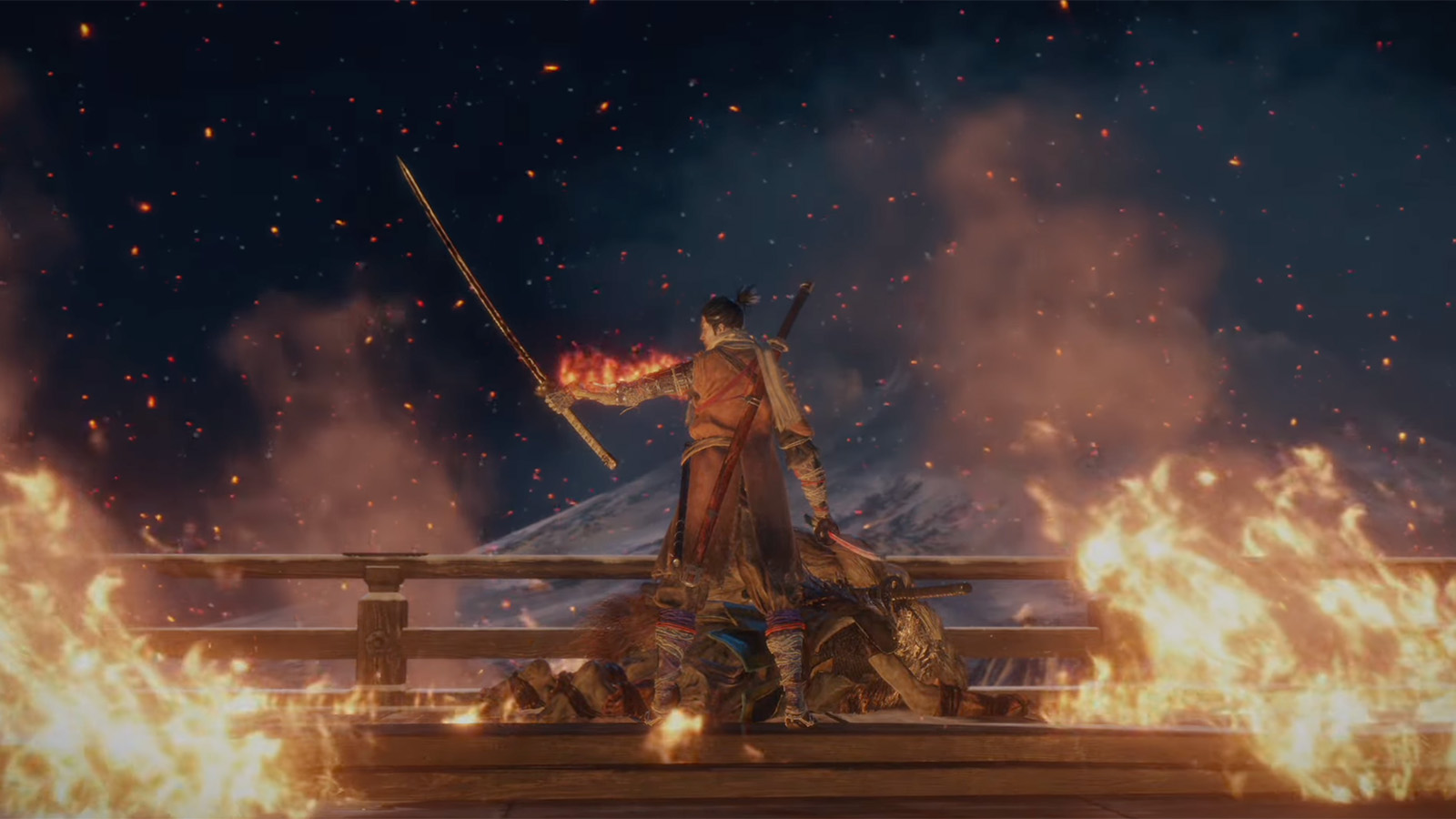
If one succumbs to the sweet words of the adoptive father, Owl, and chooses to “abandon the master and obey the code,” Wolf slays Emma, who had cared for him, with his own hands, and further strikes down the aged Isshin Ashina. Owl, in ecstatic joy that his ambitions have been achieved, strokes Wolf’s back, but immediately after, Wolf mercilessly stabs his adoptive father to death from behind.
What is important in the consideration of this ending is the fact that while Wolf appears to have “obeyed the Shinobi code,” he has actually “completely trampled even the code” by murdering Owl. This indicates that Wolf has transformed into a mere “slaughtering mechanism,” driven neither by loyalty to his lord nor obedience to his parent. It is the epitome of Shura that the Sculptor once almost fell into: “forgetting even why they were killing, and coming to find joy only in the act of killing itself.” Escaping from the acquisition of ego—protecting his master by his own will—and abandoning thought to rely solely on the act of swinging his blade, he completely lost his humanity as a result. Without even becoming a vessel (demon) to absorb the flames of hatred accumulating on the battlefield, Wolf, having become an incarnation of pure malice and slaughter, embodies the most tragic “fate of a tool.” The text stating that Ashina is later passed down as a “land where Shura roams” signifies that the Karma of a single individual expanded into a disaster on a national scale.
5.2 [Immortal Severance]: The Inheritance of Karma and the Endless Prison of Samsara
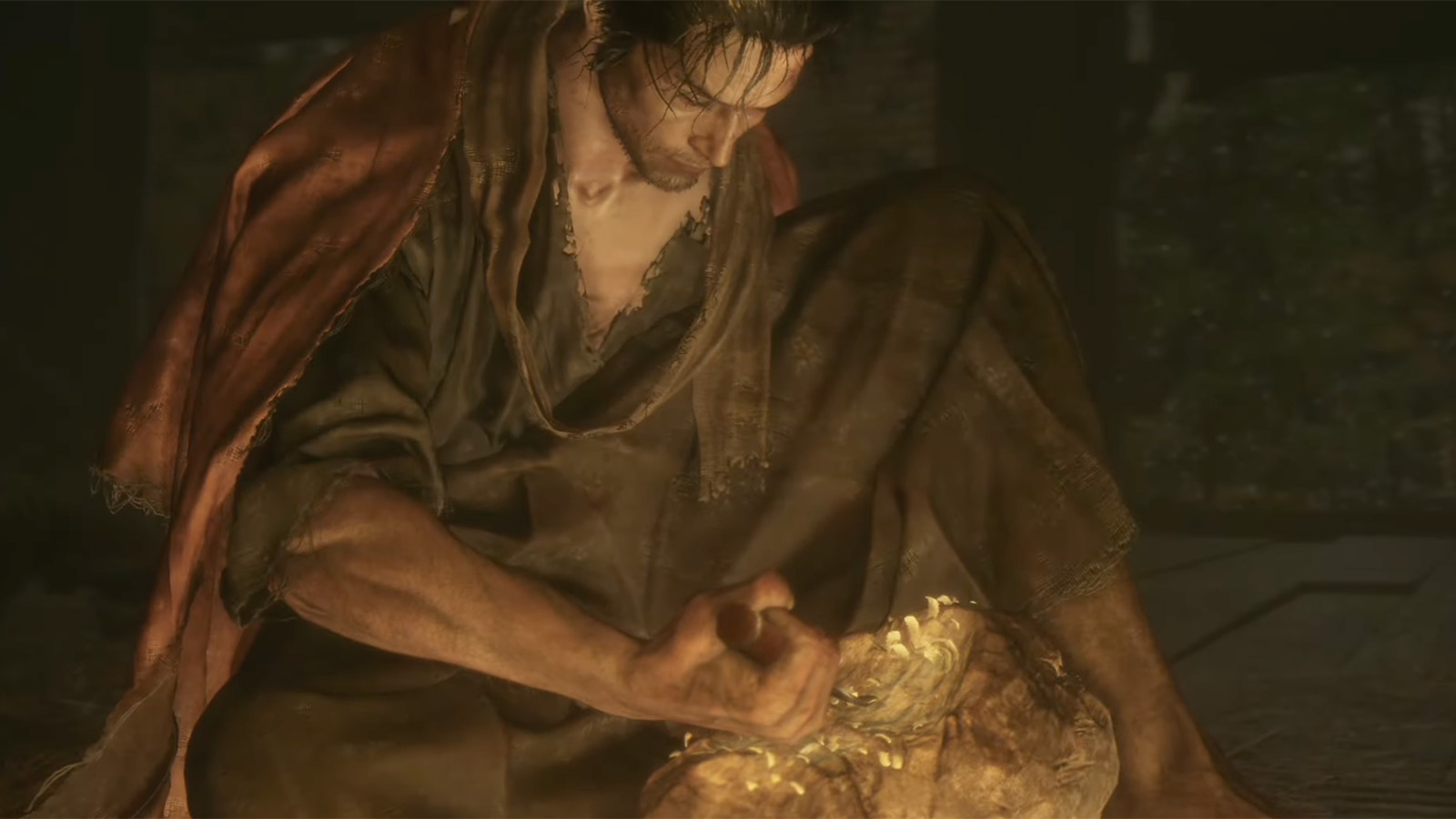
This is the ending where immortality is severed according to Kuro’s original wish. Wolf brings down the red Mortal Blade (Gracious Gift of Tears) upon Kuro, erasing the Stagnation of the Dragon’s Heritage from the world. However, the destination of Wolf, having lost his master, was exactly the same as the former Sculptor: “days of secluding himself in the Dilapidated Temple, single-mindedly continuing to carve Buddhas of wrath.” Beside him, Emma stands quietly, just as she once stood by the Sculptor.
This ending fulfills his ultimate purpose as a Shinobi in that he achieved Kuro’s dearest wish. However, viewed philosophically and structurally, this is nothing but the “complete inheritance of the Sculptor’s Karma.” Despite the Sculptor being burned away by the flames of hatred and the informant old woman strongly warning, “You must not take his place,” Wolf sits in the Dilapidated Temple as a solitary Shinobi who has lost his left arm, destined to become the next “vessel for the flames of hatred.” It depicts the harsh Samsara of causality: a tool known as a Shinobi, having lost its master and its purpose for fighting, has no choice but to rot away while being tormented by the Karma of past slaughters. The Buddha statues he carves have also, just like the Sculptor’s, been reduced to representations of defense, desperately attempting to suppress the Karma of Shura.
5.3 [Purification]: Ultimate Self-Sacrifice and Completion as a “Human”
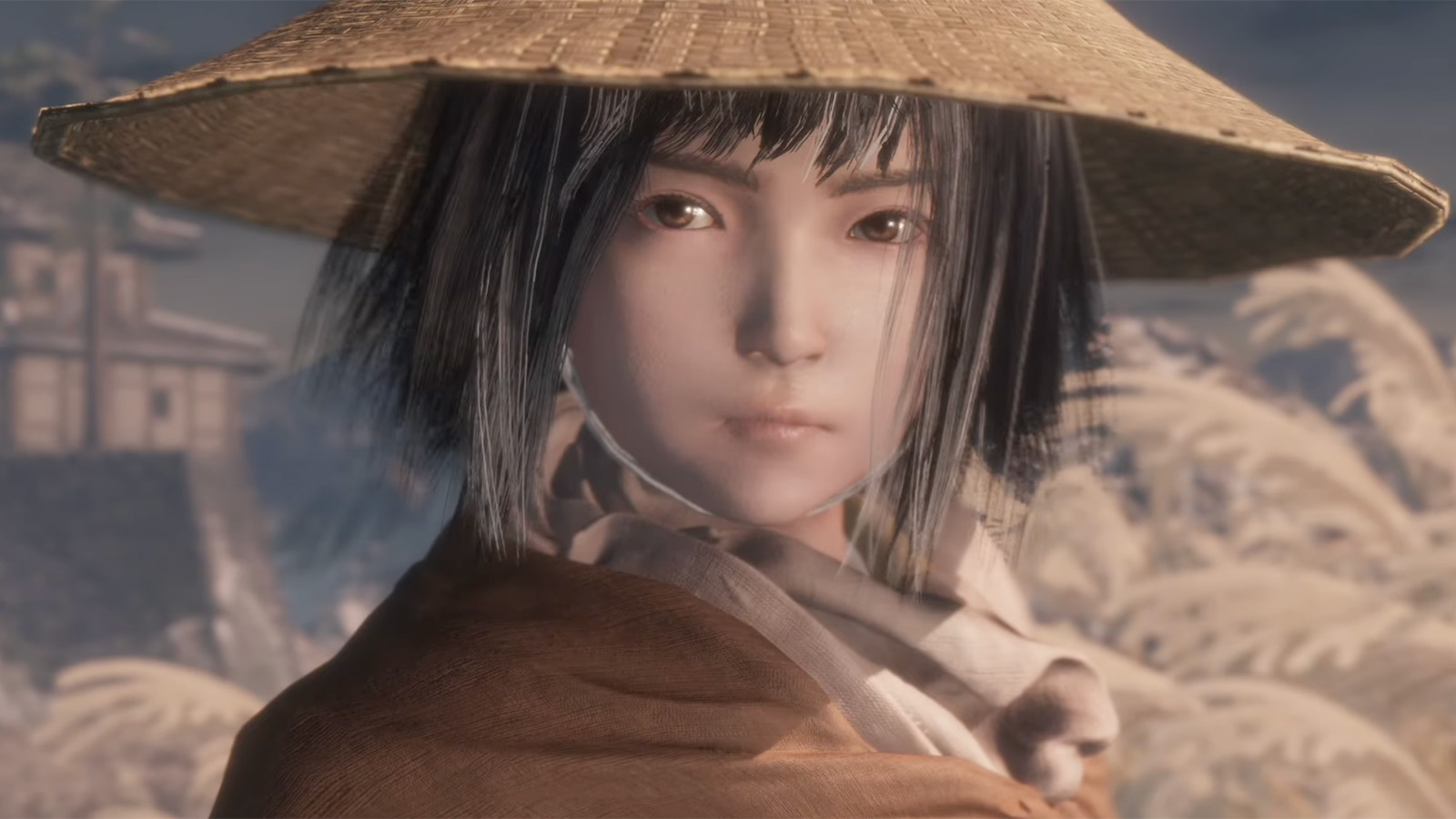
Learning that Kuro is destined to die as the price for Immortal Severance, Wolf secretly seeks another path (a path using the Everblossom’s flower) with Emma, and at the cost of his own life, returns Kuro to being “a normal human.” This is the ending of Purification.
Here, Wolf’s ego reaches its noblest dimension. For the first time, he transcends even the “master’s order (= sever immortality and cut me down),” making his own strong, intrinsic will to “let the master live” his guiding principle for action. He breaks his adoptive father’s code, and furthermore, overcomes even the supposedly absolute order of his master out of “deep affection for his master.” The sight of Wolf thrusting the Mortal Blade into his own neck to allow Kuro to enjoy life as a human is not that of a cold-blooded Shinobi. It is the practice of the “Bodhisattva path” in Mahayana Buddhism, saving others through self-sacrifice, and the moment a single human being fulfills the meaning of his own existence. Through this ending, Wolf severs all the Karma of Shura falling upon him and the causality of becoming the next vessel of hatred with his own death, disappearing into the darkness of history under complete free will. The sight of the remaining Kuro setting off on a journey as a normal human is the proof of hope brought about by Wolf’s choice.
5.4 [Return]: Transcendence of Samsara and Pilgrimage to Cosmic Harmony
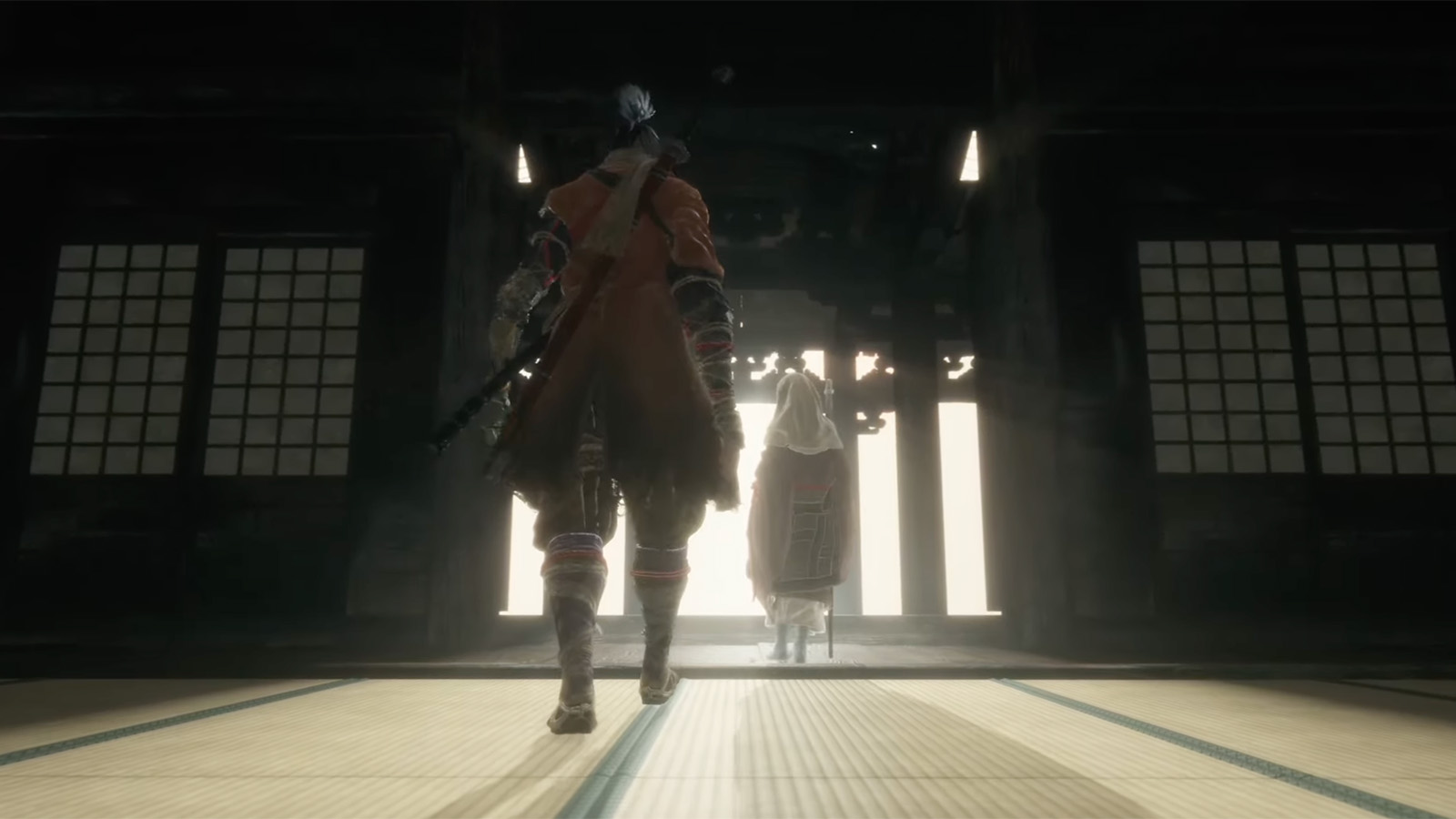
This is the ending where Kuro’s soul (Dragon’s Heritage) is cradled within the womb of the Divine Child of Rejuvenation (a child created as a vessel for the divine), another individual involved with the Dragon’s Heritage, and they journey together towards the “West,” the homeland of the Dragon’s Heritage. This is the highest and most comprehensive solution: not merely “severing (destroying)” the Stagnation of immortality, but “returning” it to its rightful source.
Wolf, having chosen this path, is no longer bound in any way by the causality of the narrow land of Ashina or the framework of a tool known as a Shinobi. He has undergone a dramatic evolution from the “Shinobi of the Divine Heir” to the “guardian of seekers striving to return the laws of life to their rightful state.” Interpreted Buddhistically, it is a departure on a pilgrimage journey towards the West (a direction metaphorically representing the Western Pure Land), aiming for enlightenment and harmony, escaping the crucible of Ashina where Shura and hatred swirl. Completely liberated from worldly attachments such as the chain of hatred and the Karma of Shura, Wolf, who has begun walking the path that simultaneously achieves the Shinto purification of Kegare (Defilement) and Buddhist liberation, can be said to embody the true “destination,” having reached the supreme realm as both a human and a Shinobi.
Conclusion: The Blade of Mercy Cleaving Through Ignorance—The Completion of the Human Known as “Wolf”
The character “Wolf (Sekiro)” presented by FromSoftware did not possess a heroic will from the beginning, nor did he burn with a sense of justice. He was an empty vessel drawn to a blade on a gruesome battlefield, nothing more than a pitiful puppet bound by the selfish code of his adoptive father, Owl. However, through his interactions with his master, Kuro, he touched upon warm humanity; facing his own gruesome future reflected in the mirror that is the Sculptor (Sekijo), and throwing himself into the causality of hatred and Shura covering Ashina, he slowly but surely acquired a “heart.”
While the Sculptor avoided becoming Shura but took upon himself the hatred of the battlefield, meeting a tragic end as a demon, and Genichiro Ashina met his ruin by resorting to the taboo Black Mortal Blade out of attachment to his country, Wolf, despite being at the center of that vortex of causality, ultimately finds a path to sever his own attachments.
When he destroys the absolute norm set by another known as the “code” and makes the existential decision to “choose his master’s destiny by his own will,” he is completed for the first time as an individual human being, the “one-armed Wolf.” The reason he swings his sword in the final stages is neither mere pleasure of slaughter (Shura) nor blind obedience (tool); it has been sublimated into a “blade of mercy” to bring an end to a world where life and death have stagnated, and to bring true peace to a cherished other (Kuro).
It can be concluded that Sekiro: Shadows Die Twice was a fierce yet tranquil pilgrimage of the soul, hidden within the echoes of bloody sword clashes, detailing how a single Shinobi escaped the spiral of Karma and Samsara to regain a human heart. The back of Wolf, who transcended the code and carried out his own will, quietly yet powerfully tells of the hope that even in a despairing world swirling with gods and the curse of immortality, one can carve out their own destiny with their own hands.
Dialectics of Immortality and Fate: Sekiro: 11 Meditations on the Dragon’s Heritage and Mortal Struggle
The book version is now available. Read for free with Kindle Unlimited.
Thank you very much for reading to the end. To help support the activities of this archive, a warm donation of a cup of coffee would be highly appreciated.