Memory.09: Sculptor and Emma
 © FromSoftware
Introduction: The Intersecting Karma of “Salvation” and “Ruin” in Ashina
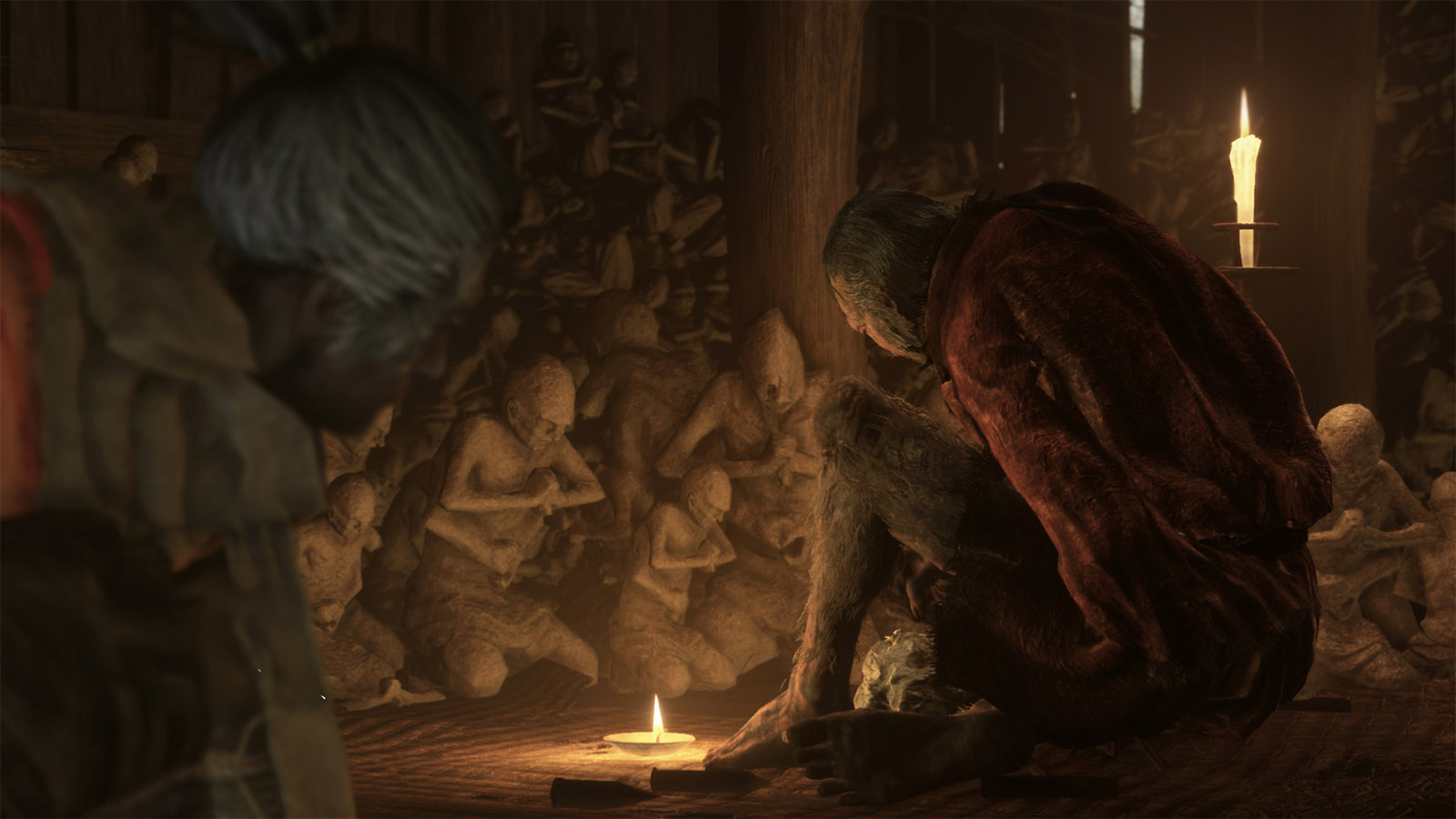
In the narrative of Sekiro: Shadows Die Twice presented by FromSoftware, the land of Ashina serves as the stage for a multi-layered tragedy, driven by the supernatural power of immortality and the obsessions of the humans who flock to it. If the tale of the master and servant—the Divine Heir and Wolf (Sekiro)—is the main melody of this work, there exists a contrapuntal theme playing quietly yet with undeniable fervor in the background. That is the story of the karmic bond between the “Sculptor,” who continues to carve wrathful Buddhas in the Dilapidated Temple, and “Emma,” the genius physician who watches over him.
The narrative of this game avoids explicit exposition, instead constructing itself through countless “dots”—fragmented item descriptions, conversations with NPCs, shared memories over sake, and environmental storytelling. The purpose of this article is to logically integrate these scattered fragments of fact and thoroughly unravel the trajectory of the Sculptor and Emma’s souls, examining them against religious and philosophical backgrounds such as “Karma” and the “Realm of Asura” in Japanese Buddhism, and “Kegare (Defilement)” in Shinto.
How did an exceptional Shinobi once known as “Shoujou” step into the realm of “Shura” and ultimately transform into the “Demon of Hatred”? And what of the inner world of Emma, who rose from being a battlefield orphan and harbored the fierce resolve to strike down her benefactor, the Sculptor, with her own hands? In this article, we will describe the full scope of the quiet resolve they embodied, strictly distinguishing between the “facts” explicitly stated in the game and the “speculations” based on historical and philosophical contexts.
1. The Shinobi “Shoujou” and the Sprouting of Shura
The Sculptor’s past originates in the “Sunken Valley,” a deep ravine in Ashina. He was originally a solitary Shinobi who lived in the wild, leaping through the Sunken Valley alongside wordless monkeys. The reason he was called “Shoujou” stems from his beast-like agility and the accumulation of harsh Karma, which will be discussed later.
1.1 The Facts Revealed by Monkey Booze and the Memory of “Shura”
In unraveling the Sculptor’s past, the first solid piece of evidence is the dialogue shared over “Monkey Booze.” When Wolf brings Monkey Booze to the Dilapidated Temple and offers it to the Sculptor, he recounts his gruesome memories.
As a matter of fact, in the in-game dialogue, the Sculptor speaks as follows. He once bounded through the valley with the monkeys, but eventually became consumed by the very act of slaughter. “In the past, I kept cutting down Shura,” “I even forgot what I was killing for,” he confesses, warning that the “god of Shura” dwells even in the eyes of the valley’s monkeys.
The speculation derived from this points to the concept of the “Realm of Asura” in the Buddhist worldview. The Realm of Asura is one of the Six Realms of Samsara (Hell, Hungry Ghost Realm, Realm of Animals, Realm of Asura, Human Realm, and Heavenly Realm), a world dominated by ceaseless conflict and anger. Those who fall into Shura are not those who harm others out of human motives such as a righteous cause, loyalty, or patriotism, but rather those who have made combat and slaughter an end in themselves. The fact that the Sculptor says he “forgot what I was killing for” clearly suggests that he had completely lost his human ego and ethics, and was on the verge of transforming into an entity driven solely by pure fighting instinct—an “aberration.” His statement that he sees the god of Shura even in the eyes of monkeys signifies a severe mental collapse, where his own inner world was so completely consumed by the hellfire of Shura that he projected his own madness even into the eyes of others.
1.2 The Severing of the Left Arm by the Sword Saint: Physical Castration and the Halting of the Soul
The one who stopped Shoujou when he was on the verge of fully transforming into Shura was the Sword Saint, Isshin Ashina, who stood at the pinnacle of Ashina. As a matter of fact, the context within the work indicates that Isshin forcibly severed the chain of slaughter by cutting off Shoujou’s left arm.
The speculation regarding this fact transcends the framework of a mere physical combat outcome. For a Shinobi, an arm is a lifeline, and being deprived of it means the eternal stripping of “martial power (the means of slaughter)“—in other words, a “physical castration” as a warrior. At the same time, however, it can be said that Isshin’s blade narrowly scraped away the “hellfire of Shura” that clung to Shoujou’s soul. Through this act, which could be called the ultimate expression of the “life-saving sword (Katsujinken)” in Japanese martial arts, Shoujou ostensibly prolonged his life, spending his remaining years merely as a “one-armed man.” Yet, in the depths of his soul, the unextinguished embers of Shura continued to smolder, serving as a fatal foreshadowing for the later birth of the “Demon of Hatred.”
2. The Dragonspring Banquet and the Remnants of Humanity Blooming in the Fires of War
In the half-life of the Sculptor, frightened by the shadow of Shura, the madness of slaughter was by no means everything. The fact that proves this remains in the sharing of memories over the fine sake known as “Dragonspring.”
2.1 The Banquet of Fools: Relationships as Facts
When Wolf offers “Dragonspring” to the Sculptor, he speaks in an unusually elated manner, detailing the scene of a banquet once held in Ashina. From this dialogue, the kind of relationships the man named Shoujou had built with the key figures of Ashina emerges as concrete facts. Based on the Sculptor’s references, the figures present at the gathering and their characteristics are organized in the table below.
| Figure (As called by the Sculptor) | Presumed Identity | Characteristics and Depiction at the Banquet | Relationship with the Sculptor and Subsequent Fate |
|---|---|---|---|
| A fool who wouldn’t let go of his cross-spear | Gyoubu Oniwa (Gyoubu Masataka Oniwa) | The epitome of a warrior, never letting go of his weapon even while drinking. | A comrade-in-arms who ran through the battlefield together. Later slain by Wolf at the Castle Gate. |
| A fool who used illusions to steal others’ sake | Lady Butterfly | An aloof demeanor, interweaving reality and illusion to snatch sake from others. | A fellow Shinobi. Slain by Wolf at the Hirata Estate. |
| A fool who stayed up all night tinkering with a half-made prosthetic | Dogen the Physician | An eccentric who immersed himself in the study of mechanisms even in the midst of a banquet. | The benefactor who crafted the Sculptor’s lost left arm (Shinobi Prosthetic), and Emma’s adoptive father. |
| A big, imposing Owl who turned bright red immediately, all for show | Great Shinobi Owl | Despite his massive frame, he was a lightweight drinker who quickly turned red in the face. | A fellow Shinobi and Wolf’s adoptive father. Consumed by ambition, later slain by Wolf. |
The memory of this banquet is a fact that records the final brilliance of the “human side” possessed by the Sculptor. It proves that the man named Shoujou was not merely a solitary assassin, but someone who, at the historical turning point of Ashina’s rebellion, shared sake with his peers and forged genuine human bonds.
2.2 The Meaning of the Prosthetic Arm: The Embodiment of Bonds and the Chain of Karma
What should be particularly examined here is the philosophical significance of the “Shinobi Prosthetic” crafted by Dogen. As a matter of fact, this prosthetic is a complex mechanism made to compensate for Shoujou’s lost left arm. However, on a speculative level, this prosthetic can be interpreted as an “anchor” that tethered Shoujou’s soul from the realm of Shura back to the human world.
The fact that a genius like Dogen stayed up all night continuing to build the prosthetic is proof of his deep friendship and affection for Shoujou. Although the Sculptor loathed his own past, he never neglected the maintenance of this prosthetic, and later entrusted it to Wolf, who had lost his left arm just like himself. The duality of this prosthetic—being a bloodstained Shinobi tool while simultaneously a crystallization of unconditional love from another—brilliantly embodies the “inseparability of violence and affection” inherent in the land of Ashina.
3. The Encounter on the Battlefield and the Birth of Emma
The personal Karma between the Sculptor and Emma begins on a gruesome battlefield reeking of blood and death. This encounter is the fateful intersection between a man captivated by Shura and the young girl who would later be by his side at his death.
3.1 The Memory of the Rice Ball: The Gift of Life in the Realm of Death
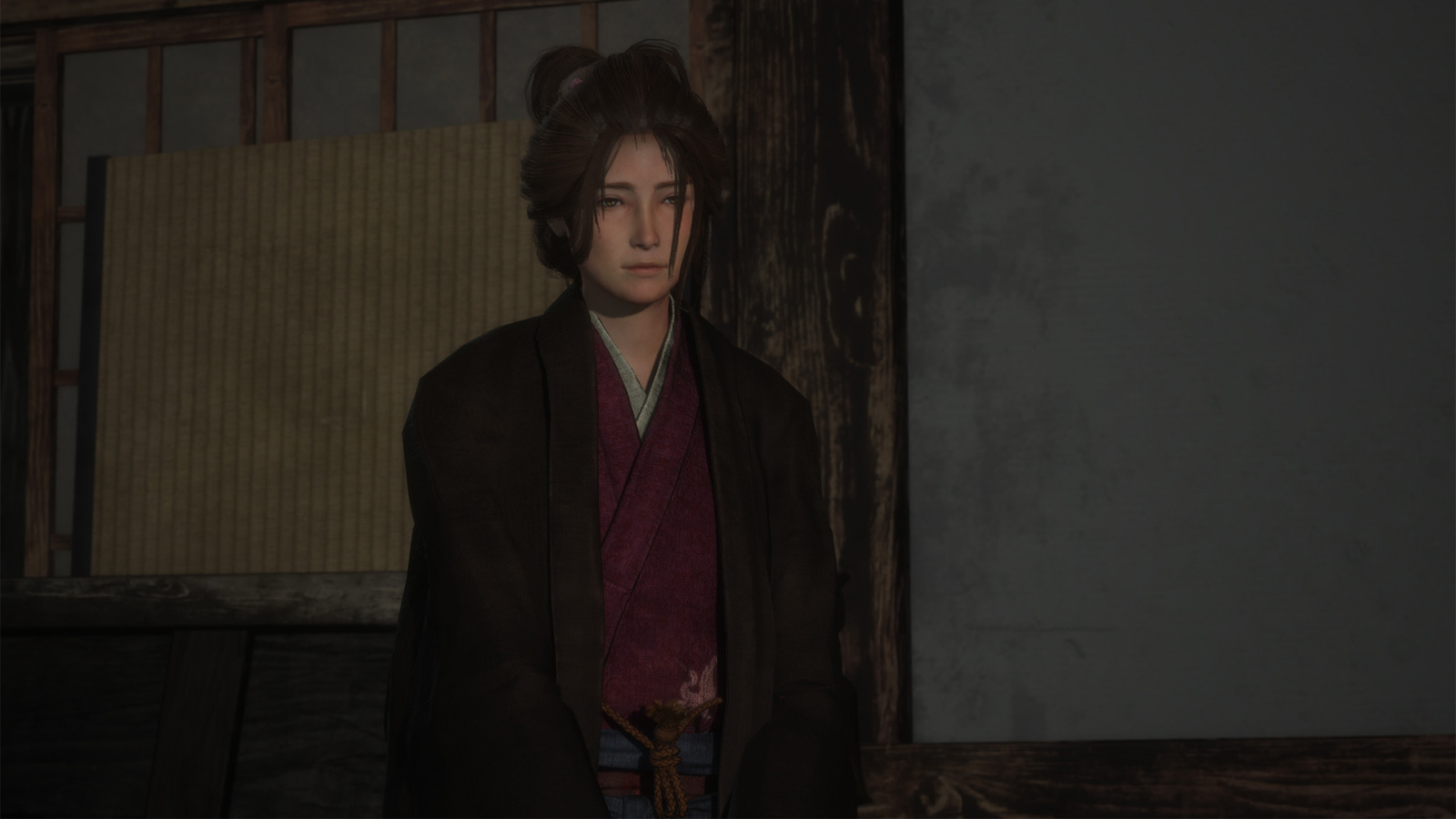
As an in-game fact, it is told that when Emma was still young, wandering the battlefield as an orphan and suffering from starvation, a passing Shoujou (the Sculptor) shared his rice ball with her. The Sculptor offered the food in silence, without uttering a word.
Let us develop a Shinto and folkloric speculation based on this fact. A battlefield is a domain saturated with “Kegare (Defilement)” brought about by mass death. In the ancient Japanese View of life and death, death is the strongest Kegare, and those who touch it are isolated from society and require purification (Misogi). In such an absolute realm of death, the act of “transferring food,” shown just once by the Sculptor who was walking the path of Shura, signifies a powerful reception of vitality, almost like an inversion of the Shinto concept of “Shinjin Kyoshoku” (gods and humans eating together). The act of sharing or giving food creates a fundamental bond of souls. By giving food to a child, a symbol of pure life, the man smeared with the Karma of Shura paradoxically reaffirmed the faint “humanity” left within himself.
3.2 The One Who Chased “Monkeys”: The Sculptor’s Trajectory from Emma’s Perspective
Emma later speaks quietly to Wolf, “There was once someone with a mission, much like you. I believe he chased monkeys for a time, but eventually, he grew quiet. I pray that you will be able to catch the monkeys.”
As a speculation on this fact (dialogue), the multiple layers of meaning indicated by these “monkeys” can be raised. On the surface, it sounds as though she is hinting at the mission to capture the “Seeing, Hearing, Speaking, and Invisible Monkeys” in the Halls of Illusion, but beneath Emma’s words, her affection for the Sculptor is always hidden. When overlaying the fact that the Sculptor himself once bounded through the valley like a “monkey,” Emma’s words can be read as a metaphor for the Sculptor’s half-life: “A man trapped by the Karma of Shura (the wildness of a monkey) eventually laid down his blade and found tranquility in the Dilapidated Temple.”
After being given the rice ball on the battlefield, Emma followed the Sculptor relentlessly. Since the Sculptor himself was not suited to raising a child, Emma was taken in as the adoptive daughter of his friend Dogen. However, at the very foundation of her soul, a deep reverence for the “wordless, monkey-like man” she met on that battlefield was forever engraved.
4. The Wrathful Buddhas of the Dilapidated Temple and the Accumulation of “Karma”
Having lost his left arm and ended his life as a Shinobi, the man secluded himself in the Dilapidated Temple as if hiding from the world, continuing to carve Buddhas day after day. He calls himself a “Sculptor,” but the multitude of Buddha statues he carves vividly represents the distortion of Ashina’s religious views.
4.1 Infinite Buddha Carving and the Absence of the Pure Land
As a matter of fact, countless wooden Buddha statues are lined up around the Dilapidated Temple, but none of them wear an expression of mercy; they uniformly possess faces of fierce “wrath.” The Sculptor himself speaks with a hint of self-deprecation, “The Buddhas I carve… are all wrathful.”
The Buddhist philosophical speculation derived from this fact is extremely profound. In Japanese Buddhism (especially the Jodo and Jodo Shinshu sects), acts such as carving Buddhas or reciting the Nembutsu are meant to rely on the Primal Vow (Other Power) of Amida Buddha, praying for rebirth in the Pure Land. The Sculptor, too, continued to carve Buddhas as an atonement for the countless lives he had cut down, and to quell the flames of Shura swirling within him. However, what he carves are always “wrathful Buddhas.” This demonstrates just how deep and irrevocable the “Karma” engraved upon his soul truly was.
“Karma” in Buddhism is the force by which past physical, verbal, and mental actions (the three karmas of body, speech, and mind) accumulate and exert an inevitable influence on one’s present existence. In the Sculptor’s case, the number of lives he took in the past and the accompanying grudges of others pierce through the surface of his own consciousness, manifesting through the physical medium of wood. He is trapped in an Avici hell where his act of atonement—carving Buddhas through his own power—ironically continues to constantly visualize the depth of his own sins.
4.2 Unrefined Sake and the Signs of Hatred: A Vessel Absorbing the Kegare of War
As the story progresses, the invasion by the Interior Ministry forces intensifies at Ashina’s borders, and mountains of corpses are built. Here, the dialogue shared over “Unrefined Sake” holds extremely significant meaning.
As a matter of fact, after drinking the Unrefined Sake, the Sculptor speaks as follows: “When dawn breaks, it will snow, and soon there will be war. In war, corpses are piled into mountains, hatred swirls like flames, and surely, a demon will be born. You wouldn’t want to meet a demon either, would you?”
As a speculation on this fact, it can be pointed out that the Sculptor was not merely a former Shinobi, but functioned as a spiritual vessel absorbing the “Kegare (Defilement)” harbored by the entire land of Ashina. From a Shinto perspective, mass death and the spilling of blood on a battlefield generate intense Kegare. The massive amount of “hatred (grudges and anger that have lost their destination)” generated in the enclosed land of Ashina pollutes the atmosphere and ultimately seeks to flow into the most massive “vessel of Karma.” That vessel was none other than the Sculptor himself—an empty vessel who had once stepped into Shura and was barely suppressing the flames within. The words he uttered while drinking the Unrefined Sake can be seen as a self-referential prophecy, foreseeing and fearing a future where he himself would become the medium for hatred and transform into a demon.
5. Transformation into the Demon of Hatred and the Clearing of Karma
When the Ashina Outskirts turn into a field of Jizo statues and the all-out assault by the Interior Ministry forces begins in earnest, the Sculptor disappears from the Dilapidated Temple, and a grotesque monster wreathed in massive flames appears on the battlefield of the Outskirts. It is the “Demon of Hatred.”
5.1 The Ontological Difference Between Shura and Hatred
The focus of speculation here should be on the ontological difference that the Sculptor did not become “Shura,” but rather the “Demon of Hatred.” These two concepts should be clearly distinguished and interpreted within Japanese folklore and religious views.
| Concept | Definition and Religious Background | Nature and Embodiment in Sekiro |
|---|---|---|
| Shura | A state of having fallen into the Realm of Asura in the Buddhist Six Realms of Samsara. A human or demigod obsessed with the joy of combat, making slaughter an end in itself. | A state where the mind has fallen to evil while maintaining a human form. Possesses a cold, sharp ego. Embodied by “Wolf in the Shura route” or “Shoujou in his youth.” |
| Demon (Demon of Hatred) | A monster transformed into a grotesque shape through the physical incarnation of grudges and anger (hatred) that have lost their destination. Strongly features the aspect of a natural disaster found in Japanese demon (Oni) folklore. | Grown massive, completely losing all reason. A beast that scatters flames not by its own will, but as an amalgamation of others’ grudges. Embodied by “the final fate of the Sculptor.” |
The Sculptor was once cut off from the path to “Shura” by Isshin’s sword. However, as a result of the “hatred” of others generated on the battlefields of Ashina flowing like a muddy stream into the hollowed-out vessel of his soul, he underwent a metamorphosis not into his own madness, but into a “demon” that is an amalgamation of others’ grudges. He completely lost his own will, reduced to an extremely tragic existence that merely rampages while writhing in the agonizing pain of flames.
5.2 Malcontent’s Ring and the Remnants of Ego
In the battle against the Demon of Hatred, there is a fact that when Wolf sounds the Shinobi Prosthetic tool “Malcontent’s Ring,” the demon temporarily halts its actions and raises a voice of agony amidst its frenzy. This “Malcontent” ring belonged to a finger-whistle user who was once the Sculptor’s partner (and is presumed to have been bound to him by deep affection).
As a speculation from this fact, it can be read that the Sculptor was not completely swallowed by evil and reduced to a mere inorganic disaster. Even as a demon that had completely lost its reason and turned into a beast, only the tone of his former partner’s finger-whistle reached the deepest part of his soul. This indicates that at the very bottom of the flames of hatred, his former ego as “Shoujou” is still crying out while being burned by the fire. This environmental storytelling through the combat system is a brilliant mechanism that strongly makes the player realize that the Demon of Hatred is not merely a monster to be subjugated, but “a single human being trapped in extreme agony.”
5.3 The One Who Guides the Dead: The Old Woman’s Testimony and the Mercy of “Sending Off”
After Wolf slays the Demon of Hatred, the words spoken by the old information broker woman standing in the ruins of the battlefield are an important fact that determines the conclusion of this Karma.
The old woman speaks the truth to Wolf. “Do you know who that one-armed demon used to be? …He kept carving Buddhas, only to be burned by the flames of hatred, turning into a demon and going mad. That is his Karma, his fate.” She continues, “You put an end to it. You sent him off. He is grateful to you, too. Remember this: if wars continue where hatred loses its place to go, the world will become an even more terrible place. So there is no need for you to take his place.”
If we speculate on this fact within a Buddhist context, Wolf’s act was the ultimate “Indo” (guiding the dead to enlightenment without hesitation) for one who bore the Karma of Shura. One who is burned by their own hellfire cannot clear that Karma through suicide. The only path to liberation from that endless suffering was to have their life physically severed by the hands of another bound by the threads of Karma (in this case, Wolf). Just as the old woman says, “there is no need for you to take his place,” it can be interpreted that by sacrificing himself to absorb the hatred of Ashina, the Sculptor ultimately used his own body to avert the fate of the next generation, Wolf, becoming a vessel for that same hatred.
6. The Contradiction of the Life-Saving Sword and Emma’s Quiet Resolve
How did Emma perceive the series of tragic Karma in which her benefactor, the Sculptor, transformed into the Demon of Hatred, wandered the battlefield, and was ultimately buried by Wolf’s hands? Her very existence is the symbol of “salvation” in this work.
6.1 A Sword to Kill and a Sword to Save
As a matter of fact, while Emma studied medicine under Dogen as a genius physician, she also learned swordsmanship directly from the Sword Saint, Isshin Ashina. Regarding the reason for her swordsmanship, she states, “If he should ever be swallowed by Shura again, I will cut him down with my own hands.”
The philosophical speculation based on this fact highlights the sheer intensity of Emma’s spirituality. The reason she, a doctor, took up a sword was neither for self-defense nor to protect the nation of Ashina. It was for a resolve fraught with ultimate contradiction: “To take the life of her most beloved benefactor with her own hands in order to liberate (=save) him from the suffering of hatred.” This is an even more inverted form of Isshin’s “life-saving sword” mentioned in the first chapter. Her blade, honed not to physically harm others but solely to rescue the soul of a single man from the Realm of Asura, is the pinnacle of sorrowful self-sacrifice.
6.2 The Reason Blades Were Not Crossed: The Delegation of Karma
However, as an in-game fact, Emma never drew her sword to confront the Sculptor after he transformed into the Demon of Hatred.
Why did she not draw her sword? According to speculation, the reason has a two-layered structure. The first reason is that what the Sculptor became was not “Shura,” but the “Demon of Hatred.” Shura is a murderer with a will, and Emma’s sword existed to sever that madness. However, the Demon of Hatred was merely a disaster being burned to ashes by the grudges of others, having already transcended the dimension where her sword could halt its soul.
The second and most essential reason is that the role of guiding him to the next life had been completely passed on to “Wolf.” Emma had been watching the entire process of Wolf and the Sculptor forming a strange bond (a master-disciple-like relationship through the inheritance of the prosthetic arm) at the Dilapidated Temple. The man who had once picked her up on the battlefield had this time picked up a young Shinobi on the brink of death, entrusting him with the prosthetic that was his own left arm and guiding him. For Emma, the role of being at the Sculptor’s side at his death was no longer her solitary, tragic duty; it had been elevated to something that should be entrusted to “Wolf,” who had rightfully inherited the Sculptor’s martial arts and Karma.
6.3 The Philosophy of the Watcher: The Inheritance of Memory and the Cycle of Life
After everything is over, Emma stands beside the Dilapidated Temple. She does not say much, but her silent, standing figure harbors a quiet requiem for the man who once saved her, and a resilient will to see the vortex of Karma he left behind through to the very end.
Her act of “watching over his death” is not merely witnessing the physical phenomenon of death. It is a philosophical practice of engraving into memory the proof that the man known as the Sculptor lived, the sins he committed, and all of the clumsy mercy he showed at the end, passing them on to future generations. Emma, who connects human lives as a physician, eternally liberated the Sculptor from the suffering of hatred and severed the chain of his Karma by watching over his “death.”
As Wolf continues his grueling journey of “Immortal Severance,” Emma constantly remains at the Dilapidated Temple or Kuro’s Room, continuing to support them both mentally and physically. Her existence is the symbol of the sole remaining “unconditional affection” in the land of Ashina, which is filled with bloodstained Karma such as Shura and hatred. That handful of kindness when the Sculptor gave a young girl a rice ball on the battlefield formed the resilient human being known as Emma, and in turn, became a massive driving force to save the lives of the next generation, Wolf and Kuro.
Conclusion: What is Inherited Beyond the Hellfire
The story of the Sculptor and Emma encompasses the grand theme of the terror of Buddhist “Karma,” and how humans overcome and elevate it. As the analysis in this article shows, their trajectory goes beyond a mere sub-plot within the game, posing profound questions about the life and death of beings, as well as crime and punishment.
Those who have even once drowned in the joy of slaughter and begun to walk the path of Shura can ultimately never escape its hellfire, no matter how much they regret, carve Buddhas, or try to atone for their sins. The conclusion where the Sculptor transformed into the Demon of Hatred embodies the cold, cosmic law of karmic retribution, and is extremely cruel and tragic.
At the same time, however, this story is not one of complete despair. The fact that Shoujou, standing on the abyss of Shura, gave a rice ball to a stranger orphan on a battlefield reeking of death. The fact that he accepted Dogen’s mechanical prosthetic and shared Dragonspring sake. And the fact that he entrusted the prosthetic to Wolf at the Dilapidated Temple and bestowed Shinobi techniques upon him. These “chains of emotion” he left behind had certainly sown the seeds of salvation in the cursed land of Ashina.
Emma is a single, pure flower that bloomed from those seeds. The “resolve to cut down Shura” that she imbued in her sword was never directly exercised, but precisely because she possessed that quiet and fierce resolve, she was able to guide Wolf and nobly witness the end of Ashina. The Karma of Shura is passed down through generations, becoming flames of hatred with every war and burning people to ashes. Yet, human “affection” and the “inheritance of memory” that resist it are also passed down, never ceasing.
Behind the profound View of life and death depicted in Sekiro: Shadows Die Twice, the light of the “quiet resolve” of these two individuals, the Sculptor and Emma—which certainly existed even while being burned by hellfire—shines on, never fading. Unraveling their Karma is nothing less than an exploration of the universal aesthetics of how humans can maintain their dignity in a world heading toward ruin.
Dialectics of Immortality and Fate: Sekiro: 11 Meditations on the Dragon’s Heritage and Mortal Struggle
The book version is now available. Read for free with Kindle Unlimited.
Thank you very much for reading to the end. To help support the activities of this archive, a warm donation of a cup of coffee would be highly appreciated.