Memory.01: Fountainhead Palace and the Divine Dragon
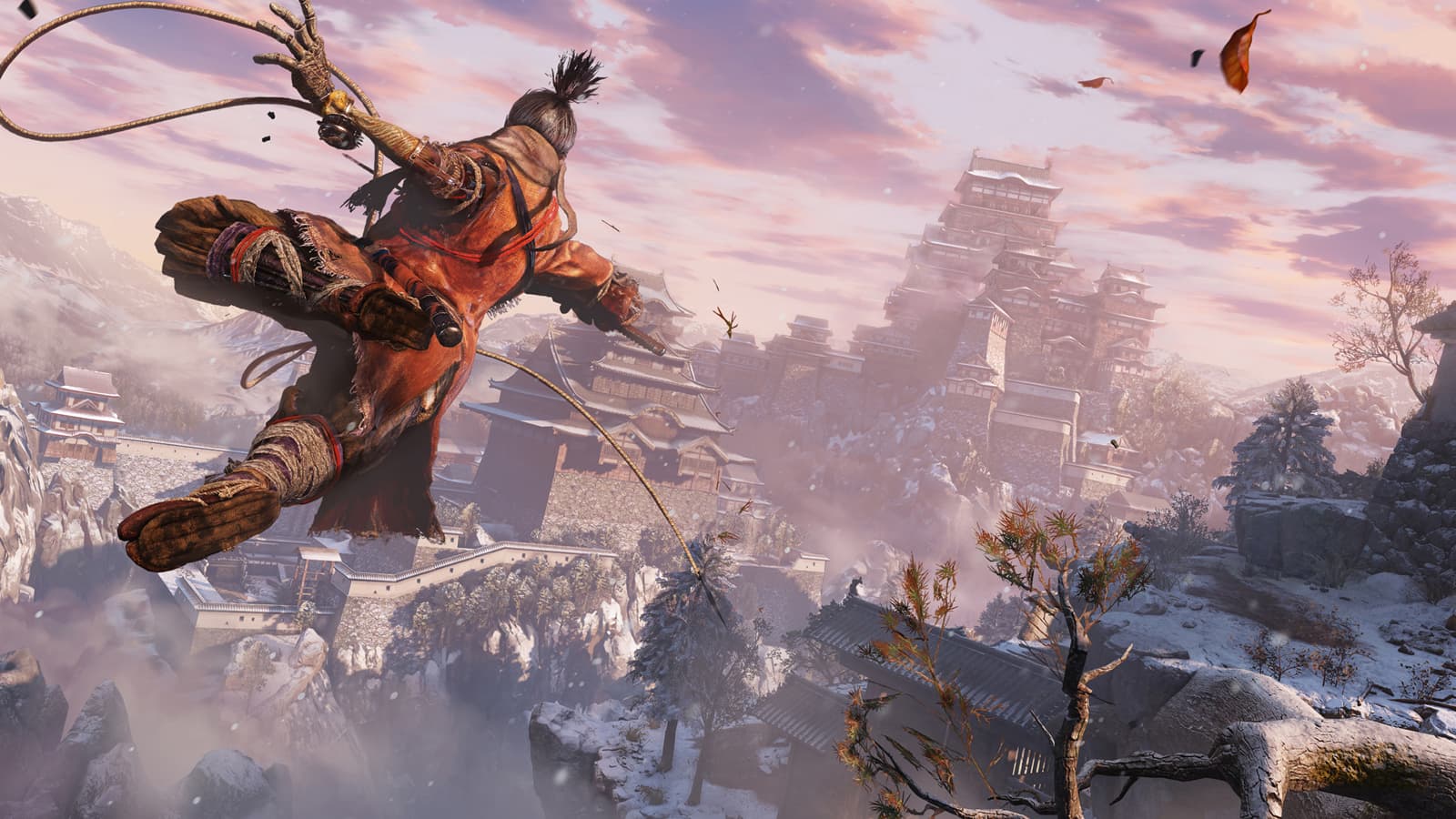 © FromSoftware
Introduction: The God from the West Residing at Ashina’s Source and the Origins of the “Stagnation of Immortality”
At the apex of the water currents that nourish the land of Ashina, isolated beyond a sea of clouds, lies the celestial realm of the Fountainhead Palace. While it brims with breathtakingly beautiful, elegant scenery reminiscent of a Heian-period pure land, it is simultaneously a realm of madness where those obsessed with the delusion of immortality writhe, having been reduced to grotesque forms. This report is a detailed record of inquiry aimed at unraveling the true nature of the Divine Dragon—the entity at the root of all anomalies in Ashina, namely the “Stagnation” of immortality—and the historical and philosophical causality behind the construction of the unique ecosystem that is the Fountainhead Palace.
The Waters of the Fountainhead, worshipped in Ashina since ancient times, were originally a symbol of pure water currents that nurture life. However, at some point, these waters transformed into the Rejuvenating Waters, which reject death and twist the laws of life, bringing unfathomable madness and tragedy to the entirety of Ashina. This fatal transformation originated with the arrival of the Divine Dragon, a deity said to have drifted from the “West” (a foreign land) during the age of myth. By comprehensively analyzing the fragmented texts scattered throughout the game, the environmental storytelling, and the religious backgrounds of ancient Japanese Shinto (Kegare (Defilement) and water deities) and Buddhism (Pure Land Buddhism and the Realm of Asura), the figure of the dragon emerges not merely as a powerful monster, but as a “lonely and incomplete god” who has become immobilized in the very land where it took root.
In this discourse, while strictly distinguishing between the “facts” explicitly presented in the game and the “insights” derived from historical contexts and religious symbolism, we will systematically discuss the origins of the myth hidden within the Fountainhead Palace and the full scope of the causality that the god from the West brought upon Ashina.
1. The Arrival of the Divine Dragon and the Mythological Background of the “West”
The Divine Dragon, the object of Ashina’s worship and the source of the power of the Dragon’s Heritage, is not an indigenous god originally harbored by Ashina. This fact is a crucial premise that forms the foundation of the story. To unravel the true nature of the Divine Dragon and the secrets hidden within its ecology, we must first organize the facts regarding its origins and physical characteristics.
1.1 [Fact] Origins and Ecological Characteristics of the Divine Dragon
-
Arrival from the West: Texts regarding the memory of the battle with the Divine Dragon explicitly state that this god was not born in Ashina, but drifted from the “West” long ago, taking root on the rocky peaks of the Sanctuary at the deepest part of the Fountainhead Palace.
-
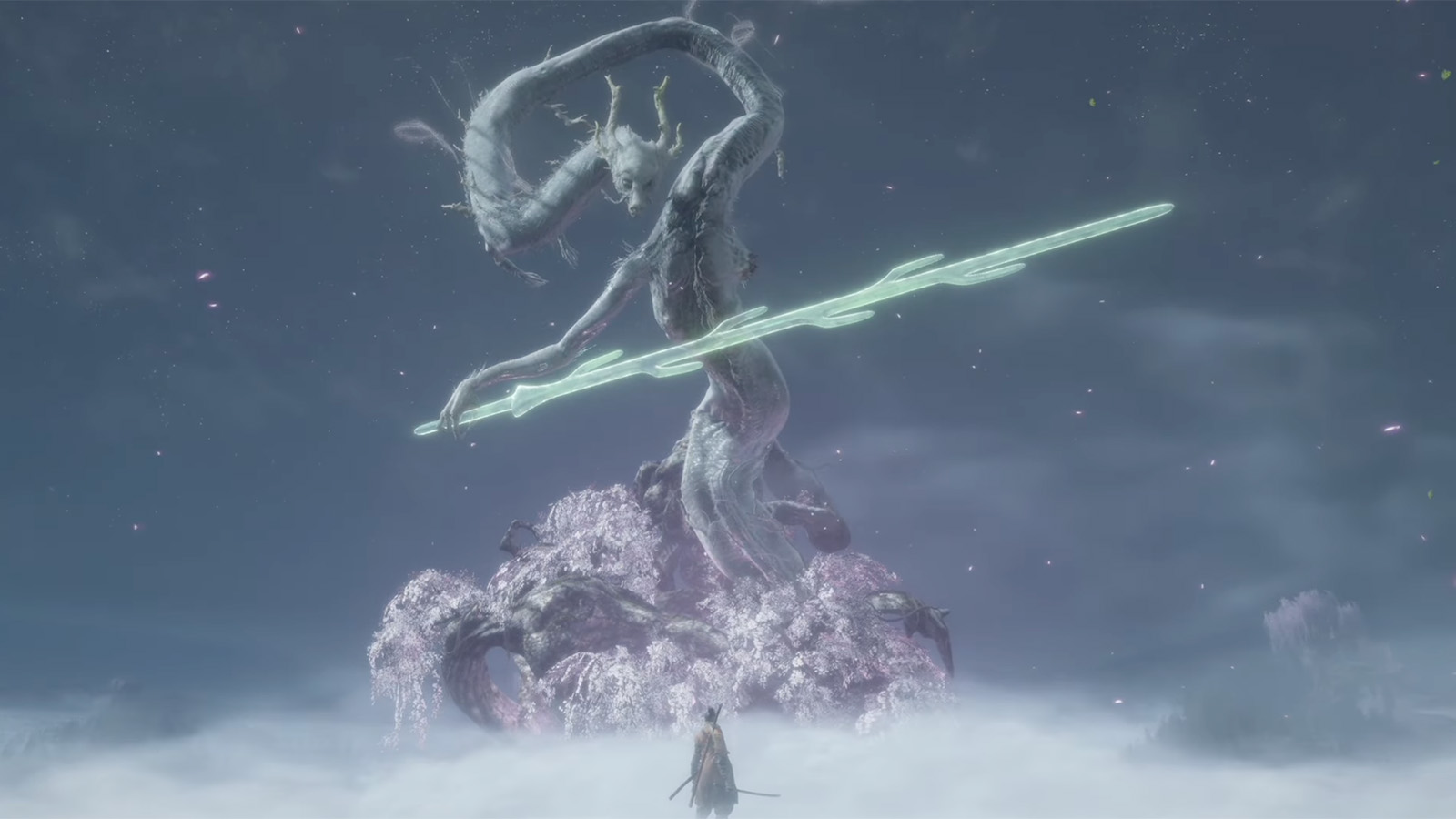
Wielding the Seven-Branched Sword: The Divine Dragon that manifests in the Sanctuary carries and fights with a peculiar sword featuring a massive blade with multiple branches (closely resembling the historical Seven-Branched Sword).
-
Botanical Characteristics: Despite being a dragon, its body is assimilated with a tree (a cherry blossom), and its lower half has become massive roots that are completely fused with the earth.
1.2 [Insight] The Rooted God and the Symbolism of the Seven-Branched Sword
In the historical and cultural context of Japan, the “West” (a foreign land) often refers to the Chinese continent, the Korean peninsula, or even further west to Tenjiku (India). The fact that the massive sword wielded by the Divine Dragon closely resembles the historical “Seven-Branched Sword,” said to have been presented to the Yamato Kingship by Baekje, strongly suggests that this god is an “imported deity” from the continent.
The Seven-Branched Sword is not a weapon for actual combat; rather, it is treated in Shinto rituals as a shintai (an object of worship housing a spirit) or a ceremonial tool for warding off evil. Its shape symbolizes the “Tree of Life” or the “branching source of all creation.” The Divine Dragon wielding this sword carries a ritualistic significance, demonstrating that it is both the subject of a sacred rite and a display of its own life force. However, what must be noted here is the contradiction that a “dragon” (an animal), which should originally soar through the heavens and move freely, is bound to the earth as a “cherry tree” (a plant).
In Shinto, while gods may descend upon specific natural objects (such as giant stones, massive trees, or waterfalls) as yorishiro (vessels), it is rare for them to monopolize the land’s nutrients and water veins like a parasitic plant, physically fixing themselves and distorting the ecosystem. Yet, the Divine Dragon took root at Ashina’s highest water source, consequently reigning in a manner that overwrote the worship of the ancient indigenous gods (such as the Great Serpent and the giant carp) that the land of Ashina originally possessed.
This act of “taking root” can be inferred as a kind of massive spiritual parasitism upon Ashina’s water veins. Because the life force of the Divine Dragon (the power of the Dragon’s Heritage) was so immensely powerful, the immortal components seeping from its roots dissolved into Ashina’s water veins, ultimately transforming ordinary water into the Rejuvenating Waters. The Divine Dragon itself harbored no malice; the mere fact that an overly powerful foreign god settled in a confined land became the primordial cause of the Stagnation in Ashina.
| Item | Ashina’s Indigenous Beliefs (Ancient Gods) | Divine Dragon (Imported God from the West) |
|---|---|---|
| Symbolic Creatures | Great Serpent, giant carp lurking in the mud, beasts | Dragon, cherry blossoms, centipedes (source of the Infested) |
| Habitat | Deep ravines like the Sunken Valley, crawling on the earth | Fountainhead Palace, the sky and mountain peaks, towering into the heavens |
| Nature | Awe of nature rooted in the land, the cycle of life and death | Arrival from outside, fixation of immortality, eternal Stagnation |
| Relationship with Water | Inhabiting water sources, enjoying the blessings of water | Taking root in the water source itself, mutating the properties of the water |
As the comparison table above shows, the nature of the Divine Dragon is distinctly alien to that of Ashina’s ancient gods, and this very alienness became the “seed of causality” that destroyed the laws of nature (the cycle of life and death) and brought unprecedented distortion to Ashina.
2. The Missing Left Arm and the Causality of the Everblossom
Observing the figure of the Divine Dragon as you confront it in the Sanctuary, one notices a decisive physical characteristic. That is the fact that the Divine Dragon’s “left arm” is gruesomely missing from its base. This loss is not merely a design choice, but evidence of a profound causality closely tied to the historical background of the story.
2.1 [Fact] The Mission of Takeru and Tomoe, and the Everblossom
-
Origin of the Everblossom: It is explicitly stated that the “Everblossom,” which existed behind Ashina Castle (in a place visible from the Divine Heir’s room), was brought down from the Fountainhead Palace and planted in Ashina by a Divine Heir named Takeru.
-
Physical Structure of the Divine Dragon: The Divine Dragon in the Sanctuary lacks a left arm, and wood-like fibers are exposed from the cross-section.
-
Proof of Homogeneity: The eternal cherry tree (Everblossom) growing in Ashina Castle was cultivated from a branch of the eternal cherry tree in the sacred realm. Since the Divine Dragon itself strongly possesses the properties of a tree, the branch Takeru used to plant the eternal cherry blossom in Ashina was, in fact, the very arm of the Divine Dragon.
2.2 [Insight] The Severing of the God’s Body and the Symbolism of “Seki” (One-Armed)
This insight holds immense significance in deciphering the causality of the story. In the past, Takeru, the Divine Heir of the Dragon’s Heritage, and his retainer Tomoe, who hailed from the Fountainhead Palace, descended from the Fountainhead Palace to Ashina in order to sever the immortal curse of the Dragon’s Heritage, or to seek the rite of Purification. At that time, they did not simply snap off a beautiful flowering branch to take home. They undertook the desperate act of physically severing and taking away “a part of the god’s body (its left arm).”
The act of damaging the body of a deity or Buddha is tantamount to a grave sin in both Shinto and Buddhism. The fact that the Divine Dragon appears before the protagonist (Wolf) in a pitiful state, having lost one arm, is a trace of the fierce “rebellion against (or supplication to) the god” once committed by Takeru and Tomoe. It also indicates that the dragon itself has lost its completeness due to that wound and is suffering within its eternal life.
Furthermore, this characteristic of “missing a left arm” perfectly aligns with the appearance of the story’s protagonist, “Wolf (Sekiro).” Wolf, too, had his left arm severed in battle with Genichiro Ashina, and wears the Shinobi Prosthetic in its place. This coincidence is by no means mere chance. The structure in which those whose fates are bound by the curse-like immortal power of the Dragon’s Heritage share the trait of “missing a part of their body (being one-armed)” symbolizes that immortality—a seemingly flawless state—is actually an incomplete existence that has profoundly lost something decisive.
Just as Wolf fights to fulfill the wish of his lord (Kuro), it can be surmised that the Divine Dragon was also waiting for a “second” (kaishaku) to liberate it from its own loss and the Stagnation of immortality. To achieve Immortal Severance, a Shinobi without a left arm confronts a god who likewise lacks a left arm. This beautiful symmetry is the very pinnacle of the causality depicted in the work Sekiro.
The ritual in which Wolf crosses swords with the Divine Dragon and ultimately receives the “Divine Dragon’s Tears” is not described with crude terms like deicide or monster subjugation, but rather with the highly solemn and respectful phrase “Gracious Gift of Tears.” This is a ritual of requiem and liberation for a wounded, stagnated foreign god, performed by one who bears a similar loss.
3. The Old Dragons of the Tree and the Accumulation of “Kegare (Defilement)”
Just before confronting the main body of the Divine Dragon, Wolf must fight a horde of mysterious beings in the Sanctuary known as the “Old Dragons of the Tree,” who resemble tree roots or dead wood. Their existence most directly represents the Shinto concept of “Kegare (Defilement)” in Ashina.
3.1 [Fact] The Ecology of the Old Dragons of the Tree
-
Life as a Collective: They have little individual will and share a single life force (HP bar) across the entire horde.
-
Manifestation of Poison and Disease: They frequently cough and spew blackish-purple venom. Their behavior is clearly that of “those afflicted by disease.”
-
Transformation from Black to White: Their body color is initially black and stagnated, but as Wolf performs Deathblows (or Anti-Air Deathblows) and whittles down their life force, they ultimately regain a white radiance as if their Kegare (Defilement) has been purified, leading to the manifestation of the Divine Dragon.
3.2 [Insight] Stagnant Water and “Misogi” (Purification) in Shinto
In Shinto, “Misogi” (purification) is necessary to maintain a “pure and bright heart.” Water possesses a self-purifying effect by flowing, washing away sins and Kegare (Defilement) from rivers to the sea. Conversely, the most abhorrent state in Shinto is “water that remains still and stagnates.”
The fact that the Divine Dragon took root at Ashina’s water source and remained in the same place for hundreds or perhaps thousands of years caused not only a physical obstruction of the water veins but a “complete Stagnation” of the spiritual water currents. Even if the Divine Dragon itself is inherently a sacred being, by remaining eternally in the same place, the “Kegare (Defilement)” rising from the land of Ashina inevitably accumulates around it.
It is surmised that the Old Dragons of the Tree are beings that take on the “Stagnation (disease, the lingering thoughts of the dead, corruption)” of all Ashina, which the dragon’s roots have absorbed, acting as an excretory organ in place of the dragon’s main body. The black venom they spew is the very Kegare (Defilement) of disease that has accumulated at the god’s feet. Water that does not flow rots, and a body that never dies harbors corruption within.
The act of Wolf cutting down the Old Dragons of the Tree is not merely a preliminary skirmish, but carries the significance of a “Misogi ritual” to purify the Kegare (Defilement) that has blanketed the Sanctuary. Only by purifying their Kegare (Defilement) can the main body of the Divine Dragon slumbering in the depths awaken, allowing the transition to the ritual of the Gracious Gift of Tears with Wolf.
4. The Maddening Ecosystem of the Fountainhead Palace and the “Water of the Palace”
The Fountainhead Palace, where the Divine Dragon took root, was physically and spiritually isolated from the outside land of Ashina for a long time, leading to the construction of its own maddening ecosystem and hierarchical society. At the center of this society is an abnormal worship of the “Water of the Palace,” water in which the immortal power of the Divine Dragon is extremely concentrated.
4.1 Organizing the Facts: The Reality of the Palace Nobles and Warriors
-
Palace Nobles (Blue/Red): Grotesque beings clad in elegant attire resembling Heian nobles, playing gagaku flutes. They have lost their humanity and maintain their shriveled bodies by draining the “vitality (youth)” of the young, including Wolf. Furthermore, their appearance has begun to take on the characteristics of fish (or carp).
-
Okami Warrior: A female-centric warrior group that guards the Fountainhead Palace. They manipulate lightning and fight as if dancing with bows and naginatas. They have a history of once invading the land of Ashina (the descent of the Okami Warriors).
-
Corrupted Monk (Yao Bikuni): A giant warrior monk guarding the vermilion bridge that serves as the entrance to the Fountainhead Palace. Her true identity is an immortal being harboring a massive “centipede” within her body.
4.2 [Insight] The Pure Land Turned Hungry Ghost Realm, and the Delusion of the “Dragon’s Gate”
The phenomenon of the Palace Nobles draining life force (vitality) from others is an embodiment of the “Hungry Ghost Realm” in Buddhism. Despite having obtained eternal life, they constantly suffer from hunger and thirst, reduced to wretched beings that slurp the lives of others. The reason they are transforming into fish-like figures is deeply connected to the myth of the “Dragon’s Gate” (a carp becomes a dragon by climbing a waterfall), widely known in East Asia.
It is surmised that the ultimate goal of the Palace Nobles and those who worship the Fountainhead Palace (such as the Pot Noble) was not mere immortality, but “to ascend to a dragon,” a god. However, at the Fountainhead Palace, the apex of Ashina, the absolute imported god known as the “Divine Dragon” is already enshrined. The ecological and spiritual niche is already filled; no matter how much Water of the Palace they drink or Treasure Carp Scales they collect, they can never become dragons. As a result, their growth stops at the stage of “incomplete aquatic creatures (carp) that can never become dragons,” forcing them into eternal Stagnation.
| Hierarchy | Entity | State and Role | Ultimate Goal (Unfulfilled Dream) |
|---|---|---|---|
| Apex | Divine Dragon | The foreign god residing in the Sanctuary. Ruler of the water source. | Return to its homeland, or liberation from Stagnation |
| Master | Great Colored Carp | The ultimate form the nobles can reach. However, it cannot become a dragon. | Ascension to a dragon (Dragon’s Gate) |
| Upper Tier | Palace Nobles (Blue/Red) | Gained immortality, but are hungry ghosts who must sip vitality to live. | Transformation into the master (Great Colored Carp) |
| Middle Tier | Okami Warrior | Warriors guarding the palace. They manipulate lightning and fight while dancing. | Absolute protection of the palace and Sanctuary |
| Lower Tier | Pot Noble, etc. | Worldly beings who dream of reaching the palace, collecting scales. | Transformation into Palace Nobles or carp |
| Lowest Tier | People of the land of Ashina | Drink the Rejuvenating Waters flowing from the palace, becoming Red-Eyed or Infested. | —— (Merely tormented by madness and immortality) |
This hierarchical society is entirely built upon the belief of “drinking water closer to the source to draw nearer to the dragon (god).” The reason the Okami Warriors once invaded the land of Ashina is likely not unrelated to this belief. Did they seek to monopolize the water source and acquire more sacrifices (sources of vitality), or was it a holy war to expel Ashina’s indigenous gods? Ultimately, they were repelled, but they continue to guard the Fountainhead Palace to this day.
4.3 The False Pure Land
The visual design of the Fountainhead Palace functions as a striking parody of the “Pure Land” (Amida Buddha’s Western Pure Land) in Buddhism. Amida Buddha is the lord of the Pure Land said to be in the West, and the Divine Dragon is also a god that came from the “West.” It is said that beautiful lotuses bloom in full glory in the Pure Land, and exquisite music is constantly played. The scenery of the Fountainhead Palace (blooming cherry blossoms, elegant kemari, the sound of flutes being played) seems to be a direct manifestation of this very description of the Pure Land.
However, its reality is utterly grotesque. The elegant sound of the flute is a dark art meant to steal the lives of others, and the inhabitants of the palace are man-eaters who devour the vitality of others. At the bottom of what should be beautiful waters, the headless corpses of giant fish lie scattered, and a giant man-eating carp prowls. Furthermore, within the body of the Corrupted Monk (Yao Bikuni) guarding the entrance to the palace, an “immortal centipede,” said to have spawned from the Stagnation of the Divine Dragon, has nested. This is nothing less than “Hell” wearing the skin of a Pure Land.
They attempted to achieve the Buddhist salvation of “liberation from the fear of death” not through spiritual enlightenment, but through the physical means of “bodily immortality.” As a result, having forgotten the salvation of the soul, they plummeted into the Realm of Asura and the Hungry Ghost Realm, where only the flesh persists eternally. In Buddhism, the truth is “Impermanence (Shogyo Mujo)“—that all things are in flux. From a Buddhist perspective, it can be concluded that the inhabitants of the Fountainhead Palace, who sought immortality and rejected impermanence, are fools who have strayed furthest from the truth.
5. The Full Scope of Causality and Historical Transition Brought to Ashina by the Foreign God
Based on the fragmented facts and religious/philosophical insights above, we will reconstruct the full scope of causality—what happened to the land of Ashina from the arrival of the Divine Dragon to the present (the era of the main game)—as a chronological and logical chain.
5.1 Stage One: The Settlement of the Foreign God and the Contamination of the Water Source (Age of Gods to Antiquity)
Long ago, the Divine Dragon, driven from the West for some reason (or having flown there of its own will), arrived at the peak of Ashina’s highest mountain and took root. Due to this event, the power of the Dragon’s Heritage mixed into the uppermost reaches of Ashina’s water veins, causing the spiritual flow of water to stagnate. In accordance with the Shinto principle that “water that does not flow equals Kegare (Defilement),” the immortal power dripping from the cherry roots gradually began to transform into a toxic “Stagnation” over a long period. It is surmised that around this time, a belief that held the Waters of the Fountainhead as sacred began to emerge in Ashina.
5.2 Stage Two: The Formation of the Fountainhead Palace and the Progression of Madness (Middle Ages)
Those living near the water source (or those who climbed to the palace of their own accord out of faith) began to continuously consume the “Water of the Palace,” which contained the dense power of the Dragon’s Heritage. They became immortal, but under the influence of the stagnated water, they gradually lost their human sanity, forming a grotesque ecosystem (the Palace Nobles) that yearned for evolution into dragons yet remained in the form of carp. They sealed off the Fountainhead Palace, abhorring outside Kegare (Defilement) and severing normal interactions, thereby further accelerating the Stagnation within the palace. In this process, the Okami clan also gained the power of lightning, transforming into a fanatical warrior group as the guardians of the palace.
5.3 Stage Three: The Despair of Takeru and Tomoe and the “Severing of the Branch” (Early Modern Period)
As time passed, Tomoe, who hailed from the Fountainhead Palace, and Takeru, the Divine Heir of the Dragon’s Heritage, rose up to sever this immortal curse (the Stagnation of the Dragon’s Heritage). Realizing the madness of the palace, they resolved to descend from the palace to the land of Ashina to accomplish the rite of Immortal Severance. At that time, they physically severed and took away the Divine Dragon’s left arm (the branch of the Everblossom). This act inflicted a deep, unhealing wound upon the dragon, bringing further pain and Stagnation to the Sanctuary. With the god wounded, the Kegare (Defilement) of the water currents pouring down upon all of Ashina became decisive.
5.4 Stage Four: The Spread of Disease to the Land of Ashina and the Emergence of the Infested
With the “Everblossom” born from the dragon’s left arm taking root in Ashina Castle, the power of the Dragon’s Heritage and the Stagnation of immortality took root more directly and powerfully not only in the Fountainhead Palace but throughout the entire land of Ashina. At the same time, the diluted immortal water (Rejuvenating Waters) flowing down from the Fountainhead Palace spread to the depths of Ashina, such as the Sunken Valley and Mibu Village, causing the creation of further grotesqueries like the Guardian Ape and the Infested monks.
Particularly noteworthy is the existence of the “centipedes.” The massive cherry roots, which do not decay in the stagnant water, naturally become a breeding ground for parasites (the Undying Centipede). Those who harbor these centipedes within their bodies become the “Infested,” unable to die. Water flows from upstream to downstream. If the Fountainhead Palace upstream goes mad, the land of Ashina downstream will inevitably go mad as well. This is the absolute law of causality behind the tragedy that blankets all of Ashina.
5.5 Stage Five: And Thus to the “Gracious Gift of Tears”
Finally, Wolf appears before the Divine Dragon, who was wounded, missing an arm, and suffering from the accumulation of Kegare (Defilement) (the Old Dragons of the Tree). Wolf purifying the Kegare (Defilement) of the Old Dragons of the Tree, crossing swords with the Divine Dragon, and receiving its tears was an act of “setting in motion the frozen time” of the foreign god that had been stagnating for so long.
During the battle, the attacks of the Seven-Branched Sword wielded by the Divine Dragon are accompanied by fierce lightning. In Shinto, lightning is “Kaminari” (the sounding of the gods), a violent manifestation of the will of the heavenly gods. However, by having its massive power struck back by Wolf’s “Lightning Reversal,” the Divine Dragon finally ceases its movements. This can be interpreted as the moment the foreign god accepted the end of its role in the land of Ashina, entrusting its kaishaku (seconding) to one who likewise lacked a left arm.
Conclusion: The Stagnation Named Eternity, and the Return to the Cycle
The Fountainhead Palace, hidden high in the sky of Ashina beyond the clouds, and the true nature of the Divine Dragon residing there, are not merely an “evil dragon to be subjugated” in a fantasy work. They are the traces of a tragic myth, created by the selfish attachments of those who defied the natural cycle of flux and desired eternal life.
The Divine Dragon itself likely never wished to drive the land of Ashina mad. A god who left its homeland and drifted from the West, it unwillingly took root due to its immense life force, had one arm taken by the Divine Heirs of the past, and over long years could only look down as its feet filled with the Kegare (Defilement) of the people’s attachments. Its figure is far too lonely for a god, and even pitiful.
From a human perspective, “immortality” may at first glance seem like ultimate salvation or evolution. However, immortality in this work is synonymous with “not changing,” and not changing means “stagnation and corruption (Stagnation).” Water cannot maintain its purity unless it continues to flow. Life, too, can only cycle to the next generation because there is the absolute end known as death.
The scenery where the Palace Nobles revel in an eternal banquet to the elegant sound of flutes, while the Divine Dragon quietly sheds tears bearing the pain of its missing left arm, presents us with the universal theme of “the beauty of limited life and the preciousness of accepting impermanence” through the View of life and death found in the ancient strata of Japanese Shinto and Buddhism. The tears Wolf received from the Divine Dragon were the first and last drops of hope to set the gears of a stagnated and corrupted history in motion once more, and to restore Ashina’s once-pure water veins and the normal cycle of life and death. The myth of Ashina was distorted by the arrival of a foreign god, and with the requiem for the god performed by a single Shinobi, it finally gained the promise of cleansing that Stagnation.
Dialectics of Immortality and Fate: Sekiro: 11 Meditations on the Dragon’s Heritage and Mortal Struggle
The book version is now available. Read for free with Kindle Unlimited.
Thank you very much for reading to the end. To help support the activities of this archive, a warm donation of a cup of coffee would be highly appreciated.