Memory.08: Great Shinobi Owl
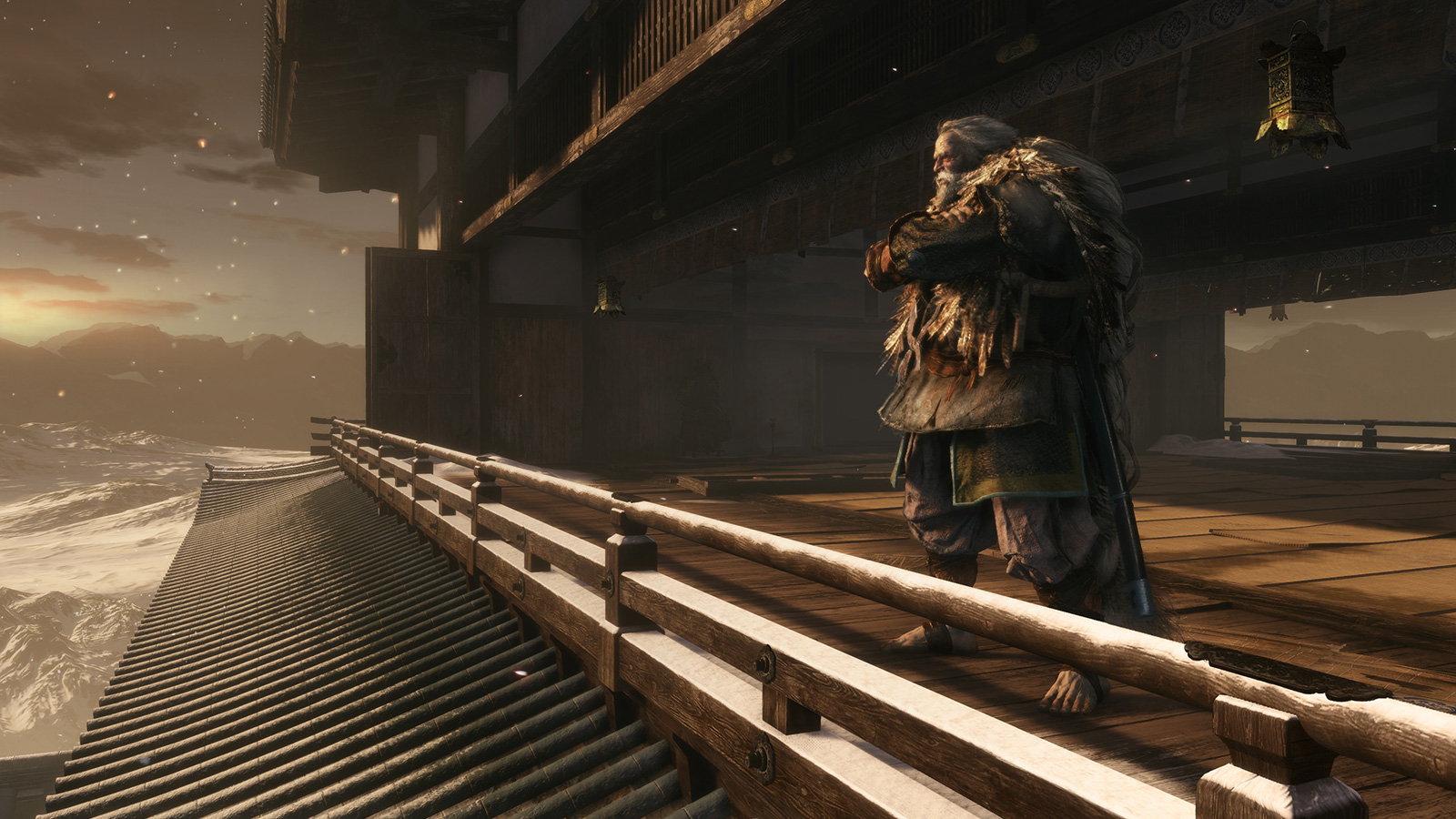 © FromSoftware
Introduction: Ambition Lurking in the Shadows of History and the Embodiment of Karma
In the world of Sekiro: Shadows Die Twice crafted by FromSoftware, the land of Ashina at the end of the Sengoku period is depicted as a unique space where divine protection, indigenous beliefs, and raw human desires intersect. Set against the backdrop of this perishing nation, many characters are driven by irresistible forces: their own convictions, loyalty to their country, or the destiny of their blood. While Genichiro Ashina dabbles in the heretical powers of the “Rejuvenating Waters” and the “Dragon’s Heritage” for the earnest wish of his country’s survival, and the Sword Saint, Isshin Ashina, calmly observes the era from the threshold between his view of life and death and the pinnacle of martial arts, there exists a profoundly anomalous entity radiating an unfathomable, dark brilliance. That entity is none other than the “Great Shinobi Owl,” the adoptive father of the protagonist, Wolf (Sekiro), and his greatest curse.
This article will elucidate the behavioral principles, psychological background, and the full scope of the causality brought about by Owl, who maneuvered in the shadows within the microcosm of Ashina and plotted to usurp the very fabric of the world’s logic (the Dragon’s Heritage). He cannot be simply categorized by the word “villain.” In the Sengoku era, an age of gekokujo (the lower overcoming the higher), how did a “shadow,” who was never meant to stand on the main stage, come to desire absolute power, brainwash those around him, and ultimately be swallowed by the Buddhist spiral of karmic retribution?
By integrating the fragmented texts scattered throughout the game, the reminiscences shared by Isshin Ashina and Emma during drinking encounters, and the environmental storytelling presented by the contradictory “memory bells,” this piece will logically separate fact from speculation. It will delve into the deep psychology of the man known as Owl, weaving in the historical context of Japanese Buddhist philosophy (Karma, Realm of Asura) and Shinto (Kegare (Defilement)).
1. Ashina’s Rebellion and the “Deceptively Grand” Giant: The Self-Contradiction of a Shinobi
Essential to discussing Owl’s background is the “rebellion” (war to steal the country) once led by Isshin Ashina. The land of Ashina was originally governed by its indigenous people but was placed under the control of the central government (the Interior Ministry) and had long been oppressed. To break through this situation, Isshin led a group of highly skilled warriors in a rebellion, successfully reclaiming the land of Ashina. Owl, along with Lady Butterfly, the leaping monkey (later the Sculptor), and Gyoubu Masataka Oniwa, was one of the central figures who operated in the shadows during this rebellion.
However, Owl’s physical characteristics and mentality harbor a fundamental self-contradiction regarding the profession of a Shinobi. A Shinobi is inherently an existence that erases its presence, blends into the darkness of history, and lives namelessly as the blade of its lord. Yet, Owl possessed a massive physique that far surpassed ordinary men, and the ambition he harbored within had also swelled to a point where it could no longer be hidden.
| Character | Role and Position | Evaluation/Impression from Isshin Ashina (From conversations over “Ashina Sake” and “Dragonspring Sake”) | Symbolic Existence |
|---|---|---|---|
| Isshin Ashina | The symbol of Ashina, the daimyo standing at the pinnacle | (Himself) A hero who attracted people like the sun and reclaimed the country on the main stage | The ruler of light, the pinnacle of martial arts |
| Lady Butterfly | Master of illusion techniques, one of Wolf’s mentors | A comrade-in-arms who ran through the battlefield together, a highly regarded figure | The contributor in the shadows, a pure seeker of technique |
| Sculptor (Leaping Monkey) | Pioneer of Shinobi techniques, original owner of the Shinobi Prosthetic | A “fool” with whom he shared drinks, now carving Buddha statues | A hermit burdened with Karma |
| Great Shinobi Owl | Wolf’s adoptive father, the linchpin of covert operations | Weak to alcohol and quick to blush, a giant but a “deceptively grand fool” | A “shadow” unable to stand at the top, a mass of desire for recognition |
When Isshin Ashina recounts tales of the past to the protagonist, he offers a highly symbolic evaluation of Owl. According to Isshin’s dialogue, Owl was “a deceptively grand fool with a huge frame who would turn bright red immediately.” While Isshin’s words about this “deceptively grand owl” sound like affectionate teasing toward a comrade at a drinking party, they also carry an extremely cruel undertone, as if seeing right through the strength of Owl’s desire for self-display and his underlying shallowness.
To Isshin, Owl was ultimately a capable “pawn” and one of the “fools” he drank with. He did not recognize him as having the caliber of an equal ruler. It is presumed that by being beside the overwhelming “light” that was Isshin, Owl was constantly confronted with his own insignificance as a “shadow” and the limits of his status. His human frailty of getting drunk and quickly blushing suggests that he was an ordinary man bound by an intense desire for recognition and human emotion (ressentiment), unable to fully become a cold, emotionless Shinobi. Although the Sengoku period was an era rampant with meritocratic gekokujo, it was still nearly impossible for a Shinobi, whose livelihood was covert work, to reign as a public daimyo. What smoldered in Owl’s heart was not loyalty to Ashina, but an absurd ambition disproportionate to his station: “One day, I myself will rule the realm.” As a long-term strategic move for this purpose, he picked up a nameless orphan clutching a sword on a battlefield (likely the aftermath of the rebellion), named him “Wolf,” and raised him as his own “pawn.” Here, the seeds of a grand betrayal that would later shake Ashina to its core, and a blood-soaked causality, were sown.
2. Anatomy of the “Iron Code”: Confucian Brainwashing and the Mechanism of Control
The most crucial apparatus for Owl to realize his ambition was the “Iron Code,” constructed to psychologically control Wolf. Repeatedly mentioned throughout the game and forcing a heavy decision upon the player at the story’s branching point, this code functions beyond a mere Shinobi standard; it acts as a brainwashing program designed to satisfy Owl’s personal desires.
2.1 The Deception Hidden in the Hierarchical Structure
In Japanese samurai society, loyalty to one’s lord (chu) and filial piety to one’s parents (ko) were widely permeated as the foundation of Confucian morality. Owl distorted this to an extreme, utilizing it as his own apparatus of power.
-
The first rule of the code: The parent is absolute. (One must never disobey the parent’s word.)
-
The second rule of the code: The master is absolute. (Protect the master with your life.)
-
The third rule of the code: Fear is absolute. (Those who do not embrace fear will die.)
The terrifying aspect of this code is that, while seemingly preaching a non-contradictory “loyalty and filial piety,” it conceals an absolute hierarchical structure where the first rule (the parent) completely supersedes the second rule (the master). This was a perfect safety net designed to make Wolf, a resilient blade, preserve the value of the Dragon’s Heritage by protecting his “master (Kuro)” during times of peace, while turning him into an automaton that would betray even his master at a single command from his “parent (Owl)” when the time came. The choice to “obey the Iron Code” means abandoning the master to follow the words of the father, which are deemed absolute. Behind these words lies the complete deprivation of individual free will. It is the polar opposite of the Buddhist spirit of Jitomyo (living by relying on oneself as a light), a path of slavery where one entrusts their destiny to the desires of another. Under the noble guise of the “code,” Owl stripped Wolf of his humanity and freedom of thought, thoroughly honing him as a tool to act as a proxy for his conquest of the realm.
2.2 Binding Through Fear and Psychological Trauma
Furthermore, the placement of “fear” as the third rule of the code cannot be overlooked. Ostensibly, this is a teaching of survival strategy: “Realize the immense power of the enemy and do not let your guard down.” However, its true purpose was to engrave a fundamental awe into Wolf’s soul—that he could “never defy his parent, Owl.”
In fact, in the latter half of the story, despite Wolf having grown and defeated numerous formidable foes and even demons to reach the top of Ashina Castle, there is a depiction of him momentarily almost dropping to his knees before Owl’s overwhelming intimidation upon their reunion. Owl bound Wolf not only with physical martial prowess (swordplay and Shinobi tools) but also through years of psychological restraint and near-abusive control (the implantation of trauma). This is strikingly similar to methods of mind control and gaslighting in modern psychology, highlighting Owl’s cunning and ruthlessness as a dominator.
3. The Tragedy at Hirata Estate and Collusion with the Interior Ministry: The Truth Revealed by Contradictory Memories
In the chronological timeline of the story, Owl’s long-held ambition first manifested in a clear form during the “attack on Hirata Estate,” which occurred three years prior to the main game (and was the cause of Wolf losing his memory). This incident was not a mere pillaging by bandits, but a grand farce meticulously orchestrated by Owl, and a double betrayal.
3.1 Separating Fact from Speculation: The True Structure of the Attack
Based on the information within the game, we will clearly separate and organize the “facts” regarding the attack on Hirata Estate and the “speculations/observations” derived from them.
| Category | Content | Basis/Background |
|---|---|---|
| Fact | The main force that attacked the estate was not mere bandits, but Shinobi of the “Interior Ministry” (the central government). | This is explicitly shown by the presence of Interior Ministry soldiers, such as the Lone Shadow, stationed at Hirata Estate. |
| Fact | On the night of the attack, Owl faked being severely wounded and near death, instructing Wolf to head to the hidden temple. | The event depiction during the first visit (Young Lord’s Bell Charm). |
| Fact | It was Owl who pierced Wolf from behind with a massive odachi immediately after Wolf defeated Lady Butterfly. | The true memory during the second visit (Father’s Bell Charm), as well as the shape of the blade. |
| Speculation/Observation | Owl’s objective was to abandon Ashina, collude with the Interior Ministry, and monopolize the Dragon’s Heritage (Kuro). | Anticipating Ashina’s weakening, he is believed to be the insider who guided the Interior Ministry, a far greater power. |
| Speculation/Observation | The reason for murdering Wolf was his judgment that Wolf had awakened as “Kuro’s Shinobi” and would slip from his control. | To eliminate all witnesses (Butterfly, Wolf) and go into hiding behind the scenes by pretending to have “died in battle.” |
Owl had coldly discerned, better than anyone else, Isshin Ashina’s old age and illness, and that the lifespan of the nation of Ashina was coming to an end. Therefore, he formed a secret pact with the Interior Ministry, the likely next conquerors, and caused Hirata Estate—an important defensive stronghold of Ashina that was protecting Kuro—to collapse from within. However, to him, even the Interior Ministry was not the ultimate object of loyalty. His true objective was to take advantage of the chaos while the Interior Ministry was occupied with its own power, and claim the “Divine Heir” Kuro for himself. In a corner of the burning estate, he deceived Wolf by faking a severe, near-fatal injury. He then manipulated the situation so that Wolf would fight his former comrade, Lady Butterfly. The act of piercing the defenseless Wolf’s chest from behind immediately after Butterfly’s defeat proves that he possessed not a shred of affection as a “parent,” and was a cold-blooded man who would easily discard even the pawn he raised for the sake of his own profit.
3.2 The Multiple Structures of Memory and Subjective Truth
The events at Hirata Estate present different scenes depending on the “bell” the player offers to the Buddha. The memory from the old woman’s “Young Lord’s Bell Charm” offered first, and the memory shown by the “Father’s Bell Charm” received later from Emma, create contradictions in the flow of events and the enemy factions that appear.
This contradiction stems from the fact that “memory” in this work is not an objective historical recording device, but a spiritual phantom based on the “subjective experiences and speculations” of the bell’s owner. The first memory is a projection of Wolf’s own perception, believing—or wanting to believe—that “father fought valiantly, guided me, and died.” However, the second memory (the father’s memory) exposes the concealed truth: “the true form of Owl, boasting his power in his prime and attempting to ruthlessly eliminate Wolf.” This multiple structure of memory brilliantly embodies the Buddhist theme of Avidya (ignorance, the inability to see the truth), showing how humans are creatures who cling to the reality they wish to believe (a convenient interpretation bound by the code). Owl’s deception distorted not only physical death but even the foundation of Wolf’s spirit (his memory).
4. Usurpation of the Dragon’s Heritage and the Thirst for Divinity: An Examination from the Perspectives of Japanese Mythology and Buddhism
What Owl showed an abnormal obsession for, to the point of faking his own death in the incident three years ago, was the “Dragon’s Heritage” (the power of immortality). Why did he thirst for immortality to such an extent, even risking the abandonment of the entire nation of Ashina? Therein lies an extremely selfish and blasphemous motive, diametrically opposed to that of Genichiro Ashina.
4.1 Stagnation of Immortality and the Usurpation of “Divine” Authority
Genichiro Ashina also sought the Dragon’s Heritage, but his objective was clearly to use it as a “defensive power to save the perishing Ashina.” His behavioral principles were “love for his country” and a “sense of responsibility”; even if his methods were heretical, at their core lay the tragic resolve of a ruler.
In contrast, Owl’s objective was entirely selfish. He thirsted to make his “own true name (Great Shinobi Owl)” resound throughout all of Japan, and by extension the world, and to reign as an absolute ruler.
In the context of Shinto and Japanese mythology, “dragons” and “water” are sacred, but at the same time, “not dying (the Stagnation of immortality)” is depicted as bringing about “Kegare (Defilement)” that goes against the laws of nature. The Dragon’s Heritage brought by the Divine Dragon harbors a curse that siphons the life force of those around it (Dragonrot). While Kuro and the Divine Child of Rejuvenation wished to sever this immortality as a “Stagnation that distorts the world,” aiming to return to being human or to return the Dragon’s Heritage to its homeland, Owl actively sought to absorb this “Kegare (Defilement)” and make it the foundation of his power.
To him, the Dragon’s Heritage was the key to usurping divine authority itself and becoming a “new god.” A leap from the existence of a “shadow” as a Shinobi to the absolute “light” of a “god.” This is the pinnacle of human arrogance and the ultimate form of Gashu (strong attachment to the self) in Buddhism.
4.2 The Fear of Aging and the Desire for Recognition
Furthermore, it is inferred that a “fear of aging” lurked in the depths of Owl’s obsession with immortality. Even he, who boasted an exceptional physique and skill, could not defy the flow of time. Even an overwhelming presence like Isshin Ashina had fallen ill and stood on the brink of death. Owl harbored a fundamental fear that his life, lived only as a shadow, would be swallowed by the waves of history and vanish without ever attaining any glory.
Obtaining immortality was, for him, an absolute affirmation of “life” and a means to become an entity eternally revered by others (the ultimate form of the desire for recognition). The very title he gave himself, “Great Shinobi Owl,” is a manifestation of his unquenchable hunger to be recognized by someone.
5. “Great Shinobi” and “Father”: Suspicion and Unfathomable Darkness Revealed by Two Battles
In the latter half of the story, Owl finally appears at Ashina Castle, pressing Wolf to follow the “code” and abandon Kuro. The choice made here, and the differences in his tactics during the two ensuing battles (the “Great Shinobi Owl” fight at the castle keep, and the “Father” fight in the memory of the past), speak volumes about his true nature and psychological state.
5.1 Comparative Analysis: Psychological Differences Indicated by Combat Styles
| Combat Form | Location | Characteristic Tactics and Shinobi Tools Used | Symbolic Meaning/Psychological State |
|---|---|---|---|
| Great Shinobi Owl | Ashina Castle Keep (Present) | Poison spread, firecrackers, anti-healing charms, feigning surrender for a sneak attack | Craftiness to compensate for physical decline due to age, extreme pragmatism, obsession with survival |
| Father | Hirata Estate Hidden Temple (Past) | Spirit owl illusion, continuous attacks with Mist Raven, overwhelming physical strength | Martial prowess in his prime, the “true secret techniques” hidden even from his son (Wolf), and deep suspicion |
5.2 The Craftiness and Despicable Survival Tactics of the “Great Shinobi”
The “Great Shinobi Owl” encountered at the keep truly embodies the reality of a Shinobi who chooses no means. He utilizes every underhanded trick available: shuriken, firecrackers, poison, and an “anti-healing charm” that seals Wolf’s recovery (the gourd). Furthermore, what is particularly noteworthy is that he suddenly feigns begging for his life during the battle, striking the moment Wolf hesitates even for a second—a supremely despicable tactic that is the polar opposite of samurai honor.
This is also evidence that he has grown old and is losing his once-overwhelming physical abilities. At the same time, however, it is a manifestation of extreme pragmatism, where he calmly uses even his own dignity as a weapon for the sake of victory. What mattered to him was not the “beauty of the process,” but “domination as the result.” Moreover, the fact that he turns Wolf’s specialty, the “Mikiri Counter,” against him is a manifestation of his arrogance, showing that he grasps all of Wolf’s techniques and has him completely dancing in the palm of his hand.
5.3 The Prime of the “Father” and His Hidden Fangs
On the other hand, “Father,” his prime self confronted in the memory guided by the second bell, displays a completely different fighting style. Instead of the despicable traps and feigned surrender at the keep, he employs a spirit owl illusion (a glowing blue owl) and launches godspeed continuous attacks using the Mist Raven Shinobi tool. The weight and speed of his blade are incomparable to the present Great Shinobi.
The most important focal point of observation here is the fact: “Why did he never teach these secret techniques (the coordination of the spirit owl and Mist Raven) to Wolf, who was supposed to be his successor?” The fact that Wolf does not know these techniques and faces them for the first time in a past memory means that Owl never fully revealed his depths even to his “son,” remaining constantly vigilant and keeping a “killing move” hidden to cut him down someday.
Even while binding Wolf with the absolute chains of the “Iron Code,” Owl still could not trust another person in the slightest. The depth of his loneliness and unfathomable suspicion shines through the entirety of his martial arts as this “Father.” He did not love Wolf as a parent. Deep in his heart, he always feared the day when the masterpiece tool he had created would bare its fangs at him.
6. The Karma of Shura and Karmic Retribution: The Consequence of Buddhist Eschatology
If Wolf chooses to follow Owl’s words at the keep and uphold the “Iron Code” (abandoning Kuro), the story branches into the most gruesome conclusion: the “Shura route.” This route is the ultimate consequence of the Karma harbored by the entity known as Owl, and the story of his own ruin.
6.1 The Pathology of “Shura” as Told by Isshin and Emma
“Shura” originates from the “Realm of Asura,” one of the Six Realms of Samsara in Buddhism, and refers to an existence trapped in ceaseless conflict and anger. In this game, Shura is defined not merely as anger, but as the state of one who has lost the purpose of fighting and fallen into an existence that finds joy only in slaughter.
When offered sake at Ashina Castle, Isshin Ashina reminisces about the past when his former comrade (the Sculptor) was captivated by Shura, and speaks as follows: “Long ago, I cut down a Shura. Those who go on killing will eventually forget even why they kill, and come to find joy only in the killing itself. Even in the eyes of a bug, there is a god of Shura. Keep it in mind, lest you be cut down by a phantom.” This dialogue from Isshin warns of the fundamental danger of losing one’s humanity and purpose amidst battle, and being swallowed by violence itself. Furthermore, the physician Emma, when offered sake, says, “A long time ago… I had a very difficult patient,” suggesting her past experience of confronting a Shura (or the Sculptor who came close to it) and witnessing the depth of that Karma. Shura is not an illness that ravages the body like Dragonrot, but an “incurable disease of the soul” where resentment and murderous intent completely erode the mind.
6.2 The Tragedy Brought by Adherence to the Code and the Invocation of Causality
The choice to “obey the Iron Code” brings the in-game events to a premature close, plunging the situation headlong into two consecutive boss battles (Emma, and then Isshin Ashina). Wolf abandons his master, Kuro, completely severing the bonds and humanity he had cultivated thus far. At that moment, the righteous cause of “fighting for the master” in Wolf’s heart vanishes, and he becomes a hollow machine that merely “kills people according to the parent’s orders.” Having lost his purpose and left with only a chain of blood, Wolf completely falls into the “Shura” that Isshin had feared.
Behind Wolf (Shura), who has cut down Emma and Isshin, Owl rejoices madly. He has slain Genichiro Ashina elsewhere (likely through a sneak attack) and returns holding the other immortal-severing blade, the “Black Mortal Blade (Open Gate).” He was convinced that his strongest pawn had eliminated Isshin, the pinnacle of Ashina, and that he had finally grasped the realm and the Dragon’s Heritage in his hands. It was the moment his decades-long ambition finally bore fruit.
However, immediately after, a gruesome causality is invoked. From behind Owl, who is raising his voice in mad joy, the very Wolf he raised mercilessly thrusts his blade into him.
This scene is the exact same composition as the act of betrayal three years ago at Hirata Estate, where Owl thrust his sword into Wolf from behind. As a result of treating others as tools for his own ambition and attempting to bind them with the brainwashing known as the “Iron Code,” Owl completely stripped Wolf of his ethics and emotions, unleashing a true monster (Shura) upon the world that held no loyalty even to its parent. It is an extremely Buddhist conclusion of “karmic retribution (reaping what one sows),” where the chain of deception and violence he orchestrated comes full circle to pierce his own back. The grand ambition of Great Shinobi Owl is abruptly brought to an end by the very “shadow of himself (Wolf)” that he feared and tried to utilize the most.
Conclusion: The Philosophy of a Colossal “Shadow” Scattered at the End of Ambition
To summarize the life of Great Shinobi Owl and the causality he brought to the land of Ashina, it is a fierce cautionary tale depicting “the bottomless greed (craving) of humans” and “the inevitable self-destruction that accompanies it.”
Despairing at his own insignificant position (his destiny as a shadow) within the nation of Ashina, and struck by the Sengoku fervor of gekokujo, he resorted to atrocities such as backroom deals with the Interior Ministry and the conspiracy at Hirata Estate. The “Iron Code” he utilized in the process was the worst kind of psychological restraint, selfishly distorting the Confucian morals of loyalty and filial piety to strip his own child of humanity. However, as the contradictions in subjective memories show, the reality of the domination he constructed was always fraught with instability, and his design for complete control was gradually showing its seams.
The vulgarity of only being able to see the sacred Dragon’s Heritage as a “tool for his own power.” The deep suspicion that kept his prime martial arts hidden from his son. And the ironic and cruel end of having his back pierced by the “Shura” born at the end of the code he himself commanded. While Isshin Ashina lived for his love of the country and the pinnacle of martial arts, scattering as an existence of “light” to the very end, Owl was the pinnacle of “shadow,” continuously tormented by his desire for self-display and suspicion. The giant Shinobi, evaluated at a drinking party as a “deceptively grand fool,” could not bear the weight of his excessive ambition in his soul, and vanished into the darkness of history by the very blade he had honed.
The greatest lesson he left for Wolf (and for us) throughout the story is not the importance of the code. It was his figure as a blood-soaked negative example of how blindly obeying an absolute existence (a parent, a master, or the code itself) and abandoning thought can plunge a human soul into Shura. In the mythos of Sekiro, Owl is not a mere obstacle; he is the greatest mental barrier the protagonist must overcome to acquire “his own will (Jitomyo),” etching his name as the shadow ruler most filled with sorrow and Karma.
Dialectics of Immortality and Fate: Sekiro: 11 Meditations on the Dragon’s Heritage and Mortal Struggle
The book version is now available. Read for free with Kindle Unlimited.
Thank you very much for reading to the end. To help support the activities of this archive, a warm donation of a cup of coffee would be highly appreciated.