Memory.03: Shura and Hatred
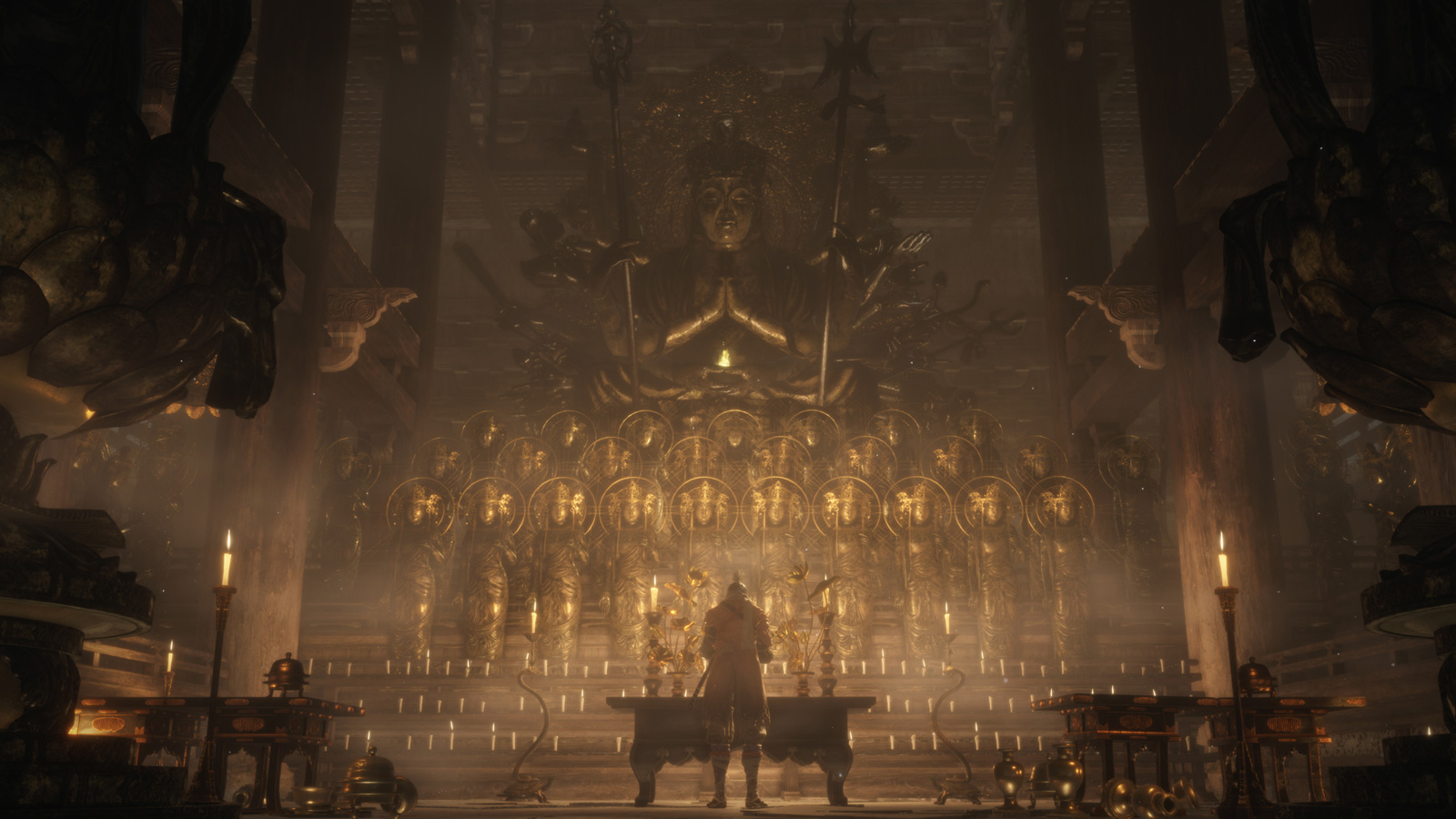 © FromSoftware
Introduction: The Dynamics of “Karma” Swirling in the Land of Ashina and the Buddhist Cosmology
In the world of Sekiro: Shadows Die Twice presented by FromSoftware, the land of Ashina is not merely a virtual space of the Sengoku period, but a metaphysical stage where the concepts of the “Six Realms of Samsara” in Buddhism, particularly Mahayana Buddhism, and the Shinto notion of “Kegare (Defilement)” intricately intersect. In this article, the third installment of an 11-part project, we focus on the two concepts of “Shura” and “Hatred,” unraveling the trajectory of the “Sculptor (Sekijo),” one of the characters who followed the most bizarre and tragic causality in the game.
In the depths of the narrative, “Karma” is depicted as the fundamental force that binds the human soul and brings about physical transformation. Derived from the Sanskrit word “karman” (action), this concept refers to the law of causality where an individual’s physical, verbal, and mental actions accumulate as invisible energy, eventually bringing about retribution (results) to that person. In the war-torn land of Ashina, the grudges and anger born from the loss of countless lives transcend the realm of mere emotion, manifesting as physical and spiritual energy known as the “flames of hatred.”
Based on the philosophy of the Six Realms of Samsara, sentient beings transmigrate through six worlds—Hell, the Hungry Ghost Realm, the Realm of Animals, the Realm of Asura, the Human Realm, and the Heavenly Realm—according to their karma from previous lives. However, the land of Ashina in this work functions as a “hell on earth” where the boundary between life and death has ambiguously collapsed. As a result of the laws of death being distorted by heretical powers such as the Dragon’s Heritage and the Rejuvenating Waters, an abnormal situation has arisen where Karma and Kegare (Defilement), which should normally depart to the underworld upon death, continue to stagnate in the present world.
In this treatise, by integrating the fragmented texts scattered throughout the game, item lore, and records of character dialogues, we will completely deconstruct and examine the causal relationship from a Buddhist and historical context: how the Sculptor harbored the seeds of “Shura,” and why he ultimately transformed into the “Demon of Hatred” rather than a Shura. By logically separating the facts explicitly stated in the game from the insights derived from historical and religious backgrounds, we will approach the truth of the causality inherent in the land of Ashina.
1. The Trajectory of the Shinobi Named Sekijo and the Seeds of “Shura”
1.1 Ignorant Slaughter in the Sunken Valley and the Loss of Purpose
The Sculptor was once a highly skilled Shinobi known as “Sekijo.” Having trained alongside monkeys in the Sunken Valley, he wielded superhuman agility and the techniques of a great Shinobi unsuited to his stature, continuing to take countless lives in the Sengoku period. In this process, irreversible Karma accumulated within him.
In the game, the fact of the psychological crisis he faced is most directly shown in his reminiscence when treated to “Monkey Booze” by Wolf. Looking back on his past, Sekijo says, “I was on the verge of becoming a Shura… Those who go on killing will eventually… forget even why they were killing in the first place.” Furthermore, he issues a clear warning: “Only the joy of killing remains, and the flames of Shura will dwell in your eyes. You’d do well to make sure I don’t cut you down.”
From this, a profound analysis based on a Buddhist perspective can be drawn. The greatest factor determining “Karma” in Buddhism is said to be not the action itself, but the “Cetana (volition or intention).” As long as there is a “purpose”—such as protecting someone or following a lord’s orders—slaughter, while an evil deed, still remains within the framework of worldly ethics and humanity. However, as Sekijo’s reminiscence indicates, when the purpose of the action is completely lost, and the “act” of killing itself becomes the purpose, finding a maddening joy in it, the human soul falls into the “Realm of Asura” while still in the present world. The fall into Shura is not a curse from the outside, but a self-destructive mutation of the soul caused by the “loss of purpose” and “Avidya (ignorance of the truth)” arising from within oneself. The fact that the “flames,” the symbol of Shura, already dwelled in his vision proves that he was on the verge of crossing the boundary of humanity.
1.2 The Decision of Sword Saint Isshin Ashina and the “Severance of Causality”
Just before Sekijo completely fell into Shura, it was Sword Saint Isshin Ashina who stopped him. As a matter of fact, Isshin severed Sekijo’s left arm with his own blade, forcibly stripping him of his murderous weapon. Behind Isshin’s actions lies a deep regret and insight regarding his own past. It is suggested that Isshin harbored an indelible, heavy burden regarding the blood-stained path he walked with his old comrades in the past, and the fate of those who followed him and perished in the flames of war. He knew better than anyone the terror of walking the path of Shura and the ruinous end it brings.
What can be inferred from the fact of this left arm severance is that it carried a strong connotation as “Danwaku” (the ritual of physically and mentally severing the chain of worldly desires) in Buddhism, going beyond mere physical subjugation. By taking away the arm that was his means of slaughter, Isshin forcibly halted the “chain of Karma” that was about to run rampant within Sekijo. It can be interpreted as both a sanction by force and a manifestation of the Sword Saint’s rough yet profound mercy, attempting to save his comrade’s soul from a complete fall into the Realm of Asura.
2. The Buddhist and Philosophical Differences Between “Shura” and the “Demon of Hatred”
The most multi-layered and difficult proposition in the narrative of this work is the elucidation of the causal relationship: “Why did the Sculptor ultimately become the ‘Demon of Hatred’ instead of a ‘Shura’?” Both Shura and the Demon of Hatred possess the aspect of monsters clad in terrifying flames that bring destruction to their surroundings, but their metaphysical origins and the philosophies they embody are fundamentally different.
Integrating the facts within the game, it is clear that although the Sculptor “almost became a Shura,” he consequently strayed from the path to Shura and transformed into the Demon of Hatred, a completely different form of Karma. We will conduct a detailed comparative analysis of the mechanisms behind this phenomenon from the perspective of Mahayana Buddhism.
2.1 Comparative Structure of the Concepts
The following table compares the properties of “Shura” and the “Demon of Hatred” in this work based on their causes of occurrence and Buddhist correspondences.
| Comparison Item | Properties of Shura | Properties of the Demon of Hatred |
|---|---|---|
| Origin and Internal Factors | Complete immersion in the pleasure of slaughter, loss of the purpose of action | Thorough suppression of murderous intent, and the accumulation of others’ grudges that have lost their destination |
| Nature of Flames and Energy Source | Flames spontaneously generated from inner murderous intent and personal evil Karma | Flames concentrated on a vessel (Yorishiro) from the hatred of those who died tragic deaths on the battlefield |
| Subjectivity (State of Ego) | A distorted ego of the “joy of killing” completely dominates the mind | The ego is swallowed by a muddy stream of grudges, running rampant in absolute agony |
| Correspondence with Buddhist Cosmology | Realm of Asura (A world of endless conflict, suspicion, and arrogance) | Hell Realm / Hungry Ghost Realm (A world of endless agony and unfulfilled thirst/craving) |
| Symbolic Emotional Expression | Maddening joy, thirst for conflict | Endless sorrow, the agony of death throes, desperate hatred |
2.2 The Logical Mechanism of Transformation and the Recovery of Purpose
The primary reason the Sculptor did not become a Shura is that, after losing his left arm, he no longer felt joy in killing and regained the awareness (a sense of repentance) that his actions were clearly evil Karma. In the days spent continuously carving Buddhas at the Dilapidated Temple after having his arm severed, he faced his past sins and acquired a resilient will to discipline himself. In other words, he reconstructed his “purpose” for fighting, or at least retained the reason to explicitly deny the “joy of purposeless slaughter.”
What can be considered from this is the ruthless law of causality known as the “indestructibility of Karma” in Buddhism. Just because the Sculptor repented and explicitly rejected the path of Shura did not mean that the immense “Karma of blood” accumulated within him had vanished. By closing the door to the Realm of Asura of his own volition, the hellfire swirling within him completely lost its outlet for release. As a result, his resilient mind became a “vessel” to contain the inner hellfire, but overwhelming negative energy continued to be compressed within that vessel.
His transformation into the Demon of Hatred was not the result of succumbing to the temptation of Shura. Rather, it is inferred to be a highly paradoxical and tragic consequence of causality: “As a result of rejecting becoming a Shura with all his might and trying to suppress his Karma with reason, he exceeded the limits of his vessel and ruptured as a ‘Yorishiro’ (vessel/medium) for the grudges of others.” He did not become a demon by his own desire; because he tried to maintain his reason, he became a sorrowful sacrifice forced to bear all the grudges of the battlefield that had nowhere else to go.
2.3 The Wrathful Buddhas and the Asceticism of Carving: The Limits of Eko (Merit Transfer) and the Visualization of Karma
The Sculptor’s daily routine at the Dilapidated Temple consists solely of carving wood and creating countless Buddha statues. In Buddhism, the act of erecting Buddha statues is called “Sabutsu,” and is itself considered an act of extremely high merit. As the ultimate means of “Eko” (transfer of merit)—repenting for his own sins and praying for the repose of the souls of those he had killed—the Sculptor continued to swing his chisel with his single arm.
However, as a matter of fact, not a single Buddha statue carved by the Sculptor bears a gentle expression of mercy; all of them turn out to be ghastly “wrathful Buddhas (Funnu-so).” The insight derived from this fact is proof that he has not yet completely purified his inner hellfire. The wrathful expressions of Wisdom Kings (Vidyaraja) such as Fudo Myoo in Esoteric Buddhism are symbols of “powerful mercy” meant to sever the worldly desires of sentient beings and guide them to the Buddhist path. However, the nature of the Sculptor’s wrathful Buddhas is entirely different from this. The Buddhas he carves are nothing but “mirrors of Karma,” where the flames of Shura burning within him and the voices of hatred from those he killed are directly projected onto the medium of wood.
Analyzing the scene of the Dilapidated Temple from the perspective of environmental storytelling, the mountains of wrathful Buddhas piled up endlessly around him are gruesome gravestones indicating the tremendous amount of time he has spent fighting his madness alone. An Avici Hell where, no matter how much he carves, his heart finds no peace, and every time he looks at the face of a completed Buddha, he merely reaffirms the weight of the indelible sins within him. It can be said that the Sculptor’s act of carving Buddhas, while intended for the repose of souls, was in reality “an endless sealing operation to prevent his inner hellfire from leaking out into the external world.”
3. The Vessel of Hatred: Ashina’s “Kegare (Defilement)” and the Acceptance of Others’ Causality
Here, it is necessary to shift our perspective from the micro-level Karma of the individual known as the Sculptor to the macro-level causality of the land of Ashina. Why did the Sculptor transform into the Demon of Hatred at the specific historical timing of Ashina’s fall due to the all-out attack by the Interior Ministry forces? To unravel the full picture of this phenomenon, we must integrate and examine the ancient Japanese Shinto concept of “Kegare (Defilement)” and the Buddhist philosophy of “Jokuse (the Corrupt World).“
3.1 The Flames of War and the Failure of Purification due to the Pervasion of Shinto Defilement
In the country of Ashina, the laws of life and death had long been distorted by heretical powers such as the Dragon’s Heritage and the Rejuvenating Waters flowing from the Fountainhead Palace. Those who should die did not, and the spilled blood continued to defile the soil. In traditional Japanese Shinto and the View of life and death, death and bloodshed generate extremely strong “Kegare (Defilement).” Normally, this defilement is washed away to the sea by the flow of pure rivers or “water” and purified (Misogi), which is the original Shinto mechanism of purification.
However, in the land of Ashina, the water essential for this process had already fallen into “Stagnation,” turning into the very defilement pregnant with the curse of immortality due to the Rejuvenating Waters. Therefore, the entire land had completely lost its function to purify defilement. Under this fatal environment, the large-scale invasion by the Interior Ministry forces began.
As a matter of fact, the Ashina Castle grounds became a raging sea of fire, where Ashina soldiers and Interior Ministry troops clashed, and countless humans met tragic deaths while harboring grudges and regrets. The immense “defilement of death” generated at this moment, along with the intense “hatred” of souls unable to pass on, wandered the earth and void of Ashina, unpurified and with nowhere to go.
3.2 Tragic Transformation: The Sculptor as the Ultimate “Yorishiro”
As mentioned earlier, the Sculptor was barely suppressing the inner flames of Shura with his resilient reason at the Dilapidated Temple. What can be considered from this state of suppression is the fact that his soul was in a state akin to a “massive empty vessel,” or a black hole with spiritual gravitational pull. Into the vacuum of his soul, created by his staunch rejection of transforming into a Shura, the tremendous energy of hatred from the war dead overflowing throughout Ashina poured in like a torrent.
In Shinto, a physical or spiritual object possessed by a god or vengeful spirit is called a “Yorishiro.” Ironically, the Sculptor’s resilient mind, which disciplined his own evil Karma and sealed away his murderous intent, and his vessel, which was empty despite containing immense Karma, functioned as the most suitable “Yorishiro for vengeful spirits” in the land of Ashina.
As a matter of fact, the Sculptor appears on the burning battlefield as a giant beast clad in flames (the Demon of Hatred), leaving no trace of his former self. His transformation into this hideous figure is not the consequence of his personal anger or turning into a Shura; it is nothing other than the “amalgamation of Karma and Kegare (Defilement)” produced by the country of Ashina itself, which had lost its means of purification, incarnating into the present world using the body of a single Shinobi, the Sculptor. This is the most cruel intersection of fate in this work, where an individual’s causality is swallowed by the historical causality of the land.
4. The Melody of the Malcontent and Craving: Salvation of the Soul and Kaishaku (Seconding)
What kind of salvation did the narrative prepare for the Sculptor, who, despite avoiding the Realm of Asura, lost his ego and fell into becoming the Demon of Hatred, an embodiment of a more miserable hell? It is the completion of a cruel yet beautiful law of causality: the “severance of causality” he once received from Isshin Ashina is now performed by the hands of Wolf (Sekiro), who could be considered his own disciple. In this process of salvation, the decisive key is the existence of the Shinobi known as “Malcontent” and the ring she left behind.
4.1 The Return of Humanity Brought by the Malcontent’s Ring and “Craving”
“Malcontent” was Sekijo’s Shinobi partner with whom he trained in the Sunken Valley, and it is said she played a beautiful melody by whistling through her slender fingers to soothe the beasts of the valley. As a fact within the game, by defeating the vengeful spirit “Shichimen Warrior” haunting the Guardian Ape’s burrow, one can obtain the item “Malcontent’s Ring.” This ring is a memento of her, who was once devoured by the Guardian Ape, and by using it as a material, it is possible to upgrade the Finger Whistle Prosthetic Tool and create the “Malcontent.”
As an even more important fact, when this “Malcontent” is used against the Demon of Hatred, it exhibits a unique effect where the demon violently clutches its head in agony, revealing a prolonged opening. When examining this phenomenon from a Buddhist and philosophical perspective, a profound meaning emerges that goes far beyond a mere combat weakness (a meta game gimmick).
The consciousness of the Sculptor, who has turned into the Demon of Hatred, is already completely swallowed by the muddy stream of tens of thousands of grudges, having fallen into a realm of madness where neither human words nor logic can reach. However, only the phantom melody of the “Malcontent” whistle pierces through the thick wall of Karma and the flames of hatred covering him, forcibly awakening his ego as “Sekijo” sealed in the deepest part of his mind—that is, his attachments and memories as a human being.
In Buddhism, strong attachment or affection for others is called “Craving (Trishna),” which is the root of worldly desires and is considered the greatest cause that binds people to the suffering of Samsara. At the same time, however, in the philosophy of Mahayana Buddhism, the heart that cherishes others and the sorrow of loss can also serve as an important catalyst for attaining the realization of truth (Bodhicitta). For the Demon of Hatred, the melody of the Malcontent was the sole light of humanity that reminded him of his pure training days in the Sunken Valley, before he was trapped by the Karma of Shura. The sight of the demon clutching its head upon hearing the melody is not the pain of a rampaging vengeful spirit, but an expression of desperate sorrow caused by its dragged-out humanity. It poignantly proves that he is not a pure evil demon, but a single human being bound by Karma and attachment.
4.2 Kaishaku by Wolf and Liberation from Samsara
At the end of the mortal struggle with the Demon of Hatred, Wolf thrusts his Shinobi Deathblow blade. At that moment, as a matter of fact, human words faintly leak from the demon, saying, “Please…”, and immediately after completely severing the hellfire, his final voice echoes, “Wolf, thank you…” From the analysis of this phenomenon, the true form of Buddhist salvation in this work is vividly demonstrated.
Salvation for him is not something sweet like ascension to the Heavenly Realm or rebirth in the Pure Land. Returning to the original teleology of Buddhism, ultimate salvation is “liberation from Samsara,” that is, the “complete extinction of suffering (Nirvana).” The flames of Shura that continued to erode him from the inside, the hatred of others he was forcibly made to bear as a vessel, and the strong law of causality of the land of Ashina, captivated by immortality and Kegare (Defilement). Liberating his soul from all that agony was his only peace.
The blade wielded by Wolf is not violence meant to slay the monster known as the Demon of Hatred. It was a “Kaishaku (sword of mercy)” to liberate the soul of the man who was his benefactor—who gave him the Prosthetic Tool and guided him—and a predecessor walking the same blood-stained path, from endless asceticism and the bonds of hatred. Just as Isshin blocked the path of Shura by physically severing his arm, Wolf liberated the Sculptor from the endless suffering of the Six Realms of Samsara by severing his life itself.
Conclusion: The Historical Significance of “Shura and Hatred” in Ashina’s Law of Causality
In summarizing the analysis of the third installment, “Shura and Hatred,” the Buddhist and historical truth of “Karma” presented by FromSoftware through the trajectory of the Sculptor (Sekijo) becomes clear.
First, the “essence of Shura” defined in this work is not a mere manifestation of anger or destructive impulses. It is a fatal mutation of one’s soul caused by the “complete loss of purpose from the act of slaughter” and the “pleasure of Avidya (ignorance).”
Second, the “tragedy of the Demon of Hatred” lies in the paradox that it was brought about precisely because he maintained his reason and overcame the temptation of Shura. The fact that his resilient mental vessel, which harbored guilt for slaughter and regained its purpose, became a Yorishiro that attracted the “grudges of others” filling the land of Ashina—which could not purify its Kegare (Defilement)—demonstrates the cruelty of a massive historical causality that cannot be resisted by individual will.
Third, the “form of salvation” granted to him was a momentary return of humanity through the melody of the “Malcontent,” and liberation from Samsara (Nirvana) through the Kaishaku by Wolf’s blade of mercy.
This fierce struggle of the soul and his end as a Yorishiro of hatred, which the Sculptor demonstrated at the cost of his own body, carries a weight that can never be measured by a simple dualism of good and evil. The causality he left behind thrusts a heavy philosophical proposition upon the “Shinobi (Wolf)” who follows: for what purpose should one wield their blade, and how should one control their own Karma? The tragedy of the Sculptor is a historical wedge that symbolizes the very Karma of the dying country of Ashina, and it continues to shine as the ultimate pole of causality that can never be avoided when unraveling the next theme of this project, “The Fall of Ashina,” and the story of Wolf’s own decisions.
Dialectics of Immortality and Fate: Sekiro: 11 Meditations on the Dragon’s Heritage and Mortal Struggle
The book version is now available. Read for free with Kindle Unlimited.
Thank you very much for reading to the end. To help support the activities of this archive, a warm donation of a cup of coffee would be highly appreciated.