Memory.05: Genichiro Ashina
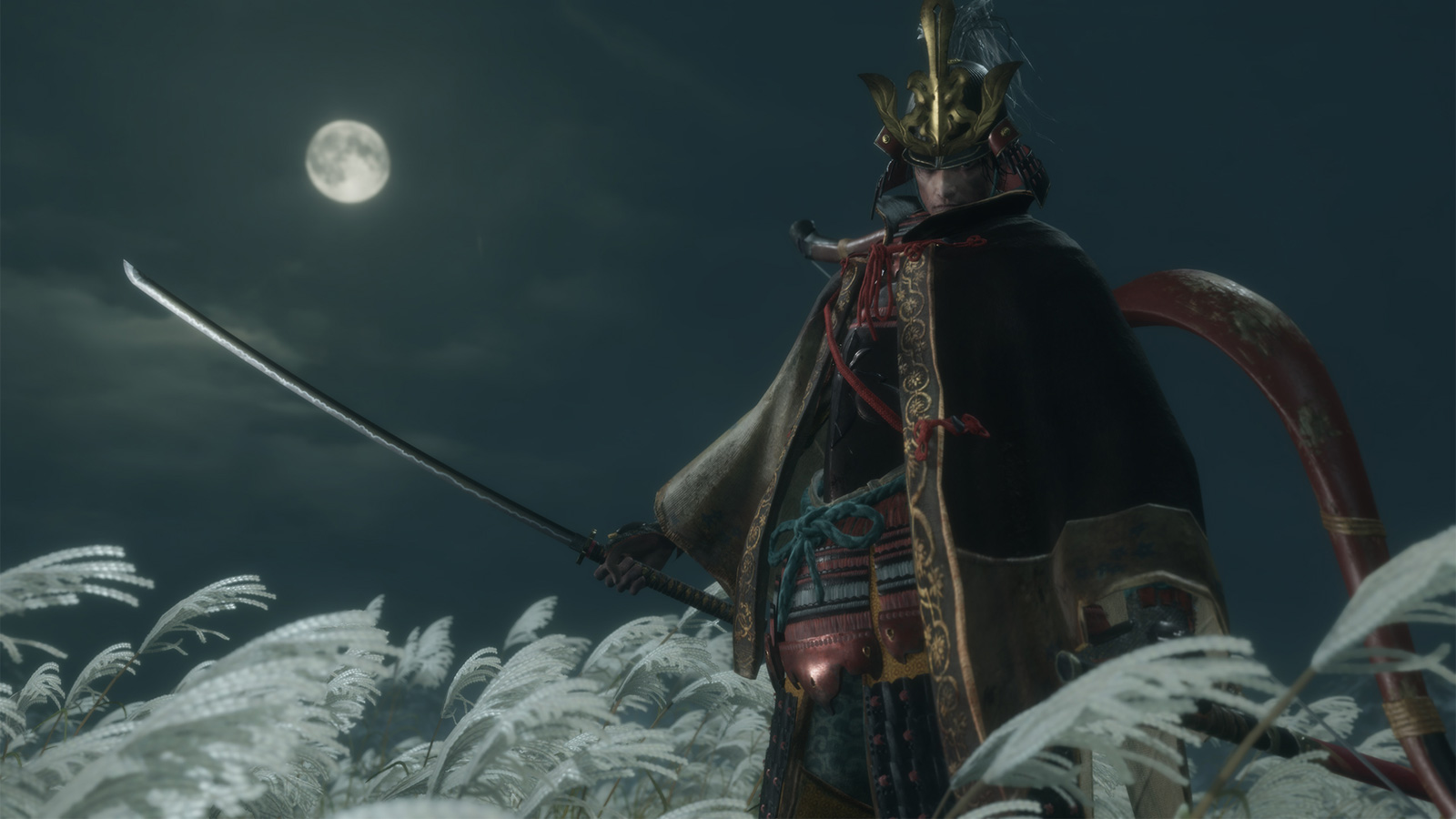 © FromSoftware
Introduction: The Fall of Ashina and the Abyss of Karma Shouldered by a Single Warlord
In the world of Sekiro: Shadows Die Twice, the land of Ashina occupies a highly unique position. It was once a sacred domain where mythical and magical powers breathed, a spiritual land deeply rooted in ancient indigenous beliefs. However, in the present time of the story, Ashina is nothing more than a dying small nation, being swallowed by the harsh historical torrent of the late Sengoku period. Under this desperate geopolitical situation, there exists a young warlord who devoted his entire being to the single great cause of Ashina’s survival, ultimately casting aside even his human dignity and ethics. That man is Genichiro Ashina. His existence is the greatest driving force behind the narrative of this work, and at the same time, a symbol of the “path trapped by attachment” that sharply contrasts with the “path of the Shinobi who follows the Iron Code” walked by the protagonist, Wolf (Sekiro).
This article aims to unravel the causality of Genichiro Ashina—from his origins, his devotion to heretical arts, and ultimately to his self-annihilation to resurrect the “Sword Saint” in his prime—based on the environmental storytelling and fragmented texts scattered throughout the game. Tracing his trajectory goes beyond a mere analysis of a single antagonist. It is the deciphering of a highly literary and philosophical epic that depicts how the pure and noble desire to love one’s country can lead a human being into madness and heresy, connecting to the chain of “Karma” from a Japanese Buddhist perspective and the acceptance of “Kegare (Defilement)” in Shinto. While strictly distinguishing between the facts explicitly presented in the game and the historical and theological insights derived from synthesizing them, we will reveal the full scope of the tragedy faced by Genichiro Ashina.
1. Origins and the Formation of Identity: Finding the Basis of Self-Existence as a Common Orphan
In logically understanding Genichiro Ashina’s behavioral principles and his extraordinary attachment to his country, his origins hold the most crucial and fundamental key. As explicitly stated in the in-game text “Memory: Genichiro,” he is not the biological grandson of Isshin Ashina. It is told that he was born a commoner, became an orphan upon his mother’s death, and was subsequently taken in by Ashina. This fact of his birth serves as a powerful rationale explaining why he clung to the nation of Ashina to the point of such extreme self-sacrifice.
1.1 The Curse Named “Debt of Gratitude” Brought About by the Fact of Being an Orphan
Had he been a pure-blooded warlord who became the legitimate successor by lineage, the situation might have been different. A person who inherited the country through bloodline might have been able to accept the nation’s ruin as the providence of nature in the face of the “inevitable tide of the times” brought by the invasion of the mighty Interior Ministry forces, or perhaps make the political decision to flee to another country to ensure the clan’s survival. However, for Genichiro, Ashina is not merely a territory to be governed or a foundation of power. To him, Ashina is “grace itself”—the entity that discovered him as an orphan covered in mud and waiting only for death, raised him, and gave him a meaning to live and a place to belong.
As an insight derived from this, it can be said that for him, the fall of Ashina meant not just the defeat of a nation, but the complete loss of his own existential significance. The fact that he, an orphan, was given the name “Genichiro Ashina” and was able to establish his identity as a warlord was entirely due to the existence of the Ashina community. Therefore, protecting Ashina was, more than protecting his own life, the proof of his soul’s existence. This overly pure desire to repay his debt of gratitude eventually transformed into a cold-blooded obsession that permitted any immoral sacrifice for the single point of “Ashina’s survival.”
1.2 The Back of the Sword Saint and the Insurmountable Wall of the “Pinnacle of Martial Arts”
His grandfather, Isshin Ashina, who took him in and raised him, is a rare hero who reclaimed the land of Ashina, which had once been stolen by another country, through swordsmanship worthy of being called divine and unfathomable caliber (the fact of the Ashina’s rebellion). Genichiro grew up watching the back of this great “Sword Saint” up close, and came to bear the heavy burden of being his successor. However, as an insight inferred from conversations with Isshin and Genichiro’s own actions, it is believed that Genichiro was more coldly and objectively aware than anyone else that he could never reach Isshin’s realm.
Isshin’s line in the game, “That boy can only swing his blade for Ashina,” sharply pierces the essence of Genichiro’s martial arts. This fact indicates that while Isshin’s sword is that of a seeker earnestly pursuing the “pinnacle of martial arts,” Genichiro’s sword functioned purely as a “means of national defense,” rather than for self-discipline or enlightenment. While Isshin found the meaning of life in the very act of swinging his sword, Genichiro swung his sword as a practical tool to protect his country. It can be argued that this decisive difference in mentality made Genichiro realize the limitation that “orthodox martial arts alone cannot fully protect the country,” forming the psychological foundation that later led him to deviate from Ashina’s traditional swordsmanship and dabble in heretical powers.
2. The Tragedy of the Hirata Estate and Intersecting Conspiracies: The Beginning of Causality
The event where Genichiro crossed a decisive line on the main stage of history and soiled his hands was the “attack on the Hirata Estate” that occurred three years prior to the main story. This incident is positioned as the first step in a massive conspiracy to imprison the Divine Heir, Kuro, and seize the immortal power of the Dragon’s Heritage. From the depictions and remaining traces in the game, it can be read that this attack involved a complex political background and the intertwined motives of multiple factions.
2.1 The Secret Maneuvers of the Interior Ministry Forces and the Possibility of Genichiro’s Involvement
The attack on the Hirata Estate is ostensibly attributed to bandits and thieves, but a close examination of the scene’s conditions confirms as a fact that this was a disguise. Deep within the estate, the “Lone Shadow,” a covert unit of the Interior Ministry forces, had intervened, and it is clear that Great Shinobi Owl guided them for his own ambition (conquering the realm using the Divine Heir’s power). However, a macroscopic analysis of the results produced by this attack reveals another truth regarding who ultimately benefited the most.
Regarding the main perpetrator of this attack, besides the view that it was Owl’s solo conspiracy, there is a compelling theory that under the impending offensive of the Interior Ministry, Genichiro Ashina himself was involved as the mastermind behind the attack, or at least tacitly approved of and utilized the Interior Ministry’s movements. A question arises: after the Hirata Estate went up in flames and suffered a devastating blow, who rescued the left-behind Divine Heir, Kuro, and took him into custody (effectively house arrest) at Ashina Castle? Considering the situation at the time, it is presumed that either Isshin Ashina or Genichiro Ashina could have done this, but given Kuro’s subsequent treatment and the fact that he was imprisoned in the “Moon-viewing Tower” of Ashina Castle, it is safe to conclude that it was Genichiro who carried out the actual custody and management.
Genichiro, with the full-scale invasion by the main forces of the Interior Ministry fast approaching, was pressed by the need to secure the “Divine Heir” at Ashina Castle as an absolute power to protect the country. It can be inferred that Owl’s personal ambition to “take the Divine Heir into his own hands” and Genichiro’s national defense objective to “protect the Divine Heir at the center of Ashina” temporarily aligned in their interests during the process of the Hirata Estate’s destruction. If Genichiro was complicit in or turned a blind eye to this attack, it means that he had already made the decision at this point to coldly discard even the sacrifice of the Hirata clan, loyal retainers who once supported Ashina together, for the sake of the greater cause. This was the moment his “Ashina supremacy” crossed the boundaries of morality and ethics.
3. Rejuvenating Waters and Red-Eyed Research: The Acceptance of “Kegare (Defilement)” and “Stagnation” in Shinto
Realizing that legitimate military strength and martial arts alone could not withstand the overwhelming numbers of the Interior Ministry, Genichiro reached out to the heretical power passed down since ancient times in the land of Ashina: the “Rejuvenating Waters.” This act goes beyond a mere choice of military means; it signifies a fundamental shift in the concepts of “purification” and “Kegare (Defilement)” in ancient Japanese Shinto, as well as his View of life and death.
3.1 The Purity of Flowing Water and the Defilement of Stagnant Water
Ashina is located in a snowy highland, a land where pure water springs forth. In Shinto, flowing, clear water is a tool for “Misogi” (purification rituals) and a symbol of vitality, purity, and a vessel for divine spirits. However, in the game’s worldview, there is a fact that the water flowing down from the Fountainhead Palace transforms into an elixir of immortality (or a curse) called the “Rejuvenating Waters” by precipitating and pooling at the bottom. Water experiencing “Stagnation” means a deviation from the “healthy cycle of life and death,” which is the providence of nature, and from a Shinto perspective, it is nothing less than the greatest “Kegare (Defilement).” The Rejuvenating Waters, which reject the natural purifying process of death and forcefully anchor the physical body to the present world, are a blasphemy against the logic of life.
In the Abandoned Dungeon of Ashina Castle, Genichiro tacitly approved of and supported the inhumane human experiments using the Rejuvenating Waters conducted by Doujun and others. The Chained Ogre, the heavily armored soldiers of the Red Guard (Taro Troop), and the Red-Eyed samurai are the products of this maddening research. As an insight derived from these facts, it becomes clear that Genichiro did not hesitate to plunge his own people and soldiers into “Kegare (Defilement)” for the sake of Ashina’s survival. Furthermore, he himself drank the extremely concentrated and stagnant “Rejuvenating Sediment,” reducing himself to a Red-Eyed immortal. This is a manifestation of his fierce resolve, having completely absorbed the Shinto “Kegare (Defilement)” into his own body and soul, abandoning his human dignity, pride, and peace after death. He willingly transformed into an abominable monster to become a “breakwater” to protect Ashina.
3.2 The Clash of Conflicting Values Regarding the Blood of the Dragon’s Heritage
This devotion to the Rejuvenating Waters is closely tied to his values regarding the “blood of the Dragon’s Heritage,” which he desired most. The Divine Heir, Kuro, detests the immortal power brought by his own blood as a “Stagnation that drives men mad,” and wishes for Immortal Severance. On the other hand, Genichiro thirsts for that blood as the “only hope to save Ashina.” This conflict between the two is not a mere difference of opinion, but a fundamental and philosophical clash over the ethics of life.
The following table compares the ideological conflict between Kuro and Genichiro regarding the power of the Dragon’s Heritage from the perspective of their View of life and death.
| Comparison Item | Divine Heir Kuro (Acceptance of Death) | Genichiro Ashina (Attachment to Immortality) |
|---|---|---|
| Perception of Immortality | A “Stagnation” that defies the logic of nature, a curse to be severed | A “means” to avoid ruin, and a hope |
| Desired Outcome | Return to human logic, ending the chain of immortality (Purification / Immortal Severance) | The eternal survival of the nation of Ashina in the present world |
| Attitude Toward Sacrifice | Refuses to live by sacrificing another (Wolf) | Permits any sacrifice, including himself, for the sake of the country |
| Underlying Philosophy | Buddhist liberation, devotion to the providence of nature | Pursuit of worldly benefits, humanistic rebellion against fate |
What Kuro presents is the “nobility of accepting the providence of nature (death),” while what Genichiro embodies is the “human Karma of trying to subjugate fate through artificial means.” The depth of Genichiro’s tragedy lies in the fact that, while he probably understood deep down the truth that “the power of immortality is an illusion and will not fundamentally save the country,” he had no choice but to cling to it. His desperate obsession during the death match with Wolf at the main keep of Ashina Castle was no longer based on rational strategy or judgment, but is considered to have been a pathetic prayer mixed with fanaticism and self-sacrifice.
4. The Heretical Master Tomoe and the Power of Lightning: A Break from Ashina’s Traditions
The uniqueness of Genichiro’s martial arts lies in the fact that he has mastered not only the orthodox Ashina Arts swordsmanship inherited from his grandfather, Isshin, but also a heretical technique known as the “Tomoe Arts.” This choice of martial arts is also an important element that clearly shows his spiritual transition and causality.
4.1 Devotion to a Heretical God and the Mastery of the Tomoe Arts
It is told in the game that Tomoe was a female warrior who once served a Divine Heir named Takeru, and that she was an outsider connected to the Fountainhead Palace. The power of “lightning” she wielded was considered completely “heretical” in Ashina, possessing an overwhelming, inhuman beauty and destructive power that made even Isshin say, “It was enough to captivate me.” Genichiro looked up to this Tomoe as his master and acquired the art of manipulating lightning himself.
There is a deep historical and Shinto context here. Even in real Japanese history, lightning (Inazuma) is written as “wife of rice,” linking it to a sacred power that enriches agriculture (the worship of the thunder god, represented by the belief in Tenjin/Sugawara no Michizane), while at the same time, it is the power of a fierce god that brings disaster and destruction to people. In the land of Ashina, where indigenous gods breathe, the act of drawing lightning down from the heavens is an invasion into the divine realm beyond human bounds.
4.2 The Symbolic Meaning of Casting Off His Armor
In the second phase of his battle with Wolf at the Castle Tower Lookout of Ashina Castle, Genichiro casts off his great armor himself, becoming half-naked and cloaking his entire body in the “lightning of Tomoe.” This moment, where he, the supreme commander of Ashina, unhesitatingly wields the power that Isshin dismissed as “heretical,” can be considered a dramatic turning point symbolizing his complete break from Ashina’s proud, traditional Bushido.
When he unleashes the lightning, even without putting it into words, he expresses with his entire body the intense will: “For the sake of Ashina, I will cease to be human.” The act of discarding his armor—“a human warlord’s protective gear (a symbol of social status and tradition)“—was a ritual of degrading himself into an “entity close to Shura” as a pure apparatus of violence. This contradiction of discarding the core spirituality of a tradition in order to protect that tradition is the greatest paradox running through Genichiro’s actions. Realizing that orthodox swordsmanship alone could not resist the overwhelming wave of the era that was the Interior Ministry, he struggled to forcefully prolong the life of his dying country by forcibly drawing down the mythical power (lightning) of the Fountainhead Palace into the present world.
5. The Incline Toward the Realm of Asura: Attachment and the Karma of a Great Cause from a Buddhist Perspective
When examining Genichiro’s way of life from the perspective of Japanese Buddhist thought, particularly “Karma” and the “Realm of Asura,” it becomes much clearer how his soul fell into an unsalvageable path.
5.1 The Dilemma of “Attachment” and “Worldly Desires” in Buddhism
In Buddhism, it is taught that the root of all suffering lies in “attachment.” Not only vulgar desires for money or power, but even noble love based on the justification of “wanting to save someone” or “wanting to protect one’s country” becomes a strong “attachment (worldly desire)” if it goes too far and harms oneself or others. His noble spirit of loving Ashina became a chain that bound him as an extremely heavy “Karma” from a Buddhist perspective.
In the game, those who are swallowed by the joy of slaughter and lose their reason become “Shura” (Wolf in the Shura ending, and the Sculptor who later became the Demon of Hatred are typical examples). However, a detailed analysis of Genichiro’s mental state reveals the fact that he did not fall into being a “Shura” in the strict sense. This is because he never enjoys the act of cutting down people itself; he continues to swing his blade solely for the cold-blooded purpose of “protecting Ashina.”
The following table logically compares the differences between the nature of “Shura” in the game and the nature of the “attachment” that binds Genichiro.
| Comparison Item | Those Who Fell to Shura (e.g., Demon of Hatred, Sculptor) | Prisoner of Attachment (Genichiro Ashina) |
|---|---|---|
| Source of Power | The joy of killing, accumulation of grudges, uncontrollable anger | Excessive love for the homeland, debt of gratitude, spirit of self-sacrifice |
| Presence of Purpose | Lost their original purpose, seeking only destruction and slaughter | Maintains the clear and single purpose of “Ashina’s survival” |
| Perception of Others | Everything is a target for destruction, no distinction between friend and foe | The coldness to perceive even the Divine Heir and Isshin as “means to save Ashina” |
| Ultimate Fate | Transformation into a monster (demon) that has completely lost its reason | Self-annihilation while maintaining reason, immersion in heretical arts |
The insight derived from this comparison is extremely cruel. Genichiro did not become a trackless monster known as Shura, but at the cost of that, he plunged himself into an “infinite hell (Samsara) of being continuously bound by a great cause.” For him, hell is not being burned by the flames of hatred. It is the continuous experience, while remaining sane, of the overwhelming sense of powerlessness that “no matter how much I stain my hands with blood and gain heretical powers, I cannot stop the reality that Ashina is heading towards ruin.”
The “good heart trying to repay a debt of gratitude” that sprouted on the day he was taken in as an orphan eventually inverted into “evil deeds” of sacrificing others out of love for his country. In light of the Buddhist principle of karmic retribution, the moment he relied on powers that defy the logic of nature, such as the Rejuvenating Waters and the Dragon’s Heritage, and toyed with the lives of others, the path for his soul to reach a peaceful Pure Land was completely closed. His patriotism was the very “Karma” that tormented him the most.
6. The Black Mortal Blade “Open Gate” and the Ritual of Self-Annihilation: The Ultimate Tragedy
In the final stages of the story, as Ashina is literally engulfed in flames by the all-out attack of the Interior Ministry forces and gruesome slaughter unfolds throughout the castle, Genichiro resorts to his last measure to save the land of Ashina. That is the use of the other Mortal Blade, the “Black Mortal Blade (Open Gate).“
6.1 The True Power of “Open Gate” and the Price of Resurrection
According to the facts recorded in the in-game text “Black Scroll,” “Open Gate” holds the terrifying power to open the gate to the underworld and call back (resurrect) the dead to the present world in their prime form. However, to perform that miracle, two critical conditions must be met. Namely, shedding the “blood of the Dragon’s Heritage” and offering the caster’s own “life” as a sacrifice.
It is not explicitly told when or how Genichiro obtained this “Open Gate,” but it is presumed that he forcefully took it out—whether it was hidden by Isshin or sealed deep within Ashina—upon realizing the end of his country. In the field of swaying silver grass, Genichiro, having wounded the Divine Heir and obtained the blood of the Dragon’s Heritage, confronts Wolf once again. However, there he suffers a decisive defeat, and finally comes to completely realize his own limits. No matter how much he strengthened his body with the Rejuvenating Waters, cloaked himself in the lightning of Tomoe, and swung the Black Mortal Blade, he could not defeat a true Shinobi who had formed a pact with the Divine Heir, let alone physically push back the massive army of the Interior Ministry filling the castle town all by himself.
6.2 The Acceptance of the Despair That He Is Not the “Savior” and the Ritual of Human Sacrifice
The decision Genichiro made here is the most heartbreaking throughout the entire story, and the ultimate choice that defines his character. He completely accepted the desperate fact that “he is not the one to save Ashina.”
His final moments, thrusting the Black Mortal Blade into his own neck and muttering lowly, “The dawn of Ashina.” This can be considered a Shinto ritual of self-sacrifice (human sacrifice), offering his own body and soul as a “vessel.” He made his life, his body, and even his future into an offering, and summoned from the underworld the “Sword Saint Isshin Ashina” in his prime, who had once built Ashina.
Isshin, whom he resurrected by taking his own life, manifests by receiving the heartbreaking wish (attachment) of his grandson upon himself. The reason Isshin stood before Wolf was not to side with the Interior Ministry, nor because he hated the Divine Heir, Kuro. It was solely to fulfill the “pitiful wish” of his grandson, Genichiro, who tried to save Ashina even at the cost of returning himself to nothingness. Isshin’s line, “It is my grandson’s wish, it cannot be helped,” contains his sorrow for the depth of the Karma Genichiro shouldered, and his resolve as a grandfather to take on that curse.
Genichiro did not want to become a hero himself. He merely wished that the beloved country that gave him a place to belong would continue to exist there tomorrow. However, he himself lacked that power, and ultimately could only fulfill his great cause by completely returning himself to nothingness. Here, the ultimate tragedy of a man who loved his country too much is completed. Because he understood his own weakness better than anyone else, he chose to become the “vessel of sacrifice” to summon the strongest existence (Isshin).
Conclusion: Genichiro’s Legacy as the Embers of Ashina and the End of Causality
To summarize the existence of Genichiro Ashina, it can be argued that he was the most “human-like” character in the world of Sekiro: Shadows Die Twice, and therefore met the most tragic fate. Unlike the Divine Heir, Kuro, who accepts death with transcendent ideals, or Wolf, who possesses absolute loyalty to risk his life solely for his master, or Isshin, who has reached the pinnacle of martial arts and accepts even death with composure, Genichiro was constantly driven by impatience, covered in mud, and agonizing over his own weakness and the impending ruin of his country. In the face of the unforgiving torrent of history, the despair of a single man picked up from the streets bearing the heavy burden of “national survival” must have been beyond our imagination.
The acts he committed—the inhumane human experiments of the Rejuvenating Waters, the possibility of secret maneuvers or tacit approval with the Interior Ministry during the attack on the Hirata Estate, and the drawing of his blade against the Divine Heir—are undeniably atrocious and cannot be ethically justified. However, the fact that all of these evil deeds stemmed not from “his own self-interest or lust for power,” but from “unconditional love and a debt of gratitude (fanatical loyalty to Ashina),” makes us feel a strong heartache that prevents us from condemning his actions as mere evil.
From a Buddhist perspective, his soul was bound by the chain of “Karma” born from an overly strong “attachment” to save his country, driving himself into infinite suffering. From a Shinto perspective, he took upon himself the “Kegare (Defilement)” of a dying nation and became a “human sacrifice” to bring down a god (the Sword Saint) using himself as a vessel.
What emerged from the scar of the “Open Gate” he carved open at his end was the figure of his great grandfather, whom he had once looked up to, admired, but could never catch up to. Genichiro’s physical body vanished, and his dream of Ashina’s survival was also ultimately severed by Wolf’s sword. The future where Ashina is completely subjugated by the forces of the Interior Ministry was sealed the moment Isshin was defeated.
However, the way of life of the tragic hero “Genichiro Ashina”—who loved his country, sipped the mud of heresy for his country, and ultimately cast aside even his own existence—flared up as the most vivid embers in the history of the dying Ashina. Without his attachment, Wolf would never have awakened as a true Shinobi, nor would the journey of Immortal Severance have been fulfilled. His actions were the starting point and the nodal point of all causality. His trajectory, embodying the “madness named patriotism” that transcends justice and ethics, is etched into our hearts as a profound theme that should be passed down eternally in this story where myth and history intersect.
Dialectics of Immortality and Fate: Sekiro: 11 Meditations on the Dragon’s Heritage and Mortal Struggle
The book version is now available. Read for free with Kindle Unlimited.
Thank you very much for reading to the end. To help support the activities of this archive, a warm donation of a cup of coffee would be highly appreciated.