Memory.07: Lady Butterfly
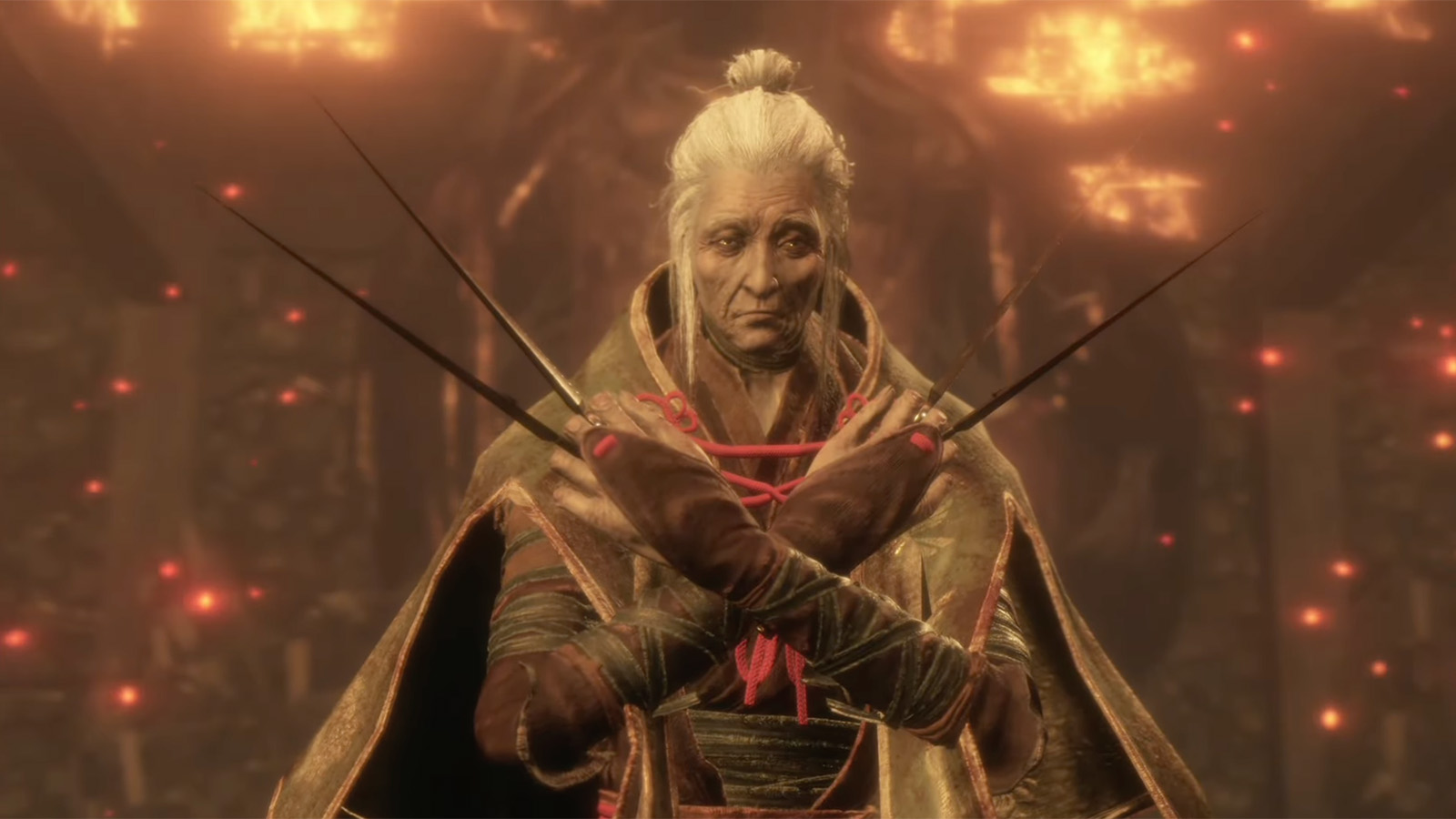 © FromSoftware
Introduction: The “Shinobi’s Baptism” of Facing Phantoms of the Past
In the narratives presented by FromSoftware, the past of the protagonist, “Wolf,” is intentionally obscured, revealed only in fragments as the story progresses. The greatest nexus for unraveling this past, and the event that forms the core of the protagonist’s identity, is the tragedy at the “Hirata Estate” three years ago. And waiting for Wolf in the deepest part of the estate, within the burning hidden temple, is his former master of illusion techniques, “Lady Butterfly.”
Lady Butterfly, alongside Wolf’s foster father Great Shinobi Owl, is one of the masters who drilled Shinobi techniques into the young Wolf. The death match with her functions as a rite of passage for Wolf to break with his past and become a true “Shinobi”—in other words, a “Shinobi’s baptism.” In this article, we will deeply examine and logically reconstruct the origins of the unique character Lady Butterfly, the Buddhist and Shinto backgrounds of the “illusion techniques” she wields, and the causal relationship of why she ended up crossing blades with Wolf at the Hirata Estate, piecing together fragments of the world’s lore.
1. Memories of Ashina’s Founding: The “Fools” Gathered Around Dragonspring
Indispensable to exploring Lady Butterfly’s background is the ensemble drama of the “shadows” during the era when Ashina achieved independence through a coup. In Isshin Ashina’s war of rebellion, there were always shadows of heretics and Shinobi behind him. The vivid human drama of this era is conveyed through the reminiscences heard when offering “Dragonspring” sake to the Sculptor (formerly the “Bounding Monkey,” Sekijo).
The Sculptor vividly recounts the scene where the behind-the-scenes key figures who supported the young Ashina gathered at a drinking party. According to the Sculptor’s words, those who found the Dragonspring gathered and drank: a fool who wouldn’t let go of his cross spear, a fool who would steal people’s sake with illusions, a fool who tinkered with a half-made prosthetic arm with a sake cup in one hand, and a deceptively large Owl who would turn bright red immediately. Furthermore, the Sculptor says that Wolf’s father, Owl, was also one of those “fools.”
This clearly shows the fact that the heroes who shaped the history of Ashina—Isshin Ashina (the fool who wouldn’t let go of his cross spear), the rare apothecary and mechanic Dogen (the fool tinkering with a half-made prosthetic arm), Great Shinobi Owl (the deceptively large Owl), and Lady Butterfly (the fool who steals people’s sake with illusions)—shared the same table.
The important insight derived from this description is that Lady Butterfly was by no means a mere solitary assassin, but one of the “legendary Shinobi” operating near the core of the great historical tide of Isshin Ashina’s coup. The mischievous act of stealing sake with illusions suggests that, amidst the blood-soaked battlefields, they had built a strong bond and a relationship full of humanity, even if only temporarily. She transcended the framework of being a mere collaborator or subordinate to Owl, standing as an equal to the heavyweights of Ashina.
When Wolf and Lady Butterfly face each other in the hidden temple, she calls Wolf “Son of Owl” (in Japanese, Segare-dono). This is an appellation based on the fact that Wolf is Owl’s adopted son (a picked-up orphan), but behind these words lies a kind of affection for the son of a close old friend, intertwined with “contempt” for not yet recognizing him as a full-fledged Shinobi, or the cold gaze of “one who imposes a trial.” Behind these complex emotions lies the intricate Karma of a master toward the son of a comrade with whom she once shared Dragonspring sake.
2. Illusion Techniques and “Usui’s Forest”: The Karma and Grudges of a Shinobi Manipulating Boundaries
The power that symbolizes Lady Butterfly is, as her name implies, “illusion techniques.” She strings invisible wires across space to dance freely in the air, unleashes “Phantom Kunai” accompanied by butterflies of light, and summons phantom soldiers. This power of illusion is not merely a physical combat technique; it is closely tied to Japanese folklore, Shinto, and the Buddhist View of life and death.
The place considered the root of her illusion techniques is “Usui’s Forest.” In the background of the story, it is told that the birds of prey inhabiting Usui’s Forest and those who base themselves there possess illusion-like powers. In Japanese folklore and Shinto worldviews, “forests” and “spaces enveloped in mist” have functioned as boundary lines between the present world (Utsushiyo) and the hidden world (Kakuriyo)—that is, marginal spaces. The name “Usui” (meaning “thin”) itself is presumed to be a metaphor for the state where the boundary between reality and illusion, or life and death, is “thin.” Lady Butterfly’s illusions are rooted in this “power to blur boundaries.”
Her symbol, the “butterfly,” holds special meaning in Eastern philosophy. As represented by Zhuangzi’s “Butterfly Dream,” the butterfly is a symbol of the “boundary between reality and illusion.” The philosophical proposition of whether one is dreaming of being a butterfly, or a butterfly is dreaming of being oneself, resonates with the Buddhist teaching of “Form is emptiness” (the visible substance is essentially empty). Furthermore, in ancient Japanese Views of life and death, butterflies have been treated as “Tokoyo no Mushi” (insects of the everlasting world), namely, carriers of the souls of the dead, or the spirits of the dead themselves.
Looking at the reality of the phantoms Lady Butterfly summons reveals an even deeper form of Karma. When deploying attacks with Phantom Kunai, Lady Butterfly summons numerous phantoms wielding three types of weapons: hoes, kitchen knives, and spears, and after a certain amount of time, turns them all into butterflies and sends them flying. What should be noted here is that the weapons held by the summoned phantoms are “agricultural tools” and “daily necessities” like “hoes” and “kitchen knives,” rather than samurai weapons.
This fact strongly suggests that during her long life as a Shinobi, Lady Butterfly took the lives not only of hostile samurai and ninjas but also of peasants caught in the crossfire and vulnerable commoners silenced to keep secrets. The phantoms she summons are not mere bundles of light, but the ghosts, or the very grudges, of those she has slaughtered thus far. The technique of materializing the thoughts of the dead, transforming them all at once into butterflies (Tokoyo no Mushi), and turning them into physical blades in the present world (Phantom Kunai) is an extremely advanced and magical Shinobi Karma, and at the same time, it tells of the mass of the “blood-soaked past” she continues to bear.
Moreover, such illusion attacks place a heavy mental burden on the opponent. The description of items related to illusions contains the phrase, “If you’re scared, cover your behind.” The “terror” toward unknown phantoms and the grudges of the dead triggers fundamental human fear. Lady Butterfly is a veteran tactician who uses this “fear” itself as a weapon, advancing the battle advantageously by breaking the opponent’s spirit.
3. The Tragedy at the Hirata Estate: Separating Fact from Speculation
The greatest mystery in Lady Butterfly’s story is, “Why did she have to fight Wolf to the death at the Hirata Estate three years ago?” The intentions of the parties involved in this incident are complexly intertwined, and the clear full picture is never told as a single line in the story. In this chapter, to reconstruct the depths of the story, we will logically distinguish and present the “facts” explicitly stated in the game and the “speculations” derived from them.
3.1 Organizing the Facts
The following table organizes the objective factual relationships confirmed in the Hirata Estate attack incident.
| Item | Factual Content |
|---|---|
| Perpetrators and Guidance of the Attack | A group of bandits, acting on the intentions of the Interior Ministry, attacked the Hirata Estate. It was Great Shinobi Owl who guided them, manipulating the bandits while leaving evidence of his guidance. |
| Lady Butterfly’s Placement and Actions | Lady Butterfly was located in the deepest part of the burning Hirata Estate, the hidden temple. There, she was deceiving Kuro (the Divine Heir) with illusions (or protecting him). |
| Confrontation with Wolf | Lady Butterfly called Wolf, who appeared in the hidden temple, “Son of Owl,” and entered combat with clear murderous intent and fighting spirit. |
| Owl’s Camouflage | Owl was lying on the path of the estate, having faked his death, and gave the rushing Wolf the instruction to “head to the hidden temple.” It was Owl who later thrust a blade into Wolf’s back in the hidden temple. |
| Sakura Droplet as a Relic | After Wolf defeated Lady Butterfly, a crystal called the “Sakura Droplet” was left behind from her body. |
3.2 [Speculation] Three Hypotheses Regarding Lady Butterfly’s True Intentions
Based on the above factual relationships, three main hypotheses (speculations) can be derived regarding why Lady Butterfly was in the hidden temple and her motives for fighting a death match with her former disciple, Wolf.
3.2.1 Hypothesis 1: Conspiracy with Owl to Usurp the Dragon’s Heritage
This is the theory that Lady Butterfly conspired with Owl and participated in the attack on the Hirata Estate to steal the power of the “Dragon’s Heritage” possessed by Kuro. Feeling her old age, Lady Butterfly, like Owl, may have been captivated by the power of “immortality.” In this case, the reason for attacking Wolf was to eliminate an obstacle to the plan (since Wolf, bound by the Iron Code, would protect Kuro). However, if they were in complete conspiracy, the question remains as to why Owl left the securing of Kuro entirely to Lady Butterfly and took the roundabout method of faking his own death outside. The possibility that Owl betrayed Lady Butterfly as well, and that they were using each other, cannot be denied.
3.2.2 Hypothesis 2: Defense of Ashina and the Divine Heir (Conflict with Owl)
The Hirata family is an important branch family that supported Isshin Ashina’s coup. This theory suggests that Lady Butterfly, who once supported the founding of Ashina alongside her comrades, unlike Owl who abandoned Ashina for his own ambitions, was trying to protect the Hirata family and the Divine Heir as Ashina’s shadow until the very end. From this perspective, to Lady Butterfly, Wolf was merely “the son and pawn of the traitor Owl,” and naturally appeared as an enemy to be eliminated. Sealing the hidden temple with illusions can also be interpreted as a defensive measure to hide Kuro from the bandits, the Interior Ministry forces, and above all, Owl.
3.2.3 Hypothesis 3: Fear of Death and Forcing the Dragon’s Heritage Contract (Independent Action)
This is the theory that Lady Butterfly was acting on her own motives, distinct from both Owl and Ashina. The “Sakura Droplet” dropped after Lady Butterfly’s death is a trace of a failed immortal contract that was supposed to be formed between the Divine Heir of the Dragon’s Heritage and his Shinobi servant. This speculation suggests that Lady Butterfly, realizing her old age and impending death, was forcing Kuro to “make her his immortal servant.” Because the Divine Heir refused, she was likely trying to deceive him with illusions and bend his will. Wolf, appearing there, became a target for murder as one who would obstruct her immortal contract.
While each of these hypotheses has its merits and flaws, looking at it from the thematic context of “attachment to immortality” that runs throughout the entire story, the most natural conclusion is that even Lady Butterfly, a veteran Shinobi, was one of those whose fate was derailed by the “Stagnation” of immortality known as the power of the “Dragon’s Heritage.”
4. The “Stagnation of Immortality” Indicated by the Sakura Droplet and Shinto Kegare (Defilement)
The “Memory: Lady Butterfly” and the “Sakura Droplet” that Wolf obtains upon defeating Lady Butterfly are items that vividly tell of her final attachments and the negative aspects of the system of immortality in this world.
The “Sakura Droplet” is said to be the crystallized residual power when the oath of the Dragon’s Heritage is not fulfilled. The fact that this is found on Lady Butterfly’s body is extremely suggestive. Two possibilities can be considered from this fact. One is, as mentioned above, the possibility that an attempt at a contract was made between Lady Butterfly and Kuro in the hidden temple of the Hirata Estate, but it ended in failure due to Kuro’s refusal. The other is the possibility that this Sakura Droplet is a remnant of Lady Butterfly’s past attempt to form a contract with another Divine Heir (such as Takeru, the previous Divine Heir of the Dragon’s Heritage), and that she had kept it hidden for many years.
In any case, there is a sorrow here that even a veteran Shinobi like Lady Butterfly could not resist the absolute providence of nature that is “aging” (the four sufferings of “birth, aging, sickness, and death” in Buddhism), and was forced to reach out for the taboo of the Dragon’s Heritage. The heroes who once drank sake together under Isshin and ran through the dawn of Ashina, over time, each had to face their own “decline” and “attachments.” Isshin fell ill, Dogen passed away, the Sculptor was tormented by the flames of Shura, and Owl became a prisoner of his own ambitions. And Lady Butterfly scattered while chasing the phantom of immortality.
This “attachment to immortality” is closely tied to the concept of “Kegare (Defilement)” in Shinto. In ancient Japanese beliefs, pure things are always likened to continuously flowing “water,” and stagnant, pooled water is said to rot and produce Kegare (Defilement). “Immortality” is exactly the act of damming the flow of life (the cycle of death and rebirth) and causing the individual to stagnate eternally. The Sakura Droplet that Lady Butterfly tried to obtain is a symbol of this “Stagnation of life,” and can be said to be the crystallization of her delusion to remain in the present world even in her old age. The fact that she, who had crossed the boundary between life and death countless times as a Shinobi, ultimately feared death and sought Stagnation (immortality), poignantly depicts the depth of human Karma.
5. The “Sound” That Shatters Phantoms: Snap Seed and Buddhist Awakening
The key to countering the illusion techniques wielded by Lady Butterfly is the existence of the “Snap Seed.” It is said that using this tool can dispel surrounding phantoms all at once. This phenomenon of “shattering illusions with sound” embodies an extremely Buddhist, particularly Zen, approach.
In Zen training, the sound of being struck on the shoulder with a Kyosaku (warning stick) during meditation, the sound of a wooden fish, or the sound of a bell functions as a device to awaken from delusion (worldly desires and ignorance) and return to the “truth (reality as it is).” In Buddhism, the world we perceive is said to be covered in “Maya” (illusion/delusion), obscuring the truth.
Lady Butterfly’s illusion techniques are the very embodiment of this Maya. She gains a mental advantage by deceiving the opponent’s sensory organs (the six roots of perception) and distorting their cognition. Her figure, dancing in the void with invisible wires strung around, is like the absolute master ruling the world of illusion.
In contrast, Wolf corrects the distortion of space through the physical vibration (wave) of sound from the “Snap Seed,” drowning out the “lie” that is the phantoms. This goes beyond the physical phenomenon of a mere countermeasure; it depicts the process of spiritual awakening in which Wolf pulls the world back by his own will from the “world of deception (illusion techniques)” to the “true present world (the blood-soaked battle of a Shinobi).”
Wolf was once a “dweller in illusions (Maya)” who had stopped thinking within the absolute framework of the Iron Code. However, at the moment he resonates the sound of the Snap Seed and shatters Lady Butterfly’s fiction, Wolf looks straight at reality as it is with his own eyes, taking his first step toward becoming a true Shinobi who carves out his own destiny with his own hands. This sound plays the role of an “awakening bell” that rouses Wolf from his slumber.
6. The Boundary with the Realm of Asura: The “Fate of a Shinobi” Seen in Contrast with the Sculptor
To understand the death and Karma of Lady Butterfly more deeply, a contrast with the existence of the “Sculptor (Sekijo),” one of the comrades who once drank Dragonspring with her, is essential. The ways of life and the ends of these two draw a vivid contrast through the Buddhist concept of the “Realm of Asura.”
The Sculptor has a past where he was once almost swallowed by “Shura,” barely remaining human by having his left arm severed by Isshin Ashina. When drinking Monkey Booze, the Sculptor speaks of the gruesomeness of the battlefield and the madness when he almost fell into Shura as follows:
“I was once on the verge of being consumed by Shura… Those who go on killing will eventually forget why they even started. They kill simply to kill. The god of Shura dwells even in the eyes of a bug. Never forget that.”
Furthermore, the Sculptor prophesies about the grudges born from war: “There will be a war soon. When war breaks out, corpses will be piled into mountains, grudges will swirl like blood, and surely a demon will be born.”
The “grudges” and “Shura” spoken of by the Sculptor are the Buddhist hell (Realm of Asura) where those who repeatedly slaughter ultimately end up. Killing itself becomes the purpose, and the soul that has lost itself is eventually burned by the flames of resentment, transforming into a non-human “demon.” To escape his own sinful Karma, the Sculptor continues to carve Buddhas single-mindedly in the Dilapidated Temple, but all the Buddhas he carves are filled with wrath, indicating that his inner Shura has never vanished.
Evaluating Lady Butterfly’s way of life from this perspective of the Realm of Asura leads to the insight that her end was extremely “Shinobi-like,” accompanied by a certain kind of salvation. Lady Butterfly, too, like the Sculptor and Owl, was a being who had taken countless lives over her long life. As shown by the phantoms of peasants she summons, her hands were stained with blood, and she must have borne numerous grudges.
However, she did not lose the purpose of cutting and turn into a monster of resentment known as Shura. Until her final moment, Lady Butterfly maintained a clear purpose (securing Kuro, or a thirst for immortality) and kept her consciousness. And before turning into a Demon of Hatred, she met her end by being struck down by the hands of the disciple she herself had once trained.
After the battle in the hidden temple, the fatally wounded Lady Butterfly breathes her last, leaving the quiet words, “You’ve grown stronger, Son of Owl…” This final line she utters contains no resentment or lingering attachment to her own death, but rather pure praise and affection for the young Shinobi who had surpassed her. The figure of Lady Butterfly, who died maintaining her pride as a Shinobi just one step short of being swallowed by the flames of Shura, despite harboring the “delusion” of attachment to immortality (Sakura Droplet), forms a beautiful yet cruel contrast with the miserable ends of the Sculptor, who later turns into the Demon of Hatred and meets a tragic fate, and Owl, who pursued his ambition for immortality by exploiting even his affection as a foster father.
7. The Baptism Left to the “Son of Owl”: The Iron Code and the Inheritance of Will
The battle with Lady Butterfly was a paradigm shift that held decisive meaning in the formation of Wolf’s individual personality and his breaking away from the “Iron Code” of the Shinobi.
Before the start of the story, Wolf was nothing more than a “dog bound by the code,” blindly obeying Owl’s teaching that “the code is absolute.” The parent’s (Owl’s) orders were absolute, and he was literally a “shadow” with no will of his own. However, the death match with Lady Butterfly at the Hirata Estate becomes Wolf’s first successful experience of “overcoming the parent’s generation (master) by his own will.”
Lady Butterfly’s combat style of stringing invisible wires in the air visually demonstrates that she is a being who “manipulates others (deceives with illusions)” and, at the same time, a symbol of the old generation that “binds others with the threads of old customs and codes.” Against the threads that dominate this space and the swarm of phantoms bundling the grudges of the dead, Wolf resists with physical blades: swordsmanship, deflecting, and shuriken. The process of overcoming the “void” of illusion techniques with the “reality” of his own flesh and steel blade is nothing but a metaphor for Wolf carving out reality with his own hands and beginning to walk as an autonomous individual.
Furthermore, immediately after the battle with Lady Butterfly, a decisive Karma visits Wolf. Wolf, having defeated Lady Butterfly in the hidden temple, is stabbed in the back by his trusted foster father, Owl, and loses his life once. However, at the brink of that death, he is granted the blood of the Dragon’s Heritage by Kuro, and achieves Resurrection as a true “immortal Shinobi.”
Here exists a highly symbolic ceremony of generational change. The “Sakura Droplet” (the trace of a failed immortal contract) left by Lady Butterfly, and the “true contract of the Dragon’s Heritage” that Wolf received from Kuro. This clearly shows that the new generation (Wolf) has stepped into a divine realm that the past generation (Lady Butterfly and Owl) could not reach no matter how much they thirsted for it, in exchange for his own life and loyalty.
Lady Butterfly bestowed the “Shinobi’s baptism” upon Wolf at the cost of her own life. The signal to start the battle, “Now then, shall we begin, Son of Owl,” was not merely a declaration to an enemy, but the signal to begin a blood-soaked education that could only be transmitted amidst a harsh struggle for survival. She did not just teach combat techniques; through her own death, she engraved into Wolf the “truth that can only be conveyed in the exchange of lives”—that is, the cruel teaching to “cut away even the affections of parent and child, master and disciple, and choose your own lord (will).”
Conclusion: The True Form Shown by the Master of Illusions at Her End
Tracing the footsteps of a single Shinobi named “Lady Butterfly” is equivalent to overlooking the history of the rise and fall of the country of Ashina, and the Karma of “aging” and “attachment” from which humans cannot escape.
The young heroes who once gathered around Dragonspring sake and laughed loudly. They brought their respective ideals and unparalleled skills (swordsmanship, prosthetic Shinobi tools, illusion techniques, stratagems) to carve out the new country of Ashina. However, time flows mercilessly, and everyone is forced to face the irresistible natural fate of “aging” and “death.” Some fell to illness, some could not bear the Karma of their own slaughter and yearned for the flames of Shura, and some reached out for the taboo of immortality (Sakura Droplet).
Lady Butterfly, as the first victim symbolizing the end of the era of those heroes, continued to remain in the “Hirata Estate of three years ago,” a symbol of the past. The illusion techniques, butterflies of light, and ghosts of the past she manipulated may have been nostalgia for the brilliant memories of her youth, and at the same time, the very lingering attachment to an eternal existence that never ages (immortality).
However, just as the sound of the “Snap Seed” rung by Wolf swept away the phantoms, the attachment and Stagnation to the past had to be severed by the sharp blade of one living in reality. Lady Butterfly’s passing was a quiet and peaceful end, as if finally waking from a long Butterfly Dream. Wolf, who witnessed her death, brought an end to one illusory era that bound Ashina, and irreversibly advanced toward the cruel truth he must bear (the temptation of Shura and the earnest wish of Immortal Severance).
The “Shinobi’s baptism” that Lady Butterfly left to the “Son of Owl.” It does not stop at mere technical instruction on how to break illusion techniques. It was a powerful prophecy for a harsh future, and a blood-soaked blessing: to unhesitatingly cut down the memories of the past that would eventually strangle him, the Iron Code that was supposed to be absolute, and even the greatest illusion for humans known as “immortality,” and to survive solely for the lord he himself has chosen.
Dialectics of Immortality and Fate: Sekiro: 11 Meditations on the Dragon’s Heritage and Mortal Struggle
The book version is now available. Read for free with Kindle Unlimited.
Thank you very much for reading to the end. To help support the activities of this archive, a warm donation of a cup of coffee would be highly appreciated.