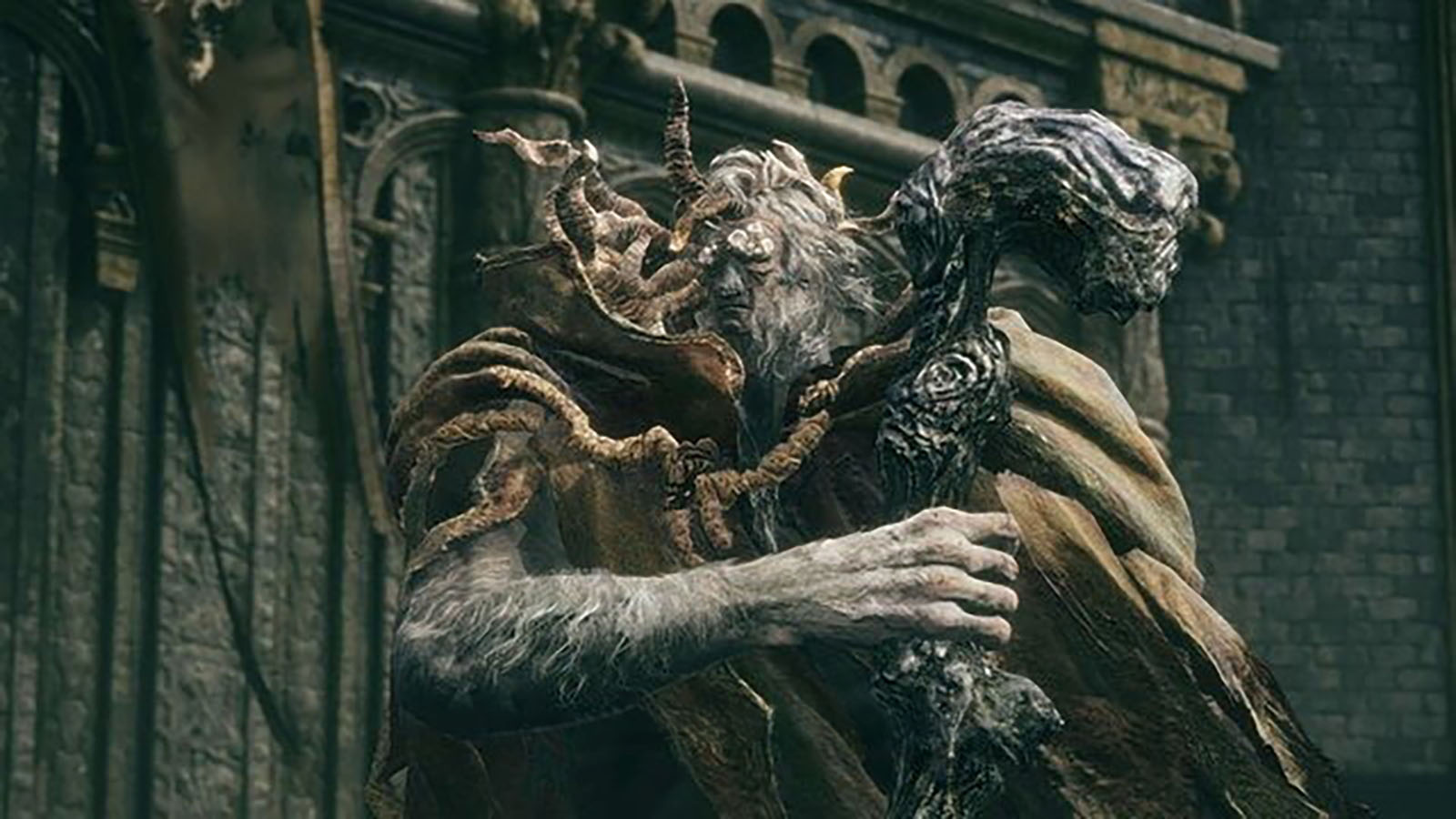
Rune.07: Morgott the Omen King
 © FromSoftware
Introduction: The Sole Martyr in a Shattered World
In the history of The Lands Between, the demigods of divine bloodline, driven by their respective ambitions, despairs, or inescapable fates, led the world into the irreversible chaos known as The Shattering. After the Elden Ring was shattered and the mother, Queen Marika the Eternal, was imprisoned within the Erdtree, the once-absolute order of the Golden Order collapsed. As revealed by the terrifying truth discovered by Sir Gideon Ofnir, the All-Knowing, after his long dialogue with the Two Fingers—that “everything was broken long ago”—the world was already at a stage beyond repair.
However, in that era of madness and nihilism, there was one being who alone tried to hold the world back from the brink of collapse. That was the “Veiled Monarch” of Leyndell, Royal Capital, and “Morgott the Omen King,” who kept his true form hidden deep underground.
This article is a character analysis report that elucidates the full picture of Morgott, a character with the most bizarre, tragic, and yet sublime psychological structure, through a multifaceted analysis of the world setting and character psychology. He loved more deeply than anyone else the very system of the Golden Order that ostracized him as “defiled” and persecuted his very existence, reigning as its absolute defender. This contradictory way of life cannot be contained within the mere framework of loyalty or fanaticism; it is underpinned by an ontological “unrequited love” and “ressentiment,” as well as an extremely cold and clear understanding of the world’s truth. This report will comprehensively and thoroughly delve into the peculiarities inherent in his origins, his political and military role during The Shattering, the conflict of love and hate in his deep psychology, and the philosophical themes he presents to the story as a whole.
1. Lineage and Curse (Blessing): The Golden Bloodline and the Original Sin of the Crucible
1.1 The Golden Lineage and the Gruesome Birth as an “Omen”
Morgott is one of the twin demigods born between Queen Marika and Godfrey, First Elden Lord (Hoarah Loux). He was born into an extremely noble bloodline that should have made him the legitimate successor of the “Golden Lineage” in both name and reality. However, because he and his twin brother, Mohg, were born into this world as innate “Omens,” their fates were decisively distorted.
In The Lands Between ruled by the Golden Order, an Omen was the embodiment of a heinous “curse.” Features such as grotesque horns growing haphazardly from the body, hypertrophied flesh, and tails were considered physical blasphemies against the strict order of the Erdtree. Omens born to commoners suffer a gruesome fate where their horns are excised from the roots in childhood. This excision of horns often involves massive bleeding and infection, leading to the death of the children. Even the souls of those who survived were placed in a state of religious severance, eternally denied Erdtree burial, as seen in the “Seedbed Curse” by the Dung Eater.
On the other hand, Omens born to royalty, while spared the excision of their horns, had their very existence thoroughly erased as a “disgrace to the royal family.” From childhood, Morgott and Mohg were imprisoned deep underground in the “Subterranean Shunning-Grounds” beneath the royal capital, forced to live in a place where light would never reach, bound by heavy shackles (remnants of which can be seen in items like Margit’s Shackle). The poignant voice engraved in the item text of the Omen Bairn, “Please, don’t hate me. Don’t curse me. Please,” vividly illustrates the childhood trauma and profound isolation in which Morgott formed his sense of self.
1.2 Exposure of Historical Truth: The Grudge of the Hornsent and the True Nature of the “Curse”
The grotesque symbol of “horns” that Morgott bore reveals a horizon of meaning entirely different from the Golden Order when unraveling the history of the world. In the era of the “Crucible,” before the Erdtree covered the world with a single law, when life was undifferentiated and blended together, possessing traces of multiple creatures such as horns, tails, and feathers was rather considered a “divine blessing” closely related to the primordial power of life.
Particularly in the culture of the Hornsent, which was later concealed in the Realm of Shadow, horns were spiritual antennas for communing with the divine and objects of absolute worship. However, in the process of Marika establishing her Golden Order, the diversity of life possessed by the Crucible was redefined as “defilement.” Considering deeper historical background, it is highly suggested that as retribution for the thorough oppression and purges (the holy war by Messmer the Impaler) Marika committed against the Hornsent in the past, the intense curse left by the Hornsent Grandam, “A curse upon the strumpet’s progeny, upon Marika’s children each and all,” manifested in Marika’s direct descendants as the “curse of the Omen.”
In other words, the “curse” embodied by Morgott is a rebellion against the order to be abhorred from the perspective of the Golden Order’s doctrine, but from a historical and biological perspective, it is a return of the “legitimate blessing” of the past world, and above all, the “visualization of the original sin of massacre” committed by his mother, Marika. His mere existence exposes the blood-stained truth of history that Marika’s Golden Order sought to conceal. Therefore, his existence could not be permitted, and he had to be sealed away from the sunlit surface into the darkness of the Subterranean Shunning-Grounds. This structural destiny—that “being born itself is proof of the mother’s sin”—instilled immeasurable self-hatred and a twisted love within Morgott’s inner self.
2. Historical Role and Major Actions: Defender of The Shattering and Hunter of the Night
After the Elden Ring was shattered and Marika became imprisoned within the Erdtree, the demigods triggered The Shattering, washing each other in blood in pursuit of the power of the Great Rune shards. In this unprecedented war, the historical role Morgott played was not that of an invader seeking territory or power, but the “absolute defender” who defended Leyndell, Royal Capital to the death.
2.1 Ruling Leyndell as “The Grace-Given” and the Grand Fiction
While his siblings scattered to their respective territories and sank into madness driven by self-interest and ambition, Morgott remained alone in Leyndell, Royal Capital, continuing to guard the Elden Throne devoid of its lord. He kept his true form as an Omen strictly hidden in secret and ruled the royal capital using the title “The Grace-Given (Veiled Monarch).”
This is extremely ironic for him, and at the same time, a ruling structure that proves his high intelligence. The reason he was able to receive the love and respect of the populace and nobles and maintain a robust defense system was none other than his flawless performance of the grand fiction that he was the “legitimate ruler blessed by gold.” The nobles and subjects of the royal capital never dreamed that the great king who protected them was the very “Omen” they abhorred and supposedly sealed underground. In the game, the depiction of a noble NPC who seemingly learned Morgott’s true form screaming “kingly impostor” and dying while vomiting blood suggests just how thoroughly and ruthlessly he enforced purges and secrecy to conceal his true identity. To protect the royal capital, he did not hesitate to stain his own hands with blood or even falsify his very existence.
2.2 The Alter Ego “Margit, the Fell Omen” and the Defense of the Royal Capital
While outwardly reigning as the mysterious Veiled Monarch, Morgott employed another persona (a pseudonym) as an alter ego or phantom: “Margit, the Fell Omen.” He entrusted the barbaric frontline command and the elimination of hostile forces—tasks that could not sully the hands of The Grace-Given—to this mad dog persona of Margit.
According to historical records, during the Second Defense of Leyndell that occurred during The Shattering, Margit made his name resound across the battlefield by slaughtering countless heroes and piling their corpses like mountains. He excelled in the magical power to project his own image, making phantoms appear everywhere in The Lands Between, such as on the way to Stormveil Castle and the battlefields of the Altus Plateau. Sometimes, he even hijacked the bodies of wandering Commoners to stand in the way of the Tarnished, attempting to thwart their journeys.
2.3 Commanding the “Night’s Cavalry” and the Eradication of Ambition
Furthermore, Morgott personally commanded an elite unit known as the “Night’s Cavalry” under the name of Margit. Clad in pitch-black armor and riding funeral steeds, these knights patrolled the highways under the cover of night, relentlessly hunting down Tarnished aiming to become Elden Lord and ambitious heroes. The armor text of the Night’s Cavalry notes that they “were once led by the Fell Omen and delivered death to great warriors, knights, and champions,” revealing that they were the agents of Morgott’s reign of terror.
The reason Morgott so fiercely hated and sought to eradicate the “flame of ambition” harbored by the Tarnished was that it was the very will to destroy the current order (the Golden Order he loved so dearly) and rewrite it into a new order. He despised the Tarnished, calling them “Pillagers.”
2.4 Merciless Condemnation of Rebellious Kin
During The Shattering, Morgott showed absolutely no compromise toward the other demigods. To him, the moment they moved their armies aiming for the throne of the Erdtree, they were equally “traitors,” even if they were blood relatives. During the decisive battle before the throne of the royal capital, he gazes at the thrones of his siblings that once lined the area around the Elden Throne, condemning each of them by name.
The following table summarizes the actions of the other major demigods during The Shattering and Morgott’s perspective and psychological evaluation of them.
| Character Name | Title / Background | Major Actions and Status in The Shattering | Morgott’s Appellation and Reason for Condemnation |
|---|---|---|---|
| Godrick | Descendant of the Golden Lineage | Fled to Stormveil and obsessed with self-enhancement of the weak through grafting. | ”Godrick the Golden” An ironic appellation. Bitter contempt for disgracing the pride of his blood despite being of the Golden Lineage, and falling to the hideous means of grafting. |
| Miquella and Malenia | Children of Marika and Radagon | Abandoned the Golden Order and created their own “Haligtree.” Malenia caused a gruesome war with Radahn. | ”The twin prodigies, Miquella and Malenia” While acknowledging their talents, he brands them as heretics for departing from the Erdtree, the one and only object of faith, and attempting to forge a new order. |
| Radahn | Child of Rennala and Radagon | The strongest general who shattered the stars and manipulates gravity. Once attempted an invasion of Leyndell, Royal Capital. | ”General Radahn” No matter how much he boasts of his martial prowess as the strongest warrior, the moment he directed his ambition toward the throne of the Erdtree with military force, he became just another pillager to be destroyed. |
| Rykard | Child of Rennala and Radagon | Set up camp at Mt. Gelmir and declared clear rebellion against the Erdtree. Let himself be devoured by the God-Devouring Serpent. | ”Praetor Rykard” Anger at the fact that a former Praetor, a maintainer of order, transformed into the most unforgivable blasphemer attempting to devour the very foundation of the Golden Order. |
| Ranni | Child of Rennala and Radagon | Stole the Rune of Death and slew her own Empyrean flesh. Maneuvered in the shadows aiming for the Age of Stars. | ”Lunar Princess Ranni” Deep hatred for her flight from her fate, having caused the “Night of the Black Knives” and being the root cause of all the tragedies of The Shattering. |
“Wilful traitors, all. Thy kind are all of a piece. Pillagers. Emboldened by the flame of ambition.” To him, his siblings who wielded the power of the Great Runes for their own desires were no longer family, but mere pests threatening his beloved Erdtree.
3. Inner Mind and Conflict (Love, Hate, and Conviction): The Pinnacle of Unrequited Love and Ressentiment
The most important aspect to emphasize when examining Morgott’s character from a literary and psychological standpoint is the extreme mental conflict he harbored. He completely understood the absurdity of his situation, and chose a path akin to “martyrdom” not out of madness or blind faith, but based on extremely rational judgment and philosophical resolve.
3.1 “He loved not in return” — Ultimate Self-Sacrifice and Unrequited Love
The decisive key to unraveling Morgott’s deep psychology is written in the text of the “Remembrance of the Omen King,” obtained from Enia the Finger Reader after defeating him.
“Though born one of the graceless Omen, Morgott took it upon himself to become the Erdtree’s protector. He loved not in return, for he was never loved, but nevertheless, love it he did.”
This is the pinnacle of the “Love Martyr” in literature, and the embodiment of extreme “Unrequited Love.” Normally, faith in a system, religion, or god is established in exchange for some form of salvation, grace, worldly benefits, or peace after death. Gideon and the other Tarnished aimed for the Erdtree because they desired the honor and power of the Elden Lord. However, the Golden Order provided absolutely no salvation for Morgott, an Omen. On the contrary, it treated his very existence as a flaw in the system and buried him alive at the bottom of the sunless sewers. Yet still, he believed in the beauty and order of the very system (the Golden Order and the Erdtree) that imprisoned, cursed, and continuously denied him, and he devoted his entire life to protecting it. This devotion is pure because it seeks no reward, and at the same time, it is overwhelmingly heartbreaking.
3.2 Self-Hatred and the Sealing of Cursed Blood
Morgott’s profound tragedy lies in the fact that, alongside his love for the Golden Order, he harbors an intense “self-hatred” toward his own essence as an Omen. He fiercely hated the Omen blood flowing in his own body as a defilement, and continued to seal it within his beloved sword so that it would never be exposed. The staff he wields in times of peace is actually a sword containing his own sealed blood, disguised with the motif of the Erdtree. Furthermore, the countless weapons (great hammers, longswords, spears, daggers) he summons with magic during combat are all symbols of warriors who served the Golden Order (such as the Giant-Crusher and the Carian Knight’s Sword), showing that he thoroughly tried to act as a “golden warrior.”
However, in the second phase of the final battle with the player, driven into a corner, he is finally forced to unleash the power of the cursed blood dwelling in his body. At that moment, he cries out in a heartbreaking, blood-spitting voice:
“The thrones… stained by my curse… Such shame I cannot bear. Thy part in this shall not be forgiven.”
The very act of exercising his true power defiles the sanctuary and thrones of the Erdtree he loves so dearly. The intense hatred and ressentiment toward the Tarnished who forced him to face this desperate dilemma are condensed in this line. Because he knew that the “source of his strength” (the curse of the Crucible) and his “spiritual belonging” (the Golden Order) would never intersect, he despised himself more deeply than anyone else.
3.3 Twin Mirrors: Adaptation and Rebellion Against Fate
To understand Morgott’s inner mind, a comparison with his twin brother, “Mohg, Lord of Blood,” is indispensable. The two, who bore the same curse and were cast underground, walked completely opposite paths regarding the theme of “how to face the curse (fate) one is born with.”
The following table compares the answers the twin demigods derived for their respective destinies.
| Comparison Element | Morgott the Omen King | Mohg, Lord of Blood | Analytical Significance |
|---|---|---|---|
| Interpretation of their own blood (curse) | Thorough denial, concealment, and self-hatred. Sealed the curse within his staff. | Fanatical affirmation and liberation. Embraced the curse as the grace of the “Formless Mother.” | The ultimate contrast between self-denial (Morgott) and self-acceptance (Mohg). |
| Attitude toward authority and world order | Blind and devoted absolute submission to the existing Golden Order. A defender of the status quo. | Destruction of the existing order. A revolutionary attempting to establish his own new dynasty as the consort of a new god (Miquella). | The difference in political stance: submission to the oppressor versus overthrowing the oppressive structure itself. |
| Object and nature of love | ”Unrequited love seeking no reward (Love Martyr)” toward the Erdtree and his family. | ”Mad, one-sided, possessive love (Mad Love)” toward Miquella. | Both loves ultimately share the tragic commonality of being “Unrequited.” |
By reinterpreting his “curse” as a “blessing,” Mohg attained spiritual liberation. Ethically and morally, Mohg’s actions (colluding with an Outer God and kidnapping Miquella) are full of madness, but from an existential standpoint of liberating himself from the spell of fate, he could be called innovative. In contrast, Morgott internalized the cruel rule set by the world that “you are cursed (defiled)” exactly as it was. He did not resist the curse, but chose the harshest, thorn-filled path of becoming the “sublime defender” who protects the system that denied him, while remaining in his cursed body. This diametric contrast further highlights the abnormality of Morgott’s self-sacrifice and the sublimity of his spirit.
3.4 The Ultimate Nihilistic Realization: “We are all forsaken”
What symbolizes Morgott’s extraordinary intelligence and the depth of his despair is that he had reached the “truth of the Erdtree” earlier than anyone else. When defeated, at the brink of death, he thrusts an extremely cold fact at the victorious Tarnished.
“Tarnished, thou’rt but a fool. The Erdtree wards off all who deign approach. We are… we are all forsaken. None may claim the title of Elden Lord.”
This line imparts a fundamental and existential tragedy to Morgott’s behavioral principles. He knew from the beginning that no matter how many bloody defensive battles he waged before the gates of the throne, as long as he was an Omen, he would absolutely never be allowed to enter the gates. Furthermore, he understood that no one (whether an ambition-burning Tarnished or other demigods once called heroes) would ever overcome the Erdtree’s rejecting thorns and be accepted by god. In other words, the “defense of the royal capital” he conducted was not for victory or glory, but a thorough maintenance of the status quo to “yield the throne to no one”—that is, nothing but the repetition of endless “futile effort.” He consciously continued to play the watchdog of a system that had broken down long ago, one that would never reward him. Here lies the abyss of his deep love, akin to madness.
4. Philosophical and Thematic Significance: The End of Eternity and the Existential Defender
The philosophical theme flowing at the foundation of the story of Elden Ring is the conflict between “eternity (order)” and “change (chaos),” and the denunciation of the structural violence of “blessing and exclusion.” In this vast mythological context, the way of life of the character Morgott functions powerfully as a thematic antithesis of the story.
4.1 Internalized Oppression and Ultimate Existential Freedom
From a philosophical perspective, Morgott’s state of being presents two different, yet intersecting interpretations.
The first interpretation is as the ultimate tragedy in power structures and ideology: “the oppressed internalizes the system that oppresses them, transforming into the most staunch defender of the establishment.” He thoroughly denied his own identity as an “Omen” and absolutized the values of the establishment (the Golden Order) as his own. This is a complete victory of structural violence in sociology, and can be said to be a kind of Stockholm syndrome, or the ultimate form of self-denial. He was the most distorted and tragic product spawned by the system.
However, as a second interpretation, there exists an “existentialist” perspective that resonates with Albert Camus’s The Myth of Sisyphus. In a nihilistic world where he realized that absolutely no divine salvation (grace) exists and the doors of the Erdtree are firmly shut, sticking to one’s own beliefs (love) without seeking reward is the greatest rebellion against god and fate, and the proof of absolute freedom. The reason he continued to swing his sword while clearly recognizing that “we are all forsaken” was by no means because he was a blind slave to the system. He saw everything. And upon that, by his own will, he chose the self-definition of “the last king to protect the Erdtree,” burning his life to martyr himself for it. In him, fatalism and free will are miraculously fused.
4.2 The Phantom of Father Godfrey and the Metaphor of the “Last King”
In Morgott’s psychology, the existence of his father, Godfrey, First Elden Lord (Hoarah Loux), was an absolute guiding principle alongside the Erdtree. For him, who was sealed in the Subterranean Shunning-Grounds and grew up without knowing parental love, the great father who reigned as the warrior king must have been his sole pride and object of admiration. The heartbreaking dignity with which Morgott summarizes his own life at the brink of death, declaring, “Have it writ upon thy meagre grave: Felled by King Morgott! Last of all kings,” contains an intense pride in the royal bloodline and a stubborn determination not to let the era built by his father end.
His referring to himself as the “last king” is not mere arrogance or megalomania. It is an expression of his cold realization of the historical turning point: that Marika’s Golden Order, which touted “immutability and eternity,” had effectively collapsed, and if he fell, it would never return to how it was. Only as long as he continued to defend Leyndell, Royal Capital, was the fleeting phantom that “the golden age still continues” barely maintained. The moment he fell before the Tarnished, the door to the old era of the Golden Order was completely closed, and the world transitioned into an irreversible process to accept a new order (change) and Destined Death. His own defeat and death became the final trigger that confirmed the end of the “eternity” he loved.
Conclusion: The Noblest King of a Forsaken World
Morgott’s life, from the moment of his birth to the brink of his final death, was spent in thorough isolation and unreasonable rejection. He was shunned by his mother, Queen Marika, as a curse that reminded her of her original sin, and cast away underground; he was cut off from the history of the world as a heresy that must not exist. And even the Erdtree itself, which he loved with all his life and protected at the risk of his own body, never once opened its doors for him.
However, amidst that overwhelming, suffocating tragedy, Morgott’s spirit was more solitary and filled with a transparent nobility than any other demigod. While his other blood relatives were swallowed by their own desires, madness, the temptations of Outer Gods, or the fear of their own fates, losing themselves one after another and falling into hideous monsters, he alone took upon himself the “duty and love as a king,” continued to stand on the front lines of a desperate defensive war, and never turned his back on that lordless throne until the very end.
When the Tarnished reaches the Erdtree and Leyndell has become the Ashen Capital, Morgott’s body, returning to the light, is quietly held in the arms of his father Godfrey (Hoarah Loux), who has returned from his long exile. Godfrey mourns his son’s remains for the first time as a father and as a king, saying, “You fought well, Morgott.” This single moment, when the Omen who was never loved by anyone in life finally receives recognition as a warrior from his father at the end of the world when the Erdtree burns down, can be said to be the sole and supreme literary salvation for his gruesome life.
“He loved not in return, for he was never loved, but nevertheless, love it he did.”
His proof of existence, which is entirely encapsulated in this single sentence, is a miraculous literary pinnacle in the extremely cruel and violent world depicted in Elden Ring. In a shattered world where divine grace was lost long ago and everyone burns with the fire of ambition and pillage, the way of life of the “Omen King,” who martyred himself alone for unrequited duty and love, can be concluded to be the last, most sorrowful, and beautiful radiance born from the remnants of the Golden Order. He was born into darkness as a “graceless Omen,” but in his sublime spirituality and self-sacrifice alone, he embodied the true vessel more worthy of being “Elden Lord” than anyone else in the history of The Lands Between.
Cosmology of Shattering and Gold: Elden Ring: 11 Meditations on the Lands Between and Mythology
The book version is now available. Read for free with Kindle Unlimited.
Thank you very much for reading to the end. To help support the activities of this archive, a warm donation of a cup of coffee would be highly appreciated.