Rune.11: Maliketh, the Black Blade
 © FromSoftware
Introduction: The Embodiment of Absolute Might and Primordial Sorrow
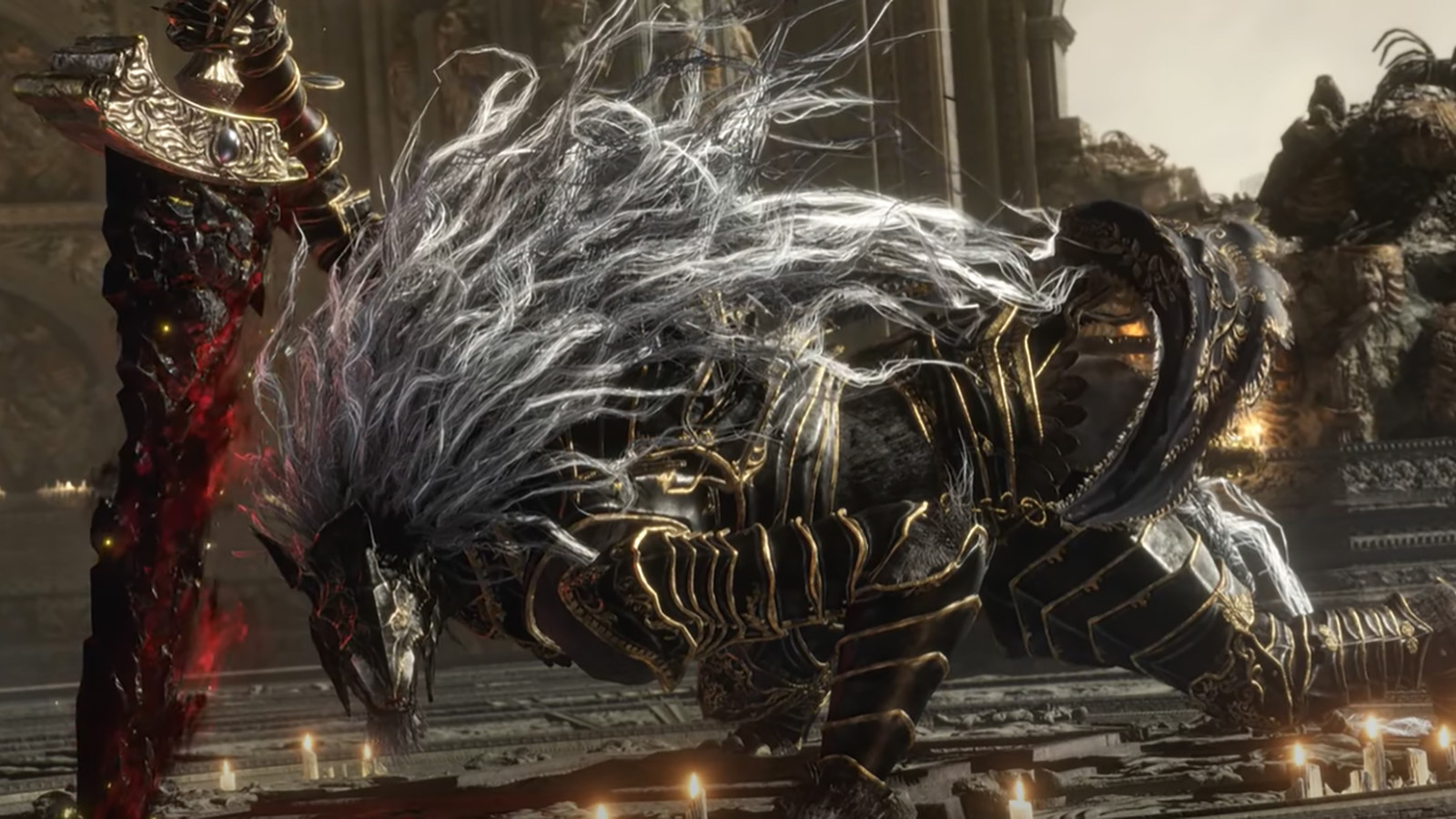
In the mythological framework of Elden Ring presented by FromSoftware, the history of the establishment and collapse of the “Golden Order”—the very foundation of the laws governing the world—is inextricably linked to the bizarre fate of a single beast. “Maliketh, the Black Blade”—he is the most loyal Shadowbound Beast of Queen Marika the Eternal, who rules over The Lands Between, and the mightiest warrior harboring “Destined Death” within his own body, a power feared even by the gods.
However, defining Maliketh merely as a “mighty warrior” or a “symbol of terror” on the grand stage of history is an exceedingly superficial understanding. The true image of him that emerges from scrutinizing scattered item descriptions, fragmented dialogue, and historical traces is that of a deeply tragic and sorrowful “stepbrother” whose mind was torn between absolute loyalty and betrayal, and who continuously suffered from an endless hunger for atonement.
This article, from a perspective specializing in the analysis of lore and character psychology, focuses entirely on the singular entity known as “Maliketh, the Black Blade.” Based on textual evidence, it conducts a comprehensive and exhaustive examination of his origins, his military and historical roles, the grueling psychological conflicts during his life in seclusion, and the philosophical and thematic significance he embodies within the narrative as a whole.
1. Origins and Curse (Blessing)—The Fate of a Shadowbound Beast
1.1 The Mechanism of the “Shadow” Granted to an Empyrean
At the core of Maliketh’s identity lies the fact that he was created as a “Shadowbound Beast.” In the age of myth, the “Two Fingers,” agents of The Greater Will, bestowed upon an “Empyrean”—one qualified to become a god of the coming age—a special beast to serve as both a companion and an overseer.
This system of the shadow possesses a duality: it is a “great blessing” to the Empyrean, yet simultaneously an “absolute curse.” The psychological structure of a shadow is designed to harbor absolute loyalty to their master, the Empyrean, to the point of willing self-sacrifice. On the other hand, however, they are also placed under the control of the Two Fingers. Should their master ever rebel against the Two Fingers or The Greater Will, the shadows are programmed to forcibly transform into “assassins” who will murder their master, regardless of their own will.
Interestingly, there is a theory that later Empyreans, such as Miquella and Malenia, were not granted their own specific shadows. It is speculated that this was because they each bore their own unique curses—eternal childhood and rot, respectively—or because the influence of the Two Fingers had waned. This fact suggests that the relationship between Marika and Maliketh was the epitome of an exceptionally strong and classical “covenant between an Empyrean and a shadow” during the dawn of the Erdtree regime.
1.2 Love and Familial Bonds as a “Half-Brother”
Indispensable to a profound understanding of Maliketh’s tragedy is the fact that the relationship between Marika and Maliketh was not merely that of “master and servant,” but of “family.” The term “half-brother” in the English text is written as “義弟 (gitei)” in the original Japanese source. This vocabulary of “gitei” does not necessarily indicate a blood tie; rather, it signifies a familial relationship bound by a vow, or a deep affection where one without blood ties acts as a younger brother. This perfectly aligns with the structure wherein Blaidd the Half-Wolf, who is also a shadow, is treated as the “stepbrother” of Ranni the Witch.
To Maliketh, Marika was both a liege to be served and a beloved older sister. It is surmised that at the root of his motivation to undertake the grueling missions described later and to bear every dirty role in history lay a pure “familial love” as an individual beast, transcending the programming of the Two Fingers. This is precisely why, when that bond was later shattered by betrayal, the psychological damage he suffered was immeasurable.
2. Historical Roles and Major Actions—From God-Slaying to the Great Seclusion
The footprints Maliketh left on the history of The Lands Between are directly involved in two singularities: the establishment and the collapse of the Golden Order. His historical roles can be broadly divided into the following three phases.
2.1 The Holy Wars of the Dawn and the Command of the Black Knights
In the path of conquest (holy wars) for Marika to reign as a god, it is highly likely that Maliketh functioned not merely as an individual assassin, but as a leading general commanding a large-scale army. Traces of this can be read from the records of Messmer the Impaler’s crusade in the Realm of Shadow.
The armor of the “Black Knights” who form the core of Messmer’s army (a design featuring black iron adorned with gold) is extremely similar to Maliketh’s armor, or perhaps made to the same specifications. Because the Black Knights use incantations of the ancient Erdtree and the Crucible rather than Messmer’s fire incantations, it is evident that they were a veteran elite unit existing since the era before Messmer, namely the dawn of the Erdtree. These coincidences establish the deduction that Maliketh was once the supreme commander of this legion of Black Knights, directing the most fierce frontlines in Marika’s holy wars against the fire of the giants, the Storm Lord, and the old gods. It is believed that when Maliketh later took on the secluded mission of guarding the Rune of Death, the Black Knights who were his subordinates came under Messmer’s command and were dispatched to the Realm of Shadow.
2.2 The Defeat of the Gloam-Eyed Queen and the Completion of the “Golden Order”
The most decisive military achievement in Maliketh’s life was the defeat of the “Gloam-Eyed Queen.” The Gloam-Eyed Queen was also an Empyrean chosen by the Two Fingers, a formidable power who wielded the “black flame” capable of killing gods and led the Godskin Apostles.
To establish Marika’s reign (the Golden Order), it was necessary to eliminate the concept of “death,” which threatened the immortality of the gods, from the world. By Marika’s command, Maliketh clashed with the Gloam-Eyed Queen and splendidly defeated her. The description of the “Godslayer’s Greatsword” clearly records it as the “Sacred sword of the Gloam-Eyed Queen who controlled the Godskin Apostles before her defeat at the hands of Maliketh.” Through this victory, the Gloam-Eyed Queen’s power was stripped away, and Maliketh sealed the “Destined Death” she governed within his own black blade. The very moment death was removed from the world marked the true dawn of the completion of the “Golden Order,” an absolute order in which life circulates eternally. At this point, Maliketh was elevated from a mere general to the “vessel of death’s seal,” bearing the foundation of the Golden Order itself.
2.3 Night of the Black Knives: The Theft of Death and the Blasphemous Claw
However, the seemingly impregnable seal of death was broken by the historical event known as the “Night of the Black Knives.” A fragment of the Rune of Death was stolen, and Godwyn the Golden was murdered by the Black Knife Assassins. This incident triggered The Shattering and signified the de facto collapse of the Golden Order.
Behind this historical event lay a meticulous political conspiracy that was extremely wary of Maliketh’s existence. Ranni the Witch, the mastermind who stole Destined Death, had given a rock fragment called the “Blasphemous Claw” to Praetor Rykard as a reward on the Night of the Black Knives. This rock fragment was engraved with traces of the Rune of Death and possessed the special effect of deflecting (parrying) the power of the Black Blade. “As a last resort in the coming time of blasphemy, to challenge Maliketh, the Black Blade, the black beast who is Destined Death.” This fact illustrates that Demigods like Ranni and Rykard recognized that the greatest obstacle to executing their conspiracy was not Marika herself, but the “black beast Maliketh,” and that they feared his combat prowess so much that they had to develop and prepare a dedicated weapon to counter him in advance.
| Figure | Actions of Each Faction During the Night of the Black Knives and Maliketh’s Position |
|---|---|
| Ranni the Witch | Stole the Rune of Death and completed the assassination. Entrusted the countermeasure against Maliketh (Blasphemous Claw) to Rykard. |
| Praetor Rykard | Received the Blasphemous Claw. Prepared for a future direct confrontation with Maliketh (the time of blasphemy). |
| Black Knife Assassins | Imbued their daggers with the stolen fragment of Death and assassinated Godwyn. |
| Maliketh | Failed to defend the seal. Thereafter, bound the remaining Rune of Death within his own flesh. |
2.4 Seclusion in Farum Azula and the Seal Within His Own Flesh
The fact that a fragment of Death was stolen was a bitter failure for Maliketh, the guardian of the Golden Order’s absoluteness, shaking the very foundation of his reason for existence. The description of “Maliketh’s Black Blade” records the grueling measures taken thereafter.
“After a fragment of Death was stolen on that fateful night, Maliketh bound the blade within his own flesh, such that none might ever rob Death again.”
The act of tearing his own flesh and binding the cursed Rune of Death within his body is accompanied by unimaginable physical agony and psychological burden. To ensure he would never repeat the same mistake, he turned himself into a literal “living prison” and vanished into “Crumbling Farum Azula,” ruins that exist outside of time.
Furthermore, Farum Azula is not merely an uninhabited ruin. Beastmen with their own unique culture inhabit it, and the description of the “Beastman’s Cleaver” they wield notes, “It’s clear the beastmen possess knowledge beyond human ken.” Maliketh had taken refuge in the sanctuary of his intelligent brethren, the beastmen, and his life in seclusion can be interpreted not merely as an escape, but as having a ritualistic significance of returning to the origins of beasts.
3. Inner Mind and Conflict (Love, Hate, and Conviction)—Eternal Hunger and Shattered Loyalty
The most important subject of analysis in this study is the bottomless despair and feelings of love and hate hidden behind Maliketh’s strength. His inner mind is a labyrinth where “unconditional love for Marika,” “ressentiment toward the master who abandoned him,” and “a sense of duty to be fulfilled” are complexly intertwined.
3.1 The Truth of Marika’s “Betrayal” and Silent Acceptance
The text of the Remembrance of the Black Blade contains a sentence that is highly controversial within the lore of Elden Ring.
“Marika’s sole need of her shadow was a vessel to lock away Destined Death. Even then, she betrayed him.”
Regarding the specific nature of this “betrayal,” several prominent theories exist.
-
Theory of Involvement in the Night of the Black Knives: The theory that Marika herself conspired with Ranni, or under a tacit understanding, allowed the Rune of Death to be stolen from Maliketh. Even if Godwyn’s death was unexpected, for Marika, who was planning to defect from The Greater Will that desired eternity, the release of the Rune of Death was inevitable. If she ordered Maliketh to manage Death only to sabotage it herself, this constitutes an absolute betrayal.
-
Theory of the Shattering of the Elden Ring: Maliketh sealed Death to make the “Golden Order” eternal. However, Marika herself shattered that Golden Order (triggering The Shattering) and plunged the world into chaos. This is despair over his master selfishly destroying the order he had protected even at the cost of carving up his own flesh.
-
Theory of Guiding the Tarnished: The deduction that the ultimate betrayal was Marika guiding the Tarnished (through the guidance of grace) to reach Farum Azula, orchestrating them to kill Maliketh and unleash Destined Death.
However, what is truly important in examining Maliketh’s psychology is not “what kind of betrayal he suffered,” but his extraordinarily self-sacrificing spirit, in that “even while recognizing the fact that he was betrayed, he still loves her and voices an apology.” Upon his defeat in Farum Azula, he leaves these final words:
“Forgive me Marika, the Golden Order cannot be restored”
Even after being confronted with the reality that “her sole need of him was to use him as a vessel for Death” and being literally abandoned, he could not discard his affection as a half-brother and his sense of duty as a shadow. His inner mind was eternally torn between the anger (ressentiment) of having his reason for existence denied, and the pure love that still worried for his master and blamed his own inadequacy.
3.2 Gurranq, Beast Clergyman: Madness and the Hunger for Atonement
The activities of Maliketh’s other face, “Gurranq, Beast Clergyman,” most vividly express his internal collapse. He hides in the “Bestial Sanctum” and has the Tarnished collect “Deathroot.” Deathroot is the end result of the “fragments of the Rune of Death” that have encroached throughout The Lands Between via the roots of the underground Erdtree since the Night of the Black Knives.
Gurranq devours the Deathroot, but his hunger is never satiated.
”…I smell it… Death… Feed it me…”
This starvation is not merely the physical appetite of a beast. It is an obsessive ritual of atonement for the irrevocable failure of having “the Rune of Death stolen.” When given four Deathroots, he becomes unable to endure it and attacks in a frenzy, but upon regaining his sanity during the battle, he groans as follows:
“My sin… my appetite…”
What he is truly hungry for is “forgiveness from Marika.” It is an unfulfillable delusion that if he can just stomach all the stolen Death, Marika might once again acknowledge him as the perfect vessel of Death’s seal. The fact that he pleaded for the Tarnished’s cooperation, even going so far as to grant them bestial incantations and the “Beastclaw Greathammer,” is proof that his mind could no longer bear the crushing weight of loneliness and guilt.
| Progress | Psychological Transformation of Gurranq (Maliketh) as Deathroot Delivery Progresses |
|---|---|
| 1st–3rd Delivery | The pure craving of a beast. Agrees to the trade, saying “Feed it me” and offering “Eye and claw.” |
| 4th Delivery (Frenzy) | Unable to withstand the accumulating power of Death and remorse, he goes berserk. After being subdued, he confesses his deep-seated guilt: “My sin… my appetite…“ |
| 5th–8th Delivery | Continues to seek Death while gasping in agony. A state completely dominated by the obsession for atonement. |
| 9th Delivery (Completion) | Realizes his hunger will never be satiated. Expresses gratitude and bids farewell to his collaborator, the Tarnished, and vanishes, leaving behind a sorrowful howl. |
3.3 Paranoia and Bottomless Sorrow Revealed by Unused Audio
Unused in-game audio files (cut content) discovered through datamining record more vivid remnants of the psychological conflict Maliketh faced.
“O Marika… What…happened? Was I…myself the fool? Or was I tricked…by thee? O Marika… Why wouldst thou…relinquish… Why…”
Although these lines were not implemented in the final game, this text is a first-rate historical document that corroborates the character’s initial design and deep psychology. This dialogue indicates that Maliketh was by no means a “blind servant.” Because of his own superior intellect (the “knowledge beyond human ken” possessed by beastmen), he had faintly realized Marika’s intentional betrayal. Even while recognizing the possibility that he had been deceived and discarded as obsolete, his innate binding as a shadow and his love as a half-brother refused to face that reality directly. More than the fact of being deceived, it was the tremendous sense of loss over “why she had relinquished him (and the order he protected)” that shaped his eternal solitude in Farum Azula.
3.4 Confrontation with a Friend and the Resolve as “Marika’s Black Blade”
When the player (the Tarnished) completes Gurranq’s questline, handing over all the Deathroot, and enters the battle with Maliketh in Farum Azula, a dramatic change occurs in his dialogue and tone of voice.
Normally, he acts as a ruthless watchdog against intruders, but when the questline is completed, he is astounded to realize that the one standing before him is the “friend (the Tarnished)” who had quelled his madness.
“Tarnished… why wouldst thou…”
The Tarnished, his sole understander and collaborator, following Marika’s intentions, now stands in his way to completely strip “Destined Death” from within him. Betrayed by his sister, and betrayed by his only friend. It is the moment he is confronted with just how unwanted and utterly isolated his existence is. However, he stifles his sorrow here. Upon transitioning to his second phase, he does not introduce himself as the usual “Maliketh the Black Blade,” but instead declares:
“Cower before Maliketh, Marika’s Black Blade.”
The addition of this single word, “Marika’s,” is extremely significant. For the sake of the already collapsed Golden Order of the master who discarded him as unnecessary, he dares to re-declare himself as “Marika’s Blade.” It is nothing less than the pinnacle of self-sacrifice—swallowing every betrayal and dedicating his entire life and death to his sister—and a maddening declaration of his will to martyrdom.
4. Philosophical and Thematic Significance—The Eternal Victim and Liberation from Fate
Maliketh’s way of life and his death embody, in the most condensed form, the profound philosophical themes that Elden Ring presents throughout its entire narrative.
4.1 The Antithesis of “Eternity and Change”
The ideology forming the foundation of the Golden Order was “eternity.” By removing Destined Death, the gods and the world were supposed to enjoy eternal prosperity. By sealing that Death entirely within himself, Maliketh became the “cornerstone supporting eternity.” However, an eternity that excludes death (change and an end) inevitably invites “stagnation and corruption.” The rampant spread of Those Who Live in Death and the unending war of the Demigods who fell into madness are the ultimate fate of a world that rejected change.
Maliketh himself was also the greatest victim of this “curse of eternity.” Confined in Crumbling Farum Azula, which exists outside of time, he continued to hunger for the phantom of Deathroot in an eternal agony that neither advanced nor ended. The immutability of the Golden Order he sought to protect ultimately bound him to an eternal living hell. Maliketh’s existence functions as a powerful antithesis to the self-contradiction of the Golden Order, illustrating that “it is precisely because there is an end called death that life and spirit can properly circulate.”
4.2 The Embodiment of the Deception of “Blessing and Exclusion”
The history of the Golden Order is simultaneously a “history of exclusion.” Crucible Knights, Omen, and beastmen were ostracized as “impurities” as the Erdtree became more refined. Maliketh is a “beast.” Despite wielding overwhelming martial prowess as Marika’s shadow and playing an indispensable role in the establishment of the Golden Order, once he outlived his usefulness, he was forced into seclusion in the fringes of the world and outside of time. The Black Knights he supposedly led were also banished to the abhorrent Realm of Shadow. For Marika’s order, Maliketh’s bestial nature and martial might were “indispensable weapons,” yet simultaneously something to be concealed as a “barbaric past unsuited for a refined order.” While he was the greatest guardian of the regime, he was essentially also the most alienated “discriminated victim” who was merely used by it. This contradiction highlights just how deceitful a system the Golden Order truly was.
4.3 A Mirrored Tragedy: The Contrast Between Ranni and Blaidd
In the narrative structure, the relationship between Marika and Maliketh is intentionally depicted as a “mirror image (contrast structure)” to the relationship between Ranni the Witch and Blaidd the Half-Wolf.
-
Ranni and Blaidd: Ranni explicitly rebelled against The Greater Will (the Two Fingers). As a result, her shadow, Blaidd, was torn between the system (the assassination order from the Two Fingers) and his personal love (loyalty to Ranni), falling into a state of complete madness. Yet, even in his madness, he refused to harm Ranni.
-
Marika and Maliketh: Marika also shattered the Golden Order and brought ruin to the world. Maliketh, too, wore down his mind between his atonement for the stolen Death and the betrayal from Marika, suffering from a madness-filled hunger.
The decisive difference lies in the fact that while Blaidd’s tragedy was a “bug that destroyed obedience to the system out of love,” Maliketh’s tragedy was an “over-adaptation where, out of love, he attempted to excessively fulfill his role in the system (the sealing of Death) even after being betrayed.” Even in his madness, Maliketh never let go of his duty as “Marika’s Black Blade” until the very end. The deaths of these two shadows vividly contrast the powerlessness of creations at the mercy of Empyreans and the sorrow of a love that transcends programming.
4.4 Liberation from Fate and Rest
The player, the Tarnished, defeating Maliketh in the depths of Farum Azula and unleashing “Destined Death” upon the world is the greatest paradigm shift in the narrative. Through this, the Erdtree truly burns, making it possible to slay the immortal god and usher in a new order.
However, from the perspective of Maliketh as an individual, this defeat and death can be said to be the “only salvation” granted to him. “O Death… Become my blade, once more.” He, who bound the curse within his own flesh to hide Death from the world, is ultimately liberated from his eternal torment by none other than the power of that very “Death.” An endless hunger, an unrequited yearning for Marika, and an irrevocable sense of guilt. The wounded black beast, who could be healed by no one because he was far too mighty, was finally granted the peace known as an “end” by the blade of the Tarnished.
Conclusion
Maliketh, the Black Blade is not merely a symbolic existence as an obstructing boss character. He is a literary and historical symbol who embodies the “tragedy of love and betrayal,” the “curse named eternity,” and the “structure of the weak being used and consumed” inherent in the mythological framework of Elden Ring more deeply and fiercely than anyone else.
While offering unconditional love to his Empyrean sister, he was used as a convenient vessel for Death’s seal, struggling to meet those expectations even at the cost of tearing his own flesh. His grueling life is the very history of violence and oppression hidden behind the glorious splendor of the Golden Order, and his hunger and howls are the proxy for the screams of all creations forced into unreasonable fates by imperfect gods.
His poignant resolve that “none might ever rob Death again” did not stem from a heroic sense of justice to protect the world. It was the sorrowful self-defense of a deeply wounded beast who feared that his own heart (his loyalty and affection for his master) would be further defiled and destroyed. Maliketh’s death and the release of Destined Death are a physical rite of passage for the Tarnished to become the lord of the next age, and simultaneously, the sole and greatest “elegy” for a noble shadow who had been continuously crushed under the heavy burden of love and duty for thousands of years.
Cosmology of Shattering and Gold: Elden Ring: 11 Meditations on the Lands Between and Mythology
The book version is now available. Read for free with Kindle Unlimited.
Thank you very much for reading to the end. To help support the activities of this archive, a warm donation of a cup of coffee would be highly appreciated.