Rune.02: Marika and the Golden Order
 © FromSoftware
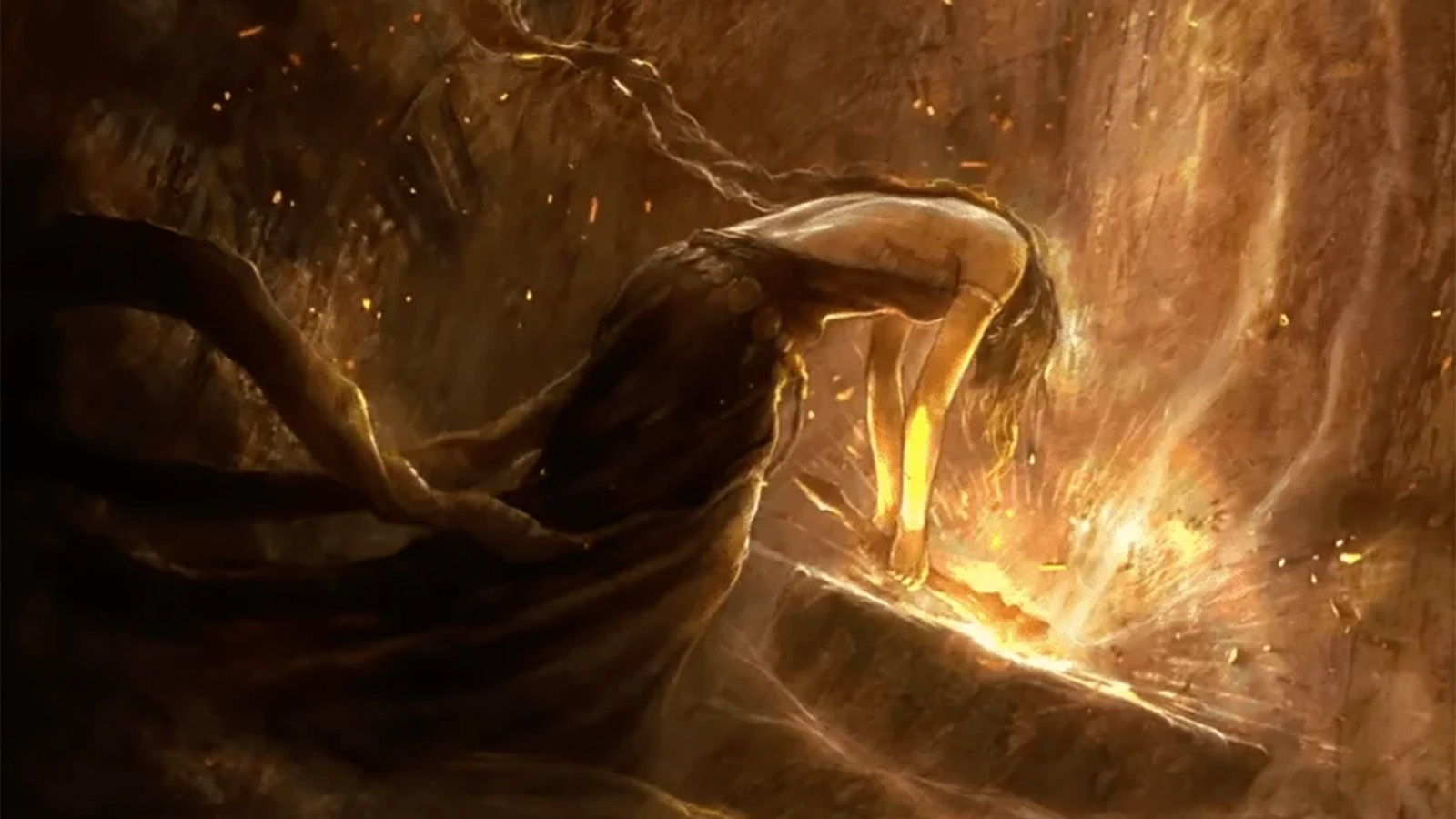
Queen Marika the Eternal. Having ruled The Lands Between for eons and imposed the absolute principle known as the “Golden Order” upon the world, this divine being has long been spoken of as an inviolable object of faith. However, with the discovery of historical relics and records in the Realm of Shadow, it has become clear that behind her deification lies a history of gruesome oppression, unspeakable trauma, and blood-stained betrayal. This report will systematically and comprehensively discuss how a single woman named Marika became an absolute god and ultimately shattered the world she herself created. It will explore the historical background and her deep-seated psychology (love, hate, and despair), strictly distinguishing between established facts (lore from item descriptions and the like) and compelling inferences (speculations) based upon them.
1. The Primordial Trauma: The Tragedy of the Shaman Village and the Fateful Ties with the Hornsent
At the foundation of the Golden Order lies not a noble philosophy or a thirst for cosmic order, but rather the inverse of a primordial and irreparable terror etched into Marika’s very soul. To understand her behavioral principles, the starting point of it all is the “Shaman Village” concealed within the Realm of Shadow, and the cultural structure of the “Hornsent” who ruled the land.
As a solid fact revealed through item descriptions, Marika hailed from the Shaman Village in the Realm of Shadow (or was a member of the group that called it home). The shamans were a peaceful minority living in harmony with nature, but their bodies possessed a peculiar biological property. The description of the “Tooth Whip” explicitly states that “the flesh of shamans was said to meld harmoniously with others.” This very trait of “melding with others” would bring upon them an unimaginable tragedy.
The Hornsent, who ruled the Realm of Shadow at the time, worshipped the “Crucible,” where all life was blended together. Based on this faith, the Hornsent Potentates conducted a fanatical religious ritual: they would chop up the flesh of sinners and beasts, stuff them into great jars, and fuse them into a single mass of flesh to create “good people (saints).” In this ritual, the shamans were targeted as the “glue” or “catalyst” to facilitate the fusion of the subject flesh. As a matter of fact, a phantom left in Bonny Village says, “For you shamans, there is no greater honor. To be stuffed in a jar, and become a saint.” Furthermore, it is specified that the “Tooth Whip” was not merely a striking weapon, but a gruesome torture device embedded with teeth rife with filthy disease, designed to infect victims with deadly poison and fester their wounds to make their flesh easier to melt.
A compelling inference drawn from these facts is the “extreme fear of death and transformation” at the root of Marika’s psychological structure. Marika was a victim who witnessed—or was constantly exposed to the terror of—her own kin (or family) being whipped alive, made to fester, and forced into cramped, dark jars alongside the flesh of others, their boundaries of ego and body forcibly dissolved. It is not hard to imagine that this trauma of being completely stripped of personal dignity and bodily autonomy became the psychological motive for her abnormal craving for “immutability” and “eternity” within the Golden Order later on.
1.1 Confession to Her Homeland and Prayers to the “Grandmother”
Even after acquiring the immense power of a god, the emotions Marika harbored toward her homeland were not those of a cold-hearted ruler, but of deep affection, an irretrievable sense of loss, and heavy guilt.
As a fact stated in the text of the incantation “Minor Erdtree,” it is written that “Marika bathed the village of her home in gold, knowing full well that there was no one to heal.” Furthermore, a severed “Golden Braid” is left behind in the Shaman Village, which is said to be an offering made by Queen Marika to the “Grandmother.” Its text explicitly states, “What she prayed for, wished for, and confessed, no one knows. Only that Marika never returned home again.”
Regarding the true identity of this “Grandmother,” there are speculations that it refers to the cosmic, metaphysical entity known as “The Greater Will,” and others that it refers to the headless statue (or the corpse itself) assimilated with a tree, located in the center of the Shaman Village. However, given that the decapitated statues found throughout the Realm of Shadow displaying the “O Mother” gesture perfectly match the grandmother statue in the Shaman Village, it is highly plausible from a geographical and emotional context to infer that this was a real grandmother (matriarch) who served as the leader or object of faith for the shamans.
An inference that can be drawn from this is that, even with the power of a god, Marika could not “heal” (restore) her kin who had already been turned into masses of flesh and lost within the jars, and in her complete sense of powerlessness, she bathed her homeland in gold. The act of cutting off and offering her “Golden Braid,” a symbol of herself, was a ritual of parting with her past self (Marika as a shaman). At the same time, as the word “confession” suggests, it can be analyzed as an expression of deep, agonizing atonement for the “betrayal” (discussed later) that she was forced to commit in the process of becoming a god.
2. The Gate of Divinity and the “Original Sin”: Seduction and Betrayal
How did Marika ascend from a merely persecuted shaman to a god ruling the world? The “Gate of Divinity,” towering at the summit of the tower settlement “Enir-Ilim” in the Realm of Shadow, was the stage for her deification, and simultaneously the greatest and most deeply concealed stain in the history of the Golden Order.
As an in-game fact, Enir-Ilim was the pinnacle of the Hornsent civilization, constructed as a spiral tower to reach godhood. And it can be clearly confirmed from the story trailer footage that the “Gate of Divinity” at its peak is formed by the fusion of countless petrified (or hardened and assimilated) bodies and mountains of corpses. Furthermore, the “Secret Rite Scroll” describes the secret rite of the divine gateway: “A lord will usher in a god’s return, and the lord’s soul will require a vessel.”
Based on compelling speculative logic, it is inferred that the countless fused bodies constituting this Gate of Divinity are the ultimate sorcerous construct, the result of shamans being consumed over many years as “flesh that melds harmoniously with others” through the great jar rituals. To construct a paranormal gate to summon a god (or birth one from among themselves), the Hornsent ground up and bound together the bodies of countless shamans as glue. Marika stood before that very gate made from the dead flesh of her kin, and raised the Elden Ring (or an amalgamation of golden runes) to the heavens to become a god.
2.1 Who Seduced, and Who Was Betrayed?
In the DLC story trailer, this event of deification is narrated as: “The seduction. And the betrayal. An affair from which Gold arose. And so too was Shadow born.” Also, as a matter of fact, the Hornsent Grandam calls Marika a “wanton strumpet,” directing unspeakably fierce hatred toward her. Furthermore, the remembrance of Messmer the Impaler notes that he was hidden away in the Realm of Shadow along with the “Original Sin.”
Synthesizing the community’s speculations on the historical background, Marika did not simply destroy the Hornsent by force alone to seize the Gate of Divinity. It is inferred that, despite being a victim, in order to achieve her goal (deification), she first “seduced” the influential figures of the Hornsent or the priestly class managing the gate, seeking political or physical collusion with them to gain access to the Gate of Divinity. The fact that the Hornsent Grandam calls her not merely a usurper but a “strumpet” likely refers to this ingratiation into the center of power and the decisive act of treachery that followed.
And the “betrayal” means that, instead of ushering in “their god” from the gate as the Hornsent demanded, Marika herself connected with The Greater Will (or Metyr, Mother of Fingers) at the last moment, becoming a god herself and establishing an entirely new principle (the Golden Order). She ascended to the seat of godhood by utilizing the gate made from the dead flesh of her own kin. The fact that, rather than immediately saving her kin who were being used by the Hornsent, she permitted and utilized their sacrifice as an “inevitable stepping stone to reach godhood” for the sake of her own cause and ambition. This very act is considered to be the “Original Sin” she was burdened with for eternity, and the true nature of the bleeding guilt that compelled her to offer her Golden Braid and confess in the Shaman Village.
| Event / Item Text | Established Fact | Emotional Background / Historical Insight |
|---|---|---|
| Visual Structure of the Gate of Divinity | A massive gate formed by the intertwining and fusion of countless bodies and corpses. | The madness of the Hornsent civilization that maximized the shaman trait of “flesh that melds harmoniously with others.” For Marika, it was the very gravestone of her clan. |
| Seduction and Betrayal | Mentioned in the story trailer. The Hornsent Grandam curses Marika as a “strumpet.” | Condemnation of Marika ingratiating herself with the Hornsent to gain their trust before usurping the deification ritual. Her departure from being a mere victim and her deeply karmic decision. |
| Original Sin | The fundamental original sin concealed in the Realm of Shadow alongside Messmer the Impaler. | Acquiring divinity by using the corpses of her kin as a foothold. Marika’s own moral corruption and guilt for stopping at nothing to achieve her goal. |
3. Messmer’s Crusade: Revenge, Concealment, and the Tragedy of Projection
After Marika became a god and established the reign of the Erdtree in The Lands Between, the Realm of Shadow was thoroughly burned to the ground by “Messmer’s Crusade,” and ultimately concealed from the world’s center stage by a veil. On the surface, this series of military actions took the form of “revenge against the Hornsent who slaughtered the shamans,” but upon closer examination of the timeline and circumstances, its aspect as a more ruthless and political “cover-up operation” strongly emerges.
3.1 Intentional Delay and the “Erasure of Records”
As a fact, Messmer the Impaler is Marika’s blood son, and he led a “purge without Grace or honor” against the Hornsent. This war was not aimed at territorial conquest; it was pure genocide.
However, the crucial point to consider is “when” this crusade took place. Given that Messmer’s forces include elements of the giants’ fire (such as Fire Knights and Furnace Golems), and that the faces of the Furnace Golems are modeled after the faces of giants, it is logically inferred that the crusade began “after” Marika concluded her war with the Fire Giants in The Lands Between and commandeered their technology. In other words, Marika did not dispatch an army of revenge immediately after becoming a god. She left the Hornsent alone (or maintained a superficial peace) for a long time until she had completely solidified her own foundation through the establishment of the Golden Order.
Why did Marika wait so long? It is none other than because the true purpose of this crusade was to physically erase the “existence of the Gate of Divinity” and the “blood-stained truth of her origins and deification (the Original Sin).” As the absolute god of the Golden Order, Marika had to be an eternal and flawless being. The gate constructed from countless corpses and her past of betrayal in collusion with the Hornsent were fatal flaws that fundamentally undermined the legitimacy of her divinity and doctrine. That is precisely why, after establishing her hegemony in The Lands Between, Marika burned away every last witness of the past, severed the Realm of Shadow itself from physical space, and buried it in eternal darkness.
3.2 Love and Hate for Her Son Messmer and the Reproduction of the “Jar”
In this severe cover-up operation, Messmer the Impaler himself, deployed as the head of the execution force, was also a victim of his mother Marika’s ruthless political decisions.
As a fact revealed from the text, an “Abyssal Serpent” writhed within Messmer from birth, and his mother Marika personally plucked out his eye, embedding a “seal of grace” in its place. And it is written, “Yet still, her fear compelled her to hide him away in the shadow. Along with the original sin, and a hatred that could not be forgotten.”
The emotional background of Marika seen here is an extremely gruesome conflict of love and hate. She harbored a primordial fear of the serpent within Messmer (a blasphemous power of darkness incompatible with the golden principle) and judged it to be an obstacle to the “perfect, sterile reign” she was building. Therefore, she forced the dirty work of destroying the Hornsent onto her own child, and then cast him aside along with the Realm of Shadow. However, rather than simply killing him, the act of “personally plucking out his eye and granting a seal of grace” shows traces of deep affection for her child, albeit in a twisted form, and an attempt to somehow save him. Messmer himself, despite realizing he had been abandoned by his mother, offers a prayer as he transitions to his second phase: “O mother, forgive me,” revealing just how much he craved his mother’s love and remained madly loyal to her.
As a noteworthy inference, in order to conceal her past trauma (the tragedy of the Shaman Village), Marika ended up locking her own son in a massive prison known as the “eternal battlefield (Realm of Shadow).” This means that Marika herself, as a perpetrator, reproduced the same kind of inhumane oppressive structure as when the Hornsent forced the shamans into cramped jars. Perhaps her intense hatred for the Hornsent also stemmed from a sense of self-loathing, having seen in them a “cruel reflection of herself (the nature to sacrifice others for one’s own goals).“
4. Establishment of the Golden Order: The Craving for Eternity and the Institutionalization of Trauma
Having concealed the Realm of Shadow and completely settled (physically erased) her past, Marika established the absolute principle known as the “Golden Order” in The Lands Between. This principle was not merely a religious doctrine or a translation of cosmic laws. It was the sublimation of Marika’s deep personal trauma and paranoid psychological defense mechanisms into a world system.
4.1 The Sealing of the Rune of Death and the True Meaning of “Eternity”
There is the fact that the Golden Order began by removing the “Rune of Death (Destined Death)” from the Elden Ring and having it sealed away by her Shadowbound Beast, Maliketh, the Black Blade. As a result, true death (the complete annihilation of soul and body) was lost from The Lands Between, and life was incorporated into the system of “Erdtree burial,” where souls return to the roots of the Erdtree to circulate once more.
Why did Marika forcefully ostracize “death,” the natural cycle of life, from the principles of the world? From a speculative standpoint, this stems directly from her gruesome experience of loss in the Shaman Village. For Marika, who helplessly witnessed her beloved kin being unreasonably abducted and ruthlessly turned into masses of flesh, “death” and the “vanishing of existence” were absolutely unacceptable terrors. By sealing the Rune of Death, she sought to create a “world where no one would ever be lost again”—a sterile room-like world where those she loved would persist and be protected for eternity. What she wanted to make “eternal” in the Golden Order was not her own power as a god, but the “perpetuation of peace” so she would never have to taste the pain of loss again. However, this extreme “obsession with eternity” would later become the very shackle that stagnated the world and drove her, as a god, into inescapable despair.
4.2 The Ostracization of the Crucible and Horns: Self-Denial and the Chain of Persecution
In the process of purifying its doctrine, the Golden Order began to fiercely persecute certain specific traits. These were the “Crucible” and “horns.”
To organize the facts, the Hornsent held the “primordial Crucible,” where all life was blended together, as sacred, and revered “horns” as a blessing of its evolution. Furthermore, the text of the incantation “Spira” states, “The spiral is a normalized Crucible current that, one day, will form a column that stretches to the gods,” proving that the spiral structure and the nature of blending were the religious foundation of the Hornsent civilization. In contrast, in the world of the Golden Order, during the early Erdtree era (the era of Godfrey, First Elden Lord), Crucible Knights existed, and their power was tolerated to some extent as the “power of the primordial Erdtree.” However, as time passed, those with horns, such as the “Omen” and “Misbegotten,” came to be thoroughly persecuted as defilements or cursed beings against the Golden Order, and were imprisoned in the subterranean sewers. Even Marika’s own children, Mohg, Lord of Blood and Morgott the Omen King, were shunned and discarded simply because they were born with horns.
It can be inferred that this cultural shift and the intensification of persecution were manifestations of Marika’s deep-rooted PTSD-like reaction toward the Hornsent. The “horns,” the symbol of the Hornsent, and the ideology of the “Crucible (spiral),” which found sanctity in blending sacrifices together, were triggers for flashbacks directly linked to the memory of the tragedy where shamans were stuffed into jars and melted. Marika thoroughly eliminated (ostracized) these elements that stimulated her trauma from the principles of the world. The Omen are abhorred for no other reason than that they were “born with the traits of the Hornsent as an atavism.” Even if they were her own flesh and blood, beloved children, Marika could not love those who bore the horns, the symbol of her abusers (or, according to the doctrine maintaining the infallibility of the Golden Order, she was forbidden to love them).
The Golden Order, which was supposed to have been created to protect her loved ones and ensure the tragedy of the shamans was never repeated, ironically transformed into a system of absolute oppression and discrimination—one that abused her own children and imprisoned them in the lightless underground (which, oddly enough, resembles the darkness inside a giant jar). It is believed that this intense cognitive dissonance gradually but surely eroded Marika’s sanity.
| Concept / Event | Ideology among the Hornsent (Realm of Shadow) | Ideology and Changes in the Golden Order (The Lands Between) | Marika’s Psychological Motive (Insight) |
|---|---|---|---|
| Crucible / Spiral | The blending of all life. The source of sacred power and the blessing of evolution. | Initially tolerated as the Lord’s forces (Crucible Knights), but later thoroughly eliminated as “chaos” and “defilement.” | Extreme disgust and terror toward the “jar rituals” that melted shamans together. A defense mechanism that permits no foreign contamination. |
| Horn | A sacred blessing from the Crucible. The taller and more complex the horns, the higher the spiritual rank is considered to be. | Subject to severe discrimination and imprisonment as the “curse of the Omen.” Horns are either excised or the individuals are discarded in the subterranean sewers. | A PTSD-like rejection of the appearance of her abusers (the Hornsent) who slaughtered the shamans, and despair over the abominable fate mixed into her own blood. |
| Concept of Death | Burning by ghostflame, or the natural circulation of souls. | Physical sealing of the Rune of Death. Centralized management of souls by the Erdtree. Complete denial of natural death. | An extreme obsession with “never wanting to lose loved ones again,” and a compensatory act for her experience of loss. |
5. The Shattering of the Elden Ring: The Collapsing Illusion and a Mother’s Rebellion
Why did Marika herself swing the hammer to shatter the Golden Order that was supposed to promise eternity, and the divine work she had completed with her own hands (The Shattering)? Behind this unprecedented self-destructive and rebellious act lies the despair of a mother who had reached her breaking point, and a fatal doubt regarding the cosmic truth governing the world.
5.1 The Collapse of the Perfect Principle and the Death of Godwyn
The direct trigger that shattered Marika’s sanity was the “Night of the Black Knives,” recorded as a historical event. As a fact, on this night, Marika’s first child and the symbol of gold, “Godwyn the Golden,” was assassinated by Black Knife Assassins harboring fragments of the Rune of Death. Even more gruesomely, Godwyn became one of “Those Who Live in Death”—a grotesque existence completely deviating from the principles of the Golden Order, where only his soul died while his body continued to live.
From a speculative perspective, Godwyn’s death held a meaning for Marika that went beyond the mere loss of a beloved son; it fundamentally shook her reason for existence. This is because the very reason she sealed the Rune of Death and created an “eternal world where no one is lost” was to prevent such unreasonable deaths. The Golden Order—which she had become a god for, betrayed her kin as a stepping stone for, mercilessly massacred the Hornsent for, and protected even at the cost of imprisoning her Omen children like Messmer and Morgott, believing without a doubt that it was a perfect order—was easily collapsed from within by a familial conspiracy. At this moment, Marika realized the cruel truth: “Even in the absolute position of a god, one can never escape the cruel essence of the world (death and loss).” That despair was a recurrence of the powerlessness she felt when she could not save her kin in the Shaman Village, driving her sanity to the brink of no return.
5.2 Doubts Toward The Greater Will and a Suicidal Terror Against the System
While there is no doubt that Godwyn’s death was the decisive trigger, a deeper philosophical despair is cited as a compelling community inference for Marika’s motive to commit the fundamental rebellion of “shattering the Elden Ring itself,” an act that jeopardized the very survival of the world.
As a crucial fact revealed in the DLC, it became clear that “Metyr, Mother of Fingers,” the mother of the Two Fingers, had actually lost contact with The Greater Will long ago and was “broken from the start.” When Marika became a god, she acted in accordance with the guidance of these Two Fingers. Also, as a fact from the main game, before the Shattering, Marika spoke of “searching the depths of the Golden Order” and urged those around her to cease their blind faith. Furthermore, she called Radagon, her other self and husband, a “leal hound of the Golden Order,” clearly opposing him for his blind obedience to the system.
A terrifying inference drawn from these facts is the possibility that, in the process of exploring the Golden Order, Marika realized the cosmic truth: “The Greater Will had already abandoned this world, and the Two Fingers that guided her to godhood were nothing more than a broken receiver.” If so, the “path to deification” she chose to rise from the tragedy of the Shaman Village was built upon a fundamental deception. She followed false guidance from a broken entity, utilized the dead flesh of her kin as the Gate of Divinity, massacred the Hornsent, and sealed her own children underground as Omen. The despair Marika must have felt upon realizing that all these sins were utterly meaningless from a cosmic perspective, and merely a wasted effort to maintain an empty system that saved no one, defies description.
The Shattering of the Elden Ring was not mere hysteria born of grief. It is considered to be Marika’s own explicit rebellion against the “flawed Golden Order, built upon a false foundation and unable to even overcome the fate of death,” and a fierce act of suicide aimed at breaking free from the dominion of The Greater Will (or its remnants, the Two Fingers). It is inferred that her past action of stripping the grace from Godfrey, First Elden Lord, and his warriors (the Tarnished) and banishing them outside The Lands Between was a long and ruthless strategic move. It was done so that one day, they would fight and grow strong in the face of death in the world outside, return to end this broken principle (the Elden Ring) and herself as a god, and carve out a new era. Marika made the decision to literally shatter her own divinity and flesh to put an end to the history of oppression and deception she herself had created.
Conclusion: The Tragedy of the Eternal
The history of Queen Marika is the record of a grand and profoundly human tragedy, wherein a “victim” subjected to overwhelming unreasonableness sought absolute power to protect herself and her loved ones, only to transform into the world’s greatest “perpetrator” as a result.
-
The Curse of Trauma: The primordial terror of gruesome bodily modification (the great jar rituals) in the Shaman Village of the Realm of Shadow compelled Marika to obsessively crave “eternity” and the “ostracization of death.”
-
The Construction and Concealment of Sin: However, to reach godhood, she committed the “Original Sin” of utilizing the Gate of Divinity made from the remains of her kin, and to conceal that past, she used her son Messmer the Impaler to carry out the massacre of the Hornsent.
-
The Collapse of the Principle and Self-Contradiction: The sterile room-like Golden Order, maintained through fear and exclusion (the persecution of horns and the Crucible), was never perfect, and met its collapse due to the internal factor of her beloved son’s death and the discovery of the fundamental deception of her guides (the Two Fingers).
-
Salvation for the Next Generation Through Self-Destruction: Ultimately, Marika acknowledged the sins she had committed and the errors of the principle she had constructed, realizing that the only way to save the world from stagnation was to destroy it.
What Marika wanted to make eternal in the Golden Order was not absolute authority as a god, but simply the “peace of her loved ones.” However, the “death” and “blending (Crucible)” that she ostracized out of sheer terror were, ironically, the natural state of life and indispensable elements for the world to move forward. It can be concluded that her Shattering of the Elden Ring was the final, grand manifestation of motherhood (or the true will of a god)—a mixture of deep despair and faint hope, severing the chain of her own blood-stained history and trauma, and entrusting the reconstruction of the world to the “outsiders” known as the Tarnished.
Cosmology of Shattering and Gold: Elden Ring: 11 Meditations on the Lands Between and Mythology
The book version is now available. Read for free with Kindle Unlimited.
Thank you very much for reading to the end. To help support the activities of this archive, a warm donation of a cup of coffee would be highly appreciated.