Rune.03: Miquella's Plan, Tragedy Arc
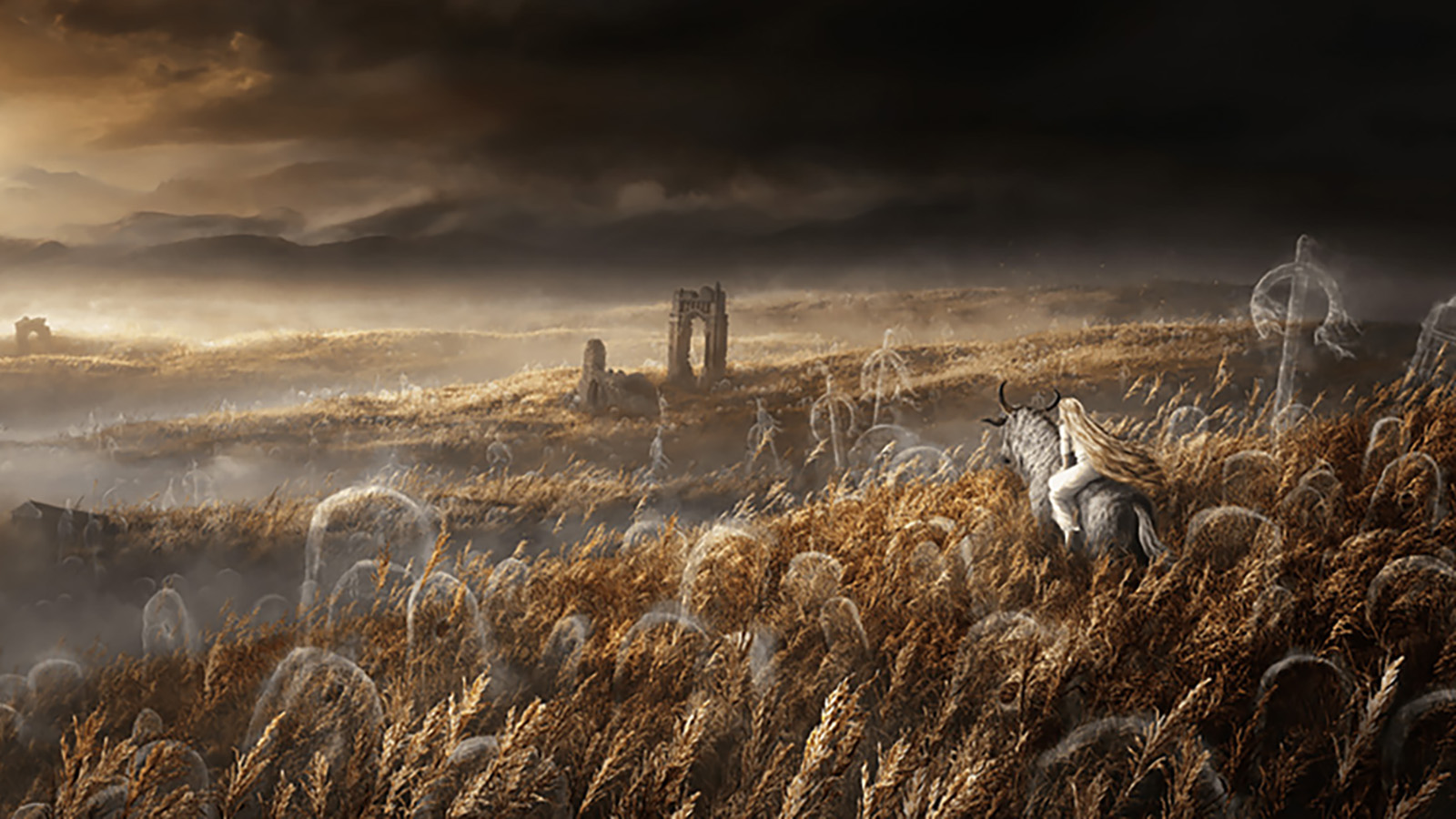 © FromSoftware
In the myth-interwoven history of Elden Ring, the story of Miquella the Unalloyed—one of the twin Empyreans born to Queen Marika and Radagon—presents the most profound and tragic philosophy in the game. Cursed to remain forever young, he simultaneously possessed the terrifying authority to “compel affection from others and captivate their hearts,” leading his sister Malenia to describe him as “the most fearsome Empyrean of all.”
This article unravels the true purpose behind Miquella’s abandonment of the existing Golden Order to journey to the Realm of Shadow, as well as the details of the Age of Compassion he sought to establish. Furthermore, it systematically examines what he discarded to realize this grand cause and the tragedy thereof, the facts and theories surrounding his “vow” with General Radahn, and why his plan was ultimately depicted as the horrifying conclusion of “the deprivation of free will.” This will be done by clearly distinguishing between in-game text (facts) and community speculation (theories).
1. Reaching the Realm of Shadow: The Limits of the Golden Order and the Vision of the Age of Compassion
To understand Miquella’s behavioral principles, one must start with the fact that he was initially a devout follower of the Golden Order. Together with his father Radagon, Miquella deeply explored Golden Order Fundamentalism, creating incantations such as “Discus of Light” and “Triple Rings of Light.” However, this exploration ultimately led him to despair.
1.1 The Limits of the Golden Order and the Transition to Unalloyed Gold
The primary reason Miquella abandoned the Golden Order was its inability to save his beloved family. The Golden Order could not cure the Scarlet Rot, the curse of an Outer God that afflicted the body of his sister Malenia, nor could it grant a “true death” to his half-brother Godwyn the Golden, whose soul alone perished during the Night of the Black Knives. Realizing these limitations, Miquella shifted his research to Unalloyed Gold, which possessed the power to ward off the meddling of Outer Gods. He crafted “Miquella’s Needle,” albeit incomplete, and sought a means to quell even the curse of the Frenzied Flame. Furthermore, he began to grow a new sacred tree, Miquella’s Haligtree, to protect those forsaken by the Golden Order (such as the Albinaurics and Misbegotten). However, this Haligtree project (Plan A) also failed to elevate him to true godhood.
1.2 Journey to the Realm of Shadow and Overcoming the Original Sin
Miquella learned of the existence of the Realm of Shadow, the place where his mother Queen Marika once ascended to godhood, now hidden and sealed within the shadow of the Erdtree. He concluded that being reborn as a new god at the Gate of Divinity located there was the only way to save the world. He intentionally allowed his abduction by Mohg, Lord of Blood (or perhaps charmed him), using him as a guiding light to reach the Realm of Shadow.
Miquella’s true objective at the Gate of Divinity was to atone for and overcome the Original Sin committed by Queen Marika. The English text for Miquella’s Great Rune states, “All in an effort to bury the original sin.” Even more crucial is the Japanese text, which reads, “To transcend the Causality that has continued since the beginning, and become a new god that embraces all.” The foundations of Golden Order Fundamentalism are Causality and Regression, but the moment Queen Marika attained divinity at the Gate of Divinity and established the Golden Order (the Original Sin), a chain of Causality was born in the world—bringing grace, but simultaneously “rejection” and “bloody strife.” To break free from this curse of Causality, Miquella sought not to inherit the Golden Order (the Elden Ring), but to establish an entirely new order founded upon his own “Circlet of Light.”
1.3 Details of the Age of Compassion (The Millennium)
The Age of Compassion that Miquella envisioned was a world of absolute love and acceptance, where no one is rejected and no one is condemned. In cut voice lines from the final battle with Miquella, the essence of the world he conceived is described as follows:
“To all the souls and living beings, herein comes the Age of Paradise/Eden. The Law of Kindness, a thousand year voyage. From then on, only love shall come for you. Nothing and no one will be condemned or rejected.”
This vision is the culmination of extreme idealism in response to the gruesome reality of The Lands Between, where the strong and the weak devour one another. However, to apply this state where “only love shall come for you” to all life, a terrifying method—the forced unification of free will, which will be discussed later—was absolutely essential.
2. The Discarded Elements and the Tragedy of St. Trina
For Miquella to become a perfect god without repeating Queen Marika’s mistake (the Original Sin), he needed to purify and discard everything of himself that belonged to the existing order. On his journey through the Realm of Shadow, he severed his own flesh, emotions, and fate one after another. The places where these were abandoned remain scattered across the Realm of Shadow as “Miquella’s Crosses.”
2.1 Miquella’s Crosses and the Record of What Was Discarded [Theories]
The locations of the 13 crosses verifiable in-game, the messages inscribed upon them, and the lore theories behind them are as follows:
| Cross Name | Inscribed Text (Equivalent) | Meaning and Theory in Lore |
|---|---|---|
| Three-Path Cross | I abandon here the first of my flesh. | The beginning of the abandonment of his material body. Breaking away from the “golden flesh” bound to the Golden Order. |
| Main Gate Cross | I abandon here a part of my flesh. | The continuous excision of his flesh on the way to Belurat. |
| Belurat Cross | I abandon here my left arm. | A grueling purification process accompanied by physical loss. |
| Castle Ensis Cross | I abandon here my flesh. | At the castle guarded by Rellana. Losing the majority of his physical body. |
| Highroad Cross | I abandon here my heart. | The abandonment of his “heart.” Discarding personal emotions and moral conflicts to transition into a purely conceptual existence. |
| Moorth Ruins Cross | I abandon here my flesh. | Further abandonment of his flesh. |
| Scaduview Cross | I abandon here my eye. | A decisive act to sever his fate as Queen Marika’s child and his belonging to the Erdtree, as the old knight Ansbach called it “the very emblem of his Empyrean lineage.” |
| Pillar Path Cross | I abandon here a part of my flesh. | Abandoned on the way to the Grand Altar of Dragon Communion. |
| Storehouse Cross | I abandon here my right arm. | The complete loss of his physical arms. As he approaches the Gate of Divinity, he loses his human form. |
| Rauh Ancient Ruins Cross | I abandon here the last of my flesh. | The complete abandonment of his physical body just before reaching the Gate of Divinity. |
| Cerulean Coast Cross | I abandon here my doubts and vacillations. | An expression of ruthless determination, willing to use any means for his ultimate goal. Mental preparation for discarding St. Trina. |
| Fissure Cross | I abandon here my love. | Parting with St. Trina, his most beloved other half and the symbol of unconditional love. |
| Spiral Rise Cross | I abandon here all my fears. | At Enir-Ilim (the Gate of Divinity). Erasing all human-like weaknesses before his rebirth as a god. |
2.2 The Abandonment of St. Trina and the Tragedy Brought by Its Contradiction
Among the things Miquella discarded, the most important and tragic in terms of the story’s theme is the abandonment of St. Trina, the embodiment of “Love.” St. Trina was discarded in the Garden of Deep Purple, located at the deepest part of the Stone Coffin Fissure at the southernmost tip of the Cerulean Coast. She was Miquella’s “other self (other half),” an enigmatic being whose appearance was sometimes spoken of as a young girl and other times as a young boy. St. Trina presided over slumber, granting a sweet and peaceful “eternal sleep” to those who despaired of the mortal world and wished for death.
After the player defeats the Putrescent Knight at the deepest part of the Fissure, if they continue to imbibe St. Trina’s nectar four to six times (bringing themselves to death), they can hear St. Trina’s voice only at the brink of death. Her words are as follows:
“Make Miquella stop… Don’t turn the poor thing into a god… Godhood would be Miquella’s prison. A caged divinity…is beyond saving. You must kill Miquella… Grant him forgiveness.”
[Lore Theory Based on Facts] This text reveals the fatal contradiction and tragedy inherent in Miquella’s actions. Miquella’s goal was to create a world that “unconditionally loves and accepts all.” However, the “unconditional love (rest and acceptance)” symbolized by St. Trina affirmed even the raw despair and death of others, offering a passive salvation in the form of sleep. In contrast, the Age of Compassion that Miquella was attempting to execute is an active salvation that forcibly rewrites the will of others to “unify” the world in peace. As a result of the clash between these two incompatible forms of love, Miquella was forced to cut away the unconditional love within himself (St. Trina) as an “impurity” or “hesitation” in order to complete his plan (active salvation).
St. Trina saw through the fact that Miquella becoming a god was synonymous with entering a “prison.” Having stripped away all his humanity (flesh, heart, fear, and love), Miquella would be reduced to nothing more than the “function of a salvation system” itself. His journey, which began with the personal motive of curing his sister Malenia’s rot, ironically reached the ultimate extreme of self-sacrifice: killing his very “loving heart” to save the world. The narrative structure—where his most deeply loving other half (St. Trina) denies his “becoming a god” and pleads that “killing him” is the true forgiveness (salvation) for him—is one of the greatest tragedies in this work.
3. The “Vow” Between Miquella and General Radahn: Solid Lore and Prominent Theories
For Miquella to be reborn as a god at the Gate of Divinity, the presence of a “Lord” was indispensable. The one he chose as his Promised Consort was his half-brother Starscourge Radahn, hailed as the mightiest Demigod. Regarding the truth of the “vow” exchanged between these two, fragmented facts and fierce community debates intertwine.
3.1 “Solid Lore (Facts)” Based on In-Game Text
First, without interjecting speculation, we will organize the facts confirmed by in-game text and depictions.
-
The Rule of the Secret Rite Scroll:
The Secret Rite Scroll, found in the Specimen Storehouse, details an important rule regarding the Gate of Divinity.
“A lord will usher in a god’s return, and the lord’s soul will require a vessel.” As the Japanese word “Yorishiro” (vessel) indicates, a new physical vessel was required to call Radahn’s soul back to the Gate of Divinity.
-
Mohg’s Corpse as a Vessel: Miquella brought the corpse of Mohg, Lord of Blood, who had been slain by the Tarnished, into the Realm of Shadow. This was to use it as a “fleshly vessel” to house the soul of his Lord, Radahn. Ansbach fiercely condemns this as an act of leaving Mohg’s soul behind and humiliating his empty husk.
-
Malenia’s Whisper in Caelid:
During the Battle of Aeonia in The Shattering, just before Malenia bloomed the flower of Scarlet Rot against Radahn, she whispered this into his ear:
“Miquella awaits thee, O promised consort.” From this fact, it is confirmed that the true purpose of Malenia’s invasion of Caelid was not to seize a Great Rune, but rather a “ritual” to physically kill (or drive to death) Radahn in order to send his soul to the Gate of Divinity in the Realm of Shadow.
-
A Childhood Wish:
The text of the “Remembrance of a God and a Lord,” obtained after the final battle, clearly states the origin of this vow.
“At a tender age, Miquella saw a King in Radahn. In his strength, that they lacked since they were frail, but in his kindness too. That’s why Miquella innocently pleaded: ‘Please, become my king’.”
-
Radahn’s Silence: In the final battle, Radahn, resurrected in his youthful form using Mohg’s body as a base, remains completely silent from start to finish. He merely carries Miquella on his back and fights using his former gravitational magic and the power of bloodflame.
3.2 Prominent Theories in the Community (Speculation and Debate)
Based on the above facts, fierce debate has taken place within the community regarding whether “Radahn truly agreed to become Miquella’s Lord.” The prominent theories can be broadly divided into the following three:
3.2.1 Theory A: Initially Agreed, But Later Reneged
This theory interprets that the two did indeed exchange a vow in their childhood, but as Radahn grew, he came to reject that vow for some reason. Radahn was a warrior who prized honor in battle, and when The Shattering broke out, he threw himself into the war over the Elden Ring to flaunt his strength (or as a protector of the Golden Order). It is also speculated that he halted the movement of the stars with gravitational magic to stop the progression of Miquella’s fate (or his own fated death). Because Radahn reneged on the vow, Miquella was forced to resort to force, sending Malenia as an assassin to forcibly kill him and retrieve his soul.
3.2.2 Theory B: Agreed on the Condition of an Honorable “Death in Battle”
This theory posits that Radahn agreed to become Lord, but out of pride as the mightiest warrior, he made “being defeated in battle” the condition for fulfilling the vow (or the condition for surrendering his soul). According to this interpretation, Malenia’s invasion of Caelid was not an act of hostility, but an “honorable duel to fulfill the contract” with Radahn. This also aligns with Radahn’s personality, as he favored a “Festival of Combat.” However, there is a counterargument that Miquella leaving Radahn in the agonizing pain of the rot for a long period, ultimately causing him to lose his sanity, decisively contradicts Miquella’s inherent “kindness.”
3.2.3 Theory C: A One-Sided Vow Through Complete Charming (Brainwashing)
This theory suggests that Radahn never agreed from the start, and that everything was the result of Miquella’s one-sided obsession and power of charming. The text stating he “innocently pleaded” is merely Miquella’s subjective perspective. The fact that Radahn speaks no words in the final battle, that his eyes glow red (a sign of being charmed), and above all, that his beloved horse Leonard—who was the catalyst for him learning gravitational magic and with whom he rode across battlefields—was not brought to the Realm of Shadow, strongly suggest that the resurrected Radahn is nothing more than “Miquella’s puppet” devoid of his own free will.
Whatever the truth may be, it is significant that the Japanese text uses the word “innocent” (junshin). For Miquella, the “vow” was not a Machiavellian scheme of malice, but began as a childlike, pure, and innocent obsession with an absolute powerhouse who could protect the physically frail twins. However, it is precisely that “innocence” that completely ignored the will of the other party and the logic of the situation, ultimately becoming the greatest factor that triggered a catastrophic war (the Battle of Aeonia) engulfing the entire continent.
4. Terrifying “Love”: The Deprivation of Free Will and the Essence of the Age of Compassion
Why is Miquella’s plan ultimately depicted as something terrifying, akin to “evil” or “madness”? It is because the means he employs take the form of “the absolute deprivation of free will.”
The one who most accurately saw through this essence and shuddered at it was the old knight Ansbach, a former subordinate of Mohg, Lord of Blood. Ansbach once challenged Miquella head-on and drew his blade to rescue his liege Mohg from abduction. However, he was not defeated in physical combat; rather, his heart (his loyalty and hostility) was cleanly stolen by Miquella’s power of “charming,” temporarily placing him in a state where he traveled the Realm of Shadow as Miquella’s follower.
4.1 Ansbach’s Testimony and the True Meaning of “Monster”
When Miquella discarded his Great Rune and the spell of his charm was broken, Ansbach realized his own folly and spoke with terror:
“Miquella the Kind is a monster. Pure and radiant, he wields love to shrive clean the hearts of men. There is nothing more terrifying.”
Ansbach called Miquella a “monster” not because he commits cruel violence or slaughter. It is because Miquella can effortlessly overwrite and erase not only the negative emotions of his enemies—such as anger, hatred, and a thirst for revenge—but even the “fundamental identity that makes a human human,” such as loyalty to a liege, personal pride, and the core of one’s ideology, all through “unalloyed love.” Ansbach even monologues, “The very thought of Miquella makes my blood run cold. I want nothing more than to run far, far away.”
4.2 The Collapse of the “Fleeting Peace” Brought by the Charm
In the early stages of the Realm of Shadow, the player encounters a group of NPCs following Miquella’s guidance (Needle Knight Leda, the Hornsent, Ansbach, Moore, Thiollier, etc.). Their composition is extremely bizarre. A fanatical follower of the Golden Order, a Hornsent whose clan was massacred by Queen Marika’s forces, a loyal retainer of the Lord of Blood—their ideologies and positions are completely contradictory, and in normal times, they would be in a relationship where they would kill each other the moment they met. However, under Miquella’s charm, they shared a strange and gentle sense of solidarity (peace), “cooperating together to follow Lord Miquella.”
Yet, the moment Miquella discards his Great Rune and the charm is broken, this fleeting peace crumbles fragilely. They regain their original hatred, paranoia, and past traumas, and begin a gruesome slaughter involving purges by Leda and infighting among comrades. This series of events brilliantly highlights the limits and truth of the Age of Compassion championed by Miquella, from both a systemic and narrative perspective. The peace Miquella offers is by no means “mutual understanding through dialogue” or “forgiveness through tolerance.” It is a dystopian mind control that can only be established by “forcibly castrating the will and thoughts of others and trapping them in a coerced sense of euphoria,” much like an endorphin rush.
4.3 Contrast with Queen Marika’s Rule (Violence) and the Homogenization of Divine Self-Righteousness
From a philosophical perspective, an irony emerges: Miquella’s actions have become fundamentally similar to the rule of his mother, Queen Marika, which he sought to deny and surpass.
To establish her own order (the Golden Order), Queen Marika eliminated Destined Death and thoroughly rejected and massacred those who “did not fit her order” through military force—such as the Gloam-Eyed Queen, the Fire Giants, and the Hornsent, the latter as revenge for the gruesome rituals at the Shaman Village. This is clearly an order of “exclusion by force.” On the other hand, Miquella proclaims that “No one will be condemned or rejected.” However, to make all life with conflicting values coexist, he chose the method of “forcibly dyeing everyone’s free will with love.” This is the ultimate order of “assimilation (brainwashing) through love.”
Although the means—“violence” and “love”—are polar opposites, the resulting outcome is completely identical in that both “fundamentally twist the natural state of life (free will, including struggle and conflict) through the ego of a transcendent individual known as a god.” When Ansbach drew his blade against Miquella and Radahn in the final battle, pleading with the Tarnished to become a Lord not for a god, but for men, it can be interpreted as his despair toward this very “structure of self-righteous mind control by a god” and a rebellion to protect human dignity.
Conclusion: The Ruin of an Empyrean Who Was Too Kind
In Elden Ring: Shadow of the Erdtree, Miquella’s story and ideology can never be measured by a simple dualism of good and evil. The driving force behind his actions stems from an earnest desire to cure his sister suffering from illness, and to save all the weak and oppressed under the Golden Order (such as the Albinaurics and Misbegotten)—motives that are extremely pure and kinder than those of any other character in the game.
However, to realize that ultimate salvation as a system, he needed to become an omniscient and omnipotent new god himself. And to become a god, he had to cut away his physical flesh, his birthright, his doubts, and above all, his “heart that unconditionally loves and accepts others as they are (St. Trina).” As a result, the Miquella who reached the Gate of Divinity and donned the Circlet of Light was no longer the kind boy he once was, but had been reduced to a “pure concept (system) that retained only the function of salvation.” His pursuit of a Lord, even going so far as to forcibly bind Radahn’s soul to Mohg’s flesh, can be said to be a rampage born of a maddening sense of duty to make the world “kind.”
The Age of Compassion he aimed for harbored a terrifying conclusion: in exchange for ridding all life of struggle and pain, it would eternally strip away freedom of choice and personal dignity. It can be concluded that the Tarnished striking him down at the Gate of Divinity is not only a battle as a Lord vying for the hegemony of the next era, but also the sole and greatest mercy in the world—to liberate Miquella from the “endless prison of godhood” and grant him salvation (forgiveness) from his overly heavy karma, just as his discarded other half, St. Trina, so desperately wished.
The unalloyed Empyrean who tried to embrace everything crushed far too much in his small hands. After leaving his most beloved other half behind in the dark, he scattered into the Realm of Shadow, along with his innocent childhood wish: “I just wanted to make the world a kinder place.”
Cosmology of Shattering and Gold: Elden Ring: 11 Meditations on the Lands Between and Mythology
The book version is now available. Read for free with Kindle Unlimited.
Thank you very much for reading to the end. To help support the activities of this archive, a warm donation of a cup of coffee would be highly appreciated.