Rune.06: Ranni the Witch
 © FromSoftware
Introduction: The Singularity and Historical Significance of Ranni the Witch in The Lands Between
In The Lands Between, the setting of Elden Ring, the entity who accomplished the most decisive and irreversible rebellion against the absolute paradigm of the Golden Order is Ranni the Witch. She is not merely a participant in a power struggle, nor just one of the Demigods harboring a difference in faith. Her actions and philosophy aimed for the Age of Stars, which fundamentally overturned the very nature of the world and sought to liberate the state of life from deterministic divine rule to existential freedom.
This article thoroughly examines the life and inner workings of Ranni the Witch, from her unique origins as an Empyrean and the accompanying curses, to her drastic decision to slay her own flesh, and the deeply human affection and conflict hidden behind the mask of a cold-blooded schemer. In superficial historical accounts, the path she walked appears to be that of a selfish and ruthless assassin who drove her stepbrother to his death and led the world into the madness of The Shattering. However, when unraveling her deep psychology through item descriptions, fragmented dialogue, and hidden historical backgrounds, a profoundly humanistic spirit of self-sacrifice emerges—one that seeks to “distance the excessive interference of gods from the world and grant true independence to life.” This article aims to elucidate the literary and philosophical significance of the character Ranni the Witch, as well as her structural contrast with other Empyreans (such as Miquella and Queen Marika), by rigorously intertwining facts and inferences.
1. Origins and Curse (Blessing): The Intersection of Gold and the Moon, and the Fate of an Empyrean
1.1 The Fusion of the Carian Royal Family and the Bloodline of the Golden Order
Ranni’s origins symbolize the political and historical fusion of two major powers in The Lands Between. She was born to Rennala, Queen of the Full Moon, who led the Academy of Raya Lucaria in its worship of the stars and the moon, and the champion Radagon, who would later become the second Elden Lord of the Golden Order. Her older brothers include General Radahn, who would later master gravitational magic and become known by the moniker “Starscourge,” and Praetor Rykard, who led the inquisitions at Mt. Gelmir and eventually transformed into Rykard, Lord of Blasphemy.
This unique bloodline held decisive significance in the formation of Ranni’s identity. The Carian royal family was originally a lineage that revered the fate of the stars and the wisdom of the moon, but by welcoming Radagon, a champion of the Erdtree, an incompatible element—“submission to the Golden Order”—was introduced into the family. And her family environment completely collapsed when her father, Radagon, suddenly abandoned Rennala and left for Leyndell, Royal Capital to become the consort of Queen Marika. Her mother, Rennala, was deeply heartbroken by her husband’s betrayal and sank into madness, clutching the amber egg of a Great Rune left behind by Radagon.
It is not hard to imagine that this formative experience planted a deep distrust and ressentiment (intense resentment) toward the Golden Order and The Greater Will manipulating it from behind the scenes in the heart of the young Ranni. The fact that the Golden Order, which championed absolute order, ultimately destroyed her mother’s mind and cruelly tore her family apart serves as the source of the powerful emotional motivation that later led Ranni to the high treason of “god-slaying.”
1.2 The Blessing as an “Empyrean” and the Existential Curse It Brings
Due to the mythological truth that her father Radagon was the same entity as Queen Marika (or her other half), Radagon’s children—Ranni, Radahn, and Rykard—were elevated to the status of Demigods as Marika’s stepchildren. Furthermore, among them, Ranni was recognized as having the qualities of an Empyrean, much like Marika and the later-born twins, Miquella and Malenia.
An Empyrean is a special being qualified to replace the current god ruling the world (Marika) and become the god of the coming age, establishing a new order. However, for Ranni, this “blessing from The Greater Will” was nothing more than a “deterministic curse” that forced her to walk a path laid out by the Two Fingers. To strictly manage Ranni as a candidate for the next god, the Two Fingers bestowed upon her Blaidd, the “half-wolf shadow,” who served as both her destined companion and her watcher. Blaidd was created to swear absolute loyalty to Ranni, but if she were to act against the intentions of the Two Fingers (succeeding the Golden Order), an internal program would force him into madness and compel him to assassinate her.
The fact that the power over her life and death was held by another, and that not only her fate but even the very soul of her closest friend (Blaidd) was designed according to the “convenience of the gods,” made Ranni crave “liberation from fate” to the utmost limit. Behind her later resort to the extreme measure of destroying her own flesh lies an earnest desire to break free from this “absolute lack of freedom born of being loved by the gods.”
1.3 Encounter with the Snowy Crone and the Reconstruction of Identity
The one who had a decisive influence on Ranni, who was deepening her rebellion against the Golden Order, and provided the foundation for her new identity was the “Snowy Crone” she met deep in the woods. She was a heretical witch, highly skilled in cold sorcery, which was considered taboo in The Lands Between. The old witch became Ranni’s secret mentor, imparting the essence of cold sorcery to her while teaching her to “fear the dark moon.”
The wisdom of the moon—cold, dark, yet independent and reliant on no one, standing in stark contrast to the warm, blinding light of the Erdtree—became Ranni’s spiritual pillar. In the main game, when she first meets the player (the Tarnished), Ranni introduces herself using the alias “Renna,” which is strongly inferred to be a borrowed name from her mentor, the Snowy Crone.
Later, Ranni prepares a life-sized doll to anchor her soul, and its appearance is modeled after the Snowy Crone she so deeply revered. It is clear from the traces of her corpse left at the Divine Tower of Liurnia that Ranni’s original body possessed the “red hair” indicative of the Golden Order’s bloodline, just like her father Radagon and her brothers. However, the temporary form she chose as the vessel for her soul was a grotesque witch with pale skin and four arms. From these facts, it can be read that she fiercely despised and discarded her divine bloodline (the red hair), achieving a spiritual rebirth by inheriting the appearance and name of the “heretical mentor” who had discovered her.
1.4 Two Faces and the Multifaceted Nature of an “Empyrean”
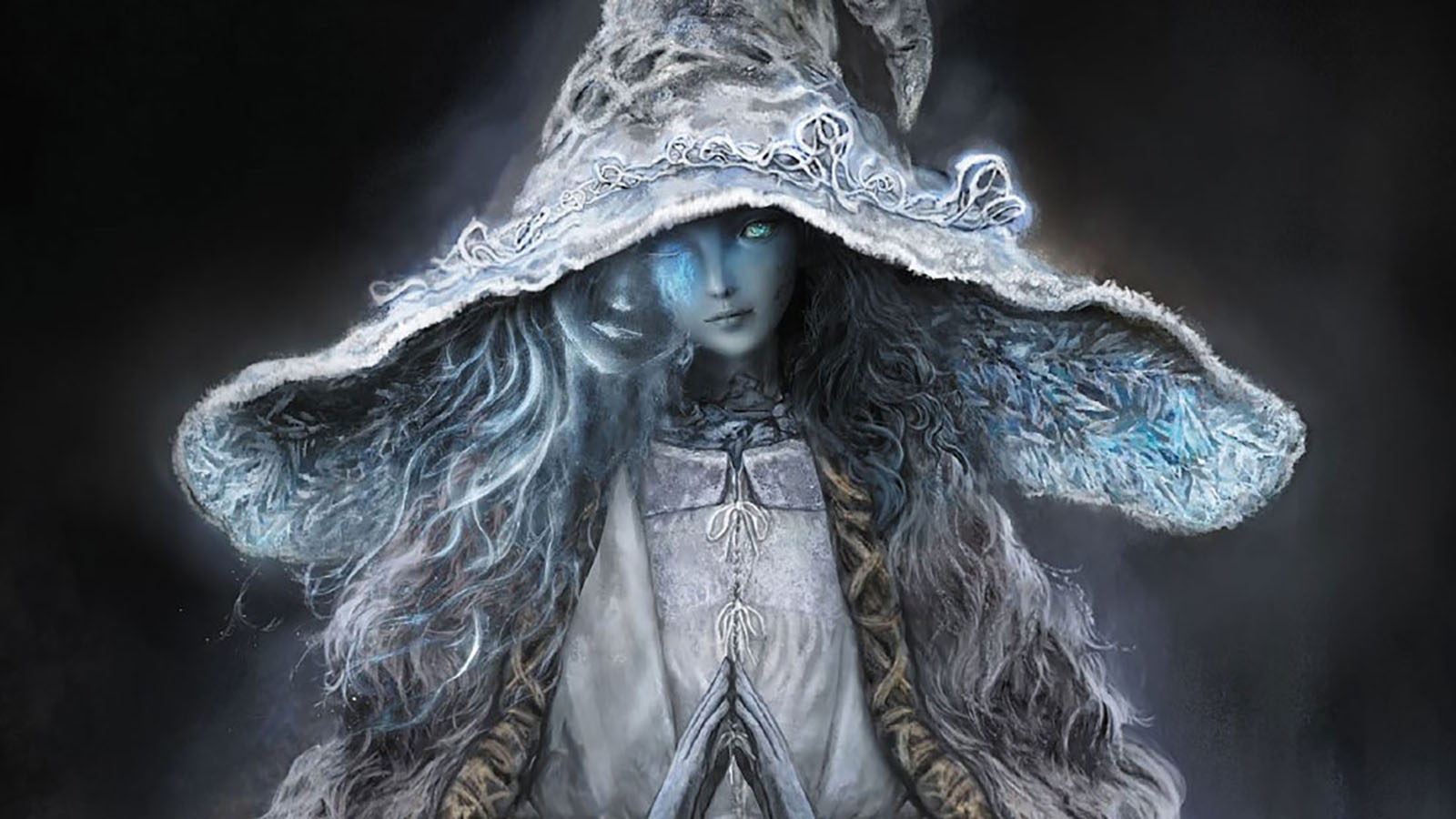
Around the right eye of Ranni’s doll, a pale spectral face (the face of Ranni’s original soul) faintly overlaps. The left eye of this spectral face is closed, which is often pointed out as a commonality with Melina, who also lost her body and exists only as a spirit (Melina’s right eye is closed), suggesting that the two are counterparts or share some deep spiritual connection.
What is particularly noteworthy is that this visual of “two faces” is not merely an expression of spiritual possession, but serves as a metaphor for the “multifaceted nature” inherently possessed by an Empyrean. Just as Marika and Radagon were the same entity yet possessed two distinct aspects, it is suggested that Empyreans are complex beings capable of encompassing multiple facets and states of the soul. Ranni slaying her own flesh, severing only her soul, and inhabiting a grotesque vessel is a physical and spiritual embodiment of the essential multifaceted nature of an Empyrean. It can be said to be the manifestation of her rejecting a single, absolute fate bestowed upon her and choosing another possibility (a life as a witch).
2. Historical Role and Major Actions: The God-Slaying Plot and the Stagnation of Fate
2.1 Actions as the Mastermind of the Night of the Black Knives and the Sacrifice of Equivalent Exchange
The most decisive event in Ranni’s historical role was her maneuvering behind the scenes as the mastermind of the Night of the Black Knives, which forever changed the history of The Lands Between. She mobilized the Black Knife Assassins and stole a fragment of the Rune of Death from Maliketh, the Black Blade. The primary objective of this plot was not the assassination of another, but “to slay her own Empyrean flesh and completely liberate her soul from the curse of The Greater Will and the Two Fingers.”
However, according to the physical and metaphysical laws of the Elden Ring, to completely slay a Demigod, both body and soul must be destroyed by the Rune of Death. To achieve the unprecedented goal of slaying only her body while preserving her soul, Ranni employed a cruel ritual of equivalent exchange: “simultaneously slaying the soul of another Demigod.” The one chosen as that sacrifice was Godwyn the Golden, Marika’s firstborn and the most brilliant symbol of the Golden Order.
At the exact moment Ranni’s body met its death atop the Divine Tower, Godwyn’s soul was slain by the Black Knives in the Royal Capital. As a result, Ranni’s body and Godwyn’s soul each met a half-death, and the cursemark of death (the centipede wound) was torn into two halves. This event became the root cause that spawned Those Who Live in Death in The Lands Between, a fundamental bug in the Golden Order.
From this utterly ruthless decision, one can glimpse Ranni’s tremendous willpower and cold-bloodedness—that for the sake of her goals (the acquisition of freedom from fate and the overthrow of the Golden Order), she was willing to mercilessly sacrifice her stepbrother Godwyn and did not even mind the collapse of the world’s entire logic.
2.2 Conspiracy with Rykard, Lord of Blasphemy, and a Meticulously Prepared “Trump Card”
It is clear from the text of the item “Blasphemous Claw” and the historical background that Ranni was not acting entirely alone during the Night of the Black Knives. On the occasion of the Night of the Black Knives, Ranni gave her biological brother, Praetor Rykard, a slab of rock engraved with traces of the Rune of Death (the Blasphemous Claw) as a reward.
The text of the “Blasphemous Claw” reads as follows: “On the night of the dire plot, Ranni rewarded Praetor Rykard with these traces. Should the coming trespass one day transpire, they would serve as a last-resort foil, allowing Rykard to challenge Maliketh the Black Blade, the black beast of Destined Death.”
From this fact, the following important insights can be drawn. First, Ranni and Rykard shared an extremely deep political and ideological solidarity as siblings under the common goal of “bringing an end to the Erdtree (the Golden Order).” It is highly likely that in the early stages, empathy for his sister’s harsh fate and a rebellious spirit against a maddened world existed behind Rykard’s later descent into being devoured by a giant serpent and transforming into the hideous Lord of Blasphemy.
Second, Ranni fully anticipated that the execution of her plot would enrage Marika and the Two Fingers, leading them to send Maliketh, the watchdog of the Golden Order and the strongest beast of death, in retaliation. She expected Rykard to act as a bulwark while she discarded her body and went into hiding, or as a comrade-in-arms fighting against the gods together, and bestowed upon him an absolute defensive measure (the Blasphemous Claw, which has a parrying effect) to counter Maliketh. This meticulous preparation proves that her stratagem was not mere fanatical terrorism, but was based on highly advanced military and political calculations.
2.3 Relationship with the Empyrean Miquella: Those Who Walk Polar Opposite Paths
To understand Ranni’s actions, a comparison and analysis of her relationship with Miquella, who was also recognized as an Empyrean, is indispensable. Miquella, too, was an Empyrean who abandoned the Golden Order and sought to establish a new order (Unalloyed Gold, or the Age of Compassion).
It is suggested that there was some sort of cooperative or exploitative relationship between Miquella and Ranni. Early in the game, Ranni (calling herself Renna) bestows the “Spirit Calling Bell” and the “Lone Wolf Ashes” upon the player, explicitly stating that they were “entrusted to her by Torrent’s former master.” It is highly probable that this “former master” is none other than Miquella. The full picture of why Miquella tried to support the Tarnished through Ranni remains shrouded in mystery, but the possibility cannot be denied that the two shared information behind the scenes regarding their “departure from The Greater Will.”
Even more important is the philosophical contrast between their means and ends. The table below compares the trajectories of the two Empyreans, Ranni and Miquella.
| Comparison Element | Ranni the Witch (Order of the Moon) | Empyrean Miquella (Age of Compassion) |
|---|---|---|
| Abandonment of the Flesh | Slew her flesh using the Rune of Death during the Night of the Black Knives | Traveled to the Realm of Shadow and discarded his flesh and Great Rune of his own volition |
| Approach to Fate | Sets the stars of fate in motion, eliminating divine interference | Uses the power of charm to forcibly harmonize and control all souls |
| Interference with Others | Absolute non-interference. Distances the Order from the world | Absolute intervention. Envelops all tragedies within his own divinity |
| Direction of the Conclusion | Acquisition of existential freedom, accompanied by loneliness and darkness | An absolute mental cage where there is no conflict, but also no free will |
Both followed the exact same process of “discarding their bestowed Empyrean flesh and privilege (Great Rune).” However, while Miquella headed toward the ultimate paternalism (benevolent domination) of “becoming a perfect god to forcibly love and manage everyone,” Ranni walked the path of “distancing the gods from the world and granting humanity loneliness and freedom.” Through this contrast, the structure makes the “trust in humanity born of coldness” inherent in Ranni’s actions stand out all the more.
2.4 The Stagnation of the Stars and the Fateful Connection with Starscourge Radahn
Ranni’s grand plan was forced into complete stagnation after a certain point in time. This was because her other brother, General Radahn, the Starscourge, used gravitational magic to physically halt the movement of the stars in outer space.
The fate of those who draw the blood of the Carian royal family is completely linked to the movement of the stars. The stars stopping meant that the time of Ranni’s fate had come to a halt. As for why Radahn halted the stars, the prevailing theory is that it was to protect the town of Sellia from the calamity of falling stars (such as Astel), but there is also the view that it was simultaneously “to thwart his dangerous sister’s fate (her god-slaying plot).” Because Radahn deeply revered the Golden Order and his father Radagon, he stood in clear opposition to his sister’s plan to destroy the Golden Order.
According to War Counselor Iji, the siblings did not have much deep interaction since childhood, but by an irony of fate, the brother’s proud life resulted in strangling his sister’s ambitions. In the main game, the player (the Tarnished) defeating Radahn and setting the stars in motion once again becomes the catalyst that decisively advances Ranni’s story. The composition wherein the sister’s fate begins to move again in exchange for the brother’s heroic death in battle speaks to the unavoidable love-hate relationships and the complexity of destiny flowing in the blood of the Carian royal family.
3. Inner Workings and Conflict (Love, Hate, and Conviction): The Hidden Affection of the Cold-Blooded Witch
What should be emphasized most in this report is the internal conflict of the character Ranni and the deep affection that can be read between the lines of item descriptions and dialogue. She continues to act as a cold-blooded schemer who discards her flesh and sacrifices others for her goals, but in truth, she bore a deep love for her vassals and a uniquely harsh sense of responsibility toward the world all on her own.
3.1 Clumsy Love for Her Vassals and the Resolve for an Inevitable Parting
Gathered in Ranni’s camp (Three Sisters) are outcasts from The Lands Between, such as the giant War Counselor Iji, the shadowbound beast Blaidd, and the selfish Preceptor Seluvis. She continually adopts a dismissive attitude toward the player, saying, “I walk a dark path. I cannot drag you into it,” but this is the flip side of her own clumsy kindness, attempting to keep them away from a doomed fate.
Her relationship with Blaidd, in particular, is extremely tragic. Blaidd was a watcher bestowed by the Two Fingers, but he chose his fraternal love for Ranni over his own instincts (submission to the gods) and swore to “be her blade.” The text of his beloved weapon, the “Royal Greatsword,” states: “In defiance of the fate he was born to, Blaidd swore to serve no master but Ranni. As a symbol of this resolve, the sword was imbued with cold magic from the moment the oath was sworn.”
Ranni, too, loved Blaidd and Iji deeply from the bottom of her heart. Immediately after obtaining the hidden treasure of Nokron (the Fingerslayer Blade) and finally slaying the Two Fingers that had bound her, before departing having fulfilled her purpose, she quietly leaves these words for the player:
“Tell Iji and Blaidd… I love them.”
This brief line is one of the greatest psychological confessions in the work, exploding with the absolute loneliness she had borne until then and the affection she could not completely hide beneath her cold mask. Ranni knew from the beginning that if she proceeded on her path and slew the Two Fingers, Blaidd was inevitably destined to go mad due to the curse of The Greater Will and would have to be put down. The reason she never broke her cold demeanor was that it served as armor (armor of ice) to endure the agony of ruining her precious ones with her own hands and to keep her resolve from dulling.
3.2 The True Humanism Embedded in the “Age of Stars” (A Reconsideration Based on Translation Issues)
To accurately grasp Ranni’s inner workings and what she desired for the world, one must understand the true meaning of her ultimate goal, the Age of Stars. What is particularly noteworthy here is the international divergence in her character image caused by a significant mistranslation of her dialogue in the English version.
In the English version’s ending, Ranni’s dialogue was translated as: “Here beginneth the chill night that encompasses all… Into fear, doubt, and loneliness…” As a result, a misconception spread among English-speaking players that Ranni was a “selfish, evil witch” who robbed the world of light and plunged people into a cold night of fear and loneliness.
However, her true intention, as read from the original Japanese text, is the exact opposite—it is profoundly humanistic. In the dialogue in her chamber, Ranni speaks as follows: “Mine will be an order not of gold, but the stars and moon of the chill night. I would keep them far from the earth beneath our feet. As it is now, life, and souls, and order are bound tightly together, but I would have them at a great remove. And have the certainties of sight, emotion, faith, and touch… All become impossibilities.”
What Ranni says she wants to “become impossibilities” here is not people’s emotions themselves. She means she wants to make it impossible to “see, feel, believe in, or touch the certain Order (gods)“—in other words, “to completely isolate the concept of gods to a place physically and mentally out of reach.”
In the era of Marika’s Golden Order, the power of the gods was far too close at hand. It directly managed people’s lives as a blessing, violently purged heresy, and even controlled death. The results were the madness of her mother Rennala, the suffering of the ostracized Omen, and the hell of the eternally continuing Shattering.
What Ranni aimed for was to pull this “Order (the order of the gods)” far away from life and souls. The “chill night,” “fear, doubt, and loneliness” she speaks of are not curses upon the world, but the “self-responsibility and existential dread” that humans living in a free world without direct divine intervention should naturally harbor as they walk on their own two feet.
And the line in the ending, “Into fear, doubt, and loneliness… As the path stretcheth into darkness. Well then. Shall we?” is not a statement forcing those hardships onto the people of the world. It is a declaration of self-sacrifice: “She and her consort (the Tarnished) will embrace the new Order and embark on an eternal journey to the lonely, dark ends of the universe in place of the people of the world.”
What did she want to protect? It was the “true freedom and independence of life.” What did she want to destroy? It was the “excessive interference in life and the forcing of fate by the gods and The Greater Will.” Ranni harbored in her heart an immense love for humanity and a sense of duty—that in exchange for taking the gods away from the world, she would become a god herself and take on eternal loneliness and darkness, just the two of them.
4. Philosophical and Thematic Significance: Metaphors of Eternity and Change, and Liberation from Fate
In the overarching theme of Elden Ring, the way of life of Ranni the Witch and the Age of Stars function as the most perfect and philosophical antithesis to the Golden Order established by Queen Marika.
4.1 The Stagnation of Gold and the Flux of the Stars and Moon: A Paradigm Shift in Order
The table below organizes the philosophical and symbolic contrasts between the “Golden Order (Marika)” and the “Age of Stars (Ranni)” within the work.
| Axis of Comparison | Golden Order (Marika’s Order) | Age of Stars (Ranni’s Order) |
|---|---|---|
| Distance from Gods | Extremely close. Reigns over the world as the physical majesty of the Erdtree | Extremely distant. The unknowable cosmos, the untouchable moon and stars |
| Nature of Fate | Deterministic. A fixed destiny through the interference of the Two Fingers | Free will and uncertainty. The flux of fate chosen by oneself |
| What it Brings to the Masses | Fanatical sense of security, and discrimination/exclusion against the unblessed | Fear, doubt, and loneliness. But accompanied by mental independence |
| Concept of Time | Eternity and stagnation. The pursuit of imperishability through the exclusion of the Rune of Death | Change and progression. The mobilization of time through an endless journey into darkness |
| Philosophical Metaphor | Patriarchal, absolutist theocratic regime | The dawn of existential, secularized humanism |
While Marika’s Golden Order excluded “death” and sought eternal immutability (stagnation), Ranni accepted “change and death” like the ever-flowing stars. In the world of the Golden Order, people gained a facade of security under the grace of the Erdtree, but it was simultaneously a discriminatory system that justified the cruel exclusion of “the unblessed (Omen, Misbegotten, Tarnished, etc.).” Ranni’s new Order offers no grace, but in return, it performs no exclusion. This is because the Order itself, which judges good and evil, departs to a distant place far out of reach.
This is a structure that completely overlaps with the “death of God (Nietzsche)” in real-world history and the process of secularization brought about by the Enlightenment. Ranni brought about the end of the mythological age and the dawn of the age of humanity in The Lands Between.
4.2 “Liberation from Fate” and the Existential Antithesis
From a philosophical perspective, Ranni’s story possesses profound themes that resonate with the existential philosophy of figures like Jean-Paul Sartre. As the famous existential proposition “Man is condemned to be free” suggests, a world that does not lean on the absolute crutch of a god is bleak, lonely, and full of doubt (a chill night). However, that is precisely the genuine, original state of life.
The very act of Ranni burning her own flesh (the vessel of her bestowed fate) during the Night of the Black Knives and transferring herself to a cold doll vessel serves as a powerful metaphor for existential liberation: “acquiring existence (the life as a witch chosen by her own will) prior to essence (the predetermined fate as an Empyrean).” She completely rejected “meaning created by gods” and embodied the nobility and terror of “creating meaning by one’s own will” through her way of life. This spirit of self-determination was the greatest conviction she carried through, even if it meant overcoming the tragedy of Blaidd’s descent into madness.
Conclusion: Walking into the Darkness, the Portrait of the Most Human God
Ranni the Witch is the most radical destroyer in the history of Elden Ring, and at the same time, the true liberator who paid the deepest self-sacrifice. She hated the Golden Order that broke her mother’s heart and rejected the rule of The Greater Will that sought to rob her of her will. In the process, she discarded her flesh, slew the soul of her half-brother, drove her vassal to madness, and plunged the world into the unprecedented chaos of the Order’s collapse. The weight of her sins is immeasurable.
However, behind that ice-cold mask lay a poignant love for her vassals like Blaidd and Iji, and an indomitable conviction that “she wanted no one else’s fate to be derailed by the convenience of the gods.” While Miquella sought to charm others and confine them in his own cage, the destination Ranni ultimately reached was not to reign as the absolute ruler of a new world, but to embrace the “Order” itself alongside her consort and vanish into the abyss of the cosmos. That is nothing less than the acceptance of eternal exile to return The Lands Between to “a world of mere earth and life, devoid of gods.”
“Into fear, doubt, and loneliness… As the path stretcheth into darkness. Well then. Shall we?”
These words she directed at her consort, the Tarnished, are not the command of a ruler, but the quiet resolve of a pilgrim bearing a heavy cross together. Ranni rejected the blessing of an Empyrean bound by fate as a curse, and chose for herself the life of a cold “witch.” Her trajectory should be passed down eternally within the grand mythos of Elden Ring as the history of the most beautiful, most gruesome, and most human rebellion against the logic of the gods.
Cosmology of Shattering and Gold: Elden Ring: 11 Meditations on the Lands Between and Mythology
The book version is now available. Read for free with Kindle Unlimited.
Thank you very much for reading to the end. To help support the activities of this archive, a warm donation of a cup of coffee would be highly appreciated.