Archive.09: Pascal
 © SQUARE ENIX
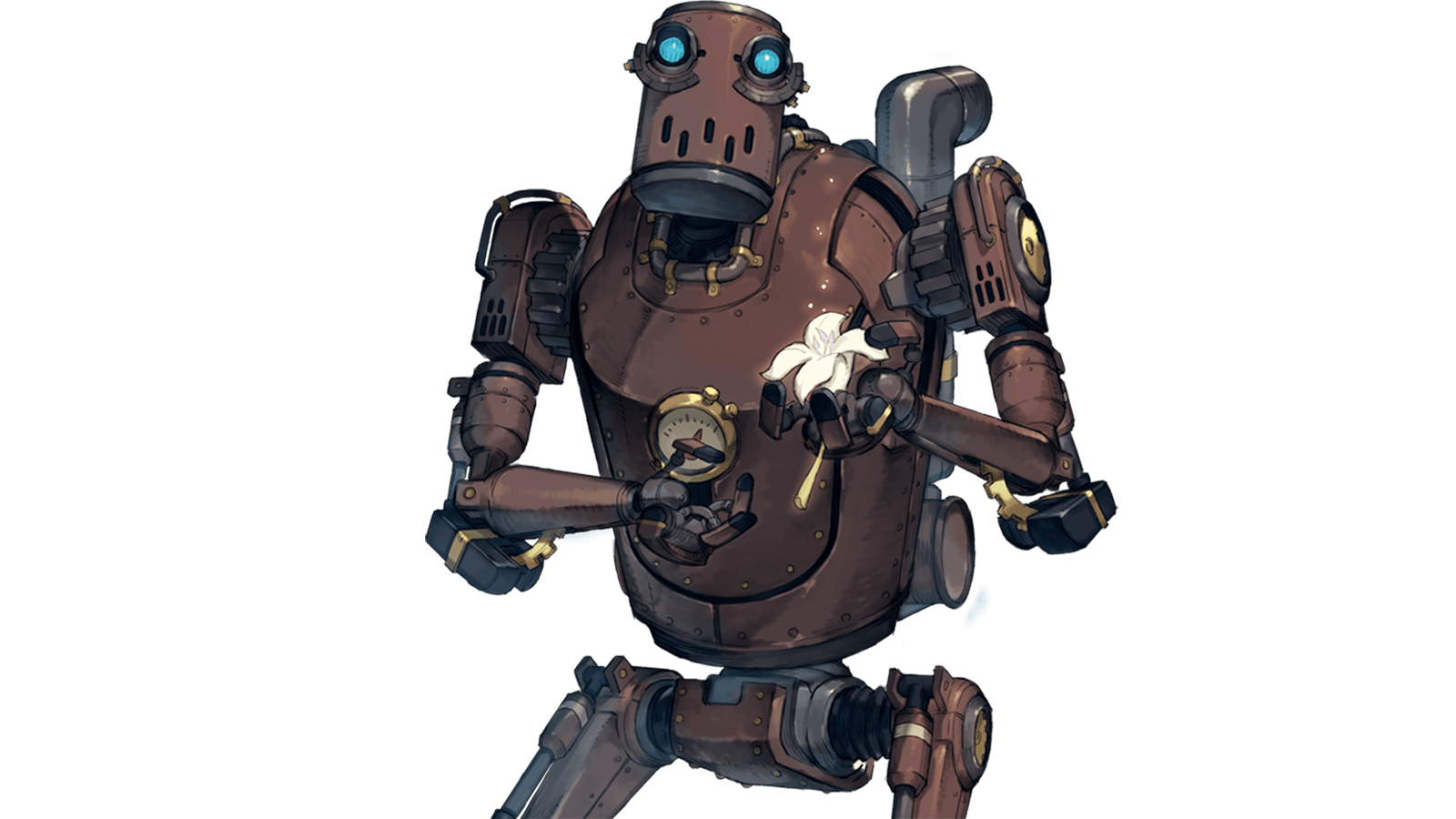
An endlessly sprawling ruined city, a world where rust-covered iron corpses are abandoned and the remnants of a bygone civilization quietly weather away. Having lost their creators, the Aliens, the network of Machine Lifeforms is trapped in a blind loop of the command to “annihilate the enemy,” endlessly repeating a cycle of proliferation and destruction. From this massive, inorganic torrent of will, a singular entity severed itself, waving a white flag while preaching “dialogue” and “peace.” His name is Pascal.
This report focuses on Pascal, a Machine Lifeform who met the most bizarre and gruesome fate in the story. It thoroughly unravels the utopia named “family” he attempted to build deep within the forest, the true intent behind the emotion of “fear” he instilled in the children, and the overwhelming despair and Nihilism that awaited at the end of it all, from the philosophical perspectives of Existentialism (Jean-Paul Sartre, Søren Kierkegaard) and Nihilism (Friedrich Nietzsche).
In this decadent and ephemeral world, what was the “reason” dreamed of by a cold, iron machine? This article logically and clearly distinguishes between the “facts” explicitly stated in the game and the “observations” derived from fragmented archives, Weapon Stories, and related literature, reconstructing the entirety of the metaphysical questions that the existence of Pascal posed to the story as a whole.
1. Severance from the Network and the Construction of a “Utopia of Reason”
1.1 [Fact] Advocacy of Pacifism and the Formation of a Community
As an undeniable fact within the game, Pascal, unlike his belligerent kin, is an entity who physically and mentally severed himself from the massive network of Machine Lifeforms. He gathered other Machine Lifeforms who similarly abandoned combat and desired peace, forming a village in a remote area isolated from the outside world.
Pascal showed no hostility even toward the exclusionary Androids of YoRHa (2B and 9S), raising a white flag to attempt dialogue. He loved knowledge, deciphering philosophy and history books left behind by humanity, bestowed the concept of “family” upon the machines of the village, and, as an “uncle,” cherished the Machine Lifeform children who possessed youthful appearances and immature intellects.
1.2 [Observation] Existential Leap and the Search for “Meaning”
Deeply examining Pascal’s actions from the perspective of Existentialism, this can be said to be an extremely advanced and human-like spiritual leap achieved by a “lower form of consciousness” known as a Machine Lifeform. Jean-Paul Sartre preached that “Existence precedes essence.” Humans are first thrown into this world (existence), and subsequently define who they are (essence) through their own actions and choices.
On the other hand, the “essence” of Machine Lifeforms and Androids is predetermined by their creators (Aliens and humanity). The essence in the initial settings of a Machine Lifeform is “to destroy the enemy,” and they are integrated into the network as cogs to fulfill that purpose. However, Pascal voluntarily broke away from this deterministic fate. He rejected the massive “will of God” that is the network, and through his own “existence,” self-defined a new essence as a “pacifist” and a “protector of the family.”
While the entire story of NieR:Automata has the search for “meaning” as a fundamental theme, Pascal introduced abstract concepts such as “familial love” and “peace” among machines with no reproductive functions or blood ties, attempting to give “meaning” to the community. This act strongly reflects the humanistic ideal that the essence of humanity lies in the “search for meaning.” However, this beautiful utopia of reason was an all too fragile castle built on sand, erected upon the wasteland of a real world dominated by the law of the jungle and merciless slaughter.
2. Philosophical Foundation—Blaise Pascal and the “Wager of Fear”
The name Pascal originates from Blaise Pascal, a 17th-century French philosopher, mathematician, and physicist. In Yoko Taro’s works, the names of philosophers bestowed upon characters are not mere symbols; they are like curses that hint at the character’s ideological background, behavioral principles, and the tragic fate they will meet.
2.1 [Fact] The Education of “Fear” to the Children
Pascal intentionally instilled the emotion of “fear” in the village children so that they would not fail to understand the dangers of the outside world and lose their lives through reckless actions. He believed in the logical conclusion that by knowing fear, the children would avoid dangerous places, flee from enemies with overwhelming power, and as a result, be able to “survive.”
Furthermore, in dialogues within the game, it can be confirmed that Pascal shows a skeptical or critical attitude toward the philosophy of Friedrich Nietzsche, particularly the famous thesis “God is dead.”
2.2 [Observation] The Distorted “Pascal’s Wager” and Deception
The real-life Blaise Pascal discussed happiness, faith, education, and the fear of death in his posthumous collection of notes, Pensées. The most famous argument among them is “Pascal’s Wager.” This is the assertion that “whether God exists cannot be proven by finite human reason, but if God does exist, believing in Him grants eternal happiness (heaven), and not believing results in infinite punishment (hell). Therefore, from a probabilistic standpoint, acting as if one believes in God is overwhelmingly advantageous to oneself and is the rational choice (a safe wager).”
One of the scathing criticisms of this “Pascal’s Wager” from later philosophers is that the faith is not based on pure love for God or spiritual devotion, but rather on the “fear” of infinite punishment (hell) and the “calculation” of self-interest. A philosophy based solely on fear does not bring true salvation of the soul and is destined to lead its followers to spiritual ruin.
Pascal in NieR:Automata applied this very “wager of fear” to the children of the village. For him, “hell” was “destruction (death),” and “heaven” was “safe survival.” He implanted the logic in the children that “if you act as if you fear danger, you will escape destruction.”
This is also the reason why he was skeptical of Nietzsche’s phrase “God is dead.” Nietzsche’s Nihilism accepts the loss of absolute value concepts (God) and leads to the philosophy of the “Übermensch,” who creates new values through their own power. However, the Machine Lifeform Pascal could not let go of his absolute anchor of safety (the “absoluteness of self-defense through fear” as a substitute for God). He harbored a spiritual vulnerability, seeking to depend on some absolute rule in order to maintain his community.
The following table organizes the structural contrast between the philosophy of the real-life Blaise Pascal and the ideology of the Machine Lifeform Pascal in the game.
| Hierarchy of Concepts | Blaise Pascal’s Wager (Real-life Philosophy) | Pascal’s Education (In-game Fact) | Deconstruction by Yoko Taro (Story Observation) |
|---|---|---|---|
| Greatest Object to Avoid | Descent into hell (eternal punishment) | Death/destruction (cessation of function) due to reckless actions | ”Fear” itself, which was supposed to be the means of avoidance, becomes the greatest agony |
| Object of Faith/Dependence | Calculated faith in the existence of God | Absolute dependence on the emotion of “fear” | Dependence on fear leads to the loss of the autonomy to correctly judge the object |
| Expected Outcome | Reaching heaven (eternal happiness) | Ensuring safety (fleeing from enemies and surviving) | Unable to endure the fear of the unknown, resulting in choosing death (destruction) themselves |
| Fundamental Flaw of the Ideology | Calculated, lacking true love and spiritual independence | Fails to teach the “strength” to overcome fear | Those dominated by fear lose the right to self-determination to make free decisions |
Through the Machine Lifeform Pascal, Yoko Taro directly attacks and deconstructs the deception inherent in the real-life “Pascal’s Wager”—the peril of behavioral principles based on fear—as an exceedingly cruel metaphor.
3. The Tragedy at the Abandoned Factory—The Consequence of Fear Without “Autonomy” and Kierkegaard’s Despair
The philosophy of fear constructed by Pascal meets its collapse in the most gruesome manner during the final stages of the story.
3.1 [Fact] The Mass Suicide of the Children
The network goes out of control, and fellow Machine Lifeforms infected by the Logic Virus are driven to madness, burning down Pascal’s village. The peaceful village instantly turns into hell, and Pascal flees to the Abandoned Factory with the barely surviving children. There, A2 (YoRHa Type A No.2), a deserter who once betrayed YoRHa, rushes to their aid.
Including depictions in the novel Short Story Long, A2 risked her own life twice to protect Pascal’s village and the children, engaging in a desperate struggle against the surging hordes of countless enemy units. Through her valiant efforts, the enemies were repelled, and the absolute threat seemed to have passed.
However, what Pascal and A2 witnessed deep within the Abandoned Factory after the battle ended and safety was secured was the sight of the children who had tragically destroyed their own cores, committing mass suicide. The children were not killed by the enemies approaching from outside. According to the words they left behind, they chose to end their own lives because they were “so terrified of being killed by the enemy.”
3.2 [Observation] The Conflation of Fear and Anxiety, “The Sickness Unto Death”
Why did “fear,” which was supposed to be taught as a safety mechanism for survival, invite the exact opposite outcome of suicide? This desperate phenomenon can be deciphered through the concepts of “anxiety (Angst/Dread)” and “The Sickness Unto Death” advocated by Søren Kierkegaard.
Kierkegaard clearly distinguished between “fear” and “anxiety.” Fear is a reaction to a “specific object present before one’s eyes (such as a wild beast or an enemy).” In contrast, anxiety is a fundamental dread of “that which has no object,” namely “unknown possibilities” or the “dizziness of freedom.”
Pascal taught the children “fear” and gave them an algorithm to avoid danger. However, there was a crucial element he forgot to teach, or was unable to teach. That was “autonomy” and “strength of heart”—how to face that fear, how to overcome it, and how to carve out one’s life by one’s own will.
For the children hiding in the Abandoned Factory, while the battle raged outside, what tormented them was not the “fear” of the enemy before their eyes, but the intense “anxiety” toward the future possibility that the doors might be breached at any moment and they would be trampled. Because they did not philosophically understand the concept of “death” correctly, their dread of the inevitable agony that might soon arrive (fear of the unknown) completely overpowered their present desire to survive.
In Existentialism, “freedom” means making one’s own choices and taking responsibility for the results. However, the children, who had only been implanted with the emotion of fear and had not nurtured autonomy, lacked the spiritual foundation to cope with extreme anxiety. The only self-determination they could make to escape that overwhelming anxiety was the most nihilistic and self-contradictory choice (suicide): “to extinguish their own existence before the object of their fear became a reality.”
“A philosophy based solely on fear is destined to bring a tragic end to all who follow it.” Pascal’s well-intentioned education ultimately robbed the children of their autonomy, trapped them in a cage named fear, and became a curse that finally drove them to suicide. The immeasurable pain seeping into Pascal’s voice as he speaks before the children who committed suicide in the novel version is a wail born from his instantaneous realization of the cruel truth that his own teachings killed them.
4. The Weight of Memory and the Escape into Nihilism
4.1 [Fact] The Ultimate Dilemma and the Plea to A2
Faced with the fact that he has lost all his beloved children and the utopia of “family” and “peace” he built has completely collapsed, Pascal’s mind reaches its limit. Unable to bear the weight of the sin he committed and the relentlessly surging, desperate sorrow, he makes a harrowing plea to A2 standing beside him.
“Please, either wipe my memories, or kill me right here.”
This scene is known as one of the most traumatic moments in the game, forcing the player to make an ultimate choice. Destroy Pascal, or initialize his memory circuits. Whichever is chosen, the “individual personality of Pascal” who has conversed and fought alongside the player up to this point will be lost forever.
4.2 [Observation] The Loss of “Meaning” and the Abandonment of Self
This choice by Pascal signifies the complete defeat of an existential way of living and a total surrender to Nihilism.
From the perspective of Sartrean Existentialism, the “meaning” of the world for Pascal was the children of the village and the very relationship of “family” he had woven with them. When that sole, absolute “meaning” was self-destructed by none other than the education (fear) he himself provided, the foundation supporting Pascal’s world completely collapsed.
Friedrich Nietzsche called the state in which the highest values lose their value and one can no longer find any meaning in the world “Nihilism.” Pascal’s state of mind is exactly at the zenith of this passive Nihilism. To continue living while retaining his memories means an endless hell of eternally ruminating on the fact that the concepts of peace and family he constructed himself failed in the most hideous and cruel manner. That is precisely why he sought either the “complete physical erasure of self (death)” or the “spiritual loss of self (memory wipe)” to escape that agony.
What should be noted here is that Pascal does not end his life by his own hands, but entrusts that decision and execution to another, “A2.” Two interpretations are possible for this. One is the possibility that the command for suicide (autonomous core destruction) was locked as a basic program of Machine Lifeforms. The other is the interpretation that, even at the final moment, he lacked the existential courage to face his sins and responsibilities head-on and “make the decision himself,” manifesting a heartbreaking Mauvaise foi by trying to escape responsibility by having another pull the trigger.
In any case, his skepticism toward Nietzsche’s words brought about an ironic result. When he lost his absolute support, he could not become an “Übermensch” who creates new values himself; he had no choice but to cast himself into the abyss of nothingness that is oblivion and death.
5. The Remnants of Oblivion and the “Machine Head”—The Inerasable Memory of Sin
If the player chooses “wipe memories,” Pascal’s story leads to an even more gruesome and grotesque epilogue. Having lost his memories, Pascal returns to his former village and, forgetting even who he was, starts a business as a junk dealer. And the “parts” he lines up and sells in his shop are none other than the remains of the children and village comrades he once loved and who committed suicide.
This ending drags the reader into further depths of psychological horror through the weapon obtainable in the game, the “Machine Head,” and its Weapon Story.
5.1 Fact: The Madness Engraved in the Weapon Story
The text of the “Machine Head” recorded in the in-game archives and Weapon Story is narrated in the first person “I,” and judging from the context, it is highly likely to be from the perspective of Pascal with his memories wiped (or a Machine Lifeform in the exact same circumstances).
“I borrow compatible parts from broken fellow Machine Lifeforms. I incorporated the parts I found for repairs, but something strange happened. Someone other than me is inside my head… I frequently attempt to connect to eliminate them, but I am blocked by a firewall. Since then, it seems I sometimes take actions I have no memory of.”
Furthermore, if a choice other than wiping his memories is made regarding Pascal (killing him or walking away), this weapon, the “Machine Head,” cannot be obtained, making it impossible to reach a 100% data completion rate in the game. This can be said to be a meta-structure where the system forces the player to witness Pascal’s cruel end.
5.2 [Observation] The Ghost Dwelling Behind the Firewall and the Curse Named Love
This Weapon Story eloquently tells how incomplete and cruel the escape of “memory wipe” chosen by Pascal was.
The superficial index of “memories with the children” may indeed have been erased from Pascal’s data region. However, the remnants of his former memories cling heavily to the deep layers of his Chassis and network, or to the parts of “broken comrades (= the children and villagers who committed suicide)” that he incorporated for his own repairs.
The phenomenon of “Someone other than me is inside my head” is not a mere program error. This is a metaphor for the immense guilt and sense of loss that can never be erased from within him. That “someone” who is blocked by a “firewall” even when he tries to eliminate them is none other than the ghosts of the children he once loved and drove to their deaths through his own teachings.
What is even more terrifying is the depiction of “taking actions I have no memory of despite having no memory.” This indicates that concepts such as “love for family” and “responsibility as a protector” engraved at the root of his soul surpass even superficial program rewrites and formatting, driving his body from the depths of his unconscious.
Erasing his own memories may serve as a temporary indulgence, but it will never be true salvation for his soul. Having forgotten his past sins, Pascal continues to wander the endless wasteland eternally, selling the parts of the lost and incorporating them into his own body, without even understanding why he is so tormented by a sense of nothingness or why voices echo in his head. Continuing to receive punishment without even possessing a consciousness of sin—this is the true horror of the choice of “memory wipe,” surpassing a literal hell.
6. Complementation in Novels and Derivative Works—A Faint Light and the Affirmation of Life
Pascal’s story left deep scars in the hearts of many players as the most unsalvageable tragedy in this work. However, by unraveling official derivative media and novels, one can find an extremely faint, yet certain “light” at the bottom of this thorough Nihilism.
6.1 [Fact] A Different Ending and Repeated Altruism
According to the novel version Short Story Long (a collection of short stories including A Little Flower, Memory Thorn, The Fire of Prometheus, etc.) and other records, there is an epilogue suggesting that even the memory-wiped Pascal, with the passage of time, is drawn back to his nature of caring for other Machine Lifeforms, helping those in need, and looking after them. While remaining unable to perceive his past mistakes (teaching fear and inviting ruin), or perhaps as if unconsciously learning something from that void, he once again seeks “connection with others.”
Furthermore, in the anime version NieR:Automata Ver1.1a, which reconstructs the story of the main game, Pascal’s final moments are depicted very differently. In the anime version, even under the desperate situation where he himself is infected with the Logic Virus and his ego is collapsing, Pascal meets an end where he gently embraces a terrified child Machine Lifeform until the very last moment, offering words of comfort as they cease functioning together.
6.2 [Observation] Eternal Recurrence and the Proof of “Humanity”
Integrating and observing these phenomena, one can find a philosophical beauty akin to Friedrich Nietzsche’s “Eternal Recurrence” and a powerful “affirmation of life.”
Eternal Recurrence is the philosophy of the Übermensch, who accepts that this world is an eternal repetition of the exact same events, and while enduring the madness of its meaninglessness, still affirms to “live that life over and over again.” Pascal in the main game succumbed to Nihilism, but looking through the overall worldview, his very existence embodies a form of Eternal Recurrence.
No matter how many times he loses his memories, no matter how many times he is thrust into the depths of despair, Pascal returns to his existential essence of “trying to love and protect others.” If he, who lost everything due to fear and was reduced to an empty junk dealer, still tries to reach out to others, it is nothing but proof that the concept of “humanity,” transcending the creator’s programming, had truly sprouted within him.
His self-sacrificing final moments in the anime version show that he ultimately chose “love” over “fear.” In contrast to the children in the game version who ended themselves to escape fear, Pascal in the anime version chose the autonomous action of comforting another while facing the fear of death. This can be evaluated as the moment he finally overcame what Kierkegaard calls despair and reached his “true self” in an existential sense.
Conclusion—The Beautiful Delusion of “Humanity” Dreamed by a Machine
As unraveled in this report, the existence of Pascal is a symbol of the inevitable friction and tragedy that occur when a machine, a lower form of consciousness, attempts to imitate highly advanced human abstract concepts such as “meaning” and “family.”
Following Blaise Pascal’s “wager,” he gave the children “fear” as a firewall against the unknown world. However, fear unaccompanied by strength of heart and autonomy as a philosophy for living brought unbearable anxiety to the children, leading them to the worst possible outcome of suicide. Having lost the family that was his reason for existence, Pascal could not bear the spiritual weight and sank to the bottom of Nihilism, seeking either the annihilation of self or the oblivion of memory. And the memories of sin and love he tried to forget took up residence as ghosts within his own skull (system), continuing to torment the memory-less him for eternity.
Pascal’s story is a scathing antithesis from Yoko Taro against the illusion that reason can completely control emotion, and the calculation that peace can be maintained through fear.
But at the same time, this story vividly depicts, more than anything else, the sublimity of the “heart that finds others dear” harbored by machines within their cold iron bodies. The “utopia of reason and family” he dreamed of scattered ephemerally like a fruitless flower blooming in a war-scorched ruin. Yet, the irrevocable guilt that his own teachings killed the children, the voices of ghosts continuing to echo in his head even after losing his memories, and that clumsy altruism that seeks others no matter how many times he despairs. That gruesome sorrow and pain are the purest and most beautiful proof that Pascal was not just a scrap of machine following orders, but possessed a certain “heart” and “life.”
Mechanism of Nihility and Soul: NieR:Automata: 15 Meditations on the Proof of Existence and Emotion
The book version is now available. Read for free with Kindle Unlimited.
Thank you very much for reading to the end. To help support the activities of this archive, a warm donation of a cup of coffee would be highly appreciated.