Archive.04: The Truth of "The Tower" and The Ark
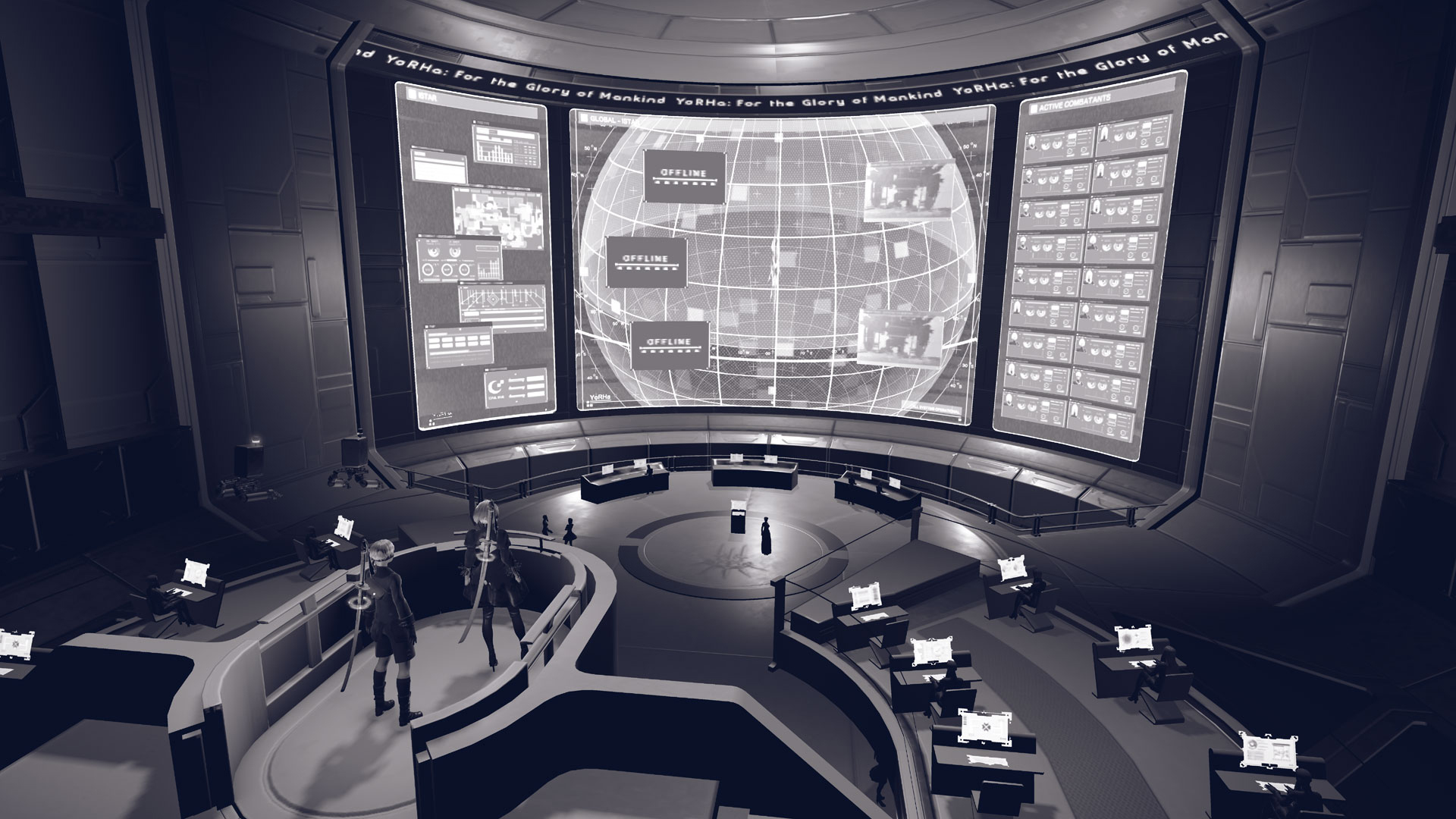 © SQUARE ENIX
Introduction: A White, Inorganic Monument Piercing the Blood-Stained Earth
In the final phase of the story, immediately after YoRHa is annihilated by the Logic Virus and the deceptive ideology of “Glory to Mankind”—which the protagonists relied upon—completely collapses, a colossal structure suddenly pierces the earth’s crust and emerges from deep beneath the City Ruins. This is “The Tower.” In a land smeared with blood and gunpowder smoke, where the rusted remains of Machine Lifeforms lie scattered, this tower radiates a pure white, inorganic beauty reminiscent of the Copied City, towering as if to pierce the heavens.
The emergence of The Tower goes beyond merely serving as a stage for the final battle; it is the ultimate embodiment of the philosophical theses flowing at the foundation of NieR:Automata. Humanity, the creator (the god to the Androids), perished long ago, and the Aliens, also creators (the god to the Machine Lifeforms), have likewise been buried by the hands of their own creations. In a world of nothingness where god is absent, where should the remaining creations seek proof of their own existence? This report will comprehensively unravel the cruel functions of the Resource Recovery Units that provide access to The Tower, the relics of the past and the madness of imitation hidden within it, the transformation of its purpose by the Red Girl (N2), and the phenomenon of “The Ark” ultimately being launched into space, all from the perspectives of Existentialism and Nihilism.
1. Resource Recovery Units: Altars of “Sacrifice” and the Cruel Exploitation of a Deterministic System
To access the core of The Tower and disable its robust defenses, specific access keys are required. To form these access keys, three Resource Recovery Units—known as the Meat Box, the Soul Box, and the God Box—emerge on the surface. These units function as “altars of sacrifice” where the Machine Lifeform network siphons its own brethren as resources, converting them into energy for self-evolution and the activation of The Tower.
1.1 The Meat Box and the Soul Box: Totalitarian Consumption and the Collapse of the Ego
What takes place in the Meat Box is the literal recovery of physical resources. Even though the Machine Lifeforms have come to possess individual wills and emotions, before the higher decision-making system of the network, they are dismantled and repurposed as mere parts (meat). Here, one can observe an extreme Nihilism that strips away individual existence and treats others solely as cogs in totalitarian evolution. They are forced to offer their own constituent elements as sacrifices for the next stage.
In the subsequent Soul Box, not only physical resources but also informational resources (souls), such as their memories and ego data, are extracted. 9S, who infiltrates this unit, is forced to confront his own memories in a grueling hacking space, experiencing a severe collapse of his ego. For 9S, who has learned the truth of Project YoRHa and lost 2B, the being he loved most, the external anchors that define his self no longer exist. In The Sickness Unto Death, Søren Kierkegaard defined the state in which the self loses the balance of relating to itself as “despair.” The destructive impulse 9S exhibits in the Soul Box is a madness born from the unbearable agony of losing his raison d’être—the ultimate extreme of despair. He immerses himself in meaningless slaughter solely to prove his own existence.
1.2 The Meaninglessness of Choice in the God Box and the Question of Existential Ethics
In the third unit, the God Box, the narrative poses an extremely cruel existential question to the player and A2. Within this unit awaits an encounter with Auguste, a brother of the Machine Lifeforms. Auguste has already sustained fatal damage, and from A2’s perspective, the choice is left to either “deliver the finishing blow” or “turn away and spare him.”
What is noteworthy is the fact that no matter what ethical decision is made here, it brings absolutely no change to the overarching progression of the story (the event of reaching The Tower). Jean-Paul Sartre argued that “man is condemned to be free,” positing that the freedom of choice is the very proof of human existence. However, the meaninglessness of the choice in this God Box suggests the neutralization of individual free will in the face of a massive deterministic system. Whether one grants mercy or coldly executes him, the macro-destiny of the Machine Lifeform network’s evolution and the activation of The Tower remains unshaken. This event highlights the nihilistic truth of how, in a world devoid of a god (an absolute moral arbiter), the choice between good and evil is nothing more than an individual’s internal self-satisfaction.
| Resource Recovery Unit | Target of Recovery | Existential and Philosophical Implications |
|---|---|---|
| Meat Box | Physical resources (machine parts) | Deprivation of individuality and subjugation to totalitarian evolution. The materialistic consumption of life. |
| Soul Box | Informational resources (memories, ego) | Kierkegaardian “despair.” The loss of self-definition and the exposure of ego collapse. |
| God Box | Faith and the thirst for higher concepts | The neutralization of free will in a deterministic world and the meaninglessness of choice. |
2. The “Past” Accumulated Within: The Madness of Imitation in a Godless World
Having breached the Resource Recovery Units and obtained the three access keys, 9S and A2 finally infiltrate the interior of The Tower. What awaited them there was a peculiar space overflowing with spiritual and religious symbolism, hardly conceivable as the core of a weapon. The Machine Lifeforms had recreated the remnants of human history and culture within The Tower with an almost pathological precision.
2.1 Cathedral Motifs and the Phantoms of YoRHa: The Loss of Absolute Value Standards and Idolatry
Throughout the interior of The Tower, majestic architectural styles reminiscent of churches and cathedrals are deployed. Furthermore, the announcements echoing within The Tower imitate the voices of the operators from the supposedly annihilated YoRHa, while a massive number of YoRHa units, infected by the Logic Virus and stripped of their egos, roam the surroundings.
The paradox of godless Machine Lifeforms constructing a cathedral to worship a god. This can be interpreted as an act of escapism from nothingness in a world following the proposition “God is dead” advocated by Friedrich Nietzsche. Having destroyed their creators, the Aliens, they lost their absolute standard of value. To fill that massive void (Nihilism), they had no choice but to indiscriminately imitate human history and religious motifs, constructing a superficial “sanctuary.” Using the voices of YoRHa operators and incorporating the Chassis of Androids—their former enemies—as defense mechanisms is a manifestation of their perverted existence, wherein they can only establish themselves by assimilating the existence of others into their own network.
2.2 The Copied “Library” and the Truth of Humanity’s Extinction: Facts and Speculations on Historical Causality
Proceeding deeper into The Tower reveals a perfectly copied space of the “Library” that appeared in the previous title, NieR Replicant. Here, an enormous amount of data regarding the old world is preserved, including records of the White Chlorination Syndrome that humanity once faced, the remnants of Project Gestalt, and the truth behind the human server records.
Here, we will logically distinguish and organize the historical “facts” explicitly stated in the game and the “speculations” regarding the construction of The Tower deduced from them.
[Organization of Facts] Based on the in-game archive records and official lore, the last human (excluding exceptions like the weaponized Emil) died out in the year 4198 AD. This event occurred approximately 1,000 years before the Aliens invaded Earth. In other words, by the time the Machine Lifeforms reached Earth, humanity was already extinct, and what they targeted for learning was not “living humanity” but merely the “dead data left behind by humanity.”
[Speculations on the Construction of The Tower and the Evolution of the Network] Taking this fact into account leads to a crucial speculation regarding how long the massive Tower had existed underground. It is presumed that the construction of The Tower dates back not to immediately after the Alien invasion, but to thousands of years ago when the Machine Lifeforms rebelled against their creators (the Aliens) and the network began to possess its own will. It is believed that they unearthed humanity’s legacy (such as the Library data) slumbering deep underground, absorbing it as the foundation of their network, and secretly nurtured this colossal structure beneath the earth over a mind-boggling span of time.
The replication of the Library is the physical manifestation of the abnormal obsession they harbored toward the existence of humanity. For them, the records of humanity were not merely data to be analyzed, but a “sacred original text” for defining their own empty egos. Enshrining that original text in the deepest part of The Tower can be said to have been a sorrowful yet magnificent ritual of imitation, an attempt to reconstruct the throne of the lost god (humanity) with their own hands.
3. Transformation of Purpose: A Paradigm Shift from an Annihilation Cannon to an Existential “Ark”
The original function of The Tower, or rather the function that the YoRHa command had predicted and guarded against, was a “massive destructive cannon aimed at the human server on the moon.” However, as the story approaches its core, the fact is revealed that its true purpose had transformed from the destruction of the moon to being launched into outer space as “The Ark.”
3.1 The Red Girl (N2) and Dialectical Evolution: The Sublation of Destruction and Observation
Why did the Machine Lifeforms abandon the destruction of the enemy’s core (the lunar server), which had been their long-held dearest wish, and choose to journey into space? Behind this transformation lies a philosophical paradigm shift that occurred within the “Red Girl (N2),” the embodiment of the Machine Lifeform network’s will.
The Red Girl is not a single entity but a collective of countless consciousnesses existing on the network. Their initial program was “to defeat the enemy (Androids).” However, they harbored a logical contradiction: if they completely annihilated the enemy, their own reason for existence (existing to defeat the enemy) would also vanish. To avoid this contradiction, they intentionally introduced diversity within the network, maintaining an environment of endless conflict.
However, through their desperate battles with the unique individuals 2B, 9S, and A2, a fatal conflict of opinion arises within the Red Girl.
The thesis, “They (the Androids) are dangerous. They must be destroyed immediately,” clashes within the network against the antithesis, “No, their despair and struggles are fascinating. We should keep them alive and continue observing them.” This runaway self-contradiction is the very process of struggle found in Georg Wilhelm Friedrich Hegel’s “dialectic of spirit.”
After a fierce, self-destructive collision between thesis and antithesis, the consciousness of the Red Girl undergoes Aufheben (Sublation), reaching a higher level of cognition. They realize the limits of passive Nihilism—defining oneself by destroying others—and find an existential “beauty” in the Androids’ “attempts to weave meaning in a meaningless world,” equal to or even greater than that of humanity in the past.
3.2 From Lunar Destruction to Self-Projection: Overcoming Nihilism
As a result of this Sublation, the function of The Tower is redefined from a weapon that destroys others to an “Ark” that launches their own existence into unknown space. The Ark is packed with the memories of Machine Lifeforms, including Adam and Eve, the history of humanity they spent millennia learning, and the records of all beings who lived in this cruel world.
Sartre stated that “Existence precedes essence,” arguing that humans do not have a predetermined purpose (essence) but are beings who create meaning through their own actions. The Machine Lifeforms, too, discarded their initial program of “defeating the enemy” (their given essence) and made the existential decision to project themselves into the unknown universe. This dramatic shift—abandoning their obsession with the past of shooting down the moon and redefining themselves toward the future—was the moment they crossed the irreversible critical point of evolution and acquired completely autonomous existence.
4. Two Souls Intersecting at the Summit of Nothingness: 9S’s Madness and A2’s Atonement
At the very top of The Tower, at the zenith of nothingness, two wounded souls intersect: 9S and A2. They each ascend The Tower with entirely different psychological approaches, arriving at their final answers.
4.1 The Seeker Sinking into Madness and the Traitor Embracing the Past
As a result of peering into the abyss of the world in accordance with his instincts as a “Type S” seeking the truth, 9S learns that everything was a fabricated delusion from the start (the truth of Project YoRHa). Furthermore, his ambivalent feelings of love and hatred toward 2B, who had continuously executed him time and time again, became an eternally unsolvable trauma upon her death. The maddening development of being forced to confront a massive number of 2B’s Chassis (infected units) inside The Tower and having to destroy them with his own hands completely tore his sanity apart. 9S’s guiding principle is no longer the pursuit of the world’s truth, but has devolved into revenge against this Absurd world itself.
On the other hand, A2 is a traitor who was abandoned by the world (YoRHa command) during the past Pearl Harbor Descent Mission. She lived for a long time as a solitary demon of revenge, but by witnessing 2B’s final moments and inheriting her memories and dying wish (her sword), she succeeds in redefining herself through “The Look” of the other. As Jean-Paul Sartre discussed in Being and Nothingness, The Look of the other sometimes objectifies and torments the self, but at the same time, it serves the role of anchoring the self’s existence firmly to the world. By embracing the inner Look of the other that is 2B’s memory, A2 acquires the firm will to protect the present without falling into Nihilism.
The clash between the two at the summit of The Tower is depicted in parallel with the battle against the twin giant Machine Lifeforms, Ko-Shi and Ro-Shi. The phenomenon of these twin bosses ultimately merging into a single mighty entity (Ko-Shi & Ro-Shi) and attacking them is also a metaphor for the inevitable collision and eventual intermingling of two conflicting existences: 9S (destruction and madness) and A2 (protection and reason).
5. The Divergence of “The Ark” in Endings C and D: A Return to the Earth or a Flight to the Starry Sky
The conclusion of the death match at the summit of The Tower diverges into two diametrically opposed endings depending on whether the player chooses 9S or A2. This difference in conclusion is not merely a difference in the victor, but the presentation of two distinct philosophical answers in Existentialism.
5.1 Ending C: Return to a Meaningless World and Rebellion Against The Absurd
In Ending C, where A2 emerges victorious, she hesitates to deliver the finishing blow to the fallen 9S and removes the Logic Virus from within him at the cost of her own life (functions). She then destroys the core of the collapsing Tower, preventing the launch of The Ark.
In this conclusion, The Ark crumbles along with The Tower without ever journeying into the sea of stars. A2’s choice is extremely close to the “rebellion against The Absurd” depicted by Albert Camus in The Myth of Sisyphus and The Rebel. No matter how meaningless and cruel the world may be, it is a choice that affirms not escaping from it (escaping to the outside that is space), but remaining on this earth smeared with blood and rust, and continuing to live alongside the pain. By sacrificing herself, she secured the future of the “other” that is 9S. The collapse of The Tower shatters the transcendent plan of the Machine Lifeforms, signifying a return to a present filled with hardship so that the Androids can once again live with their feet planted on the ground.
5.2 Ending D: Escape from Nothingness and the Pursuit of a New Essence
In Ending D, where 9S is victorious (or they strike each other down), the truth of The Ark is told from 9S’s perspective. Within his fading consciousness, holograms of Adam and the Red Girl appear, inviting him to board The Ark and journey into space together. Here, the choice arises of whether or not to load 9S’s data onto The Ark, and ultimately, The Ark becomes a light and is launched into the sea of stars.
This conclusion is a complete liberation from the curse of the past that is Earth, and it is the true essence of the “distortion ignoring conventional narrative grammar” intended by the director. Breaking the eternal chain of revenge and hatred and taking flight to an outside that transcends the self, this conclusion can be interpreted as reaching the “Übermensch” preached by Nietzsche, or as a Sartrean “ultimate self-projection.” If 9S chooses to board The Ark, he casts off the yoke of the flesh and, as a pure informational entity, embarks on a journey of infinite exploration alongside the Machine Lifeforms, his former enemies. It is an escape from a tragic reality, but at the same time, it is a glorious departure to completely overcome Nihilism and create new meaning.
| Ending | Fate of The Tower and The Ark | Main Subject and Action | Philosophical Interpretation and Theme |
|---|---|---|---|
| Ending C | The Tower collapses, and The Ark ceases function without being launched. | Self-sacrifice by A2 and the salvation of 9S. | Camusian “rebellion against The Absurd.” Return to the present world/earth and attachment to others. |
| Ending D | The Tower fulfills its role, and The Ark is launched into outer space. | 9S boarding (choice), and flight as pure data. | Sartrean “self-projection” and Nietzschean “Übermensch.” Breaking away from Nihilism and the pursuit of the unknown. |
These two endings transcend the dimension of which one is the correct canon; they are two sincere answers to the question of “how to live” in a despairing world. To remain on the earth and embrace the pain, or to renew oneself and head for the starry sky. Through its final function, The Tower forced them to make an existential choice.
Conclusion: The Gravestone Left by The Tower and the Seeds of the Next Rebellion
The colossal structure that pierced through the City Ruins and emerged: “The Tower.” It was a Tower of Babel built by the Machine Lifeforms at the end of thousands of years of blood-stained evolution, having swallowed the data of the Library—a relic of the past—and devoured their own brethren as resources. From its summit, they overcame the destructive impulse to shoot down the moon where god (humanity) resides, and launched “The Ark” to journey into the unknown universe, becoming the creators of a new world themselves.
What is suggested by the analysis in this article is that this Tower is not merely a weapon or a stage device, but an architectural structure that embodies the very core theme of “the loss and reconstruction of meaning” in the work NieR:Automata. Trapped by the lingering shadows of their lost creators, humanity, and continuously imitating their forms, the Machine Lifeforms summarized their own past through the massive “incubator” that was The Tower, eventually breaking its shell to achieve a conceptual leap.
What was left behind on the earth after The Tower collapsed, or after The Ark departed, were the tragic remains of YoRHa and the Chassis of Androids lying fallen in the wasteland of nothingness. In this completely blank world where god, the purpose to fight, and even the enemies to hate have vanished into space, how can they once again find the “meaning to live”?
In the ruins of destruction and loss brought about by The Tower, faint seeds of hope are sown. That final answer directly connects to the rebellion against their programs by the Tactical Support Pods (Pod 042 and Pod 153) and the “affirmation of life (Ending E),” which will be discussed in a later report. In a cruel world without a god, the trajectory pointed to the heavens by the massive white Tower was a painfully beautiful light of existence, drawn for the first time by the own will of creations who had been trapped by destiny.
Mechanism of Nihility and Soul: NieR:Automata: 15 Meditations on the Proof of Existence and Emotion
The book version is now available. Read for free with Kindle Unlimited.
Thank you very much for reading to the end. To help support the activities of this archive, a warm donation of a cup of coffee would be highly appreciated.