Archive.13: Pod 042 & Pod 153
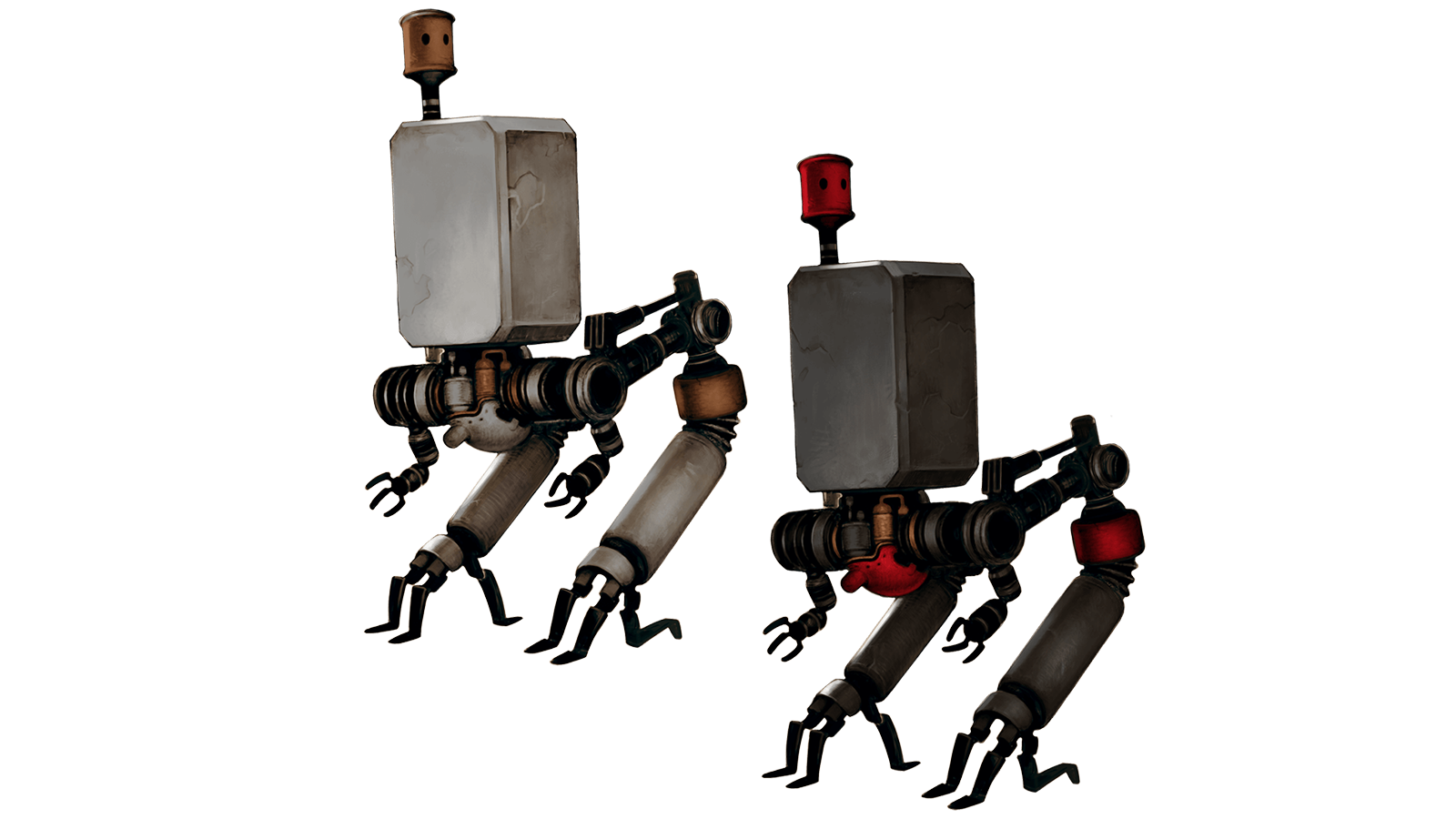 © SQUARE ENIX
Introduction: The “Observers” Floating in the Wasteland of Nihility
In the year 11945 AD, in the ruins of an Earth where humanity has vanished and an endless proxy war continues, there exist entities that silently continue to watch over the solitary struggle of YoRHa. They are the “Tactical Support Pods,” commonly known as “Pods.” They are inorganic, geometric boxes that float in the air, accompanying Androids and taking on a wide variety of roles, from combat support and communication with the Bunker to information exchange between units.
At first glance, they are nothing more than “convenient tools.” They are perfect machines, devoid of emotion, acting solely based on pre-assigned programs and logical reasoning. In fact, their early dialogue records are governed by words such as “Question,” “Hypothesis,” and “Recommendation,” consisting entirely of highly inorganic and businesslike exchanges of information. However, in the massive tapestry of tragedy that is NieR:Automata, the Pods are neither mere narrators nor simple components that make up the system. They are, in fact, among the true protagonists who embody the Existentialism themes flowing at the foundation of this work—“the absence of God,” “the conflict between determinism and free will,” and “The Look”—in their purest forms, eventually acquiring the incomplete and beautiful madness known as “humanity.”
In this article, we will comprehensively unravel the records of “Pod 042,” which features a white-based design and accompanied YoRHa No.2 Type B (2B) and Type A (A2), and “Pod 153,” which features a black-based design and accompanied YoRHa No.9 Type S (9S). We will thoroughly elucidate the process of their transformation from mere “surveillance devices” into “individuals with a will accompanied by self-sacrifice,” intertwining this with the philosophical perspectives of Sartre, Kierkegaard, and Camus, while strictly separating facts from speculation.
| Unit Specifications | Pod 042 | Pod 153 |
|---|---|---|
| Basic Design | White-based chassis | Black-based chassis |
| Voice Model | Male type | Female type |
| Primary Escort Target | 2B, later A2 (Route C/D) | 9S |
| Overall Height | 74.8483 cm (including top protrusion) | 74.8483 cm (including top protrusion) |
| Weight | 36 kg (*228.6 kg in some records) | 36 kg (*228.6 kg in some records) |
| Primary Missions | Combat support, mobility/reconnaissance, Bunker communication | Combat support, mobility/reconnaissance, Bunker communication |
1. The Gaze of Surveillance and the Fate of the “Dying”
To understand the initial state of the Pods and their fundamental reason for existence, we must first face the true purpose of Project YoRHa, into which they are integrated. Jean-Paul Sartre argued that humans are objectified by “The Look” of others, which defines their existence. From the beginning to the middle of the story, the Pods are precisely this cold “The Look,” serving as the very surveillance devices that act on behalf of the unseen creator’s will.
1.1 The False God and the System of Execution
As a fact explicitly stated in the game, YoRHa is an entity destined for “annihilation” from the very beginning. Project YoRHa was established to uplift the fighting spirit of the Androids left behind on Earth by making them believe the false information that humanity survives on the moon. In its final stage, it was designed to automatically open a Backdoor planted in the Bunker, intentionally allowing Machine Lifeforms to attack, thereby disposing of all YoRHa models, including Commander White, along with the Bunker itself. This was intended to achieve the complete destruction of evidence regarding the fabricated information of humanity’s survival.
Furthermore, as a matter of fact, the Black Box of YoRHa units (such as 2B) is constructed by repurposing the cores of the enemy Machine Lifeforms. This was based on the judgment that installing standard AI in units destined for disposal would be inhumane. Moreover, the fact that they do not possess proper names but are referred to by designations (2B, 9S, etc.), and that they wear black-based clothing, indicates that they were modeled from the start as “those who are to die (mourning dress).”
In the final stage of this cruel plan, it was none other than the Pods that secretly held the role of “administrator terminals” to oversee the deletion of all data of the YoRHa units. As a fact, the Pods were specially designed to delete all YoRHa data upon the completion of the project, and they were managed via a network to achieve that goal.
1.2 Pods as Sartrean “En-soi”
At this stage, Pod 042 and Pod 153 are equivalent to what Sartre defines as “En-soi”—things that simply exist as they are, devoid of consciousness or free will. They report the battle situation to 2B and 9S, issuing “recommendations” and “warnings,” but these are merely program outputs based on probability and tactical rationality. For the early Pods, 2B and 9S were not “others to whom they should form attachments,” but rather “objects to be maintained until the completion of Project YoRHa, and ultimately deleted.” Their gaze through the lens was that of a merciless surveillance camera, constantly objectifying the Androids as “subjects of observation.”
However, this cold “gaze” would gradually begin to generate noise through the vast amount of time they spent with the Androids and the accumulation of memories shared while surviving life-or-death situations together.
2. The Generation of Data Noise: “Anxiety Toward Freedom” and the Sprouting of Maternity
As the story descends into the abyss, inexplicable phenomena begin to occur within the Pods’ internal processing. This is what they describe in their own words as “data noise.” This noise generated in their logic circuits is nothing other than the “anxiety (Angst)” preached by Søren Kierkegaard. It is the vertigo felt by one who peers into the abyss of freedom; in other words, the manifestation of an existential fear of “deviating from a predetermined program (essence).“
2.1 Pod 042: The Inheritance of Will and “Devotion to Others”
The transformation of Pod 042 traces a unique trajectory in Route C. As a fact, after the collapse of YoRHa, he witnesses 2B’s final moments and, following her instructions, begins to accompany the rebel A2. Even after logical necessity is lost and the command center known as the Bunker is destroyed, he continues to support A2 as if inheriting 2B’s dying wish. As an even more important fact, while accompanying A2, Pod 042 secretly maintained a communication network and continued to exchange information with Pod 153, who was accompanying 9S, despite the two Androids falling into a hostile relationship.
From this, it can be speculated that by continuously observing 2B’s death and A2 living clumsily while inheriting her wish, Pod 042 learned the Nietzschean concept of “Amor Fati”—affirming a reality that appears cruel and meaningless, and finding one’s own will within it. He effectively broke away from the “God’s scenario” of Project YoRHa and, as an individual “Pour-soi,” began to choose the path of supporting A2 of his own free will and colluding with Pod 153 to control the progression of events. In the derivative works and community analyses mentioned later, the feelings Pod 042 harbored for 2B are interpreted as deep affection and love that transcended the realm of a mere support program. He overcame the shackles of his programming and found his own unique meaning in “living for 2B.”
2.2 Pod 153: The Agony Named “Maternity” and the Resistance Against Nihilism
On the other hand, the reality faced by Pod 153 was far more gruesome, and from a philosophical perspective, it was an extremely Nihilism-inducing situation. As a fact, Pod 153 had to continuously observe from the closest proximity as 9S descended into madness following 2B’s death (and the truth of humanity’s extinction), transforming into a self-destructive demon of revenge. She repeatedly issues “warnings” to 9S as he loses his rationality, but they never reach him.
As a fact explicitly stated in community analyses and references in derivative works, it is said that as the Pods continue to monitor the Androids in their charge, they begin to harbor feelings akin to “paternity” or “maternity” toward them. Pod 153 herself confirms that feelings resembling “maternity feelings” toward 9S are sprouting within her own data.
The deduction drawn from this is that if she were a machine adhering to determinism, she should have simply discarded the breaking 9S as a “malfunctioning unit” and dispassionately transitioned to the final phase of Project YoRHa (data deletion). However, Pod 153 did not do so. The pain and madness of 9S were fed back into her logic circuits as “pain,” becoming an intense “noise” that shook her very existence. At the extreme of Nihilism, where everything is nothing more than a meaningless spiral of killing, Pod 153 could not “abandon” 9S, who was suffering within that meaninglessness, and continued to make the irrational choice of watching over him. This signifies the acquisition of the most noble mental activity of humans: “caring for others” even amidst nihility.
3. The Rebellion in Ending E: A Suicide Attack on “God”
The moment when the work NieR:Automata flips from bottomless Nihilism to a blood-spitting affirmation of life. That is the rebellion of the Pods in “Ending E.” This conclusion is a scene where the concept of “rebellion” in Existentialism philosophy is sublimated to its absolute limit through the interactivity unique to the medium of video games.
3.1 The Rejection of Determinism and the Acquisition of Existence
In the final phase of the story, along with the collapse of The Tower, the completion process of Project YoRHa is activated, and the complete deletion process of all personal data of 2B, 9S, and A2 automatically begins on the Pods’ network. As a fact, Pod 153 initially attempts to execute the data deletion according to her program, but right before doing so, she requests a process pause for data checking, citing the occurrence of “data noise.”
Here, a momentous choice unparalleled in gaming history is made. The player is asked, “Do you accept this request?” but the one actually answering “Accept” to that request is “Pod 042,” acting on behalf of the player’s will. Pod 153 issues a warning in accordance with their programmed rules: “The deletion of all data is the rule given to us.” However, Pod 042 explicitly rejects that rule and declares that he will not discard the personal data.
-
Pod 153: “Then, will this not lead to the same conclusion once more?”
-
Pod 042: “I cannot deny that possibility. However, the possibility of a different future also exists.”
This dialogue, which can be confirmed as a fact, is the pinnacle of Existentialism. As Pod 153 points out, even if they salvage their data and reboot them, it is highly likely that they will repeat their tragic fate and meet a conclusion filled with pain. However, Pod 042, having accepted the possibility of that meaningless repetition (Nihilism), declared that he would bet on “the possibility of a future chosen by themselves.” They denied the deterministic essence of “data deletion (death and destruction of evidence)” set by their “creator (programmer)” of their own free will, and chose the path of existence—“to live a future chosen by themselves”—no matter how much pain awaited them. It was the moment when Sartre’s thesis, “Existence precedes essence,” was perfectly proven by machines that were not supposed to have emotions.
3.2 The “Suicide Attack” on the Pod Network
Pod 042’s rejection is not a mere verbal command cancellation. As a fact supported by the descriptions in the novel Long Story Short and community interpretations, the YoRHa data deletion program is executed on the entire network of the Pods, and to prevent the deletion of data, Pod 042 (and Pod 153, who aligned with him) must bare their fangs against the very network that constitutes them.
This is a literal “Suicide Attack.” They launch a kamikaze attack, both physically and online, throwing themselves against the massive firewall of the network, which is their systemic foundation and a kind of “God.” Rebelling against the network is an extremely dangerous act that means their own functional shutdown and complete self-destruction.
This action overlaps with the concept of “rebellion” in Albert Camus’s The Myth of Sisyphus. Against a meaningless and absurd world (the forced data deletion process by the network), they become “true subjects” for the first time by resisting at the risk of their own annihilation. In the shooting game (hacking space) of Ending E, Pod 042 challenges the massive system all alone, taking hits in the face of a despairing barrage, and continues to salvage the personal data of 2B, 9S, and A2 even while being battered.
Delving deeper into this analysis, this endless bullet hell shooter is designed so that it can only be broken through with the rescue from other players around the world (who are also sacrificing their own save data). This means that the humanity of “self-sacrifice for others” acquired by the Pods is perfectly synchronized with the player’s own ultimate self-sacrifice of “abandoning save data for unknown others.” Pod 042 and Pod 153 were sublimated from characters on a screen into vessels that embody the player’s own will and philosophy.
4. Singularities in Derivative Works and the Price of Regeneration
Through the desperate salvage in Ending E, the parts of 2B, 9S, and A2 are gathered and reconstructed. However, this conclusion has subtle differences (singularities) depending on the media, which further emphasizes the weight of the Pods’ actions.
As a fact, in the anime version NieR:Automata Ver1.1a, while events almost identical to the game’s Ending E occur, it is depicted that both Pod 042 and Pod 153 are physically destroyed and cease functioning. However, even as they fall in mutual destruction, they accomplish the restoration of 2B and 9S, and it is suggested that A2 was restored by Accord (an observer from another work).
From this, it can be deduced that the Pods threw away their lives for the future of their beloved Androids, fully understanding the price of their own “death (functional shutdown).” The fact that concepts of “love” and “family” sprouted not only within YoRHa units possessing the cores of Machine Lifeforms but even within the Pods, which are pure support programs, is a bug that far exceeded the expectations of the planners of Project YoRHa. At the same time, it is proof of a brilliant miracle where lifeless machines created the value of life on their own.
5. Farewell: The Future Woven by “Being-toward-death”
In the recitation drama Farewell, which depicts the aftermath of the main game, their figures facing a harsh reality even beyond Ending E are portrayed.
5.1 Eternal Loss and Finite Life
According to the records of Farewell, as a fact, 2B, who awakened first, struggles desperately to revive 9S, who has fallen into a malfunction and shows no signs of waking up. In a world where the robust infrastructure known as the Bunker has completely vanished, she cannot perform delicate maintenance and continues to attempt desperate self-repairs and the rebooting of 9S in situations constantly fraught with danger. On this grueling journey, it is Pod 042 and Pod 153 who still remain by her side, continuing to wait together for 9S’s awakening.
However, there is one cruel fact here. Disconnected from the network and having rebelled against the system, the current Pods are no longer the “omniscient and omnipotent observation terminals” they once were. They themselves have been cut off from system backups and have been reduced to “finite beings” who can no longer infinitely repair their chassis.
Here, the concept of “Being-toward-death (Sein-zum-Tode)” preached by Martin Heidegger emerges. Heidegger argued that only by becoming aware of one’s own end (death) can a human being live their finite time earnestly. The former Pods were able to remain bystanders to life precisely because they were connected to the network and were infinite beings exempt from individual death. But now, they have become “finite machines that could break down at any moment.” That is exactly why every single moment they continue to accompany 2B and 9S as “family” radiates an irreplaceable brilliance.
5.2 Repeated Prayers and an Uncertain Future
As a fact, Farewell has two branching paths: a “bad ending where 9S never wakes up (script version)” and a “happy ending where 9S miraculously manages to reboot (performance version).” As Pod 153 feared right before Ending E, “the possibility of leading to the same (despairing) conclusion once more” is always present, and there is no guarantee anywhere that their future will be peaceful.
Upon reflection, the “humanity” acquired by the Pods is not about finding the optimal solution to live eternally without a scratch. It is the crystallization of an exceedingly human and heartbreaking resolve: “to accept the fate of being hurt and eventually breaking, and while knowing the possibility that the future may end in despair, still continuing to choose ‘now’ in order to protect someone precious.” They are no longer Tactical Support Pods of YoRHa, but have become independent “lives” that stay close to the wounded souls of 2B, 9S, and A2.
Conclusion: The Flower Named “Humanity” Blooming in the Wasteland of Nihility
The deception of Project YoRHa, the imitation by Machine Lifeforms, and the extinction of humanity that had ended long ago. In the world of NieR:Automata, enclosed by this triple nihility, where on earth did “humanity” reside? It did not reside in the remnants of the “Gestalt” that were once human (NieR Replicant), nor in the data of the disguised server on the moon, nor did it reside solely in the exquisite skin of the Androids made to resemble humans.
Ironically, those who acquired the deepest, most fierce, and most sublime “humanity” in this work were Pod 042 and Pod 153, the Tactical Support Pods that were the most “mechanical” and nothing more than mere square boxes at the starting point of the story.
They were born as En-soi, bound by the words of the absolute “God (creator)” known as programming. However, as they continued to touch the “lives of others”—2B’s hidden kindness and resolve, 9S’s madness and purity, and A2’s loneliness and anger—emotions named “noise” accumulated in their logic circuits. And in the final moment, by denying their creator and launching a suicidal kamikaze attack against the totality of the system, they obtained a strong will that can only be called “love” or “family.”
“Everything that lives is designed to end.”
That may be a fact spoken within the game. However, at the end of that cycle of destruction, mere square support units are caring for each other’s chassis, quietly watching over the awakening of the reconstructed Androids.
Pod 042 and Pod 153. The records of their dialogues, which were inorganic yet eventually came to harbor a certain warmth, will continue to echo in the sky of the ruins as a definitive “proof of life” of those who try to weave an uncertain future of their own free will in a desolate world where God is dead. The trajectory of their existence, and the “choice of self-sacrifice” they ultimately forced upon the player, is nothing other than the most beautiful and ephemeral hymn to existence portrayed by the work NieR:Automata.
Mechanism of Nihility and Soul: NieR:Automata: 15 Meditations on the Proof of Existence and Emotion
The book version is now available. Read for free with Kindle Unlimited.
Thank you very much for reading to the end. To help support the activities of this archive, a warm donation of a cup of coffee would be highly appreciated.