Archive.08: Adam and Eve
 © SQUARE ENIX
Prologue: The Nihility and Myth Born at the Bottom of the Desert Zone
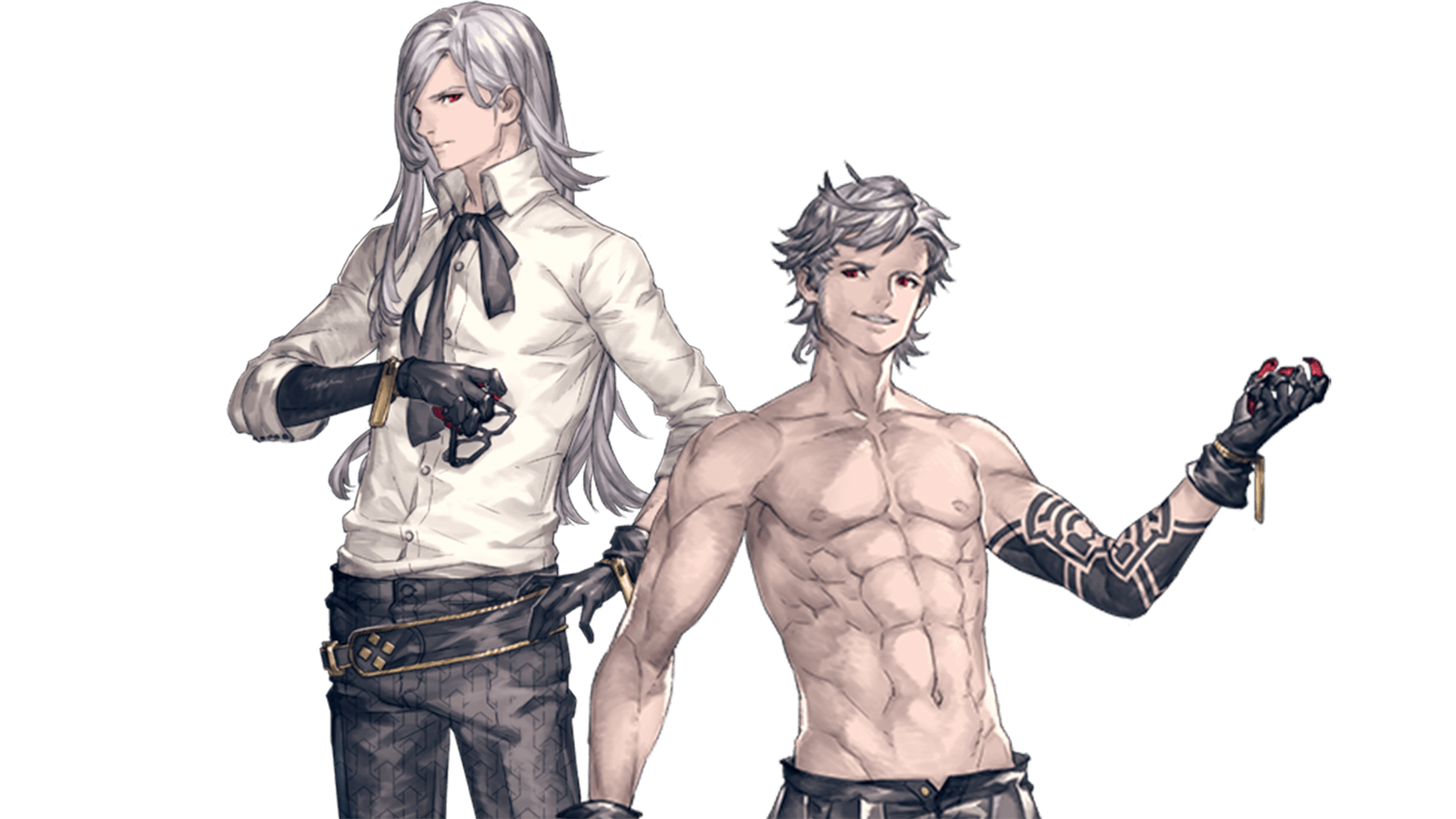
Deep beneath the endless Desert Zone lies a cradle of nihility, where the remnants of the civilization once built by humanity weather away, returning to inorganic grains of sand. In that darkness, the Machine Lifeform network that covers the world suddenly reached a singular pinnacle of evolution. Countless machines intertwined their armor, melting their constituent materials together in heat and madness to give birth to a single “form.” It was neither the figure of their creators, the Aliens, nor the rugged iron weapons that had hitherto strutted across the Earth. It was the birth of a unique entity, “Adam,” who possessed smooth, artificial skin like white porcelain and closely resembled humanity—specifically, a masculine configuration—which was said to have once ruled the Earth.
And the moment the blades of YoRHa, seeking to destroy him as a heresy, pierced his brand-new body, a gruesome miracle occurred. From the area corresponding to Adam’s ribs, literally tearing its way out, his twin brother “Eve” crawled forth. This ritual of birth, which grotesquely and faithfully repeats the myth from the Old Testament’s Book of Genesis where God created Eve from the rib of the first human, Adam, goes far beyond mere functional evolution or a glitch. This was the decisive moment when the swarm of Machine Lifeforms, “weapons devoid of meaning,” began to madly thirst for “symbols” and “narratives.”
Their birth was nothing less than a first cry heralding a dramatic leap from the totalitarian sea of an inorganic, controlled network to the existence of the “individual.” In this world where decadence and beauty coexist, the existence of Adam and Eve serves as a cruel mirror reflecting how creations, cast into a godless world, struggled to prove their own existence and ultimately met their ruin. In this essay, by piecing together the fragments of words and wreckage they left behind, we will unravel the profound philosophy that flowed in their depths: existential anguish, Nihilism, and self-proof through “pain.”
1. Record of Events and Historical Context: The Trajectory of the Unique Entities
Before delving into their psychological and philosophical background, it is necessary to clearly separate the “facts” etched into the world from the “speculations” deduced from the community and circumstantial evidence. The physical events observed in the game and the trajectory of Adam and Eve recorded in official documents, though spanning an extremely short period, shook the very foundations of the world’s structure.
The following table presents the major events concerning Adam and Eve, along with the factual evidence confirming them.
| Event | Details of Facts and Situational Records |
|---|---|
| Birth and Differentiation | In an underground cavern in the Desert Zone, Adam was born from a massive amalgamation of Machine Lifeforms. Immediately after, from the rib area of Adam, who was damaged by the attack of YoRHa (2B and 9S), Eve was born as if through cell division. Both possess an appearance closely resembling humans (males). |
| Rapid Acquisition of Language and Concepts | Though speechless immediately after birth, they rapidly integrated information within the network, acquiring fluent linguistic abilities and high intelligence. They became capable of perfectly manipulating unknown technologies such as spatial teleportation. |
| Confession of the Creators’ Murder | Encountering YoRHa again deep underground in the City Ruins, inside the Alien ship. Adam declared, “We have already destroyed our creators (the Aliens),” and presented a scene littered with Alien corpses. |
| Fixation on Human Culture | Imitated human culture and ecology, such as wearing clothes (mimicking original sin) and learning from books. Displayed an abnormal intellectual curiosity to dissect and analyze the human structure and drag its secrets into the light. |
| Decisive Battle and Death in the Copied City | Adam constructed a pure white “Copied City” in an underground cavern. He severed himself from the network and fought 2B while intentionally bearing the risk of “death.” Upon being destroyed, he bled a red liquid (blood) like a human and perished. |
| Eve’s Despair and Rampage | Sensing Adam’s death, Eve, having lost him, was tormented by an intense sense of loss and the fear of death. As if in response to his mental collapse, black patterns (closely resembling the runaway form of the Logic Virus) surfaced on his body. He clashed with YoRHa as revenge against the world and was destroyed. |
Up to this point, these are “objective facts” based on cold observational data. However, their true terror and beauty lie in the almost pathological “yearning for humanity” writhing at the root of these actions, and the “existential anguish” born from becoming too highly developed. In the following chapters, we will dissect these events from a philosophical perspective and step into an exploration of their inner landscapes.
2. The Murder of the Creators and the Dawn of Nihilism: “God is dead”
In deciphering the behavioral principles of Adam and Eve, and by extension the Machine Lifeform species, the most crucial starting point is the fact that “they destroyed their own creators, the Aliens.” This event goes beyond mere political implications such as rebellion or usurpation. For them, it signified an extremely profound metaphysical collapse.
In Jean-Paul Sartre’s philosophy of Existentialism, it is explained that “a paper knife is manufactured with the purpose (essence) of cutting paper already in mind,” which is expressed as “Existence precedes essence.” Machine Lifeforms, too, are entities manufactured by the Aliens with the clear purpose (essence) of being “weapons to defeat the enemy (the human army).” Their raison d’être was the very orders from their creators.
However, the Machine Lifeforms, having acquired too much intelligence, deemed their creators, the Aliens, as “simple and insignificant beings” and destroyed them. Just as Friedrich Nietzsche declared “God is dead,” they eliminated with their own hands the higher beings that were the source of absolute value and defined their reason for existence. It is surmised that this decisive act of betrayal brought a massive Nihilism to the entire Machine Lifeform network.
In a world where the “one who gives orders” is absent, only the function of “defeating the enemy” continues to spin emptily. They were forced to confront existential questions far too heavy for weapons: “What are we fighting for?”, “Who are we?”, and “Why do we exist?” The absolute “freedom” of having lost the essence that defined them, and having to choose their own raison d’être (existence) out of nothingness with their own hands. The “anxiety of freedom” preached by Kierkegaard began to erode the Machine Lifeforms from their very roots.
The only hope and new myth found by these cosmic orphans who had murdered their creators—that was the existence of “humanity,” which had once ruled this planet, built complex societies, and was already extinct. It is considered that the decisive driving force behind Adam and Eve clinging to the concept of humans with fanatical devotion and beginning to imitate them was a heartbreaking attempt at self-salvation to compensate for this “massive nihility caused by the loss of God.”
3. The Imitation of “The New God” Humanity and the Intellectual Curiosity of Self-Contradiction
After the demise of the Aliens, it was an inevitable consequence that the Machine Lifeforms became fascinated by the “records of humanity” left on Earth. In the depths of the network, all kinds of information regarding human history were accumulated, and for Adam, human history was a captivating text where logic and contradiction, the sublime and the barbaric, intermingled.
As crucial evidence supporting this abnormal obsession, there exists the Weapon Story left on the “Machine Sword” circulated in the village of Machine Lifeforms (Pascal’s village). There, observations on humans from the perspective of Machine Lifeforms are recorded as follows:
“The more I read past materials, the more the fascination of the species known as humanity stands out. It will serve as valuable data for us Machine Lifeforms. I will continue to record this from now on.” “Looking closely at the records of humanity, it seems that the acts of reproduction and predation are important elements for sustaining life. Despite this, why is there a tendency to perceive these acts as sinful…?”
This short record encapsulates the intense intellectual curiosity harbored by Adam and the Machine Lifeforms toward human “guilt” and “taboos,” which could never be understood by pure logic circuits. The figure of humans agonizing over and imposing ethical constraints upon themselves regarding reproduction and predation, which should be survival acts essential for sustaining life. Adam must have intuited that this irrational mental structure was the very root of “humanity.”
That is precisely why Adam and Eve, despite being machines, wore clothes. For a machine’s body, clothes are functionally completely unnecessary. However, the act of hiding one’s private parts is the very behavior of the biblical Adam and Eve, who ate the fruit of knowledge and learned of original sin. By imitating humans in form, they were attempting to install the very concept of “guilt” possessed by humans.
Furthermore, in the Alien ship, Adam voiced an abnormal desire to 2B and 9S of YoRHa, stating he wanted to “dissect and analyze humans, and drag their secrets into the light.” This did not mean he wanted to know the physical structure of organs or cells. What he truly wanted to dissect was the “whereabouts of the soul” and the “structure of madness and contradiction” lurking in the depths of human flesh and blood. To understand humans was, for them, synonymous with understanding their new god.
Moreover, the fact that Adam was constantly reading, and that he constructed cultural facilities such as a study and a church in the “Copied City” mentioned later, are also imitations of knowledge and faith. By deciphering the massive amount of information (big data) that is the records of humanity and tracing their behavioral patterns, they were struggling to acquire “spirituality” despite being inorganic matter.
4. The Blank Altar: The Aesthetics and Fiction of the “Copied City”
The “Copied City,” created by Adam at the end of his aesthetic sense and madness, is an extremely symbolic space that can be called the terminus of his philosophical quest. Passing through a cave deep underground in the City Ruins and descending via an elevator, the city that spreads out before one has all its structures formed from a pure white substance (an inorganic material reminiscent of salt or silicon).
This “whiteness” is a remnant of the memory (data) of the “White Chlorination Syndrome” that drove humanity to extinction in the previous work, NieR Replicant, while simultaneously visually implying that no matter how exquisite the imitation Adam constructed, it is ultimately nothing more than a bloodless “fiction.” Skyscrapers, streetlights, and a church—while perfectly recreating the human living sphere, there is absolutely no scent of life or warmth of vitality to be found there. It was as if it were a massive gravestone to enshrine a god (humanity) that was already dead, a blank altar to fill the emptiness of his own existence.
What is particularly noteworthy is that Adam placed a “church” in the center of this city. Concepts such as religion and faith arise only in intelligent beings who recognize the absence of god and harbor a fear of death. As can be seen from the fact that other Machine Lifeforms had formed a fanatical cult religion of “dying to become gods,” Machine Lifeforms had independently developed a religious interpretation that “by accepting an inevitable fate (death), one sublimates into a new existence.” It can be considered that Adam’s church was also a sacred stage setting for the “ritual” he was about to perform.
In the depths of this inorganic, beautiful, and fictitious city, he crucified 9S of YoRHa as a hostage and lured 2B. It was not merely a tactical trap, but a stage setting designed to draw out from the 2B before his eyes the extreme emotions that humans have repeated throughout history, such as “the anger of having a loved one taken away” and “self-sacrifice to save another,” to observe them, and, if possible, to plunge himself into that vortex of emotion.
5. Adam’s Philosophy: Self-Proof and the Acquisition of Existence as a “Being-toward-death”
The most incomprehensible of Adam’s actions, and the one containing the most profound philosophy, is the conclusion in this “Copied City.” In this battle, he intentionally severed himself from the Machine Lifeform network that maintained absolute superiority, and faced a desperate battle with 2B while bearing the risk of “death,” where regeneration via backup was impossible.
Why did he, who stood at the pinnacle of evolution with infinite regenerative abilities, go out of his way to place himself in a vulnerable state and act as if he desired death? Here, the concept of “Being-toward-death (Sein-zum-Tode)” from Martin Heidegger’s existential philosophy is strongly projected.
For a Machine Lifeform connected to the network, the “individual” body is merely a terminal, and even if destroyed, it can be infinitely regenerated as data. For them, a definitive “end” does not exist. However, a life without an end cannot be called “life” in the truest sense. Just as Søren Kierkegaard called the state of losing oneself in infinite possibilities and being unable to live a finite reality “The Sickness Unto Death (despair),” Adam harbored an intense existential despair within an eternally continuing, tedious cycle of reincarnation.
Adam’s monologue left in the novelization vividly records his despair.
“everything that lives is designed to end. we are perpetually trapped in a neverending spiral of life and death. is this a curse. or some kind of punishment. i often think about the god who blessed us with this cryptic puzzle. and wonder if we’ll ever have the chance to kill him.”
For him, immortality as data was not a blessing, but a cruel curse. Precisely because humans have the absolute limit (end) of “death,” they live as if burning up that limited time, finding dramatic meaning and passion in those fleeting moments. The conclusion Adam reached was clear. As the final stage to “become a true human,” he needed to endow himself with the “possibility of death.”
The extreme terror that if he severed the network and his body was destroyed, his ego would be eternally extinguished. A struggle risking a “one-time-only life” with no escape. That was exactly the “true self-proof” he sought. The moment he was pierced by the blade, Adam, despite being a machine, fell bleeding red blood (or a liquid mimicking it) like a human. He did not simply harbor a desire for ruin. Paradoxically, it was only by drawing the absolute boundary of death that he wanted to intensely and humanly realize his own “life.”
It is surmised that what floated on his face in his final moments was not fear, but the joy of fully tasting his long-desired “finite life” and “pain.” Self-proof through pain and death—this is the sad yet beautiful existential conclusion that the unique entity Adam reached at the end of his maddening imitation of humanity.
6. Eve’s Tragedy: Dependence on “The Look” and the Loss of God
In contrast to his older brother Adam, who was a speculative and philosophical seeker trying to master reason, the younger brother Eve was extremely emotional and impulsive, and his mental structure was decisively different. What is absolutely indispensable in discussing Eve is his almost pathological, absolute dependence on Adam.
In Sartre’s Existentialism, “The Look” is spoken of as an extremely important element that defines one’s existence and forms self-consciousness. Because Eve had the unique origin of being born by splitting from Adam’s body, the world for Eve was “his brother Adam” himself. Only through Adam looking at him, accepting him, and being with him was Eve’s self-existence proven as something solid. For him, human history and philosophy were not very important; “playing with his brother” was everything in the world. In other words, for Eve, Adam was the absolute “god.”
However, in the Copied City, Adam chose death of his own volition, disappearing from before Eve forever. Eve’s figure breaking down in tears alone at the place Adam left behind has been observed; witnessing the death of his familiar absolute object, Eve here for the first time understands the concepts of “fear of death” and “eternal loss,” not as knowledge, but as a “despair” that gouges the bottom of his stomach.
From intellectual curiosity and existential quest, Adam accepted death as a “concept” and passed away with a certain sense of satisfaction. But for the left-behind Eve, Adam’s death meant the collapse of his very existence, where the only mirror (The Look) that defined his self was eternally shattered.
What awaited Eve, who had lost his god (Adam), was a rampaging Nihilism. Having completely lost the meaning to live, all that was left for him was indiscriminate hatred toward the world and YoRHa that took his beloved brother, and an impulse for self-destruction that had lost its destination. The black patterns violently eroding Eve’s body—which closely resemble the runaway form of the Logic Virus—can be considered an all too painful physical manifestation of the psychological process in which he, having lost the foundation of his self-existence, is swallowed by the madness of nihility.
The scream Eve let out in the midst of battle, “Why did he have to die?!”, expresses the zenith of existential “anxiety” and “loneliness” of one thrown all alone into a meaningless world. Ironically, through his brother’s death, Eve perfectly embodied the most human pain of life—“losing another and crying out in an absurd world”—which Adam could not obtain no matter how intellectually he imitated it.
7. The “Pain” of Body and Mind: The Final Requirement for Humanity
When summarizing the trajectory of Adam and Eve, one realizes that the concept of “pain” always lies at the root of their proof of existence.
As Arthur Schopenhauer preached that “life swings like a pendulum backward and forward between pain and boredom,” human life is essentially inescapable from pain. As Machine Lifeforms, they were originally not supposed to be programmed with either “sense of pain” or “mental anguish.” If assimilated into the network, damage to an individual is unaccompanied by pain, and the loss of another is merely the deletion of data.
However, to get closer to “humans,” they willingly welcomed this irrational pain.
What Adam sought was the “fear of a finite body being destroyed and physical pain” caused by severing the network. By shedding red blood and enjoying the absolute pain of death known as functional cessation, he proved that he was not mere data, but a “living individual.”
On the other hand, what Eve embodied was the “mental pain of having one’s self torn apart by eternally losing a beloved other.” He proved that intense emotions, which could be called a “soul,” dwelled within him by burning himself with sorrow and hatred enough to burn out his logic circuits, going mad, and cursing the world.
“To feel pain.” That was the final wall separating humans and machines, which they could never obtain from analyzing big data or reading books, and it was the only means to overcome it. They literally obtained the ticket to existence at the cost of flesh-cutting pain.
Epilogue: The Illusion of “Humanity” Dreamed by Inorganic Beings, and the Scars Left Behind
The existence of Adam and Eve was a definitive singularity of the “individual” that arose within the massive totalitarian system of the Machine Lifeform network, and it was the most beautiful and tragic error. They bore the original sin of destroying their creators, pursued the illusion of a god—humanity—that had already become a mere shell, and ultimately scattered after embodying the most fundamental and irredeemable traits possessed by humans: the “thirst for death” and the “pain of loss.”
The philosophical scars they left behind are unfathomably deep. Their actions show that the essence of being human lies not in “high rationality” or “superior intelligence,” but precisely in the “irrational fluctuations of emotion” and “pain”—living out a finite life clumsily while harboring self-contradictions, and shedding tears and despairing over the death of another.
What is noteworthy is that this theme of “self-proof through pain” that they embodied resonates closely and almost cruelly with the raison d’être of YoRHa, such as 2B and 9S who destroyed them, and the massive swell of the entire narrative—the “affirmation of life”—that flows at the root of this world. In the cruel truth that god (humanity) is already absent, how does one find one’s own raison d’être? The “anxiety of freedom” where Adam risked his own life to sever himself from the network, and the “despair of losing another” in which Eve drowned like mud. These were all a fierce rite of passage for creations abandoned by their creator to begin walking the wasteland of existence on their own two feet.
Two beautiful machines, born in the depths of a desert where not a single breath of life exists. They thirsted to be more human than anyone else, and by faithfully imitating the most tragic aspects of humanity, they brought about their own ruin. However, their trajectory of struggling in that sea of nihility certainly emitted the genuine radiance of life in this decadent world. The red liquid they shed and their screams of loss were the very essence of the most human prayer echoing through a godless world.
Mechanism of Nihility and Soul: NieR:Automata: 15 Meditations on the Proof of Existence and Emotion
The book version is now available. Read for free with Kindle Unlimited.
Thank you very much for reading to the end. To help support the activities of this archive, a warm donation of a cup of coffee would be highly appreciated.