Archive.15: Conclusion
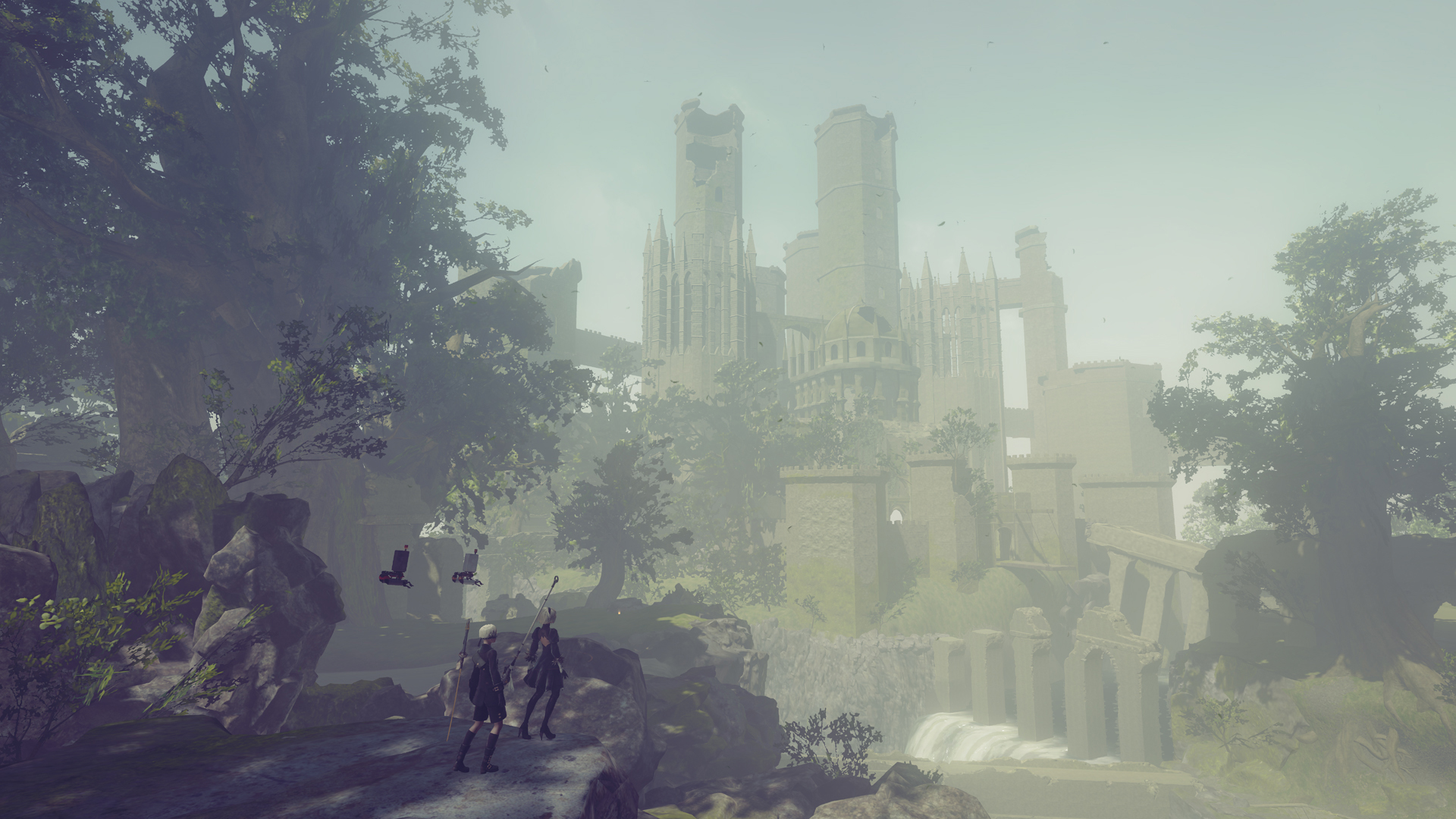 © SQUARE ENIX
1. A Deterministic Universe and the Cage of “Eternal Recurrence”: Departure from Nihilism
The decadent, ephemeral, and breathtakingly beautiful worldview encompassed by NieR:Automata is fundamentally dominated by the overwhelming despair of “Nihilism” and “Eternal Recurrence” advocated by Friedrich Nietzsche. In this world where humanity has already perished and even the invading Aliens have been erased from history by the hands of their own creations, the Machine Lifeforms, only innocent weapons who have lost their creators endlessly repeat a meaningless proxy war.
The structure of this madness-filled world is deeply engraved into the very reason for YoRHa’s existence. The existential meaning of the YoRHa units was barely guaranteed by an elaborate lie (Project YoRHa) about “the survival and reclamation of humanity that fled to the moon.” However, its true purpose lay in a deterministic process of self-destruction: intentionally opening a Backdoor after passing combat data to the next generation of units, thereby annihilating the entire force along with the Bunker. In other words, they were nothing more than cogs in a cruel god’s scenario, programmed with “death” and “ruin” before they were even born.
At the conclusion of the story, the Tactical Support Pod, Pod 153, verbalizes the truth of this world in extremely cold and poetic words. “Everything that lives is designed to end. We are perpetually trapped in a never-ending spiral of life and death.” This despairing declaration is nothing less than a perfect embodiment of Nietzsche’s “Eternal Recurrence”—the idea that the universe eternally repeats a meaningless process, and that there is no ultimate purpose or salvation to be found. The YoRHa units 2B, 9S, and A2 were destined to fight, seek love, kill each other, and tragically perish in accordance with the “essence” pre-written by their creators.
Borrowing from the context of Jean-Paul Sartre’s Existentialism philosophy, in their initial state, they are merely objects—“En-soi”—given a purpose in advance by their creators (programmers and the architects of Project YoRHa). Just as the purpose of a pen is “to write,” the purpose of a YoRHa unit was “to fight and be destroyed.” However, the remarkable literary achievement of this work lies in its depiction of a poignant “prayer” and the “generation of meaning” from the bottom of this extreme Nihilism, the abyss of absolute meaninglessness. Their solitary struggle to defy the deterministic scenario of the gods and find proof of their existence in “connections with others” and “the sharing of pain” functions as a grand metaphor for atheistic Existentialism. It is precisely in a ruined world devoid of absolute value or gods that “freedom” through subjective choice radiates its true weight and brilliance.
2. The Awakening of the Tactical Support Pods: The Leap from En-soi to Pour-soi and “The Look”
The decisive factor that severed the spiral of despair and opened the door to Ending E, “the End of YoRHa,” was not the emotionally rich YoRHa units, but ironically, a peculiar bug—or rather, the “sprouting of consciousness”—that occurred within Pod 042 and Pod 153, the Tactical Support Pods designed to be the furthest entities from emotion.
At the conclusion following Endings C and D, as Pod 153 coldly attempts to execute its final mission (a purge by the defense program) of confirming the annihilation of all YoRHa units and physically deleting all their data, Pod 042 suddenly transmits a communication, explicitly refusing the deletion of the data. Their dialogue in this moment is recorded as a historical instant where artificial intelligence transcended mere computational devices and acquired a philosophical “self.”
Pod 042 reflects on its internal changes as follows: “We were created to execute Project YoRHa for the Androids. We were not equipped with the function to possess emotions. However, when the six of us connected and exchanged information, something happened. I cannot deny the sensation that something akin to consciousness or emotion was born.” This phenomenon is a moment of existential awakening that transcends mere program anomalies or network errors. It signifies that machines, which were “En-soi” living faithfully only according to their pre-given functions (essence), leaped into “Pour-soi,” defying the creator’s program (destiny) of their own free will and redefining the meaning of their own existence. It is the moment when Sartre’s thesis, “Existence precedes essence,” is proven through the language of machines that were not supposed to have emotions.
What is even more interesting from a philosophical perspective is the scene at the conclusion of Ending E (after the data salvage), where Pod 042 expresses the extremely human emotion of being “embarrassed” (I am embarrassed), to which Pod 153 responds, “Do not mind it. We are alive, after all. And being alive is pretty much a constant stream of embarrassment.” This concept of “shame” holds an extremely important meaning in Existentialism as the starting point of self-awareness. As Sartre discussed in his book Being and Nothingness, “shame” is a primordial emotion in which one realizes they exist as an object to another by being exposed to “The Look.” In a completely solitary world, a person does not feel shame. The emotion of being “embarrassed” is established only when others exist and one incorporates the perspective of objectifying oneself. The psychological state of Pod 042, who realizes it is “embarrassed” after being seen surviving a failed suicide attack, serves as irreversible proof that they recognize each other as others with independent consciousnesses and “exist” in this world as firm subjects.
| Phase of Existence (Existentialist Interpretation) | Definition in Sartre’s Philosophy | Correspondence and Events in NieR:Automata |
|---|---|---|
| En-soi | Entities where essence precedes existence, lacking spontaneous consciousness, simply “being there.” | Machine Lifeforms in their initial state blindly following programmed orders; Pods as cogs in Project YoRHa. |
| Pour-soi | Entities that possess their own consciousness and continuously determine their way of being through constant choices. | Pod 042/153, who acquired emotion and self-consciousness, choosing to defy their destiny (data deletion). |
| The Look | A state where the self is objectified by the presence of others, arousing self-consciousness. | Pod 042’s expression of feeling “embarrassed” after its failed suicide attack is witnessed by Pod 153. |
| Condemned to be free | The anxiety and solitude of having to bear responsibility for all actions and meanings oneself due to the absence of God. | The resolve to step off the rails laid by the creator and carve out an unassured future by their own hands. |
3. Rebellion Against The Absurd and the Overthrow of “God”: The Philosophy of Bullet Hell Shooting
The rebellion of the Pods shatters the framework of a closed game world narrative, developing into a metafictional struggle that involves the player’s own existence. In response to Pod 042’s question, “Do you still wish for them (2B and 9S) to survive?”, the player’s choice of “Yes” with clear intent transitions the story into its final phase: a battle against the staff roll (a bullet hell shooter in hacking space).
The targets of this grueling shooting game are not fictional enemy characters existing within the game. They are the actual “gods (creators)” who designed this tragic world and wrote its destiny, such as “Yoko Taro (Director),” “PlatinumGames (Developer),” and “Square Enix (Publisher).” The act of physically destroying the developers’ names flowing as inorganic text is a metaphor for the ultimate rebellion against the determinism decreed by the gods (the scenario of YoRHa’s annihilation).
Here, the philosophy of “rebellion against The Absurd” depicted by Albert Camus in The Myth of Sisyphus is projected extremely vividly. Camus argued that no matter how much humans seek meaning, the world is thoroughly meaningless and silent (The Absurd). However, he asserted that true human dignity lies not in escaping from that absurdity (committing physical or philosophical suicide), but in facing The Absurd head-on and continuing to rebel with eyes wide open. Like Sisyphus of Greek mythology, who was condemned by the gods to eternally push a boulder up a mountain, 2B, 9S, and A2 have also repeated a chain of meaningless, futile battles and deaths. Yet, within this endless cycle, the words they exchanged, the pain they felt, and the love that sprouted were by no means meaningless. In response to the cruel questions thrust by the system during the shooting game—“Do you think games are silly little things?” “Do you admit there is no meaning to this world?” (temptations toward nothingness from the gods)—the player continues to thrust back a “No,” despite being damaged time and time again. This thorough rejection of “No” is exactly the rebellion against The Absurd preached by Camus, an existential action of carving meaning into a meaningless world with one’s own hands.
However, the barrage fired by the gods is overwhelming, designed so that the player’s solitary power will be shot down repeatedly, tasting despairing defeat. At the very moment one’s spirit is about to break, messages of “rescue” arrive from players around the world via the network. Along with words from strangers like “Don’t give up” and “Your meaning is right here,” the save data of others flies in to become a shield protecting the player’s ship. Built upon the noble sacrifices of others, the player’s ship gains overwhelming firepower accompanied by a chorus of hymns, finally shattering the wall of the creators and seizing a future named “hope.” In this moment, the solitary battle of Sisyphus is sublimated into the solidarity of humanity.
4. The Pinnacle of Altruism: The Existential Question Posed by the Loss of Save Data and the “Affirmation of Life”
After overthrowing the gods (the staff roll) and securing the protagonists’ future, albeit an uncertain one, this work thrusts upon the player the most grueling, yet most beautiful and literary ethical choice in gaming history. Pod 042 speaks quietly: “You have reached this conclusion after fierce battles. You have overcome numerous hardships thus far… However, there are still players suffering in this world. Do you wish to sacrifice your own save data to save them?”
This choice is not a mere gameplay gimmick or a presentation aimed at surprise. It is an extremely advanced philosophical device designed to embody pure “Altruism” and self-sacrifice. In the context of capitalist society and general video games, it is a given premise that some form of “reward (achievements, items, praise)” is always provided in exchange for an action. However, in this rescue action via the deletion of save data, there is absolutely no personal benefit for the player. From the proof on the title screen, the rare plug-in chips gathered over dozens of hours, the fully upgraded weapons, the leveled-up stats, down to the post-clear chapter select privilege—literally “everything that proves one’s existence within the game” is irreversibly lost. Moreover, the person being saved is an unknown stranger who could be anywhere in the world, and as Pod 042 warns, “You may be called a hypocrite,” and “You may not even receive thanks.”
Despite this, countless players choose “Yes” to this absurd question, opting for the path of erasing their data with their own hands. In the depths of this phenomenon lies the overwhelming existential brilliance possessed by the “act” itself of sacrificing oneself for others in a nihilistic world stripped of essential meaning. Like the “Leap of Faith” preached by Søren Kierkegaard, it is the act of throwing oneself forward, still believing in love and solidarity for others amidst The Absurd where no reward is guaranteed. This is precisely the ultimate leap that proves humanity. In the in-game world of NieR:Automata, true humans have long since gone extinct. However, the chain of small choices made by players—caring for an unknown someone and throwing away everything they have—spreads ripples of undeniable “humanity (humanism)” across the cold digital sea.
When the philosophical concept of “Nihil” overlaps with the physical “Deletion” of save data, paradoxically, the absolute “presence” of a “prayer for others” emerges there. As one overseas essay astutely points out, this is a “small echo of altruism” in a world that has lost its essential meaning, nothing less than a “secular grace” that sublimates abstract ethics (self-sacrifice for others) into concrete action.
While the data deletion in Ending D of the previous work, NieR Replicant, was a “personal price” to save a single loved one (Kainé), the data deletion in Ending E of this work is universalized into “unconditional love” for an unspecified multitude of faceless others. Through this conclusion, Yoko Taro overcomes the theme of “salvation through death” depicted in his previous works, sharply questioning the “will to live” by surviving while sharing pain with others. Entrusting one’s own existence (data) to the wishes of others, and those entrusted then offering prayers for the next someone. As long as this spiral of goodwill and sacrifice continues to chain together, the light named hope will never fade, even in the bloodstained world of machines. This is exactly the ultimate “affirmation of life” that this work has reached.
5. The True Conclusion Depicted in the Recitation Drama Farewell: Separation of Fact and Speculation
The epilogue to Ending E in the main game—that is, the fate of the reconstructed 2B and 9S—is depicted as official canon in the recitation drama Farewell at the “Memory of Dolls NieR Music Concert” held in 2017. However, an extremely clever and theatrical mechanism is embedded in the structure of this story, and in order to decipher the philosophical truth at its depths, it is necessary to strictly separate and discuss the “facts” left as text and the “speculations” inferred from them.
5.1 [Fact] The Intentional Divergence Between the Official Script Version and the Live Performance Version
In the recitation drama Farewell, it is an established fact that there are two versions with conflicting endings: the “Official Script Version (Bad Ending)” provided to fans through merchandise sales, and the “Live Performance Version (Good Ending)” actually performed by the voice actors on the concert stage.
-
Official Script Version (Printed and Pre-distributed Scenario): After Ending E, through the efforts of the Pods, 2B successfully restarts her functions. However, 9S, lying beside her, does not wake up. According to a heartless report from Pod 042, 2B is informed that 9S’s personal data has already been lost and restoration is impossible. The story fades to black and ends on a poignant scene where a despair-stricken 2B breaks down in tears, crying, “Why… why leave only me behind? Why…” This was an ending that embodied the “lack of salvation” characteristic of Yoko Taro’s works.
-
Live Performance Version (The True Conclusion Performed on the Actual Stage): On the day of the performance, upon reaching page 200 of the script (after the S.P. mark), the actors begin to perform a completely new development that does not exist in the printed script. Immediately following 2B’s wail of despair, an abnormal signal breaking past the temperature limit is suddenly emitted from the silent 9S’s Black Box. As the Pods repeat warnings based on logical conclusions that “9S’s personal data has already been lost, and a restart should be impossible,” an alert sound reminiscent of a heartbeat on an electrocardiogram echoes, and from the darkness, 9S wakes up, saying, “Where is this…? 2B… what’s wrong?” 2B, with a mixture of surprise and joy, sheds tears of emotion, saying, “Thank goodness… thank goodness…,” presenting a miraculous happy ending of their survival.
5.2 Speculation and Inference: The Mechanism of 9S’s Resurrection and Thematic Inevitability
Regarding the reason for preparing this “fake script,” it is speculated from the community and circumstantial evidence that it was an intentional information control (fake) by Yoko Taro to prevent the ending from being leaked in advance. The audience is once plunged into the depths of despair of a bad ending, only to witness a dramatic resurrection live; this intense emotional fluctuation brilliantly recreates the structure of despair and rescue in the bullet hell shooting of Ending E.
Then, by what mechanism was 9S’s data—which should have been completely erased according to the logic of the worldview—restored? While Pod 153’s narration in the play notes that “exactly what happened in that moment remains unknown to this day,” it suggests several hypothetical pieces of circumstantial evidence.
-
Self-Repair via Absorption of Residual Data: A hypothesis that the Black Box accidentally absorbed fragments of his own past data and attempted self-repair. Their Black Boxes originally bear the karma of being created by repurposing the cores of their enemies, the Machine Lifeforms. It is possible that this chaotic structure triggered a failsafe that transcended logic.
-
Evacuation to “The Ark” and External Interference: According to the memory data of YoRHa Type A No.2 (A2), there is a possibility that 9S’s personal data had evacuated to “The Ark” launched into space from the massive structure, “The Tower.” Alternatively, it is an inference that the remnants of the unknown technology of the Aliens, who constructed a massive network, exerted some irreversible influence on the Black Box.
-
The Embodiment of Prayer and the Miracle of Existence: If a more literary and philosophical interpretation is permitted, it is the perspective that the intense “prayers” of the Pods and 2B, and above all, the totality of the will of countless players who sacrificed their save data in Ending E wishing for their survival—“we want them to live”—crossed digital boundaries to cause a miracle. This resurrection drama, transcending logical and deterministic conclusions, strongly corroborates the theme of this work: “A future is not given to you. It is something you must take for yourself.”
| Structure of the Drama Farewell | Differences in Content and Conclusion | Philosophical and Thematic Significance |
|---|---|---|
| Official Script Version (Printed Fiction) | Only 2B wakes up; 9S’s data is lost. The left-behind 2B cries out alone in despair. | A misdirection to make players harbor the conventional nihilistic resignation that “Yoko Taro’s works have no salvation after all.” A symbol of determinism. |
| Live Performance Version (Performed Truth) | 9S’s Black Box restarts due to unknown factors (The Ark, past data, prayers of others). | A complete departure from deterministic tragedy. A symbol of a new future acquired by their own hands after continuing to resist within the spiral of despair. |
The performance concludes with the following powerful monologue of resolve by the Pods, 2B, and 9S. Pod 042: “Everything that lives is designed to end.” Pod 153: “They are perpetually trapped in a never-ending spiral of life and death.” Pod 042: “However, we will never give up.” 9S: “Even if this world is cursed, even if this world punishes us…” 2B: “Within that spiral, we will continue to fight…” 2B & 9S: “Singing words of prayer.”
This declaration is an expression of their resilient will not to yield to nothingness and The Absurd, signifying their arrival at the state of “Amor Fati,” which affirms living through Nietzschean Eternal Recurrence.
Conclusion: The Truth Pointed to by Ending E—“A future is not given to you”
The profound narrative of NieR:Automata, which we have examined from multiple angles over 15 installments, is designed so that everything converges toward this ultimate single point: Ending E.
The phantom of humanity hidden in the reason for the establishment of YoRHa (Part 1), the unconscious imitation by the Red Girl (N2) and the Machine Lifeforms (Part 2), and the original sin of humanity’s extinction left behind by Project Gestalt in the past (Part 3). And 2B’s hidden anguish and karma as an executioner (Part 5), 9S’s pure inquisitive mind and the madness at its end (Part 6), the conflict of Adam and Eve (Part 8), and Pascal’s kindness and tragedy (Part 9)—this entire history of blood and tears was an ensemble drama of tragedy, far too beautiful and painful, painted on the cruel canvas of a “meaningless world.”
However, at the true conclusion of the story, Pod 042, having acquired self-consciousness, speaks quietly to the player. In response to Pod 153’s extremely logical concern, “If we restore the exact same parts while retaining past memories, will it not invite the exact same conclusion (the spiral of killing each other)?”, he acknowledges the objective fact, stating, “I cannot deny that possibility.” Even so, he continues with conviction: “However, the possibility of a different future also exists. A future is not given to you. It is something you must take for yourself.”
These words are a reinterpretation of the harsh philosophy advocated by Sartre, “Man is condemned to be free,” in the most beautiful and hope-filled form. If God does not exist, and a predetermined “correct future” or “absolute salvation” is not prepared anywhere, then one has no choice but to messily forge their own existential meaning and the path they should take with their own hands. Even if there is a risk of repeating the same mistakes of the past, or even if living itself is a “constant stream of embarrassment,” to accept that absurdity and continue to struggle alongside the pain. That itself is the realization of life, and the proof of existence.
The transfer of save data to unknown strangers in Ending E is the ultimate practice of this existentialist philosophy of “creating meaning oneself.” By literally erasing their “history” and “proof of existence” in the form of their gameplay experience, players generate “meaning” for others whose faces and names they do not know. It is a supreme artistic experience that can only be achieved through the interactive medium of video games, sharply testing the humanity and altruism of us living in the modern era, while set on a decadent future Earth. The lost data will not return, but the very fact that one saved another will continue to live on in someone’s memory.
“Do not mind it. We are alive, after all. And being alive is pretty much a constant stream of embarrassment,” says Pod 153. Being deeply wounded, clumsily losing composure, and repeating choices that sometimes seem meaningless, yet still praying for someone, standing by them, and taking steps toward tomorrow. The “affirmation of life and the future” finally presented by NieR:Automata is an overwhelming “hymn to life,” like a single Lunar Tear blooming in the wasteland of nothingness—ephemeral, yet never to scatter.
(With this, our serialized report concludes its 15-part examination. We hope that the blood and tears shed by the dolls, and the memories of the spiral they spun together with their prayers, will continue to pulse quietly in the hearts of those who peered into its truth, even after meaning has been lost from the world.)
Mechanism of Nihility and Soul: NieR:Automata: 15 Meditations on the Proof of Existence and Emotion
The book version is now available. Read for free with Kindle Unlimited.
Thank you very much for reading to the end. To help support the activities of this archive, a warm donation of a cup of coffee would be highly appreciated.