Archive.11: Emil
 © SQUARE ENIX
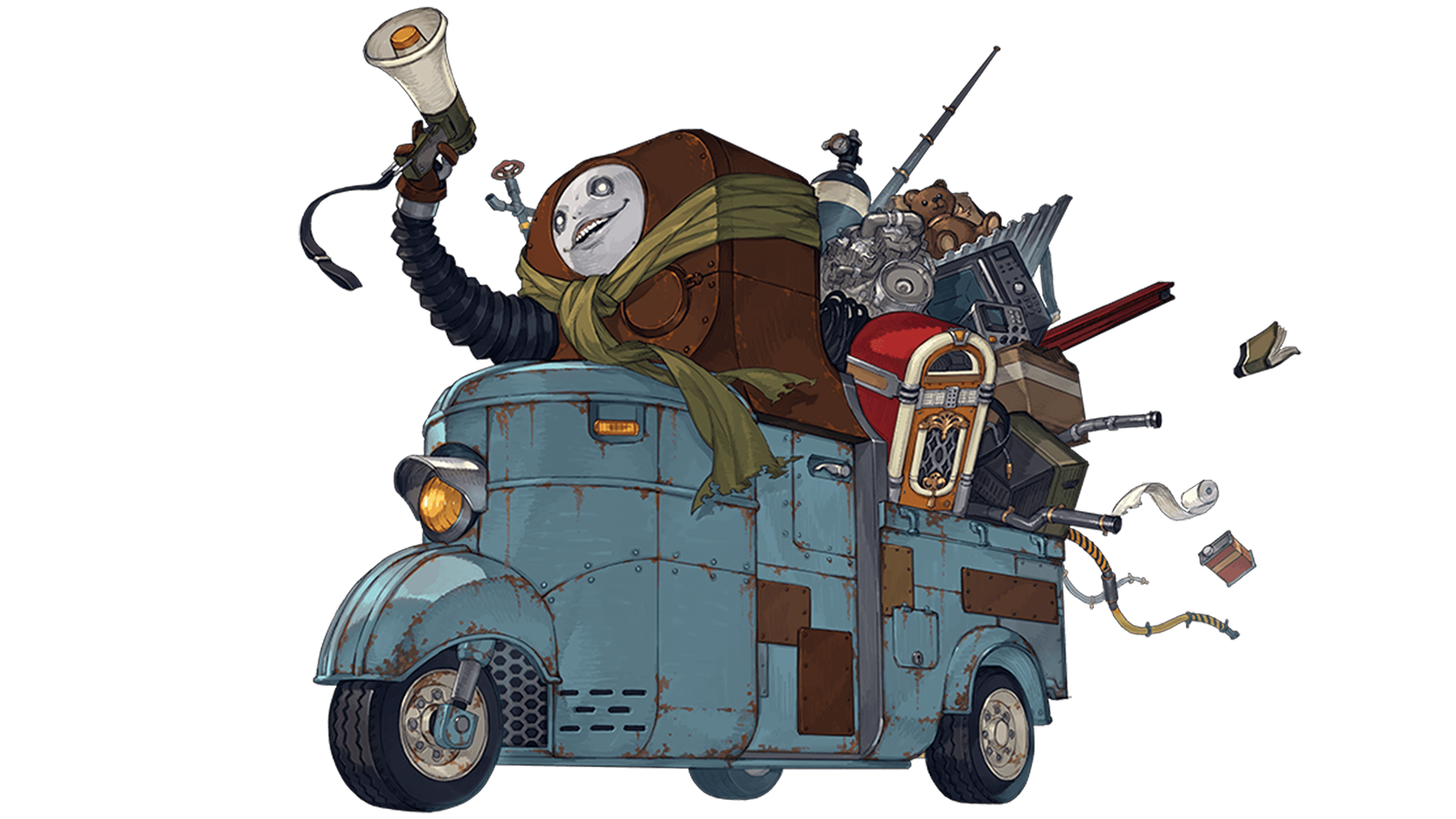
In the distant future, humanity has fled to the moon, and Earth has become the stage for an endless proxy war between Machine Lifeforms and Androids in the decadent world of NieR:Automata. Amidst this desolate landscape, there is a bizarre entity speeding around with a giant, eerily smiling head loaded on its cart, blaring upbeat and frenetic music. His name is Emil. While the slogan “Glory to Mankind” revered by YoRHa is an elaborately crafted false ideology, he is the “true witness” of the lost human world, having survived for thousands of years since the old world (the era of the previous game, NieR Replicant).
This article comprehensively integrates the fragmented texts of the main game, the conclusions of subquests, and the Weapon Stories hidden within weapons to unravel the unfathomable loneliness harbored by the individual known as Emil, the collapse of his identity through self-multiplication, and his existentialist agony surrounding memory and death. He is not merely a grotesque survivor; he is the most tragic and beautiful existence in this work, embodying philosophical themes such as Friedrich Nietzsche’s “Eternal Recurrence,” Søren Kierkegaard’s “The Sickness Unto Death” (despair), and Jean-Paul Sartre’s “The Look.”
1. Alien Invasion and Self-Multiplication: A Projection into Eternal Recurrence
1.1 The Desperate Resistance Against Aliens and the Birth of Clone Weapons
In the year 5012 AD, Aliens suddenly invaded Earth. At this time, humanity was already on the brink of virtual extinction due to the collapse of Project Gestalt, and any solid military or organization that should have protected Earth had disintegrated. Under these desperate circumstances, Emil—once a human boy who was transformed into a grotesque weapon by cursed magical powers—threw himself alone into an endless battle against the Aliens.
As an explicitly stated fact, to counter the Aliens and the hordes of Machine Lifeforms they created, he resorted to duplicating his own body, spawning countless clones. According to the historical background read from the records, it is said that only a single Alien spaceship invaded, suggesting that the battle itself, referred to as the “Great Space War,” concluded in a very short period. However, in the process, Emil created as many as 430 copies in the initial stage and did not stop his self-multiplication thereafter. This was because even after the Aliens fell silent, the Machine Lifeforms they left behind continued to multiply and evolve.
1.2 Kierkegaard’s “Despair” and the Dilution of the Ego
This decision of “self-multiplication” was inevitable from a tactical perspective. However, stepping into the realm of Existentialism, this is tantamount to a self-destructive act of abandoning one’s “unique existence (the ‘I’ as a single individual)” and throwing oneself into endless nothingness.
In his book The Sickness Unto Death, Danish philosopher Søren Kierkegaard defined “despair” as a human being not wanting to be themselves, or losing sight of their true self. The endlessly multiplied clones of Emil all share the appearance and basic design of “Emil,” yet they have lost the absolute subjectivity of the “I” that should be at their core.
As a deep psychological consideration derived from this, the possibility emerges that the reason he underwent self-multiplication was not merely to compensate for a lack of physical military strength to repel the Aliens. As his final monologue, discussed later, proves, he intentionally duplicated himself to escape the “unbearable memories of loss”—the loss of his loved ones (Nier, Kainé, and Yonah)—attempting to dilute (disperse) that immense sorrow across hundreds and thousands of individuals. Diluting one’s existence through duplication. This can be interpreted as what Sartre calls “Mauvaise foi” (bad faith)—a heartbreaking self-defense mechanism to numb the pain by escaping the heavy burden of freedom and loneliness, degrading oneself into a mere “thing (En-soi).“
2. The Self-Collapse and Nihilism Told by the Weapon Story “Emil Head”
The thousands of years of agony and madness experienced by the Emils are vividly recorded in the Weapon Story of the combat weapon “Emil Head.” This collection of texts vividly illustrates the ontological crisis faced by the duplicated individuals in chronological order. The table below organizes the facts recorded in the relevant Weapon Story and the philosophical and psychological implications behind them.
| Date of Record | Recorded Content of the Weapon Story (In-Game Facts) | Philosophical and Psychological Implications (Analysis and Consideration from Circumstantial Evidence) |
|---|---|---|
| 12422 09 02 | Confirmed that the Machine Lifeforms deployed by the Aliens are reconstructing their network functions. Also, individuals capable of manipulating gravity have re-emerged. | The terror of a “deterministic system” where Machine Lifeforms, which supposedly lack individual will, continue to evolve and reconstruct. This symbolizes the meaninglessness of the endless battle the Emils face, namely Nietzsche’s “Eternal Recurrence.” |
| 12422 10 15 | Multiplied a week ago, so memories prior to that are unclear. What is the original, missing for thousands of years, doing now? | The forgetting of memories accompanying multiplication and the absence of the root of self (God = Original). This is a metaphor for the “absence of God (atheism)” in Existentialism, and they harbor anxiety as thrown beings cast into a world without a “creator.” |
| 12422 12 14 | Confirmed that the life activities of a comrade born 25 numbers after me have ceased. It is true that “we” obtained eternal life by multiplying. However, individual death still exists. | The contradiction between eternity as a species (network) and finitude as an individual. Proof that despite having a swarm nature very similar to Machine Lifeforms, human subjectivity—“mourning the death of others”—remains in Emil’s clones. |
| 12423 01 19 | The memories of us clones are vague. The Android in black clothes I met today… I feel like I’ve seen her somewhere. She had a somewhat complicated expression, but I couldn’t remember anything. | The complete hollowing out of existence due to memory loss. The tragedy of disconnection between the objectification of the self through 2B’s “The Look” and the lack of subjectivity unable to respond to it. |
2.1 The Paradox of Eternal Life and Individual Death
The sentence in the entry for “12422 12 14,” “It is true that ‘we’ obtained eternal life by multiplying. However, individual death still exists,” carries immense weight. Here lies a profound paradox surrounding the individual and the whole. They avoided extinction as the “species of Emil” through multiplication, but this does not guarantee the eternity of the individual “I.” Every time one of the clones ceases its life activities, a certain “fear of death” and “pain of loss” occur. Ironically, within a system duplicated in pursuit of immortality, they have been burdened with the curse of repeatedly experiencing “death” tens of thousands of times.
This demonstrates the fundamental proposition of Existentialism: even if one is buried within a totalitarian crowd, one can never escape the fear of death as an individual. Despite diluting their egos through self-multiplication, the moment of death alone strikes them as an intensely personal experience. This very contradiction is the greatest factor driving Emil’s clones into madness.
2.2 The Look of the Other and the Abyss of Oblivion
The encounter with the “Android in black clothes (2B)” described in “12423 01 19” brilliantly depicts the concept of “The Look” advocated by Sartre. According to Sartre, by being looked at by another, a person becomes conscious of themselves as an “object (that which is seen)” for the other, and finds proof of their own existence therein.
2B, as a YoRHa unit retaining records of the old world, or as a pure other, makes a “complicated expression” upon seeing Emil’s figure. Within her gaze exists the image of Emil as a “great weapon of the past” or a “tragic survivor.” However, the amnesiac clone Emil cannot remember the “former self” that her gaze demands. It is the moment when the fact is exposed that, despite his existence being defined by the gaze of the other, the contents of that vessel are empty. He stands at the abyss of a painful Nihilism, where only by becoming aware of his own “oblivion” does he paradoxically recognize the lack of his own existence.
3. “Emil’s Memories” — Lunar Tear and Phenomenological Time
What brings a faint light of salvation to Emil, wandering the abyss of oblivion, is the subquest “Emil’s Memories.” In this quest, the player (2B and 9S) discovers a single white flower, the “Lunar Tear,” blooming quietly in various places around the world. The flower blooms silently in places where traces of past humanity remain, such as on a ledge in the Flooded City or under the stairs in the Amusement Park.
3.1 The “Lunar Tear” as a Trigger for Memory
The “Lunar Tear” is a highly important symbol continuing from the previous game, NieR Replicant, and carries the legend of being a “flower that grants wishes.” This flower is not merely a plant to Emil. It is a phenomenological trigger to awaken the “pure duration” advocated by French philosopher Henri Bergson—not the objective, physical “time” measurable by a clock, but the subjective “duration” flowing within the human mind, where past and present melt together in harmonious unity.
Despite the unfathomable physical time of thousands or tens of thousands of years weathering his memories and wearing down his self, the visual or olfactory information of a single flower vividly pulls “those days” that should have been lost back into the present. Similar to the madeleine experience in Marcel Proust’s In Search of Lost Time, Emil uses the Lunar Tear as a medium to temporarily reclaim the “solid ‘I’” slumbering in the depths of his self.
3.2 The Recovery of Existence Through Memory and the Acceptance of Loneliness
After finding all the Lunar Tears, Emil regains most of his past memories in a hidden underground space (a space modeled after the place where the shack of Kainé, whom he once loved, stood). He speaks to the player as follows:
“They say Lunar Tears are flowers that grant wishes… Thanks to you, I was able to remember something important. With these memories, I can keep going, even if I’m alone.”
These words encapsulate the “overcoming of anxiety” and “subjective decision” in Existentialism. The declaration that he “can keep going, even if I’m alone” signifies that he has broken free from thousands of years of escapism (the unconscious dispersion of self-multiplication) and resolved to face his own loneliness. Regaining his memories also means re-recognizing the cruel fact (absolute loneliness) that his former companions are no longer anywhere. However, the very weight of that sorrow is what elevated him from “the mere wreckage of a clone weapon” to “a single existence bearing a definite history.” As the last witness holding the memories of a lost world, he shoulders that burden by his own will and begins to walk forward.
4. The Mirror Image Relationship with the Machine Lifeform Network and Deterministic Tragedy
To understand Emil’s existence more deeply, it is necessary to consider the strange coincidence, or mirror image relationship, with the “Machine Lifeforms” he has fought against for thousands of years.
4.1 Imitating Machines and Duplicated Magic
Integrating the facts and circumstantial evidence presented in the game reveals that Emil and the Machine Lifeforms possess an extremely similar ontological structure. As inferred from records such as Jackass’s research report, Machine Lifeforms are entities incapable of creating new concepts (original ideas) on their own, attempting evolution and social construction only by “experiencing and imitating” humans and relics of the past. The reason individuals bearing names like Sartre and Pascal lean toward philosophy is that they seek proof of their existence as an extension of the act of learning the thoughts of their predecessors, imitating them, and teaching them to others.
On the other hand, Emil also took the measure of continuously “duplicating” his own body in response to the external factor of the Alien invasion. Just as the Machine Lifeforms multiply infinitely through their network and continue an endless war of attrition with the Androids, Emil also covered the earth as numerous clone weapons. Having lost their God (humanity = original) and being capable only of repeating imitation and duplication, both have become completely synchronized as cogs in a deterministic system within the closed space of Earth.
The table below contrasts the ontological structures of Emil and the Machine Lifeforms.
| Comparison Item | Emil (Clone) | Machine Lifeform (Network) |
|---|---|---|
| Origin of Existence | Modification from a human (magical weapon) | Creation by Aliens (invasion weapon) |
| Means of Multiplication | Physical duplication of one’s own body and memories | Mass production at sites like the Abandoned Factory and network connection |
| Absence of Original | Missing for thousands of years (absence of God) | Destroyed their creators, the Aliens, themselves (deicide) |
| Principle of Action | Escape from memories of loss and defense instinct | Repetition of the basic command to defeat the enemy (Androids) |
| Search for Proof of Self | Return to past memories (Lunar Tear) | Imitation of human culture and philosophy (family, nation, religion) |
4.2 The Nihilism of an Endless War of Attrition
Another cruel fact suggested by Jackass’s research report is that, despite having the objective to “defeat the enemy,” the Machine Lifeforms intentionally restricted their own evolution so as not to completely annihilate the Androids, constructing a loop of eternal fighting in order to maintain “battle” itself, which is their reason for existence. Within this “Avici hell of death and rebirth,” Emil has also been forced into a steadily declining defensive war against the infinitely multiplying Machine Lifeforms.
This structure is the most grotesque embodiment of Nietzsche’s “Eternal Recurrence.” Losing sight of their purpose, they merely repeat meaningless struggles for thousands of years, following the echoes of the past. The reason Emil speeds through the world as a cart with a maddened smile, blaring cheerful music, is none other than his mind being unable to withstand the heavy burden of this unbearable Nihilism, employing a robust defense mechanism in the form of madness. In a desperate situation where one might even think “it would be easier to just die,” what kept him alive was, ironically, madness itself.
5. “Emil’s Determination” — Anticipatory Resoluteness Towards Death and Salvation at the End of Madness
The terminus of the story surrounding Emil, and the most gruesome yet beautiful tragedy in this work, is the conclusion of the subquest “Emil’s Determination.” This quest only appears when the player collects all the weapons existing in the world and fully unlocks their Weapon Stories—the crystallization of their memories (upgrading them to Level 4). In the deepest part of the Desert Zone, a giant clone of Emil (or an aggregate of splintered self-consciousness) swallowed by despair and madness begins to run rampant.
5.1 The Lamentation Named Rampage and the Nihilism of Ending Y
This giant Emil is the very “lamentation” against the pain of thousands of years of battle, the sorrow of losing his companions, and the curse of living eternally. They attempt to destroy the Earth itself through self-destruction. This is not merely the rampage of a weapon. It is the manifestation of ultimate Nihilism, attempting to escape this meaningless cycle of Eternal Recurrence by reducing the self and the entire world to nothingness.
Here, if the player fails to stop this self-destruction, or intentionally witnesses its ruin, the story reaches a conclusion known as “Ending Y (head battle).” This bad ending, where the immense sorrow Emil harbored swallows the world itself and Earth returns to complete nothingness (Nihilism), symbolizes the ultimate destruction brought about by existential despair. However, in the canonical scenario, 2B and 9S prevent this self-destruction and put an end to the consciousness of the rampaging Emil.
5.2 “Anticipatory Resoluteness Towards Death” and Liberation from Mauvaise foi
On the verge of ceasing function, the fallen Emil is finally liberated from his long, long Mauvaise foi and confesses his true feelings. The entirety of the English voice lines left in the archives brilliantly expresses his existential salvation.
“I think this is it for me. I can’t believe I remembered something so important right at the end… I was running from the memories of losing those close to me, it was so hard… so painful. At the end I did a lot of bad things to you, 9S. But now I get to see them again really soon…”
“Oh hey there you are. I’m so glad. I got to see you all again…”
This monologue is the pinnacle of “anticipatory resoluteness towards death” (Vorlaufen in den Tod) advocated by Martin Heidegger. Heidegger preached that only by facing one’s inevitable “death” head-on and accepting it as one’s most ownmost possibility can a human being break free from everyday fallenness (a way of life merely swept along by the surrounding “they”) and attain an authentic self.
For thousands of years, by relying on an “undying body (multiplication)” and “oblivion,” Emil had continued to run away from the truth of his self that he should have faced—the pain of loss (“I was running from the memories”). That was what Sartre calls Mauvaise foi, and what Heidegger calls an inauthentic life. However, at the moment when the absolute “death” of ceasing function approached, he stopped running. He embraced his sorrow, the sins he committed, and the memories of the people he loved with his entire being, without deception.
What he felt in the face of death was not the fear of annihilation, but the “peace” of a spiritual reunion with his former companions (Nier, Kainé, Yonah, and others). Not the “we” whose identity had dissipated through countless splintering, but the “I” as a single soul had finally met its end. At this moment, Emil was freed from the curse of mechanical and deterministic self-multiplication, reclaiming a subjective and dignified “death” as a single human being.
6. [Consideration] As the Witness of a Lost World, and the “True Ark”
The greatest theme flowing at the foundation of NieR:Automata is the existential question of “how to find the meaning of life for oneself in a world that has lost its meaning (the absence of God).” YoRHa evaded this question by worshiping the grand lie (falsehood) that “humanity is surviving on the moon” as God, fabricating their own reason for existence. The Machine Lifeforms also attempted to fill their empty network by tracing and imitating the past records of humanity. However, Emil was different from both of them.
He survived for thousands of years, literally carving the cruel “truth” that humanity had perished into his very being. While the beautiful and noble image of humanity believed by YoRHa is nothing more than fabricated data, the memories Emil continued to protect—the image of humans who sacrificed themselves for their loved ones, committed sins, and cared for each other even while drowning in sorrow—were the unrefined yet true “history of humanity.”
If the giant structure “The Tower” that appears in the final stages is the “Ark” of information by the Machine Lifeforms, it can be concluded that Emil himself was the “true Ark” that encapsulated the pain and love of humanity from the old world as flesh and blood. His mind and body were shattered into pieces by the madness of the Alien invasion and self-multiplication, but within each of those fragments dwelled the stark fact that “there were once those in this world who lived desperately while defying The Absurd.”
6.1 A Single Truth Blooming in a Godless World
On an Earth where God (humanity) was absent, both Androids and Machine Lifeforms had no choice but to fabricate a God or repeat meaningless actions to fill that void. In that vast wilderness of Nihilism, the whiteness of the “Lunar Tear” that Emil sought symbolizes the affirmation of life—that no matter how full of despair the world may be, the “love and memories” that once existed there can never be taken away by anyone.
The cessation of function he finally met was not a tragic death. It was a supreme liberation, finally laying down the burden of thousands of years he had continued to carry, and returning to the “hometown of memories” where his loved ones waited. What he found within the hell of eternal life and self-multiplication was not the fate of a massive world or the significance of history, but the fulfillment of a modest and pure wish as a single boy: “I get to see you all again.”
His decadent, beautiful, sorrowful, and fleeting end serves as the purest crystallization of the “proof of self-existence” depicted in the work NieR:Automata, becoming the spiritual cornerstone leading to the affirmation of life towards the future (Ending E). The Lunar Tear he shed was the sole truth that anchored the memories of a lost world.
Mechanism of Nihility and Soul: NieR:Automata: 15 Meditations on the Proof of Existence and Emotion
The book version is now available. Read for free with Kindle Unlimited.
Thank you very much for reading to the end. To help support the activities of this archive, a warm donation of a cup of coffee would be highly appreciated.