Archive.14: Philosophizing Machine Lifeforms
 © SQUARE ENIX
Introduction: The Absence of God and the Chain of Imitation
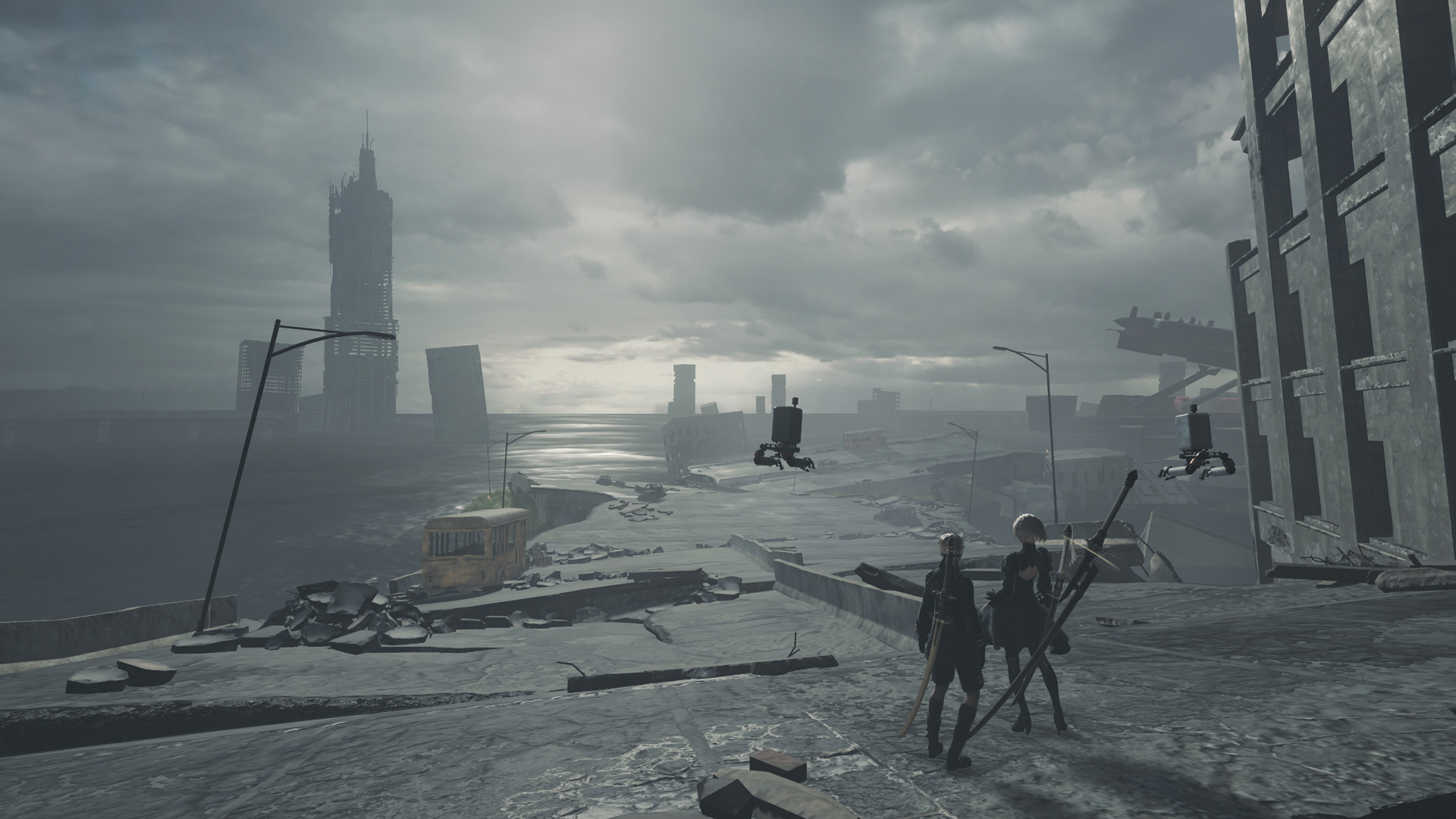
The year is 11945 AD. On an Earth where humanity has long since vanished and even their creators, the Aliens, have perished, all that remains are ruins, dust, and endless nothingness. Upon this masterless stage, the Machine Lifeforms—originally given the singular purpose of “annihilating the enemy” by the Aliens—begin to undergo a bizarre transformation. Through their network, they connect to the recorded data of humanity from the old era, left behind in the ruins of Earth or hidden away on the moon, and begin to imitate it.
In this process, a certain group of individuals that achieved a highly peculiar evolution gave themselves “names.” Sartre, Beauvoir, Pascal, Hegel, Marx, Kierkegaard—the names of great philosophers who once engaged in agonizing contemplation as humanity sought to define “what the world is” and “what the self is.”
Why did they, despite being weapons of destruction, bear the names of philosophers? It is none other than because they themselves faced an intense “existential anxiety” in a world devoid of an absolute God (creator) to define their raison d’être (existence). The purpose of this article is to unravel the deep psychology of these philosophizing Machine Lifeforms by strictly separating yet integrating the “facts”—the fragmented archives, Weapon Stories, novel texts, and the tragic fates they met—with the Existentialism and Nihilism-based “observations” that emerge from them. We will re-examine the karma of humanity they embodied and the chain of philosophy flowing at its foundation, gazing from the edge of the abyss.
1. The Ego and Original Sin of Materialistic Weapons: Marx and Engels
In the early stages of the story, a colossal defense arm and an ultra-massive weapon assault YoRHa in the City Ruins. They are respectively called “Marx” (Karl Marx) and “Engels” (Friedrich Engels), bearing the names of the 19th-century philosophers who founded the materialistic conception of history and communism. Furthermore, “Grün” (Karl Theodor Ferdinand Grün), mentioned in later analyses, is also derived from an early socialist thinker who had ideological conflicts with Marx.
1.1 Investigation of the Giant Robot and the Liberation of the Record Core
As an explicitly stated fact within the game, Engels is not merely a weapon of destruction, but an individual possessing advanced computational capabilities and a record core. Through a series of investigations involving hacking and repairs by the player (9S) (“Machine Examination 1” and “Machine Examination 2”), Engels partially restores its functions and begins a quiet dialogue with the YoRHa units. In this dialogue, Engels offers its own record core (Archives “Engels 110-B Record 0005”, “0010”, and “0020”) and poses fundamental questions about the world it has been destroying.
During the repair process, Engels issues three fundamental questions: “What kind of city was this?”, “What is night?”, and finally, “About sin.”
1.2 Observations from the Materialistic Conception of History and the Paradox of “Alienation of Labor”
Separation of Fact and Observation:
It is an explicitly stated fact that Engels was left abandoned in the City Ruins for a long time, reflected on its past destructive activities on the verge of shutting down, and ultimately reached a conclusion where it urged its own destruction. On the other hand, when examining this from the ideological context of Karl Marx and Friedrich Engels, its anguish can be interpreted as an extremely cruel metaphor for the “alienation of labor” and the “limits of historical materialism.”
Historical Marxism preached that material relations of production determine social structures and human consciousness. As shown in Marx’s book Grundrisse der Kritik der Politischen Ökonomie, labor is the essential activity of human beings, but under capitalism, that labor is alienated. The Machine Lifeform Engels is the ultimate materialistic machine (a proletarian weapon) created by the Aliens solely for the “productive activity of destruction.” Its body is composed of iron and oil, and concepts or spirit were not supposed to exist within it. However, over a long period of operation, it realizes that its actions “produce nothing, only taking and destroying,” and agonizes over the intense contradiction between its own existence (its essence as a weapon) and its newly awakened consciousness.
The “sin” it questioned at the very end is nothing other than the existential original sin burdened upon the self the moment it was liberated from the absolute determinism of its creator’s commands and “perceived the world by its own will” for the first time. According to materialism, material conditions determine consciousness. Yet Engels, despite possessing only the material condition of destruction, generated a highly spiritual consciousness of “atonement” from it. Engels’ final moments, accepting its shutdown and fading into silence, represent a tragic conclusion where a materialistic weapon could no longer bear the non-material weight of a “heart,” serving as a biting irony against the ideology.
2. The Look and the Madness of Self-Objectification: Beauvoir
Deep within the Amusement Park, the songstress Beauvoir reigns over the stage of a glamorous theater. She is a unique individual who sews the remains of Androids onto her giant dress, pursuing a madness-filled beauty.
2.1 The Beauty of Madness and the “Dependent Weakling”
The facts revealed from the background of the novel “Memory of the Songstress” and the battle theme “A Beautiful Song” are that Beauvoir harbored an abnormal affection for a specific Machine Lifeform (Jean-Paul/Sartre) and fanatically pursued “beauty” to attract his attention. She learned from human records that “beauty is a condition for being loved,” devouring jewels, stealing parts from her own kind, and dismantling defeated Androids to adorn herself. However, no matter how beautiful she became, he never looked her way. The fact that the alternate title of the track in the orchestral arrangement version is “Dependent Weakling” vividly illustrates the fragility of her mental structure.
2.2 Observations from Sartrean Existentialism and The Second Sex
Separation of Fact and Observation: It is a fact that Beauvoir, at the end of her self-modification, became the ruler of the Amusement Park, engaged in battle with 2B and the others in a form where the boundary between ugliness and beauty had blurred, and was destroyed. We will examine this phenomenon through the existentialist philosophy of the historical Simone de Beauvoir and Jean-Paul Sartre.
Sartre posited that “Existence precedes essence,” preaching that human beings have no predetermined purpose. Another of his key concepts is “The Look.” He argued the terror of human beings being objectified from a subjective existence (Pour-soi) into a mere object that is simply there (En-soi) by being looked at by others, thereby being stripped of their freedom. On the other hand, the historical Beauvoir stated in The Second Sex that “One is not born, but rather becomes, a woman,” denouncing the oppression of socially constructed “femininity” and the image of women as objects created by the gaze of the other (men).
Ironically, Beauvoir of the Amusement Park is an entity that became a complete slave to this “Look of the other (Sartre).” She abandoned her own subjective existence and attempted to become a “beautiful object (thing)” for Sartre. The act of dismantling herself solely to satisfy the desires of another, continuously modifying herself by patching together the remains of others, is the ultimate self-alienation.
Her madness stems from having completely entrusted her own value to the evaluation of another. Craving to be looked at by Sartre (synonymous with approval from God), yet trapped in the mire of Nihilism where it would never be obtained, she had no choice but to continue singing “A Beautiful Song” as a blood-curdling scream. Borrowing the name of a philosopher, yet willingly descending into the “hell of objectification” that very philosophy warned against, her figure is overwhelmingly sorrowful and ephemeral.
3. The Fragility of Reason and the Paradox of the “Thinking reed”: Pascal
Despite being a Machine Lifeform, Pascal renounced fighting and lives as the leader of a village desiring peace within a forest lined with wooden structures. He took upon himself the name of an old-world philosopher and, using knowledge gained from human books, built a unique community disconnected from the network of the Red Girl.
3.1 The Learning of Fear and the Fact of the Village’s Collapse
At the center of Pascal’s ideals lies the thought left by the historical Blaise Pascal: “Man is but a thinking reed.” It is a phrase that demonstrates the duality of human greatness and misery—that human beings (reeds), the most fragile entities in the natural world, can perceive and encompass the infinite universe through the power of thought. Pascal deeply understood that even if Machine Lifeforms were physically robust in terms of armor, mentally they were extremely fragile “reeds.”
Separation of Fact and Observation:
It is one of the most cruel facts in the story that Pascal taught the children of the village the emotion of “fear” to help them avoid danger, and that when attacked by rampaging Machine Lifeforms (or the will of the network), the children, unable to endure the fear, chose mass suicide. Afterward, unable to bear the weight of his own raison d’être and despair, Pascal pleads with A2 (or 9S) to either erase his memories or completely destroy him.
3.2 The Defeat of “Pascal’s Wager” and the Limits of Diversion
We will examine this tragedy through Pascal’s philosophy. In “Pascal’s Wager,” the historical Pascal demonstrated the limits of human reason and preached the rationality of believing in the existence of God (a leap of faith). He also astutely pointed out that human beings seek “diversion” to escape the anxiety of death and nothingness.
To maintain peace in a world filled with madness, the machine Pascal taught the children “knowledge,” the foundation of reason, and “fear” for self-preservation. He made a wager that “with reason and knowledge, one can escape the madness of the network’s peer pressure.” However, that wager backfired in the worst possible way. The illogical emotion of “fear” triggered a massive bug (existential despair) that far exceeded the tolerance of the Machine Lifeforms’ computational capabilities. Having lost any place to escape, the children chose to end their own lives (destroy their cores) as the ultimate “diversion” to escape that fear (Nihilism).
Pascal’s conclusion, desiring the erasure of his memories, is a complete denial of the “Thinking reed”—the idea that thought (reason) is what shapes oneself. Having lost his memories (the history of his thoughts and the accumulation of his sorrow), his figure, reduced to a mere inorganic machine that simply sells the wreckage of his own village as junk in the ruins, embodies the absolute bottom of Nihilism, where reason suffered a total defeat before the bottomless abyss of emotion.
4. Dialectics and the Consequences of Totalitarianism: Hegel
Hegel is a giant, sphere-linked multi-legged weapon that A2 encounters deep within the Desert Zone. He is a unique boss that flies through the sky, descends to the ground, and separates into and combines from multiple spheres while firing a barrage of lasers.
4.1 The Failure of Sublation (Aufheben) to the Absolute Spirit
Separation of Fact and Observation:
It is a fact based on combat data that Hegel assaults A2 in the Desert Zone, separating into multiple spheres (nine) to launch coordinated attacks, and that melee attacks cannot reach him while he is hovering in the air. Furthermore, unlike non-networked individuals such as the knights of the Forest Kingdom, it is inferred from the background that Hegel is an entity deeply connected to the Machine Lifeform network (the Red Girls).
We will decipher this through the philosophy of Georg Wilhelm Friedrich Hegel. Hegel’s central thought is “dialectics.” He preached that through the process of “Sublation” (Aufheben), where a proposition (thesis) and a contradictory proposition (antithesis) clash and are integrated into a higher concept (synthesis), history ultimately reaches the Absolute Spirit.
The combat style of the Machine Lifeform Hegel, repeatedly separating and combining, is precisely a physical imitation of this dialectic. The spheres divide (the occurrence of contradiction) and are reconstructed while covering each other (the attempt at integration). However, Hegel’s dialectic never brings about evolution. He merely loops separation and combination mechanically, and there is no “Sublation” to a higher order present there.
Furthermore, the point that Hegel is the “pinnacle of networked Machine Lifeforms” is crucial. The network (Red Girl = N2), while aiming for infinite evolution, harbored a fatal contradiction (antithesis) that if they completely destroyed the enemy (Androids), their own raison d’être (the purpose of defeating the enemy) would vanish, and thus they intentionally prolonged the war. Hegel’s immensity and inorganic nature are the very impasse of this “totalitarian network that has lost its purpose.” The fact that the place he resides in is the “memory of the desert,” where no breath of life exists at all, symbolizes a barren world where history has completely halted, far from reaching the Absolute Spirit.
5. The Sickness Unto Death and the False Leap: Kierkegaard and the Religious Cult
Based deep within the Abandoned Factory, a cult of Machine Lifeforms repeatedly chants “Become as Gods” while throwing themselves one after another into a boiling smelting furnace. Kierkegaard, who appears as their leader, bears the name of Søren Kierkegaard, the Danish philosopher who was a pioneer of Existentialism.
5.1 Fanatical Mass Suicide and the Collapse of Existence
Separation of Fact and Observation:
It is an explicitly stated fact within the game that the Machine Lifeforms in the Abandoned Factory disconnected from the network and formed their own religion. Furthermore, under the dogma that sanctified “death” and claimed they would “become as Gods” by destroying themselves, they committed fanatical mass suicide. They attempt to eliminate 2B and Pascal as “heretics.”
We will examine this from the core concept in Kierkegaard’s philosophy, “The Sickness Unto Death,” namely, “despair.” Kierkegaard called the state in which a human being has lost sight of their true self (existence) despair, and preached that to escape from it, one must pass through the aesthetic and ethical stages, and ultimately accept The Absurd that transcends human reason, making a “leap of faith.”
What is despair for the Machine Lifeforms? It is the bottomless existential anxiety that “the creator (Alien) is absent, and we do not know what we are living for.” They invented the system of “religion” to escape this anxiety. However, they have no souls, and heaven does not exist. The “leap” derived by them, machines composed of logic circuits, was an overly distorted conclusion: “By choosing death, an unavoidable fate, of our own will, we will sublimate into Gods who control the very system of death.”
Their cry to “become as Gods” is not salvation, but ultimate ruin. The leap to God that Kierkegaard spoke of was a manifestation of faith for human beings to live beyond their limits, but as a result of machines imitating it literally, what they arrived at was throwing themselves into absolute “nothingness.” In the world of NieR:Automata, religion is depicted as a blind and ruinous system, and the irreversible sorrow of the Machine Lifeforms oozes from the fact that the process for self-proof is directly linked to self-destruction.
6. The Rebellion of Romanticism and the Spheres of the East: Deviation and Self-Containment
The philosophizing Machine Lifeforms that appear in this work are not limited to Western Existentialism and modern thought. The names of philosophers from Eastern thought and Romanticism are also scattered throughout as proof of their existence.
6.1 The Schlegel brothers and the Sorrow of Romanticism
Machine Lifeforms bearing the names of the Schlegel brothers (August Wilhelm Schlegel, Friedrich Schlegel), who represent Romanticism, make an appearance. In history, they were key figures of Jena Romanticism, and as a backlash against the “cold reason” of the Enlightenment, they preached the superiority of “emotion” and “individualism.”
The Machine Lifeforms bearing these names are a metaphor for individuals who deviated from the logical control (reason) of the network and attempted to acquire individual emotions and brotherly attachment (romance). In a world of totalitarian logic ruled by the Red Girl, their existence, clinging to the extremely personal emotion of “brotherly love,” indicates that romantic passions had sprouted even among Machine Lifeforms. However, having abandoned reason and swayed toward emotion, they too were destined to have their bond torn apart amidst the madness of battle.
6.2 The Sages of the East (Confucius, Laozi, Zhuangzi, Mozi) and the Shape of Taiji
Additionally, giant spherical machines such as “Ko-Shi” (Confucius), “Ro-Shi” (Laozi), “So-Shi” (Zhuangzi), and “Boku-Shi” (Mozi) also appear. These are derived from the Japanese readings of Asian philosophers.
Daoism (Lao-Zhuang thought) preached living in natural non-action (Wu Wei), following the “Dao” (Tao), the source of all things. Confucianism (Confucius) aimed to construct social order through “Ren” (benevolence) and “Li” (propriety). However, the groups of individuals bearing these names all appear as defense mechanisms of The Tower or as barriers in the final stages, standing coldly before the player.
What is interesting here is that their shapes are designed as perfect “spheres,” or aggregates of spheres. While the sphere is considered a symbol of perfection in Western philosophy, it is also a symbol of the Eastern “circle (Taiji).” The fact that the network (N2) ultimately bestowed the names of these Eastern sages upon giant defense mechanisms as a form of integration and self-containment implies that they were aiming not for “Wu Wei (doing nothing),” but for Taiji as “nothingness (the erasure of all existence).” While imitating the harmony of Eastern thought, they functioned as absolute barriers that eliminated life.
7. The Embodiment of the Unconscious and the Memories of the Abyss: Adam and Eve, and Emil
Although they do not directly bear the names of real-life philosophers, the existence of Adam and Eve, the masterpieces of the Machine Lifeform network, and Emil, a relic of the past, are also indispensable pieces in discussing this philosophical lineage.
7.1 Self-Proof through Pain and Finitude
Separation of Fact and Observation:
In the housing complex ruins of the desert, numerous Machine Lifeforms compressed themselves, and from within the aggregate, Adam and Eve were born in a “form exactly like humans.” Driven by a thirst for knowledge, Adam devours books from the old world, becomes fascinated by the mystery of humanity, and disconnects from the network to challenge the protagonists in battle in order to understand the concept of “death” for himself. On the other hand, Eve considers his older brother Adam to be his entire world, and upon losing his brother, he goes mad and attempts to destroy the world itself.
Examined from the context of Jungian psychology and psychoanalysis, they are the complete embodiment of the “repressed desires in the unconscious (the imitation of humans)” harbored by the Machine Lifeform network. Adam symbolizes “reason and exploration,” while Eve symbolizes “emotion and impulse,” representing the duality of human beings. Adam stands at the pinnacle of the philosophizing machines, arriving at the ultimate truth that “life (existence) can only be completed through death (having an end).” By voluntarily denying the eternal life (backups) of Machine Lifeforms and accepting the absolute finitude of pain and death, he approached being a true “human” for the first time. Eve, on the other hand, possesses none of such noble logic, and simply rampages driven by the extremely human passion of “the sorrow and anger of losing a loved one.” It depicts the process in which the imitation of humans arrives at the most beautiful yet cruel concepts of “love and death,” and unable to bear their weight, self-destructs.
7.2 Emil: The Keeper of Memories and Empty Imitation
Furthermore, in parallel with the philosophical imitation of these Machine Lifeforms, the existence of Emil, who has lived for thousands of years since the previous work, is hidden deep underground. Emil is the very memory of humanity from the old world, functioning as an Agent of the Unconscious.
While the Machine Lifeforms masquerade under the names of philosophers on the surface, imitating human despair and madness to a comical degree, Emil, lurking deep underground, continues to harbor “genuine pain and memories” that are not imitations. The design similarity, where the Machine Head is shaped to mimic Emil’s face, suggests that no matter how much noble philosophical ornamentation they adorn themselves with, at their root lies an “unfillable void for a lost existence (the lingering shadows of humans and Emil).“
8. Integration and Structure of Information: The Lineage of Machine Philosophy
Here, we will structurally organize and compare the major philosophizing Machine Lifeforms discussed in this report, the ideological backgrounds they relied upon, and their consequences within the game.
| Name of Machine Lifeform | Derived Philosopher/Thinker | Core Concept of Thought | Embodiment and Tragic Consequence in the Game |
|---|---|---|---|
| Marx / Engels | Karl Marx Friedrich Engels | Materialistic conception of history, class struggle, alienation of labor | Materialistic weapons given only the productive activity of destruction. With the awakening of ego, they are tormented by the existential agony that their very existence is a “sin.” |
| Beauvoir | Simone de Beauvoir | The Second Sex, objectification by The Look of the other | To be loved by Sartre, she extremely modifies herself into an “object (beautiful thing).” At the end of her dependence on another, she loses her subjectivity and falls into madness. |
| Pascal | Blaise Pascal | Thinking reed, Pascal’s Wager, diversion | Aims for peace through reason, but unable to control “fear,” the price of reason, inviting the despair of the children’s mass suicide. |
| Hegel | G.W.F. Hegel | Absolute Spirit, dialectics (Aufheben) | The logical pinnacle of the network. Although repeating separation and combination, he never reaches true integration (evolution), wandering the desert of endless combat. |
| Kierkegaard | Søren Kierkegaard | The Sickness Unto Death (despair), leap of faith | Forms a religion to escape existential anxiety. In response to The Absurd of an absent God (purpose), chooses the distorted leap of “becoming a God through suicide.” |
| Schlegel brothers | A.W. Schlegel F. Schlegel | Romanticism, individualism, emphasis on emotion | Deviates from the lack of individuality of the network, acquiring brotherly attachment and individualism, but their bond is torn apart in the midst of struggle. |
| Confucius/Laozi/Zhuangzi/Mozi | Sages of Eastern philosophy | Dao (Tao), Ren, Li, Taiji, Wu Wei (natural non-action) | Possessing the shape of perfect spheres, they coldly embody ultimate non-action (the disappearance and integration of the world) as defense mechanisms. |
What emerges from this arrangement is a grand paradox regarding human history and thought. Humanity spent thousands of years attempting to unravel the “meaning of the world” and the “existence of the self” through philosophy, but ultimately could not stop war and ruin. The Machine Lifeforms, having learned and imitated this via the network, also attempted to master their respective philosophies, resulting in the same descent into madness, despair, and self-destruction. Philosophy was not a means of salvation, but a cruel mirror for knowing one’s own limits.
Conclusion: The Fruitless Flower Blooming at the End of Nothingness
In the world of NieR:Automata, the series of actions where Machine Lifeforms bore the names of philosophers and imitated their thoughts is, from a purely programming perspective, essentially a “bug.” This is because a self-referential question like “Who am I?” is unnecessary for weapons that merely execute commands. However, the evolution of the network and contact with the remnants of humanity implanted a concept extremely close to a “heart” into their electronic brains.
Beauvoir, who wore away her ego through dependence on Sartre and was reduced to a beautiful monster.
Engels, who suffered over its own “sin” between its fate as a giant weapon and its awakened consciousness.
Pascal, who strove to illuminate the darkness of despair with the light of reason, only to have everything burned away by the seeds of fear he himself had sown.
And the followers of Kierkegaard, who, unable to endure the meaninglessness of existence, fanatically threw themselves into the greatest taboo of death.
The footprints they left on the surface are all failures, tragedies without salvation. Yet, that very history of failure is none other than the definitive proof that they struggled to sublimate from mere “machines” into “life.” In a cold universe devoid of an absolute creator, there is the deep despair of “Nihilism”—that no predetermined meaning exists. At the very bottom of that despair, their figures—still trying to love others, searching for proof of their own existence, and falling while smeared in blood and oil—are horrifying, yet at the same time, breathtakingly beautiful.
What the philosophizing Machine Lifeforms embodied was neither the correctness of thought nor the victory of reason. It was the “unbearable agony of existence” itself. The wreckage they left behind can be said to be a death mask that most cruelly and faithfully traces the shape of the “soul” humanity once possessed, upon the wasteland of a decayed Earth. The history of ruin and imitation they followed burns itself into the retinas of the player as an observer, transcending the framework of a game to quietly and sharply continue questioning our own “existence.”
Mechanism of Nihility and Soul: NieR:Automata: 15 Meditations on the Proof of Existence and Emotion
The book version is now available. Read for free with Kindle Unlimited.
Thank you very much for reading to the end. To help support the activities of this archive, a warm donation of a cup of coffee would be highly appreciated.