Lore.08: Abyss Watchers and the Undead Legion of Farron
 © FromSoftware
1. A World Falling to Ash and the System of the Linking of the Fire Reaching Its Limit
At the end of the Age of Fire, where the sun bleeds red and a pale twilight obscures the sky, the world has forgotten even the memories of its former glory, quietly sinking into ash. Countless ages have passed since The First Flame was kindled, and the system known as the Linking of the Fire has been regarded as the sole means of sustaining the world. However, it is now nothing more than a forced life-support measure that has long surpassed its limits. The cycle of life and light has stagnated, and as a massive toll for maintaining the system, the past “Lords of Cinder” who once linked the fire have abandoned their thrones and fled. Within this despairing worldview, the reality faced by the “Unkindled,” burdened with the grueling mission of bringing the lords back, is not the conclusion of glorious legends of heroes, but a wretched fate consumed by madness and nihilism.
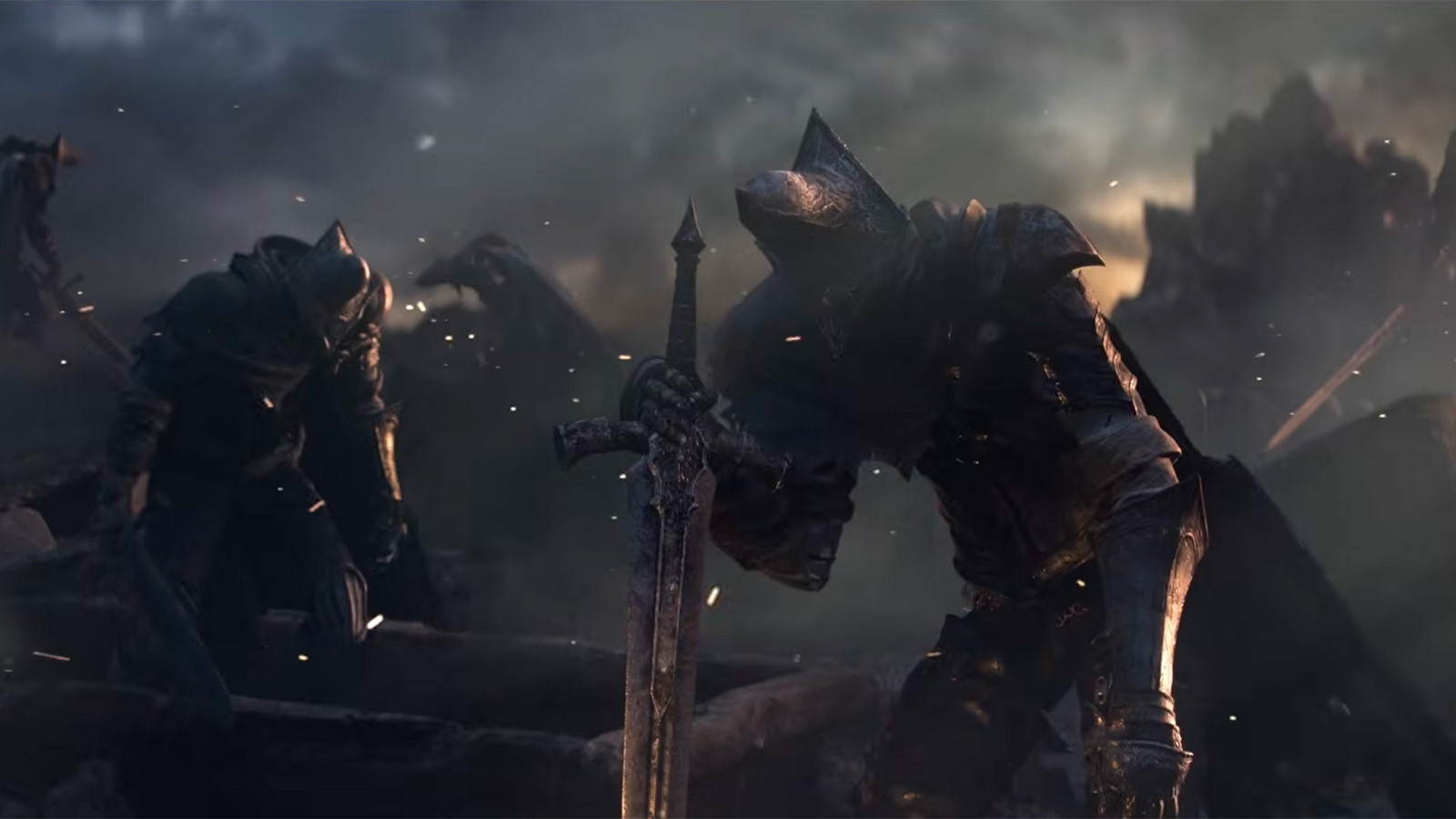
The “Abyss Watchers,” the focus of this article, and the “Undead Legion of Farron” they comprise, are entities that most vividly embody this aesthetic of ruin and sorrow. They are not a single mighty god or a transcendent king. They are a legion of nameless undead who shared their souls through the unique medium of the “blood of the wolf,” sacrificing their individual egos to artificially forge a colossal soul fit for a Lord of Cinder. Formed with the sole existential purpose of watching over “The Abyss”—the spreading darkness that corrupts the world from its very roots—and utterly eradicating it, they drove themselves to the brink of ruin due to the sheer severity and purity of their mission.
This report will meticulously unravel the environmental storytelling etched into the rotting earth of Farron Keep, the philosophies hidden within their left-behind armaments, and the psychological evolution of a single deserter who fled from the maddened ranks of the Undead Legion. By deeply delving into the causal relationships and emotional subtleties that emerge, and through a philosophical and literary approach addressing the curse of duty, the price of solidarity through blood, and the attainment of free will from a deterministic fate, we will uncover the true nature of the Undead Legion of Farron.
2. Artorias’s Legacy and the Price of Solidarity Brought by the “Blood of the Wolf”
The origins of the Undead Legion of Farron trace back to the distant age of myth. The legacy of Artorias the Abysswalker, the tragic knight who continued to resist to the very end even as he was swallowed by The Abyss, is the very root of their existence. While they do not claim Artorias himself as their direct progenitor, by partaking of the blood of his companion, the Great Wolf, they inherited the karmic burden of hunting The Abyss.
The greatest characteristic and the greatest tragedy of the Undead Legion is the absolute solidarity of their souls, achieved by sharing the “blood of the wolf.” Normally, the seat of a Lord of Cinder, the qualification to partake in the Linking of the Fire, is filled by a single entity harboring an overwhelming soul. However, despite being an aggregate of countless undead, the Undead Legion of Farron is recognized as a single lord seated upon one throne. This signifies that the covenant made through the wolf’s blood is not merely an initiation rite into an organization or a declaration of loyalty, but rather something that induces a spiritual and ontological fusion of souls.
They possess no individual names, operating solely as a collective entity known as the “Undead Legion.” This solidarity of blood diluted the individual’s fear of death and agony across the whole, granting them a maddened courage to confront the indescribable terror of The Abyss. Simultaneously, however, it harbored a fatal vulnerability: the dread that “if even one is swallowed by The Abyss, the entire collective is instantly corrupted through their blood connection.” From the perspective of fatalistic determinism, the moment they partook of the wolf’s blood, their conclusion was completely locked into a binary choice: “hunt The Abyss to extinction and save the world, or become monsters of The Abyss themselves.” They may have believed they chose their mission of their own free will, but in truth, they were nothing more than cogs integrated into a magical system of blood.
3. Attire and Combat Philosophy as the Embodiment of Fanatical Dogma
Their abnormal sense of duty and nihilism are heavily reflected in their unique equipment and combat dogma. It is said that the Undead Legion of Farron would cross borders at the slightest sign of The Abyss, burying an entire kingdom under earth just to eradicate it. Their attire appears to prioritize resistance against The Abyss over physical defense, but an analysis of the properties of the armaments they left behind reveals an ironic contradiction.
The following table compares the resistance properties of the “Undead Legion Helm,” worn universally by the Undead Legion of Farron. These figures serve as historical evidence indicating how they prepared against external threats.
| Resistance Type | Defense / Resistance Value | Philosophical and Tactical Implications |
|---|---|---|
| Fire Defense | 4.8 | Relatively high resistance to the power of fire. A foreshadowing of their eventual destiny to partake in the Linking of the Fire. |
| Lightning Defense | 4.9 | Indicates preparation against the power of the ancient gods (lightning), or the immense weight of a mission that rivals it. |
| Magic Defense | 4.7 | A certain level of preparation against ancient magical threats, such as the sorceries of Oolacile. |
| Dark Defense | 4.2 | The fatal contradiction of having lower resistance to Dark (The Abyss) compared to Fire and Lightning, despite being a legion dedicated to hunting The Abyss. |
| Frost Resistance | 29 | Strong resistance to the frost that visits a stagnated world. |
| Curse Resistance | 21 | A certain degree of resistance against the curse of death brought about by the miasma of The Abyss. |
| Poise | 2.3 | Extremely low. Proof that they did not anticipate taking hits, specializing instead in evasion and offense. |
The most crucial insight to be gleaned from this data is the fact that, despite their supreme objective of hunting The Abyss (Dark), their “Dark Defense” is actually relatively lower than their Fire and Lightning defenses. Their distinctive, pointed iron helms were designed to ensure no sign of The Abyss was overlooked, yet they could not serve as an absolute bulwark to protect them from its encroachment. This structural fragility foreshadows their ultimate fate of being swallowed by The Abyss.
Furthermore, their combat style is exceedingly unique and self-sacrificial. Wielding a custom dagger in their left hand and swinging the Farron Greatsword in their right, their movements mimic beasts crawling upon the earth, cutting down enemies with unpredictable trajectories. What is particularly noteworthy is their complete rejection of “shields” at a dogmatic level. A shield is a tool for self-protection, a manifestation of the instinct for self-preservation—an attachment to the “individual.” The act of discarding the shield demonstrates that they have forsaken their own lives from the outset, purifying themselves into mere “blades” functioning solely to eradicate The Abyss. This absolute offensive doctrine is heroic, yet simultaneously the pinnacle of ultimate nihilism, recognizing no value in life whatsoever.
4. Decoding the Corruption of Farron Through Environmental Storytelling
There is strong circumstantial evidence that Farron Keep, the stronghold of the Undead Legion, is built upon the ruins of Oolacile, an ancient kingdom of sorcery once struck by the calamity of The Abyss. The ancient magic scrolls scattered deep within the keep, along with the corpses of the mushroom people who seem to have survived since ancient times, quietly narrate the long continuum of history this land bears. This geographical and historical background symbolizes the underlying theme of “cycle and stagnation” present throughout the game.
The present Farron Keep has devolved into a poisonous swamp as far as the eye can see, a hellscape prowled by giant slugs and monsters known as “Ghru”—the grotesque remnants of their former acolytes. Why did this land, which must have once been a beautiful forest, sink into such a gruesome, venomous bog? It is the inevitable consequence of the extreme measures the Undead Legion continuously employed to prevent the expansion of The Abyss.
They mercilessly buried under earth and sealed away anything that showed even the slightest sign of The Abyss. However, this ultimately halted the flow of the land entirely, creating a fatal stagnation and causing the forest to rot into a highly toxic swamp. Just as damming flowing water causes it to stagnate and rot, this horrific environmental transformation is the result of forcibly attempting to suppress a part of nature (or perhaps humanity itself) known as The Abyss. The structural distortion of a world attempting to forcibly prolong the Age of Fire—a system that has reached its limit—is directly expressed as the corrupted ecosystem of Farron Keep. The world they sought to protect had already sunk to the depths of putrefaction, where life could no longer properly breathe, all due to their own maddened sense of duty. This is a poignant irony: the destruction brought about by the nobility of a mission.
5. Eternal Infighting and the Paranoia of The Abyss
When the Ashen One steps into the deepest part of Farron Keep, beyond the heavily sealed doors of the wolf’s blood, what unfolds is no solemn ceremony awaiting the return of a lord. It is a floor blanketed with the countless corpses of the Undead Legion, and in the center, two Abyss Watchers endlessly crossing blades.
5.1 The Propagation of The Abyss and the Tragedy of a Closed Space
They continue to slaughter each other for eternity. This is because they themselves, whose very reason for existence was to eradicate The Abyss, have finally been swallowed by it. Possessing a strict dogma that harbored an extreme hatred for The Abyss—dictating that any sign of it meant instantly cutting down even an ally—when they sensed the corruption of The Abyss spreading throughout the collective via the wolf’s blood, they began executing their “corrupted brethren” in accordance with their own creed.
Being undead, even when killed, they eventually resurrect. If the eyes of a resurrected comrade bear the reddish-black glow indicative of The Abyss, they behead them once more. This endless infighting is a tragic loop that replicates the “stagnation of the world”—the end of the Age of Fire—on a profoundly micro scale. The environmental storytelling within this combat space is, in a word, breathtaking. Only the heavy, metallic clashing of swords echoes hollowly through the mausoleum; the “outer Abyss” they were meant to defeat no longer exists, leaving only a closed space where they continuously battle their inner madness. There is no longer a shred of heroic glory to be found; there is only the sorrow of broken machines eternally executing a program called duty.
5.2 The Tragic Awakening Cloaked in Flame
At the end of the death struggle, all the Abyss Watchers fall to the ground. However, true despair and beauty arrive immediately after. The “blood of the wolf” rising from the countless corpses around them converges upon a single Watcher, awakening him as a true Lord of Cinder. Cloaked entirely in flame, wielding a fiercer, more refined ancient swordplay, his figure radiates a heartbreakingly tragic beauty.
This awakened Watcher no longer stands by his own individual will. The sense of duty, sorrow, and the despair of having partaken in the Linking of the Fire, accumulated from countless brethren within the blood, move him like a marionette. The cruelty of causality—that the very act of linking the fire to save the world burned away their souls, awakening the threat of the dense dark (The Abyss) left behind—is embedded in this dance of flame. Striking him down is the sole proof of mercy, liberating them from this endless, absurd toil.
6. Hawkwood the Deserter and the Attainment of Individual Free Will
In highlighting the paranoia and madness into which the collective of the Undead Legion of Farron fell, an absolutely indispensable, mirroring existence is Hawkwood the Deserter. Despite being a former member of the Undead Legion, he is a solitary warrior who fled from their grueling mission, sitting broken-hearted in the Firelink Shrine.
6.1 “Self-Preservation” Symbolized by the Shield, and Its Abandonment
As previously mentioned, the Undead Legion does not carry shields. To them, a shield is a symbol of escapism, an impurity that degrades the purity of their mission. However, Hawkwood alone possessed a shield. His shield is found discarded near Farron Keep, or perhaps at a place that seems to be his personal gravestone.
The fact that Hawkwood carried a shield signifies that he could not completely discard his “individuality”—meaning he retained highly human emotions such as the instinct for self-preservation and the fear of death. Unable to bear the sight of his brethren being swallowed by The Abyss, or perhaps to escape the sheer madness of eternal infighting, he fled, clutching his shield—the “boundary of the individual.” However, the environmental storytelling of abandoning that shield in the lands of Farron silently speaks to the fact that he subsequently faced his own fears head-on and settled his past as a deserter.
6.2 Rebellion Against Fate and the Existential Leap
Hawkwood’s story is not merely the flight of a defeated man. After leaving the shrine, he ultimately becomes captivated by the Path of the Dragon. Ancient dragons are everlasting entities from before the birth of the Age of Fire (the cycle of life and death, light and dark). The thirst for an absolute “eternity” that lies entirely outside the dualistic framework of the conflict between The Abyss and Fire, which had bound the Undead Legion, was the new purpose in life he discovered.
The dialogue he delivers to the protagonist in the final stages possesses some of the most profound philosophical resonance in the game.
“you are a dragon more dragon than I ah this is unexpected. well I’ve decided to stop running from my fate loathe me all you like i shall take what makes you dragon. you are a dragon more dragon than I.”
This statement carries a dual meaning. One is pure respect and envy toward the protagonist, who is acquiring the power of the ancient dragons. The other is his own powerful declaration of free will: “I’ve decided to stop running from my fate.” He fled from the “maddened fate bestowed by the system” as a member of the Undead Legion of Farron, but this time, he solidified his resolve to face head-on the “true fate of becoming a dragon” that he discovered for himself. Borrowing from Sartre’s existentialist philosophy, it can be said that he broke free from being an entity upon whom the essence of duty was forced, achieving an “existential leap” to determine his own essence through his actions.
The Farron Ring, which he handed over to the protagonist or left behind as a trace of his journey, is a relic that reduces the mental burden of wielding weapon arts. The existence of this ring demonstrates how deeply he had once mastered Farron swordplay, fighting while wearing down his own soul, and simultaneously serves as proof that he completely let go of that relic of the past to walk the Path of the Dragon. The fact that the protagonist and Hawkwood engage in a final duel at the Farron mausoleum (the stage of madness where the Undead Legion once fought each other) is highly symbolic. He deliberately returned to the fateful place he had fled, attempting to prove his will as an “individual”—for no one’s sake but his own—atop the corpses of his former brethren. What he sought was no longer subjugation to the system as a Lord of Cinder, but to elevate himself into an existence that transcended the world.
7. Logical Distinction Between Historical Truth and Philosophical Inference
In dissecting the story of the Abyss Watchers, we must strictly distinguish between the “historical facts” presented fragmentarily within the game and the “inferences and speculations” derived from circumstantial evidence and philosophical frameworks, logically reconstructing the deep structure of the narrative.
First, it is an undeniable fact that they are Lords of Cinder. In some past era, they artificially formed a colossal soul through the solidarity of blood, partaking in the Linking of the Fire to prolong the world. Furthermore, it is explicitly shown as a reality unfolding before our eyes that they watched over The Abyss, executing even allies at the slightest sign of it, and that they ultimately suffered the corruption of The Abyss themselves, engaging in endless infighting within the Farron mausoleum. Additionally, the fact that Hawkwood, despite being a former member of the Undead Legion, deserted, ultimately walked the Path of the Dragon, left the Firelink Shrine, and dueled the protagonist, is definitive history proven by his left-behind dialogue and relics.
Building upon these facts as a foundation, we step into deeper philosophical inference. Why did they fall into such madness-filled infighting within a closed space? It is surmised to be due to extreme paranoia brought about by the “fear of collective responsibility.” As long as they are connected by blood, if one is captivated by The Abyss, all are corrupted. In other words, the former comrade standing beside them always harbors the danger of transforming into a “bomb that might drag them into The Abyss.” It is believed that after a long and grueling watch, before they could hunt the outer Abyss, they became abnormally hypersensitive to the signs of inner traitors, leading to their own collapse. The moment their blades turned toward their brethren, the Undead Legion of Farron was, in effect, ideologically annihilated.
We must also discuss the fatal contradiction that the very act of their Linking of the Fire sealed their ruin. To link the fire is to offer one’s own soul (and the essence of humanity) as fuel for the flame. As a result, the “light” within them burned out, and perhaps only the dense “Dark (The Abyss)” surfaced as the remaining dregs. They supposedly linked the fire to fulfill their objective of eradicating The Abyss, yet that very ritual of noble self-sacrifice became the trigger that awakened the primordial Abyss slumbering within themselves. This structural irony and paradox are the very core that renders the story of the Watchers the most gruesome and melancholic of tragedies. Much like the absurd toil in Albert Camus’s The Myth of Sisyphus, where a boulder is pushed to the summit only to roll back down, the Undead Legion’s goal of completely erasing the negative aspect of humanity (The Abyss) was, from the very beginning, an unattainable illusion.
Conclusion - The Aesthetic of Ruin and the Inheritance to the Ashen One
The bizarre fate traced by the Undead Legion of Farron and the Abyss Watchers serves as a showcase that most intuitively and cruelly expresses the profound theme blanketing the entire game: “the end of the Age of Fire and the prolongation of a world that has reached its limit.”
The noble legacy of the former hero Artorias was organized into a distorted form over time, mutating into a maddened dogma of “discarding the individual to serve the whole.” Their attempt to resist The Abyss—the primordial darkness of human existence—through physical force and containment brought about the environmental corruption of a poisonous swamp and the spiritual corruption of infinite infighting, ultimately ending in complete failure. They polluted the world they were meant to protect with their own hands and were swallowed by The Abyss they were meant to strike down, trapped in an inescapable circle of karma.
Yet, even amidst that devastation and madness, their existence is mysteriously beautiful, deeply striking the hearts of those who witness it. The final figure of the Watcher, gathering the blood of countless brethren who fell in chagrin into his own body, standing alone amidst the roaring flames. It is an exceedingly tragic final flicker, proving that in a nihilistic world where everything is returning to ash, human dignity in the name of “duty” once truly existed.
And then there is the resolve of Hawkwood the Deserter, who fled from that vortex of madness, wandered the brink of despair, and ultimately aimed for new heights on his own two feet. The shield of self-preservation he discarded, and the ring he later left behind, will be deeply etched into the memory of the Ashen One as proof of human free will and a rebellious spirit that refuses to simply be crushed by fate.
The sound of clashing swords echoing hollowly in the Farron mausoleum where the Abyss Watchers sleep is no longer for the sake of hunting The Abyss. It is a poignant and melancholic requiem for the complete end of the good old Age of Fire, and for all pride and duty returning to meaningless ash. Only by quietly bearing witness to their tragic demise can the world barely take a step forward from the stagnated cycle, advancing into the inevitable darkness of the next age.
Thank you very much for reading to the end. To help support the activities of this archive, a warm donation of a cup of coffee would be highly appreciated.