Lore.01: The End of Fire and the Unkindled
 © FromSoftware
Introduction: When the World Sinks into Ash, the Bell of the Apocalypse Tolls
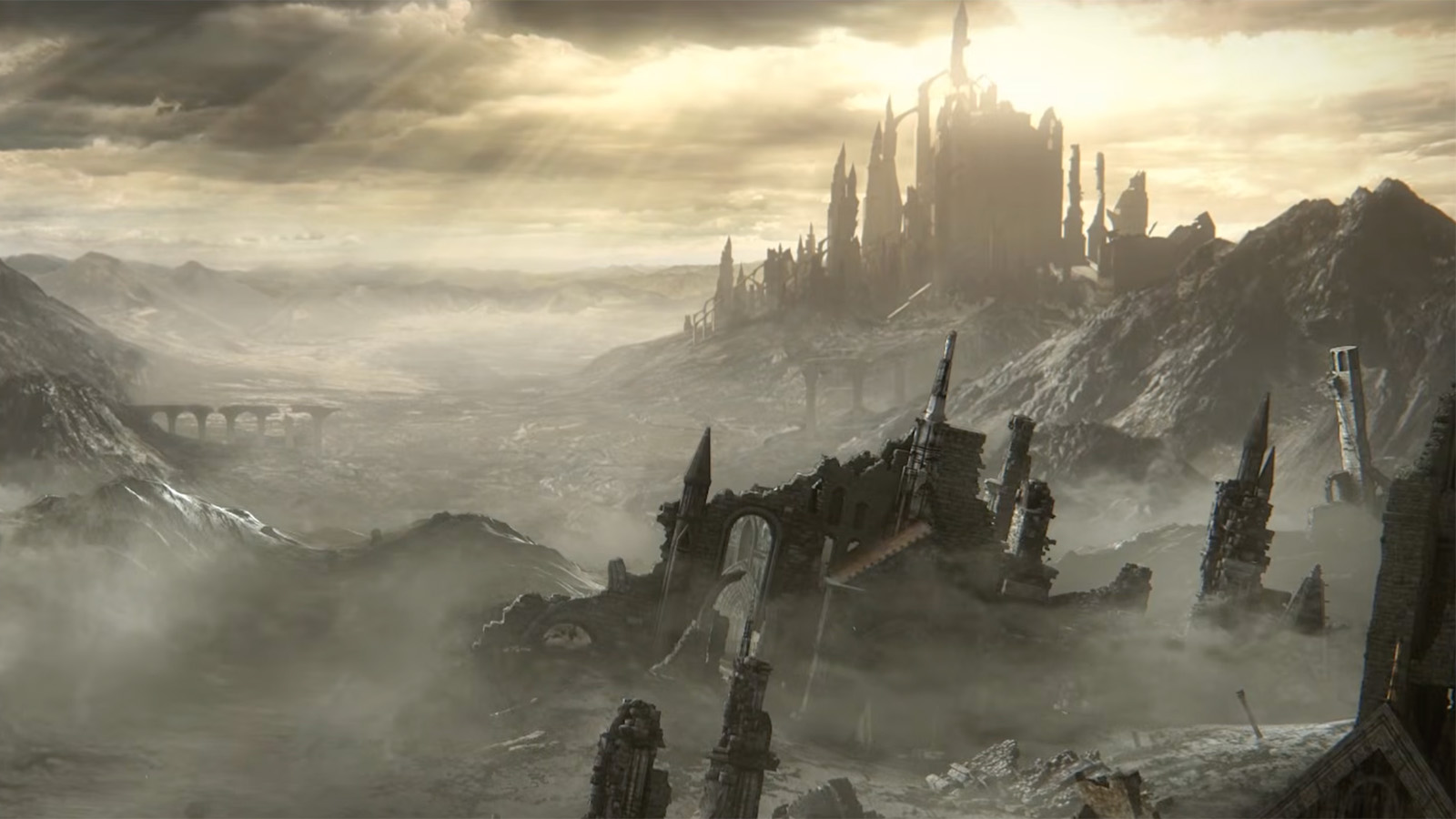
“Yes, indeed…” With these words, spoken by an old woman whose tone carries the profound resignation of one who has lived through an unfathomable expanse of time, this apocalyptic epic begins. The age of prosperity once built by the gods has long since passed, and the world is slowly but surely losing its heat. “The First Flame,” which once blazed brightly fueled by the magnificent souls of kings, has finally reached its limit after repeated life-prolonging measures, and the world has now transformed into a dead realm largely covered in ash. The very resonance of the mature voice uttered by the narrator in the opening embodies the world’s deep fatigue and sorrow toward the cosmic futility of the “Linking of the Fire,” a cycle repeated thousands, if not tens of thousands, of times.
Flowing at the foundation of this work, which depicts the end of the “Age of Fire,” is an extremely melancholic aesthetic of ruin and the sorrow of “stagnation” caused by forcibly prolonging a system (the cycle of the Linking of the Fire) that has reached its limit. When the bell tolls and the “Lords of Cinder” who once linked the fire abandon their thrones, the beings awakened from the graveyard to serve as their substitutes are known as the “Unkindled.” The virtual death sentence in the opening—“Nameless, accursed Undead, unfit even to be cinder”—illustrates just how miserable their existence is. Nameless, accursed, and unable even to become cinder. Why do they awaken, and why do they seek “Embers”?
In this article, while strictly distinguishing between “facts”—such as in-game item descriptions, environmental storytelling, and the fragmentary dialogue and actions of NPCs—and the historical and philosophical “speculations” derived from them, we will unravel the causal relationships and emotional subtleties lying at the depths of the phenomenon that is the end of the Age of Fire. As the world regresses into nothingness, we will deeply and systematically delve into the humanity that still faintly shines and its philosophy of attachment.
1. Cosmological Stagnation and the Truth of “Embers”—An Age Not Allowed to End
To understand the worldview in this game, it is essential to grasp the cosmological positioning of fire, dark, and the substance known as “ash.” Tracing the historical continuity from the original Dark Souls, it has been believed that once the Age of Fire ends, the Age of Dark will naturally follow as a matter of providence. However, according to deep community speculations and circumstantial evidence within the lore, the reality presented by the apocalyptic world in which this game is set reveals a cruel state of affairs that differs from this belief.
1.1 The False Age of Dark and the Curse of the “Fading Flame”
There is a compelling theory that, historically, the world has never actually experienced a true “Age Without Fire” (a complete Age of Dark). This is because no matter how much The First Flame weakens, there has always been an “Ember” left behind to serve as a seed for reignition. Although the fire fades and darkness encroaches, it is never completely extinguished, and the world has constantly been stranded in a twilight state—a midpoint between a “blazing flame” and a “fading flame.”
This state of “being unable to end when it should” gives rise to “stagnation,” the greatest tragedy in this work. Ever since the first king, Lord Gwyn, offered himself as the first cinder to prolong the Age of Fire, the providence of nature was shattered, and fire became something artificially circulated. The gods instilled in humanity the dogma that “fire is good and must be protected,” passing down the Linking of the Fire as a virtue. As a result, the world lost its normal cycle of death and rebirth, taking on a grotesque appearance where only rot and ash accumulate.
| Cosmological Phase | Definition of State | Impact on the World and Phenomena |
|---|---|---|
| Age of Fire (Early) | The state where The First Flame burns fiercely. | The prosperity of the gods. The boundaries between life and death, light and dark are clear, and the laws of nature are maintained. |
| Fading Flame (Present) | The state where the fire fades, and only Embers barely survive. | The blurring of boundaries. The rampant spread of undeath, the emergence of Hollows, and the proliferation of ash covering the world (stagnation). |
| True Age of Dark | The state where even Embers vanish, and the concept of fire is completely lost. | The end of the cycle. Liberation from the curse of the Linking of the Fire. A return to the original, natural state (unreached). |
1.2 The Fading of Fire and the Rampant Phenomenon of Undeath
As a result of the Linking of the Fire system reaching its limit and the fire itself weakening, a certain reversal phenomenon occurs in the world. If we align with the theory that the “Unkindled” are unique beings born from the repeated Linking of the Fire, the fact that “the fire fades” indicates a deepening of the dark accompanying the weakening of the fire. The power of the dark, namely the “Dark Soul” which is the essence of humanity, grows relatively stronger as the fire weakens, and in conjunction with this, human immortality is abnormally enhanced. Furthermore, the fact that humanity itself possesses the property of fueling the fire, equivalent to the souls of past lords, is one of the reasons this contradictory system has been prolonged.
The phenomenon where even corpses—which normally would have long ceased activity and returned to the earth—achieve resurrection is presumed to stem from this rampant undeath. Those who in past eras would have merely wandered as “Undead” can no longer even maintain their physical forms, burning out once as “ash,” yet they are still denied death and crawl out of their graves. This is a tragic consequence, akin to a cosmological bug, resulting from a system that has continued to operate beyond its limits.
2. Anatomy of the “Unkindled”—The Philosophy of “Attachment” that Fills the Void
In the opening narration, the “Unkindled” are defined, as mentioned earlier, as those “unfit even to be cinder.” And it is said that they act according to the instinct that “Ash seeketh Embers.” However, when integrating the dialogue of the countless NPCs encountered in the game and the fates they meet, it becomes clear that the essence of ash is not merely an “automaton seeking fire.”
2.1 The “Unburnt Regret” Hidden Within the “Instinct to Seek Fire”
As a matter of fact, ash are those who once attempted the Linking of the Fire but lacked the strength of soul, burning in the flame to become nothing more than ash. Therefore, they possess an instinctual nature to seek what they could not obtain, namely “fire (Embers).” This is akin to a physical law of the game world.
However, according to deeper speculation, a highly human definition emerges: the “Unkindled” are beings resurrected because they harbor “unfinished business (strong regrets)” at their core and cling to it. Even though their bodies were literally burned to “ash,” their hearts still harbor personal passions that have yet to burn out. They awakened not merely for the quest of fire, but to bring closure to their own lives.
The journey of Siegward of Catarina vividly illustrates this tragic sense of duty. He is not merely a seeker of adventure; he awakened solely to fulfill a “promise” to strike down his old friend, Yhorm the Giant, should he lose his reason. The sight of him quietly expiring (or falling asleep) and fading away immediately after defeating his old friend at the end of a grueling journey poignantly demonstrates that the fuel driving him was not “Embers,” but his “attachment to a promise.”
The journey of Anri of Astora is similar. Anri’s goal is to defeat Aldrich, Devourer of Gods, the evil being who devoured the children Anri once lived with in their homeland. Anri’s journey is filled with revenge and sorrow, and the regret of needing to slay Aldrich is the sole force propelling Anri forward in a despairing world. Furthermore, Sirris of the Sunless Realms is also resurrected with the heartbreaking resolve of a blood curse: to personally deliver the final blow to her grandfather, who has succumbed to madness and become a “Mound-Maker.”
Also noteworthy is the existence of villains resurrected from past games who could hardly be called heroes, such as Unbreakable Patches, Creighton the Wanderer, and Longfinger Kirk. The fact that they too are resurrected as “ash” further reinforces this theory. What drives them is not some noble mission to save the world, but the inexhaustible “desires” of humanity and a gritty yet intense clinging to life, a feeling of “not having played enough in this world yet.” In other words, the true form of the “Unkindled” is not a hodgepodge of past losers, but a collective term for “those who possess an intense will that has yet to burn out.” The fact that their resurrection requires “their corpse to remain,” as seen in the graveyard around the Firelink Shrine, also suggests that their souls are still strongly tethered to the physical world.
2.2 The Philosophical Contrast Woven by the Black Knights and the “Unkindled”
Here, by contrasting Lord Gwyn’s “Black Knights” from the original Dark Souls with the “Unkindled” of this game, the theme of this work emerges more clearly and multidimensionally. As a historical fact, the Black Knights were burned in The First Flame alongside their lord, Gwyn, literally becoming “ash” that wanders the world. However, they are kin to the gods, not humans.
On the other hand, the “Unkindled” in this game are humans whose immortality has been heightened as a result of the fire weakening to its absolute limit. While the servants of the gods became ash as a “noble sacrifice and loyalty to their lord,” the human ash crawled out of the ashes of their own accord due to “unfulfilled personal attachments.” Despite their entirely different origins and the disparity between high-ranking beings and the lowest cursed ones, they share the common appearance of “being burned to ash by the flame.” Above all, they form a terrifyingly beautiful and sorrowful contrast in that the fundamental reason they continue to wander the world is a “strong attachment to the past.”
3. Lothric’s “Linking of the Fire Recycling Plan” and Its Miserable Collapse
The direct cause of the protagonist, an “Unkindled,” awakening and wandering the world lies in the collapse of an abnormal and blasphemous system for the Linking of the Fire devised by the Kingdom of Lothric, the center of this world. Lothric, the setting of the story, is a nation that reveres the bloodline tasked with the sacred duty of the Linking of the Fire. However, the reality they faced was the despair of the “fading of the fire,” which had reached a point where the power of a single hero could no longer suffice.
3.1 The Recreation of the Oldest Linking of the Fire and Desperate Life-Prolonging Measures
In the past, the fire was linked by those with powerful souls burning themselves. However, in the era of this game, the fire itself has fatally weakened, falling into a state where even the strong cannot link it. Here, we consider the mad plan devised by Lothric. They schemed to artificially recreate the “oldest Linking of the Fire,” said to have been performed by the first Lord Gwyn, by gathering the Embers of the “Lords of Cinder” who had linked the fire in the past and forcibly increasing the total mass of “Lord Souls.”
As a matter of fact, dedicated thrones inscribed with the names of specific Lords of Cinder (Abyss Watchers, Aldrich, Yhorm the Giant, and Ludleth) are prepared from the beginning at the Firelink Shrine. The interpretation that they resurrected by chance does not hold; it strongly suggests that this “Lord of Cinder Recycling Plan” had been anticipated for generations, and they were carefully selected and their thrones prepared to be used as “bridging fuel” for the impending Linking of the Fire. The quiet words of Ludleth of Courland, the only one who remains at the shrine, stating that he “became a Lord of Cinder for that very purpose,” corroborate the fact that he fully understood his role in this cruel system and willingly made himself a human sacrifice.
3.2 The Flawless Two-Tiered System and the Prince’s Rejection
However, no matter how many souls of past lords are gathered and their heads returned to their thrones, the ritual of the Linking of the Fire cannot be completed without a new lord to serve as the “vessel” to feed that massive bundle of souls to the fire. The Kingdom of Lothric attempted to burden the younger of the specially bred Twin Princes, Prince Lothric, with this great role. But he rejected this cursed fate—the meaningless system of eternally burning cinder—and secluded himself deep within the Grand Archives. This was the de facto collapse of the system.
This is where the “Unkindled” function as a failsafe. The ash, including the protagonist, are originally nothing more than the masses who lack the vessel to link the fire. However, by defeating Prince Lothric, who abandoned his destiny, and forcibly usurping (inheriting) his qualification as the “vessel of the lord” through martial might, the gathered “old cinder” and the “new cinder (vessel)” are forcibly brought together. It is speculated that this “two-tiered Linking of the Fire system,” prepared in case the orthodox route was severed, was the full extent of Lothric’s tenacious plan.
| System Component | Role and Subject | Notes and System Abnormality |
|---|---|---|
| Fuel (Old Cinder) | Past Lords of Cinder (Yhorm, Aldrich, Abyss Watchers, Ludleth) | A blasphemous recycling of the dead, functioning even if only their heads are returned to the thrones. |
| Vessel (New Cinder) | Prince Lothric (Originally intended) | Rejected the Linking of the Fire. The tragedy of cursed blood burdened upon a frail body. |
| Procurer & Backup Vessel | Unkindled (Protagonist) | Forcibly supplements the system by hunting the heads of the fleeing lords and usurping the prince’s qualification through force. |
3.3 The Decline of Lothric and the Chronicles of the Lords of Cinder
As for the era to which these four Lords of Cinder belong, a certain degree of speculation is possible from the transition of Lothric’s national power. As a fact gleaned from environmental storytelling, it is believed that Lothric in the past, backed by the mighty military force of employing wyverns, conquered or subjugated other nations that drifted to them (the homelands of the Lords of Cinder). However, in the era of the main game, the wyverns exposing their corpses on the High Wall of Lothric have already decayed into ash, and there is no trace of their former overwhelming national power.
From this circumstantial evidence, it can be deduced that the resurrected Lords of Cinder were not figures from the distant past of the mythological age, but rather the “last four generations of lords” who were forced to link the fire consecutively in a “relatively recent era” when Lothric’s national power began to decline and the fading of the fire became decisive. They were victims of Lothric’s forceful life-prolonging measures, and at the same time, accomplices forced to sustain the world under desperate circumstances.
4. The Conflict Between the Abandonment of Duty and Free Will—Those Who Abandon Their Thrones
As the opening narration coldly prophesied, “And the Lords will abandon their thrones,” the resurrected Lords of Cinder (with the exception of Ludleth, who remained of his own free will) refused to return to their thrones and returned to their respective homelands. Why did they so easily abandon the mission of the Linking of the Fire, which they had once performed at the cost of their own lives?
4.1 The Commonality of “Ash” Nesting in the Resurrected Lords
The key to unraveling the reason the Lords of Cinder abandoned their mission lies in the speculation that they too were resurrected by the exact same principle as the “Unkindled.” That is, they too did not burn out completely, but met their deaths leaving “strong regrets and attachments” or “ineradicable despair” in their hearts. The former heroes chose to follow the personal despair hidden within themselves rather than the grand cause of saving the world.
Yhorm the Giant once offered himself to link the fire in order to protect the people who did not believe in him. However, what he saw upon his resurrection was the reality that the Profaned Capital he tried to protect had long since perished, becoming a ruin crawling with grotesque beings. All that remained for him was the fulfillment of a sad promise with his old friend Siegward, and there was no longer any reason to burn for the world again.
The Abyss Watchers (Undead Legion of Farron), driven by a maddening sense of duty to prevent the spread of The Abyss, partook of the wolf’s blood and linked the fire as a collective. However, what awaited them was an eternal hell where their homeland itself was swallowed by The Abyss, and they continued an endless mutual slaughter among compatriots. Far from returning to their thrones, they merely cling to the remnants of their mission by sealing their keep and continuing to hunt their own kind.
As for Aldrich, Devourer of Gods, he foresaw the coming of the Age of the Deep Sea (the true Age of Dark) and had not the slightest intention of linking the fire in the first place. However, due to his overwhelmingly powerful soul, he was forcibly made into a Lord of Cinder by the world. It was an absolute inevitability that he would abandon his throne, and he headed to Anor Londo, the ancient city of the gods, to satisfy the continuation of his endless desire to devour gods.
They refused to become inorganic cogs in the determinist “circulation system of fire.” Even if it invited the catastrophic end of the world, they exercised their free will and returned to their homelands to face their respective despairs.
4.2 The Despair of Hawkwood the Deserter and the Thirst for the “Dragon”
The NPC who most vividly and humanly embodies this theme of “abandonment of duty” and “free will” is Hawkwood the Deserter from the Undead Legion of Farron. In the early stages, he slumps on the stairs of the Firelink Shrine, completely despairing over the fact that he is “ash unfit even to be cinder” and that his once-proud compatriots have been swallowed by madness, losing the will to fight. With self-deprecation, he continuously throws apathetic words at the player.
However, as he witnesses the protagonist, the player, carving through a harsh fate and striking down terrifying lords, the “Ember” smoldering within Hawkwood begins to heat up again. He finds his reason for being in the “pursuit of the ancient dragons”—a form entirely different from the Linking of the Fire—and stops running from his fate. His line, “You are a dragon, more dragon than I,” is not mere marvel. It is a declaration of the moment he escapes the void of being a mere deserter and finds the “attachment (= yearning for the immortal, everlasting ancient dragons)” that he must achieve by his own will, even as a cursed being of ash.
When he declares, “Loathe me all you like, I shall take what makes you dragon,” and finally crosses blades with the protagonist, it is not out of hatred. It is an extremely pure and noble clash of wills to prove the “truth” each has found. Hawkwood’s trajectory symbolizes the sorrowful yet beautiful way of life of the “ash” who, tossed about by fate and broken once, ultimately never stop resisting. The path to the dragon is an escape to the eternity of unperishing stone, belonging neither to the fading fire nor the deepening dark, and that was his ultimate exercise of “free will.”
5. The Aesthetics of Ruin and The End of Fire—Liberation from the Eternal Cycle
The Unkindled, while clearing their own regrets, successively strike down the fleeing Lords of Cinder and bring their heads (cinder) back to the thrones. It is a literal “dragging back of corpses,” a gruesome execution of fate completed by the hands of nameless ash. However, when all the power of the lords is gathered and one finally reaches the “Kiln of the First Flame,” the player (and the protagonist as the Ashen One) is confronted with an ultimate philosophical choice.
5.1 The True Salvation Brought by “The End of Fire”
This game offers multiple endings, but the most philosophical ending, which could be called the true salvation of this world, is “The End of Fire.” By summoning the Fire Keeper who has regained her eyes and entrusting the faintly burning Ember to her hands, the fire that has continued for tens of thousands of years finally vanishes completely.
As touched upon in Chapter 1, in history thus far, the Age of Dark has been nothing more than an “Age of the Fading Flame,” where Embers always remained, keeping the world stranded in a twilight stagnation. However, in this ending, as the Fire Keeper gently gathers all the Embers within herself and watches over the fire’s final moments, this abominable cycle of death and rebirth is finally severed. It is the arrival of the true Age of Dark (a world without fire), where not even an Ember exists to reignite the flame.
At first glance, this conclusion might seem like a tragic ending that plunges the world into complete despair in the sense that light is lost. However, in light of the philosophy underlying this work, this is precisely the “return to the natural providence as it should be.”
5.2 The End of a System at Its Limit and Its Sorrow
The system known as the “Linking of the Fire,” created as a result of the gods fearing the extinguishing of the fire and trying to distance the power of the Dark Soul from humanity, had turned into a curse that brought only rot and ash to the world. The Fire Keeper’s act of extinguishing the fire is a quiet yet clear thrust of “No” against a system that endlessly repeats meaningless pain, akin to the “eternal return” proposed by the German philosopher Nietzsche.
The world is already old and utterly exhausted. What awaits at the end of the blood-soaked journey where the “Unkindled” struck down the lords while sublimating their own regrets is not a glorious Age of Fire filled with new hope. It is the acceptance of a “peaceful eternal sleep” for the world itself. The Fire Keeper’s silence-filled declaration, “The darkness will shortly settle,” signifies liberation from a life filled with pain (the curse of undeath), and what drifts there is an extremely dignified sorrow and aesthetic of ruin.
The Age of Dark is also the true age for humans who possess the Dark Soul. When the fire fades and the world is completely enveloped in silence, there are no longer the bindings of the gods nor the suffering of undeath; only a quiet, peaceful, true dark spreads. The faint voice of the Fire Keeper asking in the darkness, “Ashen One, hearest thou my voice, still?” leaves a lingering resonance akin to hope, suggesting that even in a world where all causality has vanished, the “humanity” of connection between people certainly remains.
Conclusion: The Ember of Humanity Flickering in an Ash-Covered World
“The End of Fire” depicted in Dark Souls III is not merely the closing act of a myth in a fantasy world. It is a fundamental questioning of how people, and the world, should face inevitable “death (the end).”
The “Unkindled” are, as declared in the opening, accursed Undead unfit even to be cinder. They are born losers of fate, their bodies made of cold ash. However, what drove them and became the power to strike down even mighty lords was not some noble mission ordained by the gods, but extremely gritty “humanity (regrets)” itself—such as a promise to a friend, revenge, or a greedy clinging to life.
They challenge the lords of the thrones not to save the world, but to bring closure to their own souls, and at the end of it all, they choose the end of fire. That was the sole proof of “free will” resisting a world dominated by nothingness and stagnation. Just as the lords abandoned their thrones following their own despair, the ash too chose to end the world following their own attachments.
The majesty of the gods who once built the Age of Fire is completely lost, a black sun floats in the sky, and the earth is literally buried in ash. Amidst this thorough sense of nothingness and melancholic landscape, the flickers of passion emitted by the Ashen One and those around them will never fade. They can be said to be the exceptionally beautiful and fleeting “Embers” launched at the very end in a world that ought to end. The endless journey of the nameless ash, awakened with the tolling of the apocalyptic bell, was the most noble and sorrowful funeral rite to put an eternal end to the tragic cycle of the Linking of the Fire and bring great rest to an aged, withered world.
Thank you very much for reading to the end. To help support the activities of this archive, a warm donation of a cup of coffee would be highly appreciated.