Lore.06: Aldrich, Cleric of the Deep
 © FromSoftware
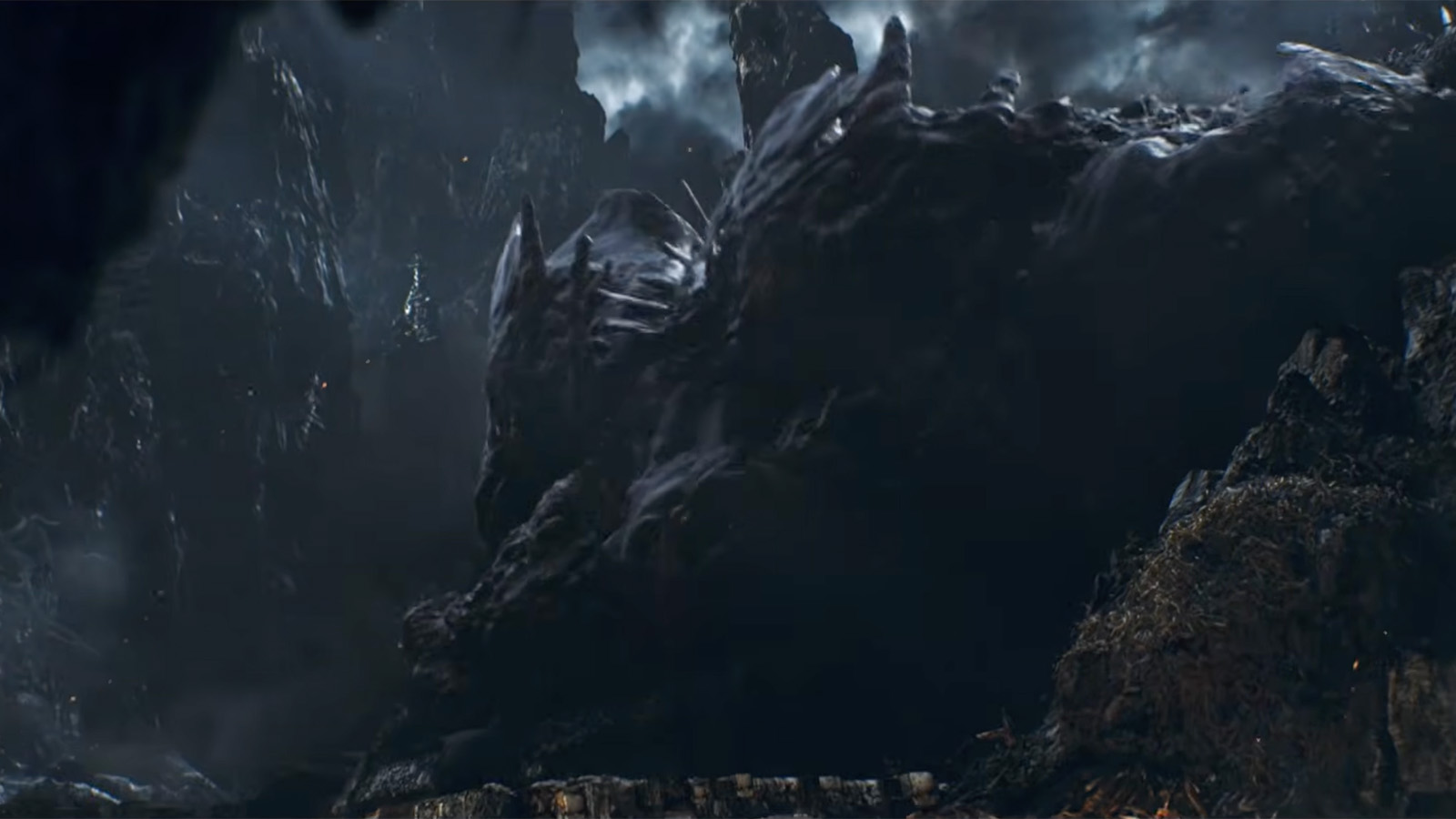
In unraveling the end of the Age of Fire, the entity that most gruesomely embodies its pathology and limitations is one of the former Lords of Cinder, “Aldrich, Cleric of the Deep.” The noble ritual of self-sacrifice known as the Linking of the Fire had, over its long history, become completely hollowed out, reduced to nothing more than the extension of a system that had reached its absolute limit. Amidst the melancholy and nihilism of a world sinking into ash, the existence of Aldrich demonstrates the cruel “reality” of a world where even heroes have been depleted, serving as a desperate response to the absurdity of fate.
This article will integrate environmental storytelling—such as the placement of corpses and architectural styles—scattered item descriptions, and the philosophical views on life and death that flow beneath the world’s lore, to conduct an extremely detailed analysis of the true nature of Aldrich, the structure of fanaticism surrounding him, and the concept of the “Deep Sea” he envisioned beyond the fading fire. Including historical connections from previous titles, the full picture of the role he played at the end of the Age of Fire will be documented here.
1. The Fall of the Cleric and Transformation into “Sludge”: The Karma of Maneating and the Collapse of Faith
The fundamental terror and revulsion of Aldrich stem from the fact that he was originally a “cleric.” How did one who served the gods, preached of light and miracles, and guided the people, degenerate into that hideous sludge? Not only does this reveal human madness and the collapse of ethics in extreme conditions, but it also conceals a terrifying insight into the “essence of humanity” within the world of Dark Souls.
As Hawkwood the Deserter, a former Blue Sentinel, recounts, Aldrich was originally but a humble cleric who gradually drowned in an abnormal appetite for “eating men.” As a result of continuously devouring people, he bloated like a drowned corpse, eventually losing the original form of his flesh and softening into a viscous “sludge.” It is evident that Hawkwood himself, while self-deprecatingly mocking his own weakness in constantly running from his fate, harbored a profound sense of nihilism toward the fact that a monster like Aldrich reigned as a king.
To deeply consider the process of this transformation, one must understand the metaphysical meaning that the act of “eating men” holds in this world. In the lore of Dark Souls, humanity—fragments of the Dark Soul—dwells within humans. Humanity is fundamentally dark, possessing a heavy and stagnant nature. To devour a person means not merely to consume their physical flesh, but to physically and mentally ingest the heavy humanity (darkness) that settles within others. It can be logically deduced that Aldrich transformed into sludge because he accumulated an excessive stagnation of humanity—namely, The Deep—within his body, rendering him unable to maintain the orderly outer shell (human form) bestowed upon humans by the gods.
Furthermore, the text of the ornaments associated with Aldrich (the Ruby and Sapphire rings) clearly states that he “reveled in the agonizing cries of his victims.” This indicates that he did not resort to maneating out of mere survival instinct or a rampage of madness, but consciously possessed a “malice” that sadistically enjoyed the suffering of others. The fact that a Lord of Cinder, who was supposed to bear a noble mission, was such a hideous sadist is an extremely melancholic scene that illustrates just how desperate the end of the Age of Fire is, and how the moral and spiritual standards of the world have collapsed from their very foundations. In a world where the objects of faith are absent and miracles degenerate into mere stories, he may have found a new form of faith in the most primitive and direct usurpation of power: “chewing on the lives of others.”
2. The “Cathedral of the Deep” and the Structure of Fanaticism: The Philosophy of Stagnation and the Reversal of Doctrine
An absolutely indispensable element in discussing Aldrich’s madness is the existence of the “Cathedral of the Deep” that reveres him. This was originally a pure cathedral meant to seal away evil things. However, at some point, its mission was reversed, transforming into a sinister cult that worshipped the very “Deep” it had sealed away. The Cathedral of the Deep embodies Friedrich Nietzsche’s philosophical proposition—“He who fights with monsters should look to it that he himself does not become a monster. And if you gaze long into an abyss, the abyss also gazes into you”—in the most cruel manner imaginable.
The faith of the Cathedral of the Deep was supported by three Archdeacons. By piecing together the placement of their corpses and the texts of related items, the division of roles within the cult and how their faith became distorted and ultimately collapsed are brought into sharp relief. The following table illustrates the roles of the three Archdeacons and the structure of environmental storytelling that can be read from them.
| Archdeacon | Role within the Cult and Symbolized Theme | Facts and Observations Based on Environmental Storytelling |
|---|---|---|
| Royce | Guarding Aldrich’s main altar and executing rituals | At the deepest part of the cathedral, in front of Aldrich’s massive coffin, he continues to offer prayers alongside followers clad in red robes. His figure, blindly guarding an empty coffin long abandoned by its master, symbolizes the “stagnation” of a faith that has lost its purpose and the ultimate form of escapism. |
| Klimt | Serving the Goddess Rosaria (Abandonment and mutation of faith) | He serves “Rosaria, Mother of Rebirth,” who resides in a hidden room beyond the cathedral’s rafters. From the fact that Man-Grubs bearing Klimt’s holy symbol are placed around her, it is presumed that he abandoned even the faith of The Deep, seeking salvation in another form through physical mutation (regression into maggots). |
| McDonnell | Proselytizing to the Boreal Valley and exploring the sorceries of The Deep | Discovered as a corpse alongside two massive beasts at the “Water Reserve” bonfire beneath Anor Londo. He was the mastermind of the cult who sublimated the dregs of The Deep into sorcery and promoted the alliance with Pontiff Sulyvahn, and is highly likely a victim of a power struggle. |
As a fact explicitly stated in the game, the Evangelists of the cathedral ventured outside to places like the Undead Settlement, luring people through sweet words or coercion, and transporting them to the cathedral as “food” for Aldrich. The staggering number of slave giants placed inside and around the cathedral, as well as the crawling sludge monsters, are the direct victims of this gruesome system.
As an observation derived from this, it is conceivable that the cult of The Deep did not merely worship Aldrich as a god, but attempted to reconstruct the world itself as part of a massive cosmic digestive organ that “devours all things and spews them out.” To them, the mission of the Linking of the Fire was a trivial matter; solely satisfying their master’s bottomless appetite was their “prayer” and “ritual.” Just as pure water rots when its flow is stopped, their faith too rotted away within the stagnation known as The Deep, transforming into a writhing, maggot-like fanaticism.
3. The “Deep Sea” Envisioned Beyond the Fading Fire and Fatalism
The greatest mystery in this theme, and the one bearing the most profound philosophical depth, is the concept of the “Age of the Deep Sea” that Aldrich envisioned. The text of his Soul, the remnant of his power, contains the following decisive sentence:
“He saw for himself the age of the deep sea that lies beyond the fading fire. Thus, he began to devour the gods, even knowing it would be a long and arduous path.”
This single sentence encapsulates a paradigm shift that fundamentally overturns Aldrich’s behavioral principles. His maneating, and the god-devouring mentioned later, were not mere madness or a rampage of appetite, but his own fierce “survival strategy” and “preparation” for the impending apocalypse. From the perspective of a lore scholar observing the world, this can be said to be an extremely rational, yet simultaneously thoroughly ruthless, acceptance of fatalism.
Here, in order to understand the structure of the world, it is necessary to clarify the difference between “The Abyss,” which has continued since past eras (the era of the original Dark Souls), and “The Deep,” newly presented in this title. These two are often confused as darkness of the same quality, but their essential natures and philosophical implications differ greatly.
The following comparison structures the differences in their properties.
| Concept | Origin and Nature | Symbolized Philosophical Theme and State |
|---|---|---|
| The Abyss | The rampage of humanity (the Dark Soul). Seen in Manus and Oolacile. | Emotional, turbulent, multiplying and shape-shifting “dynamic” darkness. A shadow-like existence that thickens in proportion to the strength of the light in the Age of Fire. Accompanied by explosive mutations of life. |
| The Deep | Heavy darkness that stagnates at the bottom of water, falling completely silent. | ”Static” darkness where even emotions settle, swallowing all light and ceasing all movement. The ultimate extreme of stagnation where insects spawn and all things rot and mix together. The heat death of the universe. |
Sorcery texts such as “Deep Soul” state that “dregs are the heaviest things within man, and thus they sink endlessly.” It is believed that the “Deep Sea” was born as a result of the essential malice, sorrow, and weight of life of humanity continuing to accumulate at the bottom of the world at the end of thousands, tens of thousands of cycles of the Linking of the Fire.
If light is time, then a world where the fire has faded and light is lost means a space where time has completely stopped. As some lore theorists point out, in this world where light and time are closely intertwined, the end of the Age of Fire is synonymous with the disappearance of time. The “Age of the Deep Sea” that Aldrich envisioned is an era of absolute stagnation where light (time) is completely lost, and everything sinks to the heavy, cold bottom of the water and mixes together.
In the English text, this deep sea is expressed as the “Deep sea,” and as Aldrich’s own name (Eldritch: eerie, unfathomable) suggests, elements of cosmic horror akin to those found in the Cthulhu Mythos are strongly reflected here. In contrast to the maintenance of the world through human will known as the Linking of the Fire (free will), there is the era of absolute darkness and cold water that will inevitably arrive after the fire fades (fatalism). Aldrich either had his mind broken by the vision of that predetermined, desperate future, or he conceptually evolved (or devolved) himself in order to transcend it.
As the text “even knowing it would be a long and arduous path” indicates, the act of devouring gods was by no means merely for pleasure to him. It was the ultimate extreme of a terrifying survival instinct, attempting to survive the coming Age of the Deep Sea by ascending his own existence into a “paranormal sludge that encompasses even the gods.” Coexisting there is a defiance against the absolute laws of the universe, and simultaneously, a sorrowful resignation of completely abandoning his dignity as a human being.
4. Elevation to Lord of Cinder: The Extension and Paradox of a System at Its Limit
The greatest irony in Aldrich’s story is the fact that he was elevated as a “Lord of Cinder” and had his body burned in The First Flame. Tracing back through history, the Linking of the Fire was an extremely self-sacrificing and noble act, in which the first Lord of the Dead, Lord Gwyn, went so far as to burn his own body to sustain the world. It was supposed to be a sacred ritual to maintain the order of the world.
However, as time passed, in the era of this title where the repeatedly performed system of the Linking of the Fire had reached its absolute limit, the fire had lost its dignity and blindly craved an overwhelming mass of kindling to burn, “no matter whose soul it was.” Aldrich was not chosen for his nobility or sense of duty as a king. Simply because he possessed an “overwhelming mass of souls” accumulated within him from relentlessly devouring people, he was forcibly made into a Lord of Cinder as fuel to prolong the life of the world.
This fact brilliantly expresses just how terminal the state of the world is. The Linking of the Fire is no longer a sacred ritual, but has degenerated into a cold-blooded “processing” to forcibly connect monsters with massive souls to the system. The fact that those of Londor plotted the usurpation of the fire to bring a new order to the world (the Age of the Lord of Hollows) is precisely because they sharply saw through the collapse of this system.
When the Ashen One awakened, Aldrich had already abandoned his throne and returned to what could be called his homeland, the Boreal Valley, and to the former city of the gods, Anor Londo. For him, the Linking of the Fire was nothing more than a meaningless shackle hindering his grand journey to the Deep Sea. For one who knows as a definitive future that the fire will fade and the Deep Sea will arrive, the act of prolonging the fire is the height of folly and mere wasted effort.
However, a cruel paradox of fate exists here. Aldrich loathed the fire, rejected the Linking of the Fire, and thirsted for the cold water world of the Deep Sea. Yet, during the battle with him, when he transitions to his second phase, “flames” crackle and spread around the sludge he wears. This is profound environmental storytelling that goes beyond mere gameplay visual effects. No matter how much he hated the fire and tried to escape into The Deep, the spiritual fact that his body was once burned in The First Flame as a “Lord of Cinder” cannot be erased. In the depths of his soul, or the deepest part of his rotting flesh, the “fire” he despised most continued to smolder like a curse.
The sight of him fighting while being burned by the fire left within him, at the very moment he tried to become a perfect creature of the Deep Sea by devouring a god, highlights the absurdity and pathos of one struggling to escape their fate. The fact that he too, despite being a god-devouring monster, was merely a victim trapped in the cruel laws (cycles) of the world, strikes the player’s heart with a sense of melancholy.
5. Alliance with Pontiff Sulyvahn and Dark Ambitions: The Machinations of the Boreal Valley
Indispensable for Aldrich to accomplish the great deed of devouring gods was the existence of “Pontiff Sulyvahn,” who ruled Irithyll of the Boreal Valley. It is presumed that they were in a cooperative relationship, but that relationship was by no means a simple master-servant dynamic or a friendship based on trust. There existed an eerie alignment of cold-blooded interests in a world heading toward ruin.
Sulyvahn, an ambitious man who came from the Painted World of Ariandel—a world outside the external order—despaired of the world, or perhaps questioned the very nature of the world, and desired the arrival of a new age (The Deep, or darkness). Upon usurping power in Irithyll, he imprisoned the gods of the old royal family, Gwyndolin and Yorshka. Then, Sulyvahn invited Aldrich deeper into Irithyll, to the old cathedral of the former city of the gods, Anor Londo, and offered the bedridden Gwyndolin as “food.”
Sulyvahn chose not to murder the gods directly with his own hands, but opted for the extremely humiliating and blasphemous method of “feeding them to a mud monster.” For Aldrich, this provided the supreme offering of a god, and for Sulyvahn, it offered the advantage of the complete destruction of the old regime’s authority and the absolute establishment of his own power. This alliance between the two can be said to be the worst in history, sealing the end of the Age of Fire.
However, behind this alliance, traces of a quiet power struggle can be glimpsed. In the underground “Water Reserve” of Anor Londo, the corpse of Archdeacon McDonnell, who should have been the mastermind of the cult of The Deep, is left abandoned in the cold water. And around him, two of Sulyvahn’s Beasts (former knights turned into beasts by rings) are placed, and it is here that the covenant of the “Aldrich Faithful” can be obtained.
The facts indicated by this environmental storytelling are heavy. While utilizing Aldrich, Sulyvahn may have feared that his boundless appetite and the influence of The Deep would extend across all of Irithyll, and thus maneuvered to “isolate” or “seal” him in the old cathedral of Anor Londo. It is presumed that McDonnell either realized Sulyvahn’s true intentions (the imprisonment of Aldrich) or tried too hard to expand the cult’s power, and was consequently purged deep underground by the beasts unleashed by Sulyvahn. At the bottom of the Boreal Valley, where immense malice intersected with malice, the ritual of god-devouring proceeded quietly, blessed by no one.
6. The End of the Darkmoon God: The Sound of Digestion Echoing in Anor Londo
In the story of Aldrich, what most wrings the heart of the observer is the vividness of the tragedy of “what” he was devouring. When the Ashen One passed through the snowbound Irithyll and stepped into the deepest part of the former city of the gods, Anor Londo, the figure of “Aldrich, Devourer of Gods” they confronted there was an all too cruel sight.
The tip of that mud monster, the part functioning as its upper body, was none other than “Gwyndolin”—the Dark Sun and the master of the Blades of the Darkmoon whom the player met in the original Dark Souls.
Synthesizing Yorshka’s dialogue and item texts in the game reveals that Gwyndolin inherited the will of his father, Lord Gwyn, and continued to protect Anor Londo for a long time, but eventually fell gravely ill. Sulyvahn ruthlessly imprisoned the weakened god and offered him to Aldrich.
Aldrich’s appearance in the boss fight consists of a lower body made of massive, sludge-like muck, from which sprouts the upper body of Gwyndolin, pale as a corpse and hanging his head powerlessly. This is not Aldrich mimicking Gwyndolin’s form. It is a truly horrifying state in which he is “at this very moment, slowly digesting Gwyndolin while manipulating his flesh and magic like a puppet.”
During the battle, Aldrich (using Gwyndolin’s manipulated body) rains down a maddening shower of arrows from the Darkmoon Bow, and furthermore, wields an illusion of the “Lifehunt Scythe” used by Crossbreed Priscilla in the original Dark Souls. The text for the miracle “Lifehunt Scythe” states, “Aldrich dreamt as he slowly devoured the God of the Darkmoon.”
The meaning carried by this single sentence is immeasurably heavy. Aldrich was not only devouring the physical flesh of the god, but also mentally absorbing the god’s memories, the concepts of those the god loved (Priscilla) and feared, and converting them into his own power. This act of invading deep into the inner mind of another and trampling even the foundation of their identity as his own nourishment is fitting to be called the ultimate extreme of violence.
Anor Londo, the magnificent city of the gods that once bathed in sunlight and shone in gold. Even if it was an illusion created by Gwyndolin, there was the majesty and beauty of the age of the gods. But now, the city is coldly illuminated by silver moonlight, reduced to a desolate ruin with sludge clinging everywhere. And in its throne room, which should be the most sacred of places, the last remaining god is being slowly digested by a nameless mud monster. This fact is a melancholic requiem announcing that the Age of Fire has completely and decisively ended. The heroes have departed, the gods have been devoured, and all that remains is the mud that covers the rotting world.
Conclusion: The Final Destination of Humanity and the Elegy Seen at the Bottom of the Abyss
What has become clear through the in-depth analysis of this article is the fact that Aldrich, Cleric of the Deep, is not merely an “evil monster to be defeated,” but an “inevitable product” born from the structural flaws of the Age of Fire. His existence and actions brilliantly mirror the contradictions and despair harbored by the world.
First, the complete collapse of mission. Running to cannibalism despite being a cleric, and abandoning the fire despite being a Lord of Cinder, he is a symbol of how the authority and mission that once maintained the world have become completely meaningless in a world of ash. The system has become a hollow shell, and morality has sunk into the mud.
Second, his figure as the embodiment of stagnation. As a result of taking in too much “stagnant humanity” known as The Deep, his figure, which lost its individual outline and turned into sludge, shows the most hideous fate of a life that has stopped flowing—that is, a world that has rejected change.
Third, the complete end of the age of the gods. The act of physically and mentally digesting Gwyndolin, the remnant of Anor Londo, was a decisive end and a blasphemous usurpation of the history of the gods who once ruled the world. The sight of a god being swallowed by mud signifies the death of the mythological age.
Fourth, the fear of the future and the rampage of survival instinct. Fixating on the “Deep Sea” beyond the fading fire as a certain future, his behavioral principle of devouring everything to become an entity capable of withstanding it was the embodiment of a sorrowful fatalism, a mixture of extreme survival instinct and submission to cosmic horror.
In the story of Aldrich, there is absolutely no heroic catharsis. What exists is only the aesthetics of ruin, where what was once beautiful rots away hideously, and a spine-chilling sense of nihilism in the sound of digestion echoing through the throne room of a silent, ruined city. However, it is precisely within that gruesomeness that one extreme form of life, which “struggled to become something nonetheless” in a world that had reached its limit, is recorded as an undeniable fact.
Amidst the melancholy of the fire fading and the world turning to ash, the trajectory Aldrich left in the mire continues to settle in the deepest part of Dark Souls history as a dark, heavy, and never-to-be-erased stagnation. The Deep Sea he dreamt of may not have arrived, but the ripples of cold despair he brought to the world will never fade away.
Thank you very much for reading to the end. To help support the activities of this archive, a warm donation of a cup of coffee would be highly appreciated.