Insight.15: The Philosophy of the Three Endings
Introduction: Beyond Blood and Insight, the Conclusion Brought Forth by Cosmic Horror
In the ancient city of Yharnam, reminiscent of Victorian maturity and decadence, the Blood Ministration of the “Old Blood” brought by the Healing Church provided people with a panacea, but at the cost of spreading the dreadful Scourge of the Beast. The thirst for evolution to a higher dimension through the acquisition of “Eyes on the inside,” advocated by Provost Willem of Byrgenwerth, was also a product of the arrogance that sought to transcend human limits, much like the pursuit of blood. The history of madness that unfolded in this cursed city reaches its final phase when a single foreign Hunter arrives at the deepest depths of the Hunter’s Dream.
This article aims to unravel the philosophical and mythological themes underlying the three endings that serve as the culmination of this work, which masterfully depicts a vivid transformation from Gothic horror to Cosmic Horror: “Yharnam Sunrise,” “Honoring Wishes,” and “Childhood’s Beginning.” The three paths faced by the Hunter, the player’s avatar, are not mere narrative branching points. They are philosophical answers to the fundamental human dilemma of fear and evolution: “the mercy named ignorance (oblivion),” “the tragic eternal return (slave to fate),” and “the arrogant existential transformation (loss of humanity).” What fate awaits the insignificant existence of humanity when it touches the great cosmic truth (the Great Ones)? By synthesizing the factual relationships, environmental storytelling, and scattered fragments of information in each ending, this article will demonstrate the “causality and hidden sins” lurking in the depths of this madness-filled history.
1. “Yharnam Sunrise” — The Mercy Named Ignorance and Self-Deception
The first choice, and in a sense the most “human” conclusion, is “Yharnam Sunrise.” To the Hunter who has completed all of The Hunt and fulfilled the primary purpose of the dream (the subjugation of Mergo’s Wet Nurse in the Nightmare of Mensis), Gehrman, the First Hunter quietly offers “execution.” By meeting death in the dream by the blade he wields, the Hunter is freed from the yoke of the terrifying nightmare and greets the morning sun in the waking Yharnam.
1.1 The Burial Blade and the Metaphor of “Decapitation”
The weapon used by Gehrman, the “Burial Blade,” is said to have been forged from siderite (a meteorite) that fell from the heavens. The origin of this weapon suggests that the power he wields is not merely a beast-hunting technique, but something connected to the cosmic abyss (the realm of the Great Ones). Gehrman prompts liberation through death and decapitates the Hunter. This act of “decapitation” is highly symbolic. The head (or brain) is the seat where “Insight (eyes)” resides in this work, and the organ for receiving cosmic truth. Severing the head means physically disconnecting the “seat of the mind (Insight) that has come too close to the dimension of the Great Ones” from the “body (blood),” detaching it from madness and pulling it back to being a mere human.
1.2 Eileen the Crow Proves the “Liberation from the Dream”
After dying in the dream, the Hunter awakens in the waking Yharnam illuminated by the morning sun, losing most of their memories of the dream and surviving merely as a survivor. However, it is clear that this conclusion is not a “solution to the problem” in the true sense. This is because the scars of the Scourge of the Beast still remain in the city of Yharnam, the fundamental sins of the Healing Church have not been atoned for, and the transcendent interference of the Great Ones has not ended.
The living proof that attests to the truth of this conclusion is the existence of predecessors such as Eileen the Crow and the retired hunter Djura. In her dialogue with the Hunter, Eileen says, “I no longer dream. If I die, that’s it… The mark ahead is my prey. You turn back, don’t interfere.” This line proves that although she was once trapped in the Hunter’s Dream just like the protagonist, she received execution from Gehrman and is now living in the waking world having lost access to the dream (a state of no longer dreaming). Even though they have lost the protection of the dream (immortality), they continue to live in the harsh reality according to their own beliefs.
1.3 The Salvation of Oblivion and the Prayer of the Left-Behind Gravestone
H.P. Lovecraft, the forefather of the Cthulhu Mythos, wrote, “The most merciful thing in the world, I think, is the inability of the human mind to correlate all its contents.” This ending embodies exactly that “mercy named ignorance.” To forget the immense madness of the cosmos and escape into the insignificant yet peaceful framework of human perception. It is both the spiritual salvation of an individual and the ultimate form of macroscopic self-deception.
After this conclusion, a new gravestone is added to the Hunter’s Dream, and the Plain Doll can be seen kneeling and offering a prayer there. “This grave is a trace of a certain Hunter. Though trapped in the dream, they remained strong, and welcomed the dawn. May your awakening be a gentle and meaningful one.” The countless gravestones scattered throughout the dream are nothing but the traces of old Hunters who once visited this place and returned to the waking world through Gehrman’s execution. The protagonist, too, is merely one link in a great chain, and the fundamental administrative control of the nightmare remains in the hands of Gehrman and the Moon Presence.
2. “Honoring Wishes” — The Unending Wheel and the Inheritance of Sorrow
If the Hunter refuses Gehrman’s offer, they will cross blades with Gehrman, the First Hunter himself. His declaration, “Tonight, Gehrman joins the hunt,” is a trial to test whether they have the strength to inherit his will, and at the same time, a manifestation of his own tragic mercy, attempting to forcibly liberate his junior trapped in the dream.
2.1 Gehrman’s Sorrow and Liberation Through Death
How harsh a servitude Gehrman was forced into is evident from his own sleeping breaths and the testimony of the Plain Doll. The Plain Doll tells the Hunter, “I can hear Gehrman sleeping… He is very peaceful tonight. I wonder if he has found even a sliver of salvation.” For a long time, forced to manage the solitary dream by the will of an unseen Great One, and having spent an eternity with the phantom of his beloved pupil Lady Maria of the Astral Clocktower (the Plain Doll), his soul had reached its limit. By being struck down at the end of a mortal struggle with the protagonist, he is finally liberated from the nightmare and attains true rest (death).
2.2 The Descent and Subjugation of the Moon Presence (Flora)
When Gehrman is defeated, the true mastermind, the Great One known as the “Moon Presence,” descends from the crimson-stained Blood Moon for the first time. By piecing together environmental storytelling and the texts of Caryll Runes, it can be inferred that this entity is the fundamental energy source that maintains the space of the “Hunter’s Dream” and the being that gave life to the Plain Doll. The invocation whispered by the Plain Doll in her prayer, “O Flora, of the moon, of the dream. O little ones, O fleeting will of the ancients… Let the hunter be safe,” strongly implies that the true name (or moniker) of this Moon Presence is Flora.
The descended Moon Presence gently embraces the Hunter, and the Hunter is bound to the wheelchair where Gehrman once sat, as the new administrator of the dream. In this conclusion, the protagonist is confined to the wheelchair as if deprived of the freedom of their limbs (in a state of quadriplegia), destined to spend an eternity as the new Gehrman. The physical constraint of the wheelchair is a perfect metaphor for the absolute powerlessness of humans against the unknowable existence of the Great Ones, and the inescapable wheel of fate (samsara).
2.3 The Hunter as a Surrogate
This conclusion, “Honoring Wishes,” highlights the sorrowful ecology and madness of the Great Ones. As a major premise explicitly stated in the text of the Caryll Rune “Moon” and others, there is the fact that “The Great Ones of the nightmare generally lose their children, and thus are sympathetic, and often answer when called upon.” Every Great One loses its child, and yearns for a “surrogate.”
The Moon Presence sought an excellent Hunter with a resilient mind and body, either as a guardian to maintain the cradle that is the dream, or as an object upon which to project its own lost child. Because the protagonist demonstrated the prowess to strike down the mighty Gehrman, they ironically caught the eye of the Moon Presence and were chosen as its new possession. No matter how much humans struggle and strike down mighty beasts, they are nothing more than mere tools before the will of the cosmos. To the Hunter who has become the newly appointed administrator, staring into the void in a wheelchair, the Plain Doll simply and quietly attends expressionlessly, just as she did for her former master, saying, “May your awakening be a meaningful one, good Hunter.” This conclusion is a gruesome tragedy that most vividly expresses the “insignificance of humanity and the feeling of desperate powerlessness” in Cosmic Horror.
3. “Childhood’s Beginning” — Arrogant Evolution and the Incarnation of Cosmic Horror
What can be called the true culmination of this work is the third conclusion, “Childhood’s Beginning.” To reach this conclusion, one must use and internalize three (or more) of the “One Third of Umbilical Cord” hidden in the world, and then defeat Gehrman.
3.1 “One Third of Umbilical Cord” and the Acquisition of Eyes on the inside
The “One Third of Umbilical Cord” is an extremely peculiar cursed object that can only be obtained from one who has harbored the child of a Great One, or from a Great One itself. In the game, they are discovered in the following locations:
-
Mergo’s Wet Nurse: Obtained upon defeating her in the Nightmare of Mensis. Connected to the invisible child conceived by Yharnam, Pthumerian Queen.
-
Arianna, Woman of Pleasure: Obtained from the grotesque larva she gave birth to at the end of her madness around the Tomb of Oedon, possessing the tainted blood (the lineage of Cainhurst).
-
Imposter Iosefka: Obtained from her as she writhes in agony, having conceived the child of a Great One after repeatedly conducting experiments of the Healing Church in an attempt to line her own brain with “eyes.”
-
Abandoned Old Workshop: Left behind in the discarded workshop in the waking world. Considered a trace of the ritual where Gehrman and Laurence, the First Vicar beckoned the Moon Presence.
These are all tied to the “madness of motherhood and childbirth.” Provost Willem of Byrgenwerth preached, “We are born of the blood, made men by the blood, undone by the blood. Our eyes are yet to open,” abandoning the limits of physical Blood Ministration and thirsting for dimensional evolution through the accumulation of spiritual Insight. By using three umbilical cords, the protagonist completely harbors the “Insight that transcends human limits (Eyes on the inside),” which even Willem could not reach.
3.2 Rebellion Against the Great Ones and the Birth of the Superman
After defeating Gehrman, the Moon Presence descends in the same manner, attempting to embrace and subjugate the Hunter. However, the Hunter, having opened their Eyes on the inside, repels that embrace with a brilliant flash of light. This is because the Hunter was no longer an entity on a dimension that the Moon Presence could control as a “puppet,” but had sublimated into a being with equal or greater cognitive power. Here, the Hunter strikes down the Moon Presence itself, the ruler of the dream. As the fact that “the moon became the Old Blood, and the thin blood hunted the great one” shows, one who was once nothing more than mere human blood (thin blood) achieves the miracle of surpassing and slaying Cosmic Horror itself.
3.3 Existential Transformation and the Complete Loss of Humanity
However, the price of that victory is utterly gruesome. After defeating the Moon Presence, the protagonist’s “human body” vanishes, and they undergo a metamorphosis into an “infant Great One,” reminiscent of a mollusk like a slug or squid. The long night of Yharnam comes to a close with a scene where the Plain Doll gently picks up the protagonist, who has become a hideous larva crawling on the ground, and smiles, saying, “Are you cold? Oh, good hunter.”
From a philosophical perspective, this conclusion allows for a dual interpretation.
One is the realization of Friedrich Nietzsche’s concept of the “Übermensch” (Superman). It is a positive interpretation that the protagonist, having shattered old values (the Healing Church’s faith in blood) and overcome themselves, has finally elevated themselves from the human dimension to the “next stage” of being a Great One. In fact, the trophy text for this ending reads, “You became an infant Great One, lifting humanity into its next childhood,” explicitly indicating a dimensional evolution of humanity reminiscent of Arthur C. Clarke’s sci-fi novel Childhood’s End.
However, the other interpretation is a conclusion as a thoroughly grotesque Cosmic Horror. It is a despairing irony that the final form of “evolution” thirsted for by humanity was a crawling mollusk that had completely lost its humanity. The Victorian eugenics and the arrogant pursuit of the Healing Church attempting to step into the realm of God did not bring humans closer to divine beings like angels, but merely mutated them into indescribable cosmic monsters. As a result of elevating Insight (knowledge) to its absolute limit, what awaited was the “death of the rational human” and “assimilation into the unknowable abyss.” Here, the essence of the Lovecraftian cosmic view is expressed.
4. The Metaphor of “Motherhood and Madness” Seen in the Plain Doll and the Moon Presence
In synthesizing and examining the philosophy of these three endings, one cannot avoid the causal relationship between the existence of the “Plain Doll” and the theme of “motherhood” that pervades this work.
4.1 The True Identity of the Plain Doll and Gehrman’s Obsession
The Plain Doll is an artificial lifeform created by Gehrman, the First Hunter, modeled after the visage of his beloved pupil, Lady Maria of the Astral Clocktower, out of an abnormal obsession. However, it was not Gehrman’s power that breathed life into the physical, inorganic doll and enabled it to act autonomously. As mentioned earlier, it is natural to think that the Great One of the nightmare (the Moon Presence) responded to Gehrman’s maddened wish and gave life to the Plain Doll as a necessary piece to maintain the dream.
The Plain Doll herself is extremely devoted to the Hunter, taking care of the player and pouring out unconditional affirmation and affection. However, it is highly likely that her fundamental programming was a “sweet trap (or the provision of motherhood) for the Moon Presence to tether the Hunter to the dream.” From the fact that her prayers are directed toward the Moon Presence (Flora), it is clear that the foundation of her existence depends on the Great Ones.
4.2 The Distortion of Motherhood and Ultimate Inorganicity in Cosmic Horror
In the world of Bloodborne, “motherhood” is entirely cursed, distorted, and meets a tragic end. Yharnam, Pthumerian Queen had her stomach torn open because she conceived the child of a Great One, and Arianna sank into madness after giving birth to an abominable larva. Imposter Iosefka, too, used her own body as a test subject and became pregnant with cosmic madness. In the mythological background, the female body is thoroughly violated and utilized as a “seedbed for the Great Ones to manifest in the present world.”
However, only the “Plain Doll” is depicted as an entity that continues to provide unconditional and pure motherhood. In “Childhood’s Beginning,” the sight of the Plain Doll affectionately cradling the protagonist who has turned into an infant Great One (a slug-like creature) carries a sanctity akin to a Christian Madonna and Child, while simultaneously exuding a bottomless eeriness. This is because the object of her affection is no longer human, but a “Cosmic Horror” of the same nature as the root cause that drove her former master (Gehrman) to madness.
Her love remains completely unchanged whether the object is a human or a crawling, grotesque infant. That “complete inorganicity” and “absolute acceptance regardless of the object” prove that she is a resident of the dream, transcending the ethics and values of human society. Her motherhood is not an imitation of the warm emotions held by humanity, but nothing other than a reflection of the cold, cosmic “sympathy” possessed by the Great Ones.
5. Comparative Analysis of the Philosophical Approaches Shown by the Three Endings
The following table structurally organizes the protagonist’s existential situation, philosophical themes, and causal relationship with the Great One (Moon Presence) contained in each ending.
| Name of Ending | Protagonist’s Final Existential State | Extraction of Philosophical and Literary Themes | Relationship and Causality with the Moon Presence (Great One) | Transformation of the Boundary Between the Hunter’s Dream and Reality |
|---|---|---|---|---|
| ヤーナムの夜明け (Yharnam Sunrise) | A human who survived (Loss of dream memories and transcendent protection) | The mercy of oblivion, the bliss of ignorance. Escape from reality and the self-deception of returning to being an insignificant human. | Non-interference. After dancing in the palm of the Great One’s hand, discarded as no longer useful (or severed out of mercy). | Completely severed. The dream becomes a distant remnant, and reality remains sunk in blood and the Scourge of the Beast. |
| 遺志を継ぐ者 (Honoring Wishes) | Administrator of the dream in a wheelchair deprived of the freedom of their limbs | Eternal return, fatalistic despair. The worthlessness of human effort and rebellion, subjugation to a greater power. | Absolute subjugation. A surrogate child for the Great One, or a slave to maintain the system of the dream. | Fall to the maintainer of the boundary. Cut off from returning to reality, eternally confined in the dream world. |
| 幼年期の始まり (Childhood’s Beginning) | A slug-like mollusk (Infant Great One) | Existential transformation, the culmination of the Superman ideology. The collapse of the definition of human, and the cosmic madness at the end of evolution. | Usurpation and transcendence. Hunting the Great One who was the former ruler, and taking its throne (the next dimension) oneself. | Transcendence and destruction of the boundary. Becoming the new source of the dream (a Great One) oneself, ascending the dimensions of the multi-layered world. |
These conclusions branch depending on how much “Insight (hidden truth)” the player has acquired through the exploration of Yharnam. Those without Insight return to reality, those with half-baked power become slaves to the dream, and only those who have obtained ultimate Insight (three umbilical cords) break through the dimensional wall. This structure itself follows the classical theme of Gothic literature, warning of the dangers brought about by the pursuit of knowledge.
Conclusion: The Philosophy Left Behind by Yharnam’s Blood-Stained History
The story of Bloodborne begins in the darkness of the Pthumerian Labyrinth where Laurence, the First Vicar of the Healing Church discovered the “Old Blood,” and after exploring the “multi-layered world of dreams and nightmares” that overlap in many folds, it reaches its historical juncture through the decision of a single foreign Hunter.
The true horror revealed through the process of unraveling the records of the Healing Church and restoring the history of madness does not lie in the figures of bloodthirsty beasts themselves, nor in the figures of the grotesque Great Ones. The most terrifying thing is the “arrogance” within the human mind itself. The limits of Victorian and modern rationalism, which believed that one could understand cosmic truth with their own insignificant intellect and evolve into an equal being, caused the gruesome tragedy of Yharnam. Both physical healing through blood (Laurence’s path) and spiritual evolution through eyes (Willem’s path) ultimately brought ruin to humanity.
In “Yharnam Sunrise,” the Hunter realized the recklessness of that pursuit (or averted their eyes from the truth) and clung to life by accepting the mercy of oblivion.
In “Honoring Wishes,” the Hunter drowned in their own martial prowess, and as a result, was ensnared as a cog in a much larger cosmic mechanism.
And in “Childhood’s Beginning,” the Hunter finally severed the yoke of blood and beasts, opened their Eyes on the inside, and reached the cosmic truth. However, that conclusion was the complete death of humanity and assimilation into the unknowable abyss.
None of the three endings fit into the simplistic dualistic framework of a “happy ending” or a “bad ending.” They are the junctures where the “thirst for knowledge (evolution)” and the “desire for self-preservation (maintenance of humanity)” fundamentally held by humanity violently collide, and they are the ultimate proposition presented by the genre of Cosmic Horror. This work perfectly embodies Nietzsche’s aphorism, “And if you gaze long into an abyss, the abyss also gazes into you,” quite literally through the extremely grotesque methods of “acquiring Eyes on the inside” and “physical metamorphosis into a Great One.”
The trajectory of a single Hunter who sought Paleblood concludes here. However, as long as the dreams of the Great Ones are connected in multiple layers, the night of Yharnam may never see a true dawn. Whichever path is chosen, the curse of the Old Blood and Cosmic Horror will change shape and continue to creep into the darkness of human history for eternity. For the stronger the light of Insight becomes, the darker and deeper the shadow of blood stretches.
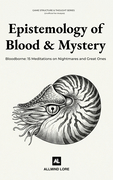
Epistemology of Blood and Mystery: Bloodborne: 15 Meditations on Nightmares and Great Ones
The book version is now available. Read for free with Kindle Unlimited.
Thank you very much for reading to the end. To help support the activities of this archive, a warm donation of a cup of coffee would be highly appreciated.