Insight.03: The Schism Between Byrgenwerth and the Healing Church
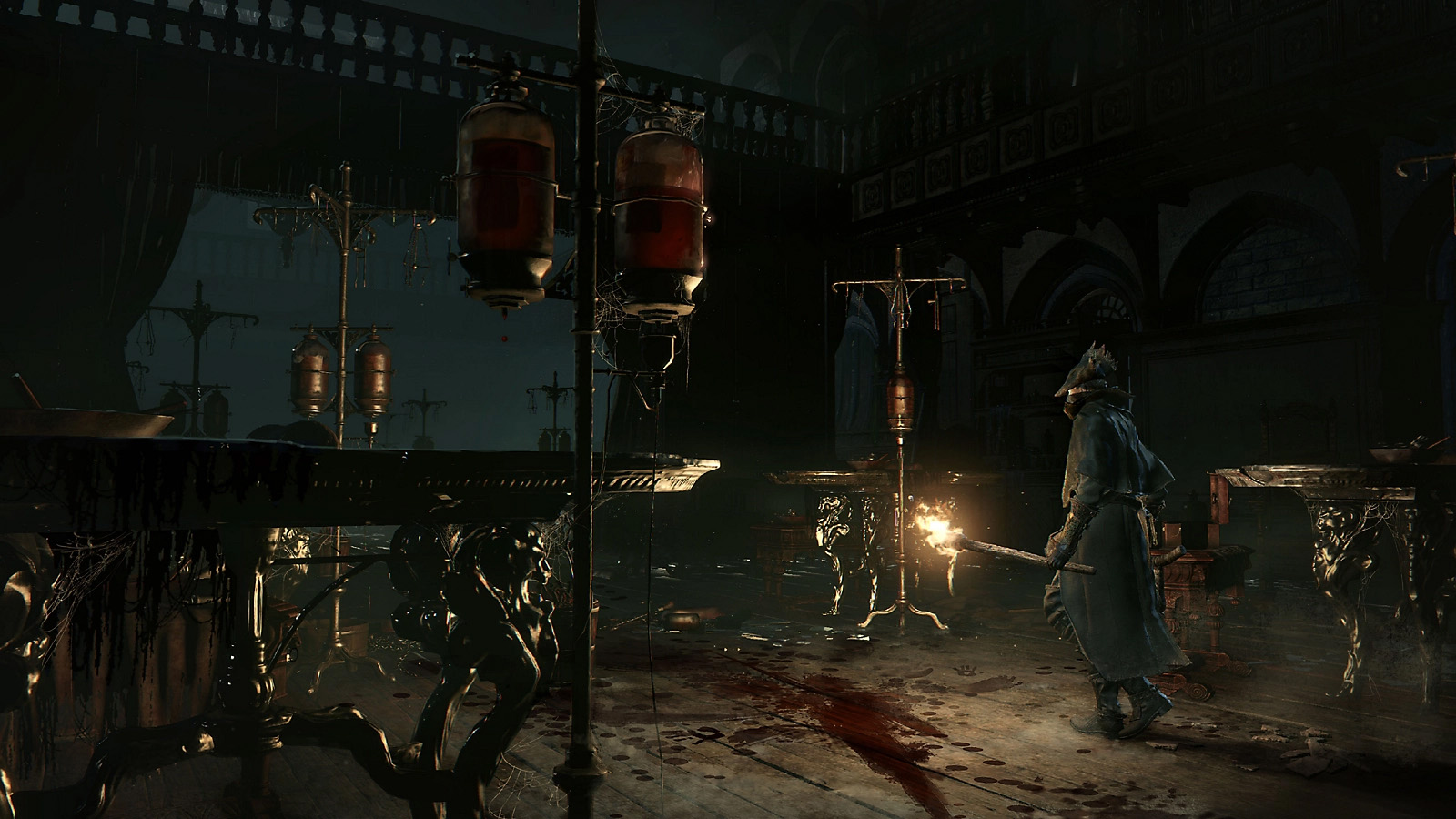 © Sony Interactive Entertainment, © FromSoftware
Introduction: The Profane Discovery in the Deep Pthumerian Labyrinth and the Origins of an Inevitable Downfall
Lying in stratified layers deep beneath Yharnam is the ancient Pthumerian Labyrinth. It serves as a colossal gravestone for superhumans who once discovered the divine Great Ones, receiving both their blessings and their terrifying curses. In this lightless abyss, the very moment the early scholars of Byrgenwerth discovered the “holy medium” (the remnants of the Great Ones, the image of gods) or the “Old Blood,” marked the true beginning of the blood-soaked history of madness and the Scourge of the Beast that would later engulf Yharnam. This historical turning point was not merely an academic discovery, but the fundamental manifestation of Cosmic Horror that defines the limits of humanity as a species.
In the lineage of the Cthulhu Mythos, the trigger for cosmic terror is always pulled by “accidental or arrogant contact with truths that should not be known.” Humans who touch the remnants of the “Great Ones”—absolute higher beings—are forced to face the collapse of their existing epistemology before their own insignificance and the overwhelming expanse of a universe beyond their perception. The inquiry at Byrgenwerth was precisely the act of biting into this forbidden fruit of knowledge. The scholars who touched the truth of the world were irresistibly captivated by the possibility of “evolution,” which could elevate humanity, an insignificant existence, to the next dimension.
However, a decisive difference in the interpretation of the means of this evolution would bring an irreparable rift to the silent academy. There were those who sought to physically approach godhood through the material medium of “blood,” and those who aimed for a spiritual dimensional ascension through the acquisition of “eyes”—an internal, higher-dimensional cognitive ability (Insight). In this article, we will unravel in extreme detail the decisive rupture between the two titans, Provost Willem and Laurence, the First Vicar, the madness of the Healing Church that stemmed from it, and the ideological divergence leading to the School of Mensis and The Choir. By weaving together facts and analysis drawn from item descriptions scattered throughout the game, environmental storytelling, and fragments of left-behind records, we will expose the full scope of their causal relationships and hidden sins.
1. Provost Willem’s Philosophy and the Concept of “Eyes on the inside”
Provost Willem, the head of Byrgenwerth and the spiritual pillar of their inquiry, was one of the discoverers of the Old Blood, yet he intuited its essential danger more than anyone else. At the core of his philosophy was a fundamental fear of humanity’s physical fragility and the material substance of “blood,” which was directly linked to Beasthood.
1.1 The Acquisition of “Perspective” in Cosmic Horror and Caryll Runes
The “eyes” (Insight) advocated by Willem were not an extension of the physical visual organ of the eyeball, but a metaphor for a higher cognitive ability to perceive higher-dimensional beings (Great Ones) as they are and to synchronize with them. The thoughts of the Great Ones and the truths of the cosmos far transcend the fragile logical structure of humans. If humans with three-dimensional bodies attempt to approach them directly, their brains cannot withstand the crushing weight of the information, resulting in Frenzy. Willem believed that only by lining the inside of the human skull with “eyes”—that is, by gaining “Insight”—could this cosmic terror be overcome, safely elevating the human spirit to the dimension of the Great Ones.
This philosophy is embodied by the Caryll Runes. Runesmith Caryll, a student of Byrgenwerth, succeeded in transcribing the inhuman utterances (voices) of the Great Ones into visual runes. The Caryll Rune “Eye” has the effect of making “additional items easier to discover,” but this is not merely an improvement in physical searching ability; it signifies “the acquisition of the power to perceive hidden truths (elements of Insight) invisible to ordinary people.” Furthermore, the importance of shutting out external information and turning one’s gaze toward the cosmos within can be read from the Blindfold Cap and the appearance of students who lack eyeballs (or have their eyes covered).
As a fact explicitly shown in the game, Willem himself covers his eyes and remains seated in a rocking chair at the Lunarium, built on the shores of the mystic lake. This is a symbol of his complete abandonment of attachment to the material world, sinking entirely into internal contemplation and the acquisition of Insight.
1.2 Water and the Arcane Bulwark: Deciphering Environmental Storytelling
The fact that Willem eternally gazes at the lake below from the Lunarium holds extremely significant meaning from the perspective of environmental storytelling. In this work, the fact that “water” serves as a powerful bulwark against the interference of the Great Ones and nightmares, or as an arcane buffer, is proven by the text of the Caryll Runes “Lake” and “Deep Sea.”
“Lake” reduces physical damage, and “Deep Sea” increases resistance to abnormal statuses like Frenzy and poison. Water is a veil meant to separate the waking world from the madness-inducing truths of the cosmos. The massive volume of water that is the lake at Byrgenwerth was a giant lid holding back the nightmares of the Great Ones.
To develop an analysis based on circumstantial evidence here, it is believed that Willem, in order to escape the temptation of blood that promotes physical transformation (Beasthood) and to achieve evolution through pure intellect, was hiding or protecting the truth concealed beyond the bulwark of water—namely, “Rom, the Vacuous Spider.” A prominent theory suggests that Rom was once a student of Byrgenwerth who, following Willem’s teachings, lined her skull with eyes and underwent an incomplete metamorphosis into a Great One (or their Kin). By placing Rom at the bottom of the lake (or in another dimension reflected on the water’s surface), Willem sought to conceal the interference of the “Paleblood” (Moon Presence) raining down upon Yharnam, attempting to stem the spread of madness.
2. Laurence’s Defection and the Rupture of the “Adage of Blood”
In contrast to Willem’s cautious, ascetic approach to spiritual evolution, which required an immense amount of time, it was his beloved pupil, the young genius Laurence, who sought a more radical, practical, and physical evolution. Laurence fanatically believed that the “Old Blood” discovered in the Pthumerian Labyrinth was a panacea that would liberate humanity from existing diseases and physical limitations, bringing about direct evolution.
2.1 The Dialogue of Parting: Two Diverging Madnesses and Victorian Arrogance
Beyond the great doors of Byrgenwerth, echoing as a remnant of memory in the academy where time seems to have stopped, the dialogue of their parting vividly recounts the moment of an irreversible catastrophe surrounding blood and Insight.
“Master Willem, I’ve come to bid you farewell.” “Oh, I know, I know. You think now, to betray me.” “No, but you will never listen.” “Laurence, fear the old blood.” “Yes, I know. I will not forget our adage.”
Upon leaving, Laurence recites Byrgenwerth’s most important adage. “We are born of the blood, made men by the blood, undone by the blood. Our eyes are yet to open. Fear the old blood.”
Within this highly multi-layered adage lies the fundamental definition and limitations of humanity, as well as the entirety of their research. “Born of the blood, made men by the blood” is an affirmation of the biological formation of humans and the fact that the very vitality of life depends on blood. However, what Willem feared most and left as a warning for future generations was the caveat: “undone by the blood.”
Within humans slumbers the seed of the “Scourge of the Beast,” an unbroken lineage from the ancient Pthumerian era—a primordial Beasthood resting as a dark instinct. Taking the blood of the Great Ones (the Old Blood) into the body was an act that violently awakened this sleeping Beasthood, irreversibly destroying human intellect.
Willem strictly forbade the exploration and use of blood for the absolute reason that “our eyes are yet to open”—meaning that humanity did not yet possess the higher-dimensional cognitive ability (Insight) necessary to control the Old Blood and withstand the dimension of the Great Ones. However, Laurence was possessed by a Victorian eugenic ideology and an arrogant blind faith in science and technology, believing that through the power of his own intellect and will, he could overcome the side effects of the blood and guide humanity to the realm of the gods. With Willem’s sorrowful cry, “By the gods, fear it, Laurence,” at his back, Laurence parted ways with his mentor and left Byrgenwerth. At this moment, the “bulwark of intellect” for humans to stand against cosmic terror crumbled, promising an endless chain of Beasthood.
2.2 The Metaphor of Blood and Motherhood
Laurence’s obsession with the “Old Blood” encapsulates the metaphor of “regression to and exploitation of the source of life (motherhood)” in Gothic horror. Blood is a symbol of nourishment from the maternal body that nurtures life, and their clinging to the Old Blood overlaps with the image of a dependent infant craving its mother’s milk. While Willem aimed for spiritual independence through the acquisition of independent perception in the form of “eyes,” Laurence attempted physical protection and forced growth (evolution) by depending on the “breast milk” that was the blood of the Great Ones. This very nature of dependency would become the factor that led the people of Yharnam to their ruin.
3. The Establishment of the Healing Church and the Deceitful Architectural Structure of the Grand Cathedral
Laurence and the scholars who agreed with him descended to Yharnam, where they established the “Healing Church.” They established “Blood Ministration” using the “Old Blood,” administering it widely to the people of Yharnam as a miraculous practice that instantly cured all incurable and endemic diseases. This Blood Communion instantly led the city of Yharnam to the pinnacle of unprecedented prosperity, and the Church gathered immense power and fanatical faith in both political and religious spheres.
3.1 The Madness of Victorian “Medicine” and the Blood Saint
The handling of blood in the Healing Church took on an extremely peculiar and unethical ritualistic nature. Blood extracted from special women known as “Blood Saints” (such as Adella) was revered as the basic unit of ministration. In fact, item descriptions note that the blood of special Church women provides pleasure and healing beyond ordinary Blood Ministration. This is a grotesque materialization of the Christian Eucharist (the ritual of treating bread and wine as the body and blood of Christ), while simultaneously depicting the dark side of Victorian medicine and the history of female oppression in the context of Gothic horror, treating the female body merely as a “sacred blood refinement plant.”
The people of Yharnam found pleasant intoxication and healing in the blood administered by the Church, falling into severe addiction. The catalyst for evolution that was supposed to guide humanity to the Great Ones was consumed by the masses merely as a narcotic, quietly eroding their reason. From the text of the Hunter attire, we can read the fact that the Healing Church was divided into the “Black Church” and the “White Church.” The Hunters of the White Church were “doctors” who administered Blood Ministration and studied the mechanisms of the disease. On the other hand, the Hunters of the Black Church were “preventative purgers” who secretly disposed of those showing signs of Beasthood. This institutional design itself proves the terrifying deceit that the Church was aware of the side effects of Blood Ministration (Beasthood) from the very beginning, utilizing the masses as guinea pigs for human experimentation while covering it up.
3.2 The Hidden Truth: The Altar Elevator and the Human Skull
The ultimate destination of Blood Ministration was inevitable “Beasthood.” Those who partook of large amounts of blood would eventually become drunk on it, swallowed by their inner Beasthood, and transform into horrific beasts. This was the fate of those who partook of the Old Blood, but the most gruesome tragedy befell none other than the founder of the Church himself, Laurence. He took in more of the Old Blood than anyone else, and as a result, he was reduced to a burning beast larger and more terrifying than any other, bearing the title of the “First Vicar.”
The deepest part of the Grand Cathedral, where one confronts Vicar Amelia. The structure of this solemn altar has the deceit of the Healing Church and their greatest concealed sin engraved into it as physical environmental storytelling. In the Hunter’s Nightmare (an illusion of Yharnam’s past) in the DLC “The Old Hunters,” the altar of the Grand Cathedral serves as a special elevator. By pulling the lever attached to the altar, the very pedestal where prayers are offered sinks down as an elevator to the underground “Research Hall,” and from directly beneath it, another altar emerges. Enshrined upon this hidden altar is not the skull of a giant beast, but “Laurence’s Skull” (a human one), retaining its human shape, hidden alongside the Church’s covert armaments such as the “Church Cannon.”
The placement of this skull is highly symbolic. On the surface of the Grand Cathedral (where the public eye can see), the majesty of the holy Healing Church is displayed, and prayers seeking salvation are offered. However, at its feet, in the dark depths serving as its physical foundation, the decayed remains of the Church’s founder himself (the last trace of when he was human) and the entrance to the Research Hall—a site of horrific human experimentation—are concealed. If the giant beast skull enshrined in the Grand Cathedral of the real Yharnam is indeed what Laurence ultimately became, then the human skull hidden on the altar of the nightmare can be said to be a painful testament that the Church concealed the “last moment he retained his human reason,” or that he was unable to meet his death as a human.
Laurence died as a human, and his soul met the fate of suffering eternally in the endless hell of the “Hunter’s Nightmare” as a beast burned by the flames that symbolize his own sins. The burning beast Laurence in the nightmare lets out a sorrowful groan. “Somebody help me, unshackle me please, anybody… I’ve had enough of this dream. The night blocks all sight. Oh, somebody please…” The “sight” he sought signifies the very lack of “eyes” (Insight) that Willem had once warned about. As a result of clinging to blood and growing arrogant, he was trapped in the blind darkness of the beast and the night of the nightmare, forever unable to see the truth.
4. The Schism of the Healing Church and the Runaway Lineage of Evolution
Even after Laurence was slain as a beast and completely disappeared from the center stage, the inquiry of the Healing Church did not stop. Rather, having lost a leader with overwhelming charisma, factions with different ideologies and approaches proliferated within the Church, leading to an unstoppable organizational schism and runaway escalation. The internal structure of the Healing Church, inferred from in-game text and community analysis, can be understood primarily as a differentiation into three organizations. Before long, they had splintered to the point of monitoring one another and sometimes engaging in secret feuds.
The following table summarizes the ideological backgrounds and ultimate consequences of the major splintered schools and organizations.
| Organization / School | Ideological Founder / Main Base | Object of Faith / Inquiry | Approach and Means to Evolution | Ultimate Form / Fate |
|---|---|---|---|---|
| Healing Church (Mainstream) | Laurence (Grand Cathedral) | Blood of the old lords, Blood Ministration | Physical healing and enhancement through Blood Communion. Management of blood by clerics. | Drunk on blood, regression into horrific beasts. Complete loss of reason. (e.g., Cleric Beast) |
| The Choir | Upper echelon of the Healing Church (Orphanage / Altar of Despair) | The cosmos, Celestial Emissary, Ebrietas, Daughter of the Cosmos | Human experimentation (orphans). Fusion of eyes (Insight) and blood. Communion with higher dimensions. | Physical transformation into extraterrestrials (Kin). Or maddened prayer underground. |
| School of Mensis | Micolash (Yahar’gul, Unseen Village) | Great One Mergo, Nightmare of Mensis | Ritual of the nightmare. Fusion of massive amounts of corpses, and direct interference with the brain. Abandonment of the flesh. | Death of the physical body in the waking world, and confinement of the spirit in the nightmare. Madness. (e.g., giant brain) |
4.1 The Choir: Return to Byrgenwerth and the Exploration of the Cosmos
“The Choir,” positioned at the highest echelon of the Healing Church and serving as its de facto supreme leadership, was ironically the closest to the ideals of old Byrgenwerth. Behind the superficial activity of Blood Ministration, they had reached the enlightening truth that “the sky and the cosmos are one.” The text of the Choir Garb notes that while they were the elites of the Healing Church, they were also scholars who listened to the voices of the cosmos.
Their inquiry was to put Willem’s concept of “eyes on the inside” into practice, utilizing the Church’s abundant financial resources and the fanatical lack of ethics born of power. Using the Healing Church’s “Orphanage” as a cover, The Choir repeatedly conducted horrific human experiments to remake children with no relatives into “brethren of the stars.” By placing bags over the children’s heads and forcefully pouring the truths of the cosmos (Insight) and blood into them, they mutated them into slimy, blue, extraterrestrial creatures known as “Celestial Emissaries.”
The madness of The Choir can be said to be the result of Willem’s pure philosophical inquiry and Laurence’s arrogant execution fusing in the worst possible way. Deep underground at the Altar of Despair, they committed a double profanity: physically confining and protecting a Great One equal to a god (Ebrietas, Daughter of the Cosmos) and sipping her bodily fluids (blood), while simultaneously attempting to communicate with the cosmos (the Make Contact gesture). They gained Insight, but at the cost of discarding their humanity, reducing themselves to slaves known as the “Kin” of the Great Ones.
4.2 School of Mensis: Immersion into the Nightmare and Abandonment of the Flesh
Meanwhile, the other massive faction, the “School of Mensis,” walked an even more extreme path of heresy. Presumed to inherit the lineage of an old school of thought originating in Byrgenwerth, they dabbled in the taboo “ritual of the nightmare” under the leadership of the madman Micolash, in order to completely transcend the physical laws of the waking world.
The scholars of Mensis gave up on the limits of physical evolution through “blood” and attempted to transfer their spirits directly into a higher-dimensional nightmare (the Nightmare of Mensis) by abandoning their physical flesh. What they conducted in their base of Yahar’gul, Unseen Village, was a massive ritual of death and madness: kidnapping a staggering number of citizens, stitching corpses together to create “The One Reborn,” or fusing countless human skulls and brains to construct a “giant brain.” The countless corpses plastered into the walls of Yahar’gul eternally fixate the terror of those who became sacrifices for this ritual.
Micolash and the other scholars of Mensis wear strange iron cages (Mensis Cages) on their heads. As the item description indicates, this served as an antenna that blocked out external interference and forced contact with the nightmare within. At the end of their ritual, they met the death of their physical bodies in the waking world and succeeded in transitioning only their spirits into the nightmare. However, what awaited them there was a miserable fate as the “Host of the Nightmare,” their minds burned by the madness of the Great One Mergo, eternally repeating incomprehensible ravings. They gained eyes, but the spiritual vessel meant to process them had shattered.
There are traces that these two factions, The Choir and the School of Mensis, engaged in fierce secret feuds beneath the surface due to their ideological differences. The fact that a Choir intelligencer (Edgar) had infiltrated the Nightmare of Mensis, and the corpses of Choir members captured and killed in Yahar’gul, indicate that the massive organization of the Healing Church was in a terminal state of collapse, willing even to devour each other in the face of their goal to reach the truth.
5. Causal Relationships and Hidden Sins: The Price of Evolution and the Profanation of Motherhood
Looking down upon the history of madness that engulfed all of Yharnam—beginning with Byrgenwerth, through Laurence’s defection, and the schism of the Healing Church—a single underlying philosophical thesis clearly emerges. It is the absolute fundamental principle in Cosmic Horror: “Any attempt by humans to artificially evolve into higher beings while ignoring their own vessels, regardless of the method, will inevitably invite a hideous ruin.”
5.1 Physical Transformation or Spiritual Collapse
The “path of blood” chosen by Laurence and the mainstream Healing Church brought dramatic physical enhancement and temporary healing, but as a result, it completely removed the restraints on their inner Beasthood, regressing humans into “horrific beasts” driven solely by instinct. This demonstrates the danger of relying on an external substance (blood) for biological evolution. The background behind the development of heavy weapons like “Ludwig’s Holy Blade” was also to hunt their former brethren who, as Beasthood progressed, had transformed into larger, more terrifying monsters. As a result of seeking evolution, they were reduced to the most primitive beasts of violence.
In contrast, the “path of eyes” (Insight) chosen by Willem, The Choir, and the School of Mensis, while preventing regression into Beasthood to some extent, fundamentally destroyed the human mental structure. Lining the skull with countless eyes caused the loss of ego due to an overwhelming amount of information, degrading humans into mindless lumps of flesh like the “vacuous spider” or the “giant brain,” or merely into receivers for the will of the cosmos.
Those who clung to blood became “physical monsters who lost their reason.”
Those who sought eyes became “spiritual monsters who lost their flesh (or human form).”
Both paths were self-destruction brought about by human arrogance, ignoring the unbridgeable “overwhelming disparity on a cosmic scale” between the Great Ones and humanity. Willem’s words, “Our eyes are yet to open,” pointed exactly to this absolute limit, yet he himself could not discard his thirst for the truth, and as a result, sent his own disciples into a chain of madness; in this regard, it must be said that he is equally guilty.
5.2 “The Plunder of Babes” as Original Sin and the Profanation of Mothers
In the process of these inquiries, there exists the heaviest hidden sin committed in common by both Byrgenwerth and the Healing Church. That is the “profanation of motherhood” and the “plunder of babes.”
The in-game text for “One Third of Umbilical Cord” states, “Every Great One loses its child, and then yearns for a surrogate.” In their ecosystem, a babe is an extremely rare and sacred existence. However, the scholars of Byrgenwerth once dragged a babe from the washed-up corpse of the Great One Kos in the Fishing Hamlet using profane methods, and dissected it. This is the origin of the eternal curse known as the “Hunter’s Nightmare.”
The Healing Church also repeated this sin. The attempts to forcefully impregnate special women like Arianna, woman of pleasure, and the imposter Iosefka with the babes of Great Ones. The experiments at The Choir’s Orphanage. And the School of Mensis utilizing the cries of a Great One’s babe (Mergo) as a catalyst for their ritual. Including all of these, their inquiries were entirely unethical acts that consumed and exploited the sacred bond of “mother and child”—the root of life—as mere components for evolution.
The history of exploitation against the vulnerable—women, children, and the poor—that lay behind the development of eugenics and medicine in the Victorian era is depicted extremely grotesquely in the context of Gothic horror. Humanity’s thirst for evolution, in the end, never transcended the realm of selfish plunder that trampled upon the lives and dignity of others.
Conclusion: The Twilight of Yharnam and the Unending Chain of Nightmares
As a summary of the analysis in this report, the schism between Byrgenwerth and the Healing Church should not be trivialized as a mere internal conflict within an academic institution or religious organization. It can be defined as the “divergence of responses” shown by humanity as a species when faced with incomprehensible cosmic terror, and an inevitable tragedy brought about by the limits of intellect and arrogance.
Provost Willem, while realizing the limits of humanity, could not stop his pursuit of the truth, becoming a powerless existence half-turned to a plant by the madness-sunken lakeside, left only to eternally gaze at the hidden truth (the lake). Laurence, the First Vicar, was overconfident in the control of blood through the power of human will, and as a result, became the most hideous beast clad in flames, doomed to eternally seek salvation at the bottom of the hell he himself created. And the madmen of The Choir and the School of Mensis who branched off from them were also crushed by the weight of the doctrines they built and the madness of the Great Ones; not a single one of them was able to achieve true evolution (reaching the status of a complete Great One). What they obtained were merely variations of ruin: succumbing to Frenzy, becoming beasts, or becoming slaves to the cold cosmos.
“Fear the old blood.” These words, which Willem once threw at Laurence, transcended a mere school’s adage to become a curse-like prophecy for the city of Yharnam itself, and for humanity as a whole. Those who did not fear the blood, who stepped into the realm of the gods without knowing their own limits, received the retribution for their arrogance without exception.
Deep underground beneath the Grand Cathedral, upon a cold pedestal at the bottom of a hidden elevator. Laurence’s human skull, quietly enshrined there, continues to exist in the darkness even now as the most eloquent and silent witness to the hope of humanity that once certainly existed, and the gruesome history of how it was irreversibly trampled. Every time the heavy bells of the Healing Church toll and the roars of beasts shake the night air, we are made to realize an absolute and cruel truth: when humans attempted to peer into the abyss of the cosmos that was beyond their stature, the abyss was also waiting with its giant maw open, ready to devour us along with the scent of blood.
Epistemology of Blood and Mystery: Bloodborne: 15 Meditations on Nightmares and Great Ones
The book version is now available. Read for free with Kindle Unlimited.
Thank you very much for reading to the end. To help support the activities of this archive, a warm donation of a cup of coffee would be highly appreciated.