Insight.14: The Protagonist (Hunter)
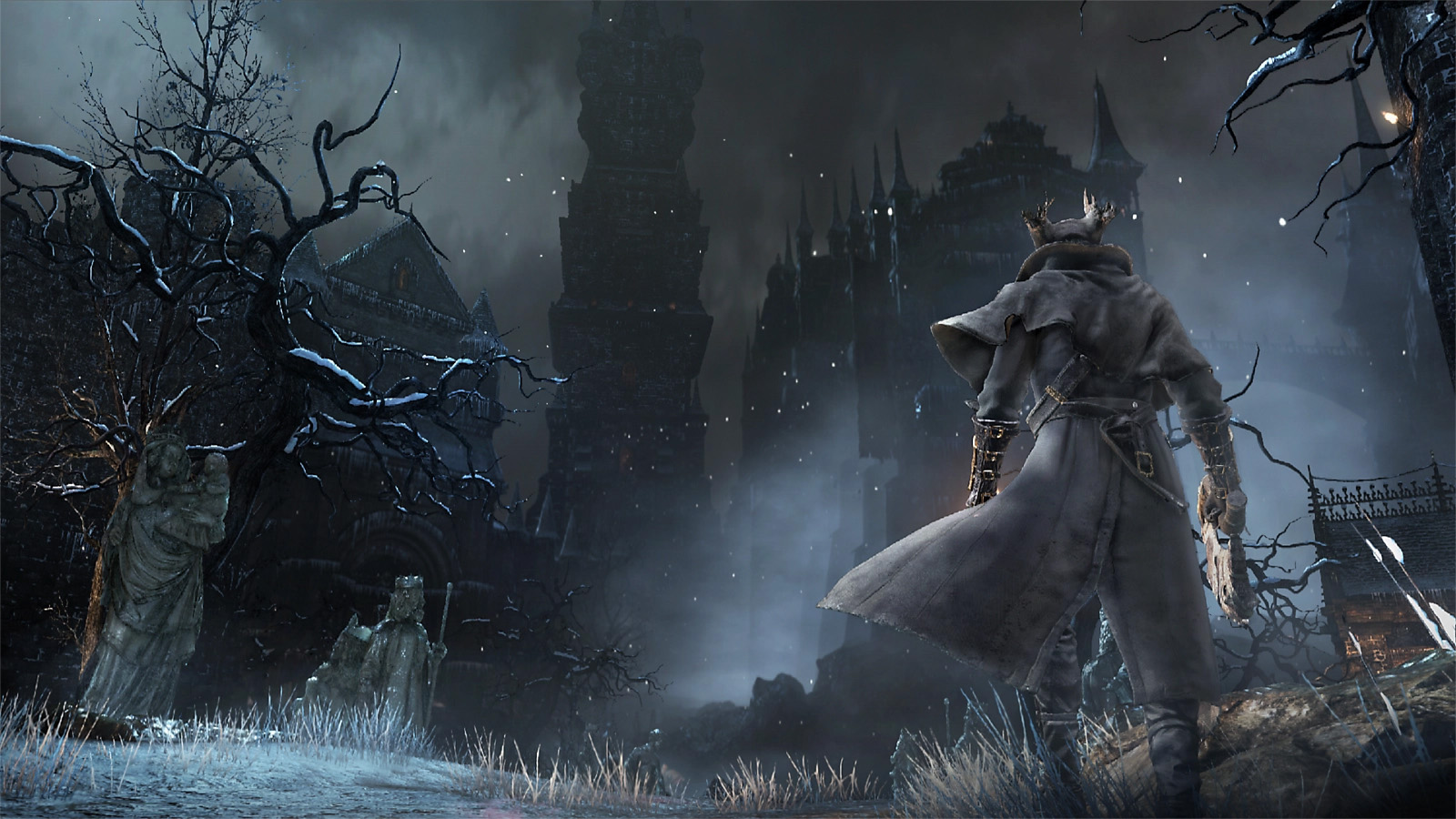 © Sony Interactive Entertainment, © FromSoftware
1. The Stripping of Memory and the Contract of Oblivion: The Original Sin of the “Outsider” in Yharnam
Yharnam is a closed-off, ancient city plagued by blood and the Scourge of the Beast, where maddened mobs roam night after night, holding torches aloft. From the periphery of this cursed topography, a single traveler steps foot in search of a cure for their illness. This is the protagonist of the game, namely the “Hunter.” The details of this individual’s past, origins, family structure, and even the specific symptoms of the illness that led them to visit Yharnam are never spoken of throughout the game’s progression, left behind in the realm of absolute oblivion. The initial attire worn by the protagonist is merely “Foreign Garb,” and its text explicitly states that they are an existence entirely unrelated to the history and customs of Yharnam.
This decisive isolation as an “outsider” follows the classical introductory techniques of Victorian Gothic literature while holding profound significance from the perspective of Cosmic Horror. While the natives of Yharnam have long relied on Blood Ministration and, as a result, been swallowed by the collective Scourge of the Beast, the protagonist is a pure “observer” arriving from the outside, simultaneously functioning as a “singularity” that weaves a new causality.
The protagonist’s story opens on a dimly lit, filth-ridden operating table in “Iosefka’s Clinic,” located in the heart of Yharnam. There, the protagonist confronts a man in a wheelchair and enters into a contract for a blood transfusion through Blood Ministration. The depiction of this medical procedure strongly reflects the eerie medical instruments characteristic of the Victorian era and the madness of a blind, thoughtless eugenic ideology regarding blood, the very source of life. The outsider, harboring an unknown, incurable disease (or a similar despair), has no choice but to cling to the medical practices hailed as Yharnam’s miracle. As the price, they take “Yharnam’s Old Blood” into their body, simultaneously losing the vast majority of their personal memories and ego up to that point.
Here, we shall strictly separate and discuss a crucial “fact” for peering into the abyss of the narrative, and the “speculation” derived from it. As a matter of fact, immediately after the protagonist awakens on the operating table, the following note is left on a nearby chair: “Seek Paleblood to transcend the hunt.” And the most chilling fact regarding this short message is that the nuance in the original text (the Japanese version) implies it is not a message from someone else, but a “handwritten note by oneself.”
The speculation drawn from this highlights a gruesome structure of psychological horror that engulfs the players themselves. “Before” entering into the blood transfusion contract that would strip them of their memories in Yharnam, the protagonist clearly recognized that their true objective was not the treatment of an illness, but the “pursuit of Paleblood.” They had left behind this supreme imperative for their future self, who would inevitably lose their memories. In other words, the protagonist driving the narrative is merely a puppet, throwing themselves into bottomless madness and a bloody tragedy in obedience to an absolute, incomprehensible command handed down by an unidentified “past self.” This paradox of binding one’s own fate and mind with words written by one’s own hand demonstrates just how fragile human free will is. It serves as an impeccably perfect introduction to Cosmic Horror, where one is ensnared by an inescapable destiny.
2. The Duality of “Paleblood”: Cosmic Madness and Astrophysical Anomaly
The concept of “Paleblood” written in the note. This is the greatest mystery in the lore of Bloodborne, and the protagonist’s raison d’être that permeates the entire narrative. However, even after exploring the city of Yharnam and conversing with its maddened inhabitants and Hunters, there is absolutely no one who knows the meaning of this word. What the residents of Yharnam face and fear is strictly the Scourge of the Beast. Because those who have directly encountered the cosmic terror brought about by beings existing in a plane higher than humanity (Great Ones) are exceedingly rare, the hidden term “Paleblood” is not circulated within general society at all.
Regarding the true nature of “Paleblood,” piecing together the game’s environmental storytelling, fragmented item descriptions, and statements from its creator, Hidetaka Miyazaki, reveals two clear facts and interpretations. This multi-layered significance is the core mechanism that elevates the work from the mere framework of Gothic vampire and werewolf hunting into a higher-dimensional, philosophical Cosmic Horror.
| Direction of Interpretation | Corresponding In-Game Events/Texts | Philosophical/Mythological Implications (Speculation) |
|---|---|---|
| Paleblood as a Phenomenon/Space | ”Behold! A Paleblood sky!” (Note in Yahar’gul). The appearance of the blood-drained sky and the giant Blood Moon after the defeat of Rom, the Vacuous Spider. | A state where the “veil of ignorance (deception)” protecting humanity’s diminutive reason has been stripped away. An astrophysical anomaly where the true madness of the cosmos—the ritual of the Great Ones—is forcibly manifested into human visual reality. |
| Paleblood as an Entity/Deity | ”The nameless moon presence beckoned by Laurence and his associates. Paleblood.” (Note in the Lecture Building). An alias for the nameless Great One that descends from the moon under specific conditions = the “Moon Presence.” | A being existing in a higher plane far transcending humanity. The embodiment of ultimate cosmic terror that fundamentally governs all of the Scourge of the Beast and the Hunter’s Dream. |
The first interpretation is the perspective that it refers to the dramatic transformation of the “sky (weather/outer space)” itself. The Great One known as Rom, the Vacuous Spider, had been concealing the mad deeds of the School of Mensis, who were advancing their ritual in Yahar’gul, Unseen Village, by offering her own body (or acting as a structural barrier). The moment the protagonist defeats Rom and shatters that seal, the sky literally turns pale as if drained of blood, and simultaneously, an ominous, giant Blood Moon approaches Yharnam. As mentioned by Miyazaki, the “Paleblood sky” implies the very state in which the concealed truth of the cosmos (the ritual) has been laid bare. This is an expression of the overwhelming despair characteristic of Cosmic Horror, where a cosmic reality that the puny human brain cannot possibly process is visualized on an inescapable scale—literally the “entire sky.”
The second interpretation is “Paleblood” as an alias for the “Moon Presence” itself, which rules the Hunter’s Dream and binds the protagonist to a spiral of death and rebirth. As a matter of fact, the note left in the Lecture Building leading to the Nightmare Frontier directly specifies the connection between the Moon Presence and Paleblood. Speculation based on this fact highlights the abnormality of the protagonist’s journey and the fathomless fanaticism lurking within it. The amnesiac protagonist might have initially been under the illusion that they were searching for “special blood (Blood Vials)” to cure their own illness. However, what their “past self” actually sought and commanded was not material blood, but an encounter with “God (a Great One) itself.” The protagonist harbored the hidden nature of an extremely blasphemous and active seeker, far exceeding the bounds of Gothic vampire hunting, making a beeline of their own volition toward a nameless madness akin to the Cthulhu Mythos.
“Seek Paleblood” is not a mere search for an item. It is nothing less than a declaration of humanity’s most arrogant and blasphemous thirst for evolution—an attempt to uncover and make contact with the absolutely unknowable existence that is a Great One.
3. Metamorphosis of the Flesh and the Fatal Deception of the Healing Church: The Conflict Between Blood and Beasthood
In the process of delving into the abyss of Yharnam, the protagonist inevitably confronts and becomes dependent on the “consumption of blood.” The Healing Church of Yharnam, reminiscent of the overripe dark underbelly of the Victorian era, made “blood” an object of worship as a panacea, transforming the entire city into a massive blood-consuming institution. The protagonist, too, in order to sustain their survival and struggle, continuously bathes in the blood of enemies and injects blood into their own body. Behind this repetitive act, the theme of “human evolution and arrogance” is depicted to a grotesque degree.
By examining the factual relationship between two contrasting items produced by the Healing Church that the protagonist uses during The Hunt, we analyze the metaphor of blood and its deceptive nature in this work.
| Item Name | In-Game Facts (Text Descriptions) | Attitude of the Healing Church and Symbolic Implications |
|---|---|---|
| Iosefka’s Blood Vial | Special blood that greatly restores HP and brings about a highly invigorating effect. | The refined blood of healing that the Healing Church ostensibly provides as “miraculous medicine,” upon which the residents of Yharnam depend. A symbol of a holy ritual that (creates the illusion that one can) receive blessings while maintaining human reason. |
| Beast Blood Pellet | A large pellet. Grants a brief spell of Beasthood to the user, where tearing flesh and bathing in blood heightens Beasthood. Its origins are unknown, and it is considered taboo. | A taboo product that the Healing Church denies involvement with and conceals. A symbol of the barbaric violence that lies at the end of blood consumption, and the regression to the beast lurking within humanity. |
The facts regarding these two items expose the fatal contradiction and deception of the organization known as the Healing Church. Both the sacred blood that brings healing and the taboo beast blood that degrades humans into hairy beasts ultimately trace back to the same source: the “blood of the Great Ones (Old Blood).” The protagonist, to survive the grueling Hunt, forcibly repairs their damaged flesh with “Iosefka’s Blood Vial,” while simultaneously using “Beast Blood Pellets” to temporarily unleash the barbaric Beasthood sleeping within them, dramatically increasing their attack power by tearing enemy flesh and bathing in their blood. This repetition of conflicting blood consumption is nothing less than a reliving of the process in which humanity’s inherent reason and ethics are gradually chipped away, regressing into a ferocious wild beast.
Furthermore, what demands attention are the “Caryll Runes,” the secret symbols extracted and left behind by the Byrgenwerth runesmith Caryll from the inhuman utterances of the Great Ones. Among these runes etched directly into the protagonist’s mind (or flesh), the text for “Clockwise Metamorphosis” clearly states a fact that forms the foundation of this madness-filled world. “The twisted cross means ‘metamorphosis.’ The discovery of blood made their dream of evolution a reality.”
The design of a cross—originally a sacred symbol of salvation—being “twisted” visually demonstrates just how utterly distorted the faith upheld by the Healing Church is. And “Metamorphosis” is not a word that merely signifies a game-like stat increase (such as an increase in HP). It represents a biological process in which the flesh itself transcends the obsolete species of humanity, mutating into an entirely different, eerie organism, much like a butterfly emerging from a chrysalis.
As a speculation here, it can be concluded that the protagonist is a horrifying existence that rapidly undergoes “metamorphosis” by slaughtering countless beasts, madmen, and even other Hunters, absorbing their “wills (Blood Echoes).” The environmental storytelling etched into the Hunter’s equipment also reinforces this fact. For example, the bloodied armbands of Brador, the Healing Church assassin, who “scalped his compatriot, and wore his beastly hide while it was still wet with blood,” illustrate the causality wherein the very existence of a Hunter descends into an extremely violent and barbaric entity, smeared in blood, madness, and the stench of death. The protagonist is no exception; rather, they serve as an extreme singularity that absorbs blood most efficiently and embodies the “dream of evolution” most purely. The root cause of humanity contracting the Scourge of the Beast was their reckless contact with Great Ones, beings utterly incomprehensible to mankind. Yet, the protagonist internalizes even that scourge as a “power” to strengthen themselves, stepping further into the deep cosmic abyss.
4. The Acquisition of Eyes (Insight): The Arrogance of Evolution that Strips Away the Veil of Ignorance
From the middle to the end of the game, the protagonist’s journey in search of “Paleblood” fundamentally transforms its nature from the Gothic horror framework of “beast hunting” to the Cosmic Horror madness of “deicide.” The fact that the in-game note obsessively reads, “Hunt the Great Ones, Hunt the Great Ones,” vividly illustrates this decisive shift in objective.
Here, another crucial philosophical theme that emerges to form a pair with “blood” is “eyes (Insight).” Provost Willem of Byrgenwerth warned his disciples to “fear the old blood,” rejecting the barbaric Blood Ministration and seeking a spiritual ascension through Eyes on the inside (lining the brain with eyes). In order to understand the truth of the tremendous cosmic terror that is the Great Ones and approach a perspective equal to theirs, one must harbor “eyes” inside the human skull and gain the “Insight” to see the world as it truly is. By crushing Madman’s Knowledge, witnessing the forms of mighty bosses, and touching fragments of the Great Ones, the protagonist gradually accumulates Insight within themselves.
In the literary tradition of Cosmic Horror originating with H.P. Lovecraft, gaining unknown cosmic knowledge (Insight) means a direct path to “mental collapse (madness).” Humans who have recognized the merciless truths of the cosmos or the existence of god-like creatures (Great Ones) that care nothing for humanity’s existence typically succumb to Frenzy, unable to bear the insignificance of their own being. However, the true abnormality of the protagonist (Hunter) lies here. No matter how highly concentrated the Insight they gain, or how gruesome the cosmic terror they face, the protagonist does not completely succumb to Frenzy and shatter their ego; instead, they calmly assimilate it as nourishment for their own spiritual and physical evolution.
Unraveling the fundamental causality of the tragedy that occurred in Yharnam reveals a history of fatal ruin born from encounters with “beings existing in a plane higher than us humans.” Laurence, the First Vicar of the Healing Church, clung to “blood,” and as a result, failed to control the Scourge of the Beast, transforming into a burning beast himself. Micolash, Host of the Nightmare, sought “eyes” and summoned a nightmare through a forced ritual, resulting in the self-destruction and mummification of the entire School of Mensis. All of them were far too humanly immature to confront the abyss of cosmic terror, falling victim to their own “arrogance” by overestimating their intellect and the power of their organizations.
In contrast, the protagonist is entirely unbound by the history of Yharnam, specific organizational rituals, or fanatical ideologies. Precisely because they are an unencumbered “outsider,” they can trample over Yharnam’s customs and the constraints of obsolete schools objectively, or rather, with extreme violence. Based in the Hunter’s Dream, within a system that incorporates even death as a temporary setback or a part of the process of accumulating experience, the protagonist silently continues to hunt Great Ones like a machine. From a mythological perspective, this endeavor is nothing less than a “blasphemous incubation process” in which some sort of “immature monster” in human form devours numerous gods (Great Ones), absorbing their blood and Insight, and emerging into a higher existence.
5. The Metaphor of Blood and Motherhood, and the Guidance of Oedon Chapel
In the process of the protagonist drawing closer to the Great Ones, the “metaphor of blood and motherhood” unique to this work plays an extremely crucial role. Every Great One is destined to lose their child as the price of evolution, and therefore, they are said to constantly yearn for a “surrogate.” Ironically, their transcendent power is tied to a highly biological and earthy “obsession with reproduction and motherhood.”
The fact of the in-game note stating “Ascend to Oedon Chapel” is not only a directive for physical movement but also implies a “dimensional ascension to a higher plane” symbolized by the Formless Oedon. As if guided by Oedon, who interferes using blood itself as a medium, the protagonist witnesses the visceral tragedies of female NPCs’ pregnancies and childbirths, ultimately collecting an extremely peculiar catalyst: “One Third of Umbilical Cord” (the remnants of an infant Great One).
In the Hunter’s Dream, the existence of the “Plain Doll,” who handles the protagonist’s stat increases (the channeling of Blood Echoes), also reinforces this metaphor of motherhood. This doll—which was implemented by designer Yamamura following Miyazaki’s conceptualization born from casual chats in early development forums—functions mechanically as a guide for the game, but within the lore, she acts as a surrogate mother nurturing the “child of madness” that is the protagonist. An exquisite doll created by humans uses human blood (Blood Echoes) to raise the protagonist into something inhuman. This perverse relationship can be called the pinnacle of Victorian Gothic horror, where the sorrow of the Great Ones yearning for their lost children intersects with the arrogance of the protagonist attempting to forcibly evolve themselves.
By consuming multiple “Umbilical Cords,” the essence of the Great Ones (the concept of the infant), who should have been their mother, is internalized within the protagonist’s body. This means that the protagonist has remade their own flesh into a “womb to birth a Great One.” Smeared in blood, gaining Insight, and devouring the umbilical cords of others, the protagonist completely shatters the biological barrier of species.
6. Transcending the Hunt: The Rebirth of the “Protagonist” as a Cosmic Terror
The most complete and fatal text left in the note: “Seek Paleblood to transcend the hunt.” The true horror of the word “transcend” is revealed in the final conclusion of the protagonist’s journey.
The Great One, the Moon Presence, binds humans to the Hunter’s Dream, using them as surrogates for its own incomprehensible purposes. As a matter of fact, this Moon Presence is the true identity of the “Paleblood” the protagonist sought, and the ultimate target of their madness-filled journey.
Speculation on the causality leading up to this point draws a chilling conclusion: the inversion of the mythos. The protagonist, of their own free will, wrote in the note to “seek Paleblood (the Moon Presence)” and erased their own memories. Then, starting with no clues whatsoever, they hunted a staggering number of beasts, consumed lethal amounts of blood, accumulated Insight to open Eyes on the inside, and slaughtered even mighty Great Ones. If the protagonist had been a mere human who knew the limits of their own mind, and whose sole purpose was simply to escape the nightmare, they would have been satisfied choosing the “human salvation” of having their head severed by Gehrman, the First Hunter, and awakening to the Yharnam Sunrise.
However, the protagonist’s fundamental thirst was to “transcend the hunt.” This meant overthrowing the very system that bound them—namely, Gehrman, the administrator of the Hunter’s Dream—and further degrading even the nameless cosmic terror lurking behind him, manipulating humans (the Moon Presence = Paleblood), into a target of “The Hunt.” Having consumed One Third of Umbilical Cord and cultivated their Eyes on the inside to the absolute limit, the protagonist is no longer susceptible to the absolute enthrallment (domination) of the Moon Presence.
The fact that Hidetaka Miyazaki suggested in an interview that “seeking Paleblood to transcend the hunt” directly connects to the ending where the Moon Presence is defeated and the protagonist themselves is reborn as a new Great One is extremely important. What this fact indicates is a spectacular paradigm shift in the very structure of the narrative.
As Miyazaki states, this work possesses a worldview even more ruthless than Demon’s Souls or Dark Souls, designed to make the player experience overwhelming fear and dread. In the early stages of the story, the protagonist was merely a fragile victim, terrified of an unknown illness and beasts, fleeing and being killed—a typical “powerless human” in Cosmic Horror. However, as a result of repeating “metamorphosis” through countless deaths and baptisms of blood, the one who reigns as the true cosmic terror at the end of the story is none other than the “protagonist (Hunter)” themselves. From the perspective of the Great Ones, the protagonist—who suddenly appears in their domain, brutally murders their brethren one after another, steals their blood and wisdom, and continues to infinitely self-evolve—is the most abominable and terrifying unknown monster (eldritch terror).
Conclusion: The Truth of Paleblood and the Ultimate Culmination of Human Arrogance
In the mythological system of Bloodborne created by FromSoftware, the protagonist (Hunter) is absolutely not a mere player avatar or a hero who saves the city. They are the ultimate experimental subject born from the distorted medical ethics and maddening eugenics of the Victorian era, and simultaneously, humanity’s most blasphemous “vessel of evolution,” ultimately surpassing and usurping even the unknowable gods of the Cthulhu Mythos.
Looking down upon the blood-soaked trajectory walked by the protagonist, one can see an intricately constructed, despairing causality. Cursed by their past self in the form of a handwritten note, and absolutely isolated as an outsider in the blood-drunk city of Yharnam, they endlessly consume “Iosefka’s Blood Vials” and “Beast Blood Pellets”—products of the Church’s deception—in order to survive. The metamorphosis of the flesh through blood consumption, and the expansion of the mind through the knowledge (Insight) of the Great Ones. It was a long, agonizing ritual to gradually but surely chip away at their humanity, elevating their ego to a dimension where they could directly face the cosmic truth of the “Paleblood sky” covering the heavens.
And the final confrontation with “Paleblood” = the nameless Moon Presence. The supreme objective of transcending the hunt could only be accomplished by completely breaking through the limits of the fragile human species and emerging as a new cosmic terror (Great One) themselves. The “meaning, value, and sense of accomplishment for one’s actions” that this work provides to the player through the medium of a game is perfectly synchronized with this philosophical process of evolution.
In the tragedy of Yharnam, painted in blood and madness, the greatest irony—and the truth that brings about the most blasphemous catharsis—is nothing other than the fathomless arrogance and tenacity of human life: “Humans, who harbored a bottomless fear of unknown gods (Great Ones), hunt those very gods to extinction at the end of extreme violence and exploration, ultimately reigning over the void as a new god themselves.”
The journey of a single outsider seeking Paleblood quietly comes to a close with the complete disappearance of their ego as a human being, and the birth of a single, unknowable, ruthless god. Here, the bloody customs of Gothic horror and the nihilistic, cold-hearted cosmology of Cosmic Horror brilliantly fuse, completing an extremely decadent and mythological narrative structure unparalleled in any literature or film. The bloody footprints left by the protagonist will remain eternally etched within the Hunter’s Dream as proof of the most beautiful and most horrifying final destination that humanity, possessed by the madness called evolution, can reach.
Epistemology of Blood and Mystery: Bloodborne: 15 Meditations on Nightmares and Great Ones
The book version is now available. Read for free with Kindle Unlimited.
Thank you very much for reading to the end. To help support the activities of this archive, a warm donation of a cup of coffee would be highly appreciated.