Insight.08: Lady Maria of the Astral Clocktower
Deep within the Hunter’s Nightmare, beyond the madness-filled Research Hall of the Healing Church, sits the colossal, sunlit “Astral Clocktower.” In the center of this profane space, where countless corpses are bound to chairs, a beautiful Hunter has fallen into a death-like slumber. Her name is Lady Maria of the Astral Clocktower. She was the beloved apprentice of Gehrman, the First Hunter, a descendant of the Vilebloods of Cainhurst, and above all, the woman who bore the most gruesome sin at the nexus where the madness of Yharnam and Cosmic Horror intersect.
In this article, we integrate left-behind texts, environmental storytelling, and fragments of a madness-filled historical background to unravel the “causality and hidden sins” lurking in the depths of the character known as Lady Maria of the Astral Clocktower. Strictly distinguishing between the “facts” explicitly stated in the game and the “speculations” deduced from them, we logically and philosophically pursue what she protected, what she feared, and why she ultimately took her own life (or escaped into an eternal slumber). We will examine this from multiple perspectives: the eugenic madness and medical runaway of the Victorian era, the unknown Cosmic Horror in the Cthulhu Mythos, and the metaphor of “blood and motherhood.”
1. Rejection of Bloodline and the Philosophy of the “Rakuyo”
Unraveling the story of Lady Maria of the Astral Clocktower, the facts regarding her origins and her favored weapon provide extremely important implications. Understanding the philosophy under which she hunted is an indispensable premise for measuring the depth of the despair she would later face.
1.1 [Fact] Devotion to the Cainhurst Bloodline and Skill
A clear fact about Maria is that she was a Vileblood of Cainhurst, a being of noble blood related to the queen’s collateral line. However, she deeply despised the “blood” associated with her origins. Her weapon of choice, the trick weapon “Rakuyo,” is a masterpiece from the same homeland as the Cainhurst “Chikage,” yet it is a peculiar weapon that does not demand blood to feed its blade, requiring only high skill. The left-behind texts convey the fact that despite being a distant relative of the queen, Maria greatly frowned upon blood blades, and instead loved the Rakuyo’s nature of not demanding blood.
| Philosophical Contrast Based on Weapon Properties | Chikage | Rakuyo |
|---|---|---|
| Source of Power | Consumption of one’s own blood and vitality | Pure skill and physical training |
| Symbolized Philosophy | Dependence on bloodline and acceptance of the curse | Self-discipline and breaking free from the karma of blood |
| User and Loyalty | Royal guards of Cainhurst (absolute loyalty to the Queen) | Lady Maria of the Astral Clocktower (devotion to her master, Gehrman) |
| Meaning of Transformation Mechanism | Cloaking the blade in one’s own tainted blood | Physically separating from a twin-blade into a saber and a dagger |
1.2 [Speculation] Escape from the Curse and Personal Aesthetics
The philosophical speculation deduced from this is that she harbored a fundamental disgust and fear toward the essence of the “tainted blood” flowing within her—namely, the vampiric or parasitic paradigm of sipping the blood of others and using one’s own blood as a weapon. In the thesis of the “cursed bloodline” in Gothic literature, blood is karma, depicted as a symbol of a destiny that cannot be escaped by individual will.
It is believed that Maria studied under the heretical Hunter Gehrman, and by honing her skills under him, she attempted to mentally break free from the curse of her bloodline. The act of hunting beasts using only highly trained skills, without relying on blood magic, was for her a “self-defense against falling into a beast (or a blood-drunk monster)” and a manifestation of an extremely fastidious aesthetic. Even within the violent act of The Hunt, she sought to find a nobility unstained by blood.
2. The True Nature of Her Affection and the “Voice” Hidden in Her Hunter Attire
Maria was one of the Hunters who studied under Gehrman, the First Hunter, and in-game texts note that she had “great admiration” for him. This affection, along with the design of the Hunter attire she wore, hides crucial evidence for deciphering her psychological transition and subsequent tragedy.
2.1 Established Fact: Devotion to Gehrman and the Design of Her Hunter Attire
In the Japanese text, the word for “admiration” encompasses complex nuances that transcend a mere master-apprentice relationship, including personal adoration, reminiscence, and even attachment. Maria found in the old Hunter a loyalty and resonance that she did not harbor for the Queen of Cainhurst.
Furthermore, the Hunter attire she wears is a chesterfield coat that retains Cainhurst motifs while possessing the practicality needed to hunt beasts under the cover of night. Notably, the cuffs are adorned with belts reminiscent of Hunter gloves, and the lining is scattered with the familiar “Caryll Runes” from the game.
2.2 [Speculation] Inner Insight and Approaching Cosmic Truth
The design of having “Caryll Runes” engraved on the lining holds extremely significant lore implications. Caryll Runes are not mere magical symbols; they are the phonetic representations of the inhuman voices uttered by the Great Ones, a visualization of cosmic truth (Insight). The fact that she kept this hidden in the “unseen lining” tells us that Maria had stepped beyond mere physical beast hunting and into the realm of Cosmic Horror, the voices of the Great Ones.
In Victorian clothing norms, while decoration indicated social status, hidden designs hinted at an individual’s deepest beliefs or secret affiliations. Did she conceal the Caryll Runes in her lining as a secret alignment with the Byrgenwerth-esque pursuit (the pursuit of eyes and Insight) that preceded the Healing Church, or was it a talisman to protect her own mind, tormented by the voices of the Great Ones? In either case, she had transformed from a beautiful noble daughter into a seeker touching upon madness, and it is speculated that the presence of her master Gehrman and his exploration into the unknown were always part of this process.
3. The Tragedy of the Fishing Hamlet and the Abandoned “Rakuyo”
The direct cause that sealed Maria’s fate and bound her to an eternal nightmare was the profane exploration and massacre conducted by Byrgenwerth at the “Fishing Hamlet.” The events here were the pinnacle of tragedy brought about by humanity’s arrogant curiosity.
3.1 Established Fact: The Death of the Great One Kos and the Disposal at the Bottom of the Well
The corpse of the Great One Kos washed ashore at the seaside Fishing Hamlet. The scholars of Byrgenwerth, along with early Hunters including Gehrman and Maria, visited this place. As a result, the inhabitants of the Fishing Hamlet became victims of gruesome human experiments, and it is an undeniable fact, evident from the horrific state of the nightmare’s Fishing Hamlet, that some profane act was committed regarding the Orphan of Kos.
While the specific depiction of Maria’s actions in this tragedy is intentionally obscured, the texts prove that the resulting aftermath brought fatal destruction to her mind. The text for the Rakuyo states, “One day, she abandoned her beloved Rakuyo in a dark well. She could stomach it no longer.” The “dark well” where she discarded her weapon is located in the center of the nightmare’s Fishing Hamlet, a place where giant, hideous fish-men writhe at the bottom.
3.2 [Speculation] Self-Denial and Accomplice to Cosmic Rape
The act of abandoning the Rakuyo is not merely the discarding of a weapon. It signifies a denial of herself as a Hunter and a complete psychological collapse over her own hands being stained with unforgivable blood. For her, who despised blood and justified a “beautiful and fastidious hunt” through skill, the act of dissecting defenseless villagers and taking something from the infant of a Great One fundamentally shattered her aesthetics and ethics.
Behind this fact that she “could stomach it no longer,” community speculations point to an even darker causality. There is a deduction that the exploration at the Fishing Hamlet went beyond mere dissection, extending to “profane experiments” aimed at descending or nurturing a Great One. In response to Gehrman’s maddening curiosity (or his obsessive physical attachment devoid of Insight), it is suggested that eugenic madness intervened—that Maria, sacrificing even her own identity for her respected master, might have been involved as a subject of the experiment (or in the role of providing essence/acting as a surrogate mother).
If this was the truth, or something close to it, the sins at the Fishing Hamlet transcended the bounds of mere “murder” and were a desecration of the very source of life (a cosmic rape). The absolute self-contradiction that Maria, who loathed her own bloodline, had become complicit in the most primitive and grotesque “exploitation of blood and life.” It can be concluded that her throwing the Rakuyo into the bottom of the dark well was a poignant confession, akin to cutting off her own hands that had touched the curse of the Great Ones.
4. Medical Madness and the “Twisted Madonna” of the Research Hall
Following the tragedy at the Fishing Hamlet, Maria abandoned her weapon and secluded herself in the Astral Clocktower. She then began caring for the patients in the Healing Church’s “Research Hall” located directly below. This is a space fitting to be called hell on earth, where the madness of a Victorian psychiatric asylum fuses with the Cthulhu Mythos-esque “communication with the unknown.”
4.1 Established Fact: Brain Fluid and the “Seedbed” Experiments
In the Research Hall, inhumane human experiments were repeatedly conducted to enlarge the patients’ heads and find “Eyes on the inside” of their skulls. This experiment was a systematic attempt by the Healing Church to bring humans closer to the Great Ones (to gain Insight). Maria took care of these patients to ease their suffering, but it is also a fact that she herself was in a position to oversee or turn a blind eye to this facility.
What is important here is her relationship with one of the patients, Adeline. Adeline seeks brain fluid and ultimately becomes a “seedbed” herself. Adeline rejoices in madness, saying, “This is my very own revelation,” and offers thanks to the Hunter who gave her the brain fluid. Furthermore, Maria gave Adeline the “Balcony Key” for the first floor of the Research Hall. The text for this key states, “A phonetic representation of inhuman voices, the wet whispers, revealing the nature of a celestial attendant. Those who swear this oath become a trunk of the lumenwood that looks up at the sky, and as a ‘seedbed,’ house phantasms within.” Adeline herself speaks of the fact that she received the key and a charm from Maria, expressing deep gratitude and pleading, “Please, don’t abandon me.”
4.2 [Speculation] The Metaphor of Motherhood and the Salvation of Deceit
Maria’s act of giving the Balcony Key to Adeline appears, at first glance, to be a merciful salvation full of affection for a patient amidst madness. By going out to the balcony (the Lumenwood Garden), Adeline becomes a celestial attendant and can find her own kind of peace. However, from a philosophical perspective, this is the fruition of an extremely cruel and twisted “metaphor of motherhood.”
A “seedbed” literally means soil in which seeds (the concepts of phantasms or Great Ones) are planted and nurtured. The experiment of harboring brain fluid and enlarging the head is clearly a grotesque parody of the female pregnancy and childbirth process. It is a profoundly gruesome irony that Maria, who faced the life and death of a Great One’s infant in the Fishing Hamlet and could no longer bear the sins committed there, now took on the role of watching over the process in the Research Hall where patients (especially women) were successively turned into “seedbeds” for the Great Ones.
Was Maria’s affection a self-deception to ease her own guilt? Or was it a desperate prayer to grant at least a “beautiful transcendence (or death)” amidst unavoidable madness? The way the patients adored Maria and found solace in her voice indicates that she was a “Madonna” to them. However, that Madonna was simultaneously part of the system sending them to the dissection table, an overseer who never actually saved them (by stopping the experiments). Tormented by a sense of guilt, she was nonetheless unable to escape the blood-stained system of the Healing Church.
5. Obsession and Imitation of Artificial Life: The “Plain Doll” of the Hunter’s Dream
When discussing Maria’s sins and karma, and her suffering, the existence of the “Plain Doll” standing in the Hunter’s Dream cannot be ignored. The doll was created as an exact replica of Lady Maria of the Astral Clocktower, from her appearance and height down to her facial features.
5.1 [Fact] Creation by Gehrman and the Doll’s Role
The Plain Doll present in the Hunter’s Dream was exquisitely crafted by Gehrman, the First Hunter. She was brought to life and plays the role of guiding the Hunters who visit the Hunter’s Dream, turning their Blood Echoes into power (a role as a wet nurse or attendant). The doll is always gentle, unconditionally accepts the Hunter, and is a being that will never cause harm.
5.2 [Speculation] The Runaway of Victorian Masculinity and the Usurpation of Identity
Maria deeply admired Gehrman, but it is speculated that Gehrman’s feelings for Maria vastly deviated from pure master-apprentice affection, becoming a maddening obsession. The fact that he created a doll modeled after Maria in the Hunter’s Dream is an expression of sorrow for his lost beloved apprentice, while simultaneously demonstrating the pinnacle of Victorian “possessiveness” and the “idealization of women.”
The real Maria was a woman who despised her own blood, had her mind broken by the tragedy of the Fishing Hamlet, was crushed by the guilt of the Research Hall, and ultimately met a fate so gruesome, weak, and profoundly human that she discarded herself. She was never merely an obedient being; she continuously fought against tremendous karma. However, the doll created by Gehrman is an obedient being that loves the Hunter, helps turn blood into power, and never goes mad.
This is evidence of an unconscious and decisive violence: Gehrman “did not understand the real Maria’s anguish or guilt at all, but merely extracted his ideal image of an ‘obedient, beautiful, and innocent woman’ to keep by his side forever.” As pointed out in community speculations, if Gehrman’s physical attachment and maddening curiosity drove Maria into a psychological corner, then the existence of the doll is the greatest desecration of Maria’s identity. The contrast between the real Maria agonizing over being forced to care for twisted “seedbeds (motherhood)” in the Research Hall, and her likeness, the doll, being given the role of nurturing Hunters as “innocent motherhood” in the Hunter’s Dream, is the most cruel and profound irony in the storytelling of this work.
6. The Seal of the Astral Clocktower and the “Polarization of Time”
We add further philosophical speculation regarding the “Astral Clocktower” where Maria resides, her discarded weapon “Rakuyo,” and the metaphorical structure lying behind them.
6.1 [Fact] The Transformation Mechanism of the Rakuyo and the Structure of the Clocktower
The Rakuyo is a trick weapon that transforms into a dual-wielding style of a saber (long blade) and a dagger (short blade) by splitting the hilt. It physically transitions from a twin-blade state before transformation into a style holding a dagger in the left hand and a saber in the right. Meanwhile, at the very top of the clocktower where she sits, there is a massive astral clock face, which serves as the sole door (lid) leading to the Nightmare’s Fishing Hamlet beyond.
6.2 [Speculation] The Metaphor of Clock Hands and Stagnant Time
This combination of the Rakuyo’s long and short blades is exactly a visual metaphor for the “minute and hour hands of a clock.” It is implied that during the era she favored this weapon, she herself was in a position to carve out the flow of time (the Night of the Hunt) or manage the time of madness.
However, she discarded those “clock hands” at the bottom of a dark well. This is, in other words, a manifestation of her resolve to stop her own time (to be trapped in past sins and completely abandon any steps toward the future). Despite being the master of the clocktower, a “place where time should constantly tick,” she chose to permanently halt her own time, becoming nothing more than a beautiful corpse solely protecting the secret hidden behind her (the tragedy of the Fishing Hamlet). By discarding the hands of the clock, she eternally imprisoned herself in the jail of her past sins.
7. A Corpse Should Be Left Well Alone: The Awakened Maria’s View on Life and Death
When the Hunter reaches the top floor of the clocktower and touches the arm of the deceased Maria, she awakens from her long slumber. Her actions, dialogue, and the transition of her combat style in this battle encapsulate all of her philosophy and the sins she tried to keep hidden.
7.1 [Fact] Maria’s Dialogue and Her Three-Stage Transformation
The awakened Maria brushes off the Hunter’s hand and speaks as follows: “A corpse… should be left well alone. Oh, I know very well. How the secrets beckon so sweetly. Only an honest death will cure you now. Liberate you, from your wild curiosity.” (*In the Japanese version, there is a subtle difference where she addresses the player as “What a terrible man” or “What a terrible woman” depending on the player’s gender, but the core view on life and death remains the same.)
In combat, she wields her favored Rakuyo (not the real one discarded in the well, but a phantom or conceptual entity formed by her consciousness within the nightmare). Then, in the middle phase of the battle, against the Hunter who has cornered her, she plunges the saber deep into her own chest (or neck), cloaking the blade in her own blood. Furthermore, in the final phase, she enchants the blood with fire (the secret art of the Vilebloods), unleashing relentless attacks that seem to tear through space itself.
7.2 [Speculation] The Mercy of Despair and Submission to Taboo
The “secrets” she speaks of refer to the tragedy of the Fishing Hamlet hidden behind the astral clock face—namely, the history of desecration humanity committed against the Great Ones. She knew firsthand that humans, driven by the arrogance named “curiosity,” would meddle with the unknown and invite irrevocable ruin (Cosmic Horror). That is precisely why she took her own life (or went to sleep) and attempted to become the lid of the clocktower to seal that secret away forever. Her logic that only by granting an “honest death” could she save (= liberate) the Hunter from those “sweet secrets” is a ruthless mercy backed by despair.
The three-stage transformation in combat is environmental storytelling that perfectly expresses Maria’s psychological collapse and the exposure of her sins.
| Combat Phase | Power Used | Symbolized Mental State and Philosophy |
|---|---|---|
| First Phase | Pure skill with the Rakuyo | The “ideal self as a Hunter” who despises blood and relies solely on skill. |
| Second Phase | Liberation of “blood” through self-harm | ”Submission to the karma of the Vilebloods,” dirtying her hands with the despised blood arts to protect the secret. |
| Third Phase | A wild dance of blood and “fire” | A madness that burns everything to ashes, and a “self-destructive defensive impulse” that does not even shy away from suicide. |
The paradox that she, who once “greatly frowned upon blood blades,” would unleash her instincts as a Vileblood of all things to protect a secret. The despair of having to conceal past sins even if it meant using the very means she had rejected. The sight of her drawing blood through self-harm appears extremely pathetic, looking less like a thirst for power to kill the Hunter and more like self-punishment (or the act of self-harm itself) for her own sinful blood. In her final moments, she could only protect the secret by willingly falling into the “blood-drunk monster” she feared and hated the most.
Conclusion: The Philosophy and Monument of Despair Left by the Guardian of the Clocktower
The story of Lady Maria of the Astral Clocktower is the most personal and emotional antithesis to the overarching theme of Bloodborne: “human evolution and arrogance.”
Provost Willem of Byrgenwerth sought “Insight,” and Laurence, the First Vicar, clung to the “Old Blood.” They were all fanatics attempting to overcome the limits of the human species. However, Maria was the only “human-like human” who could not endure the “suffering of others” and the “collapse of ethics” that occurred during that process of exploration.
Her gruesome sin was not merely the direct slaughter of the villagers. Her true sin lay in “knowing it was evil, yet being drawn into complicity by her affection for her master, and after reaching the point of no return, abandoning everything to escape into death (slumber).” While she granted mercy to the patients of the Research Hall, she did not fundamentally save them; while she grieved the tragedy of the Fishing Hamlet, she never liberated the Orphan of Kos. What she protected in the clocktower was not some noble truth to save the world, but merely a giant lid to hide a “reality she did not want to see.”
However, that very weakness, that poignant self-contradiction, gives the character of Lady Maria of the Astral Clocktower an unparalleled Gothic depth and irresistible charm. The Caryll Runes hidden behind the lining of her blood-stained chesterfield coat, the clock hands of the Rakuyo that split in two, and the Research Hall and the Plain Doll of the Hunter’s Dream as symbols of twisted motherhood. All of these are an exceedingly diminutive, and therefore beautiful, monument of despair of a single individual standing before the immense terror of the cosmos (Cosmic Horror).
When the Hunter defeats Maria, holds up the celestial dial, and proceeds further into the abyss (the Fishing Hamlet), the player is made to painfully realize the true meaning of the “honest death to cure you of your wild curiosity” that she tried to protect even at the cost of her own blood and life. Until her final moments, she was struggling to save the Hunter crossing blades with her, and above all, her past self, from that world of madness. In the history of Yharnam, where blood and cosmic madness intersect, the death of Lady Maria of the Astral Clocktower will eternally echo as the most sorrowful requiem announcing the price of lost humanity and arrogance.
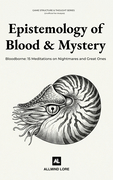
Epistemology of Blood and Mystery: Bloodborne: 15 Meditations on Nightmares and Great Ones
The book version is now available. Read for free with Kindle Unlimited.
Thank you very much for reading to the end. To help support the activities of this archive, a warm donation of a cup of coffee would be highly appreciated.