Insight.02: Pthumerian Labyrinth and the Discovery of Blood
 © Sony Interactive Entertainment, © FromSoftware
Introduction: The Cosmos Slumbering Underground, Memories of Blood, and the Inverted Celestial Sphere
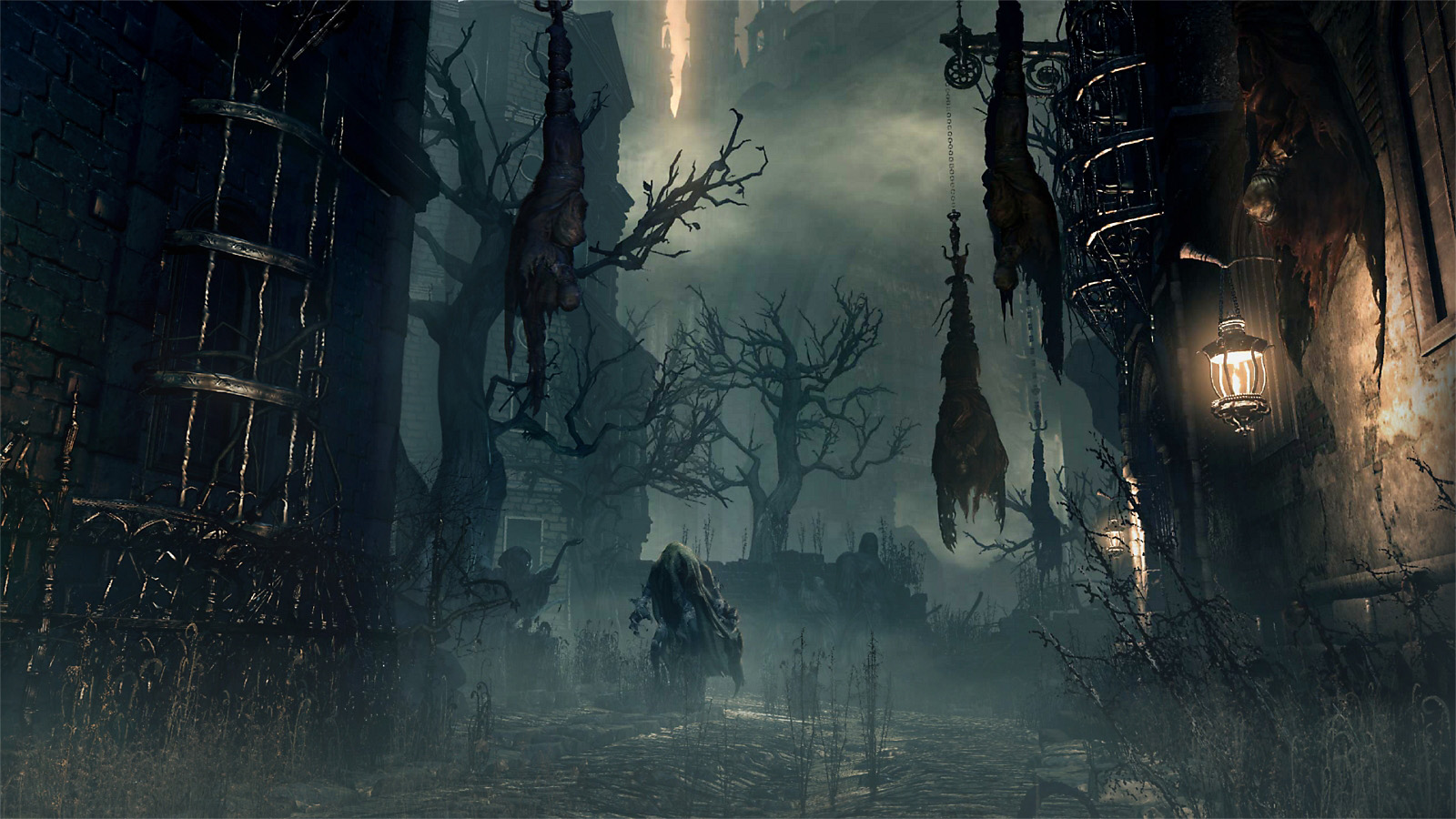
Beneath the city of Yharnam lies a massive, multi-layered expanse of ruins. This is no mere physical cavity composed of earth and rock, but a singularity where madness and the arcane are condensed—a “tomb of the gods” where even the concepts of time and space are distorted. Sealed by the Holy Chalices, this “Pthumerian Labyrinth” is the very origin of the Healing Church’s prosperity, the spread of the Scourge of the Beast, and all the Cosmic Horror that the city of Yharnam would eventually face.
When humanity looks up to unknown stars or the dimensions of gods, they typically gaze at the heavens. However, the essence of Cosmic Horror in this work lies in its paradoxical structure: “the truth was buried deep underground, further beneath the Old Yharnam smeared with putrid blood and mud.” While the Victorian-esque Gothic architecture stretches its spires high into the sky and human faith is directed upward, the fundamental power source of that civilization, the “Old Blood,” was excavated from the cold, lightless underground ruins. This vertical contrast implies how easily humanity’s fragile reason (the surface architecture) can be dismantled by the primal desires and madness (the Old Blood) crawling up from below.
This report will comprehensively discuss the ecology and the rise and fall of the ancient Pthumerians who once served the Great Ones, the history of the discovery of blood by the scholars of Byrgenwerth, and the abominable causal relationships connecting the Vilebloods and the Executioners, while strictly separating facts from speculation.
1. The Establishment of Pthumerian Civilization and the Fate of Eugenics: The “Keepers” of the Great Ones
The Pthumerians, who built the Pthumerian Labyrinth or served there as the “Keepers” of the Great Ones, are an ancient race that may be the ancestors of humanity or followed a different evolutionary tree. By analyzing the environments and remains they left behind, we can unravel what kind of beings they were and why they met their ruin (or mutation). It is presumed that the early Pthumerians were humble beings who merely guarded the Great Ones slumbering underground. However, in the process of touching the arcane of the Great Ones and partaking of their blood, their civilization underwent a decisive transformation.
1.1 The Biological Structure of Pthumerians and the Reality of Their Class Society
The Pthumerians encountered within the labyrinth generally possess pale skin, deeply sunken black eye sockets, and abnormally elongated limbs. Having long since lost their human reason, they have become part of a defense mechanism to eliminate intruders in the eternal darkness of the underground. Environmental storytelling and the text of the remaining attire clearly indicate that Pthumerian society was controlled by an extremely strict class system and religious rituals.
| Class/Category | Ecological Characteristics and Armament | Cultural and Religious Role |
|---|---|---|
| Undead Giant / Merciless Watcher | Abnormally hypertrophied bodies, the stench of rot, armed with primitive blades or cannons. They possess pale, brownish skin and sluggish movements. | Physical defense of the lowest layers and vital sectors of the labyrinth. Presumed to have handled ritual offerings and blood processing. Their hypertrophy suggests the early stages of the Old Blood’s side effects. |
| Pthumerian Descendant / Pthumerian Elder | Emaciated bodies like withered branches and abnormally long limbs. The Descendant wields shotels, while the Elder manipulates a flame-wreathed staff (a catalyst for arcane arts). | High-ranking entities wandering the deep layers of the labyrinth. Living fossils preserving ancient arcane arts and lost combat techniques into the present day. Indicates they were the class closest to the Great Ones. |
| Labyrinth Ritekeeper | Manipulates red-hot fire magic and wears distinctive attire and masks known as “Bone Ash.” | Managed ritual fires and bore a shamanic role to ward off Beasthood. The text of the Bone Ash set describes their fanaticism, willing to burn their own bodies to protect the Great Ones. |
| Queen (Yharnam, Pthumerian Queen) | A pure white (later bloodstained) dress, bound hands, manipulation of blood magic and clones. Constantly weeping tears of blood. | The “seedbed” to bear the child of a Great One. Despite being at the apex of society, she is in reality a vessel for the gods and a symbol of tragedy. |
Because the Pthumerians drew too close to the Great Ones, their human forms and reason were distorted. Their society was optimized and specialized for the singular purpose of “serving the Great Ones,” which implies the extreme fate of “eugenics” in the Victorian era. The arrogance of attempting to improve the species through the pursuit of blood and draw closer to the gods ultimately exacted the price of the loss of ego and monstrous mutation.
1.2 The Depths of the Class Society and the “Blood Oath”
What should be noted here is the text of the “Ring of Betrothal,” a peculiar relic discovered in the Chalice Dungeons. It states to the effect that “in the age of the Great Ones, marriage was a blood contract.” This single sentence proves that “blood” in Pthumerian society was not merely a medical or arcane resource, but an absolute law that dictated social class, reproduction, and even direct connection with the gods (the Great Ones).
The fact that the Pthumerian Elders manipulate high-dimensional arcane arts while the lower-class Watchers wander as abnormally hypertrophied, mindless lumps of flesh indicates that the distribution of blood was extremely unequal, or that the mutations caused by the purity of the blood differed by class. The upper-class Pthumerians maintained spiritual arcane power (akin to the later “Insight”) even as their bodies withered, but the lower classes could not suppress the “Beasthood” and “physical rampage” inherent in the blood.
2. Chalice Rituals and the Rotting Abyss: An Analysis of Environmental Storytelling
Exploring the Pthumerian Labyrinth is not merely a physical descent underground, but a dive into the abyss of history and madness. The environment within the labyrinth eloquently speaks of the full scope of the profane rituals conducted there, taking the place of the voiceless Pthumerians.
2.1 The Desecration of Life Indicated by Ritual Materials
The ritual materials used to break the seals of the Chalice Dungeons embody the maddening ecosystem of the Pthumerian civilization in themselves.
-
Tomb Mold: Giant fungi that grow using corpses and rotting flesh as a seedbed. This indicates that the underground ruins are filled with an unfathomable number of corpses, forming a unique ecosystem.
-
Ritual Blood: Old, stagnant blood. The fact that its concentration increases as one descends through the layers, being used in ever more gruesome rituals, suggests that the dependence on blood became more severe the deeper one went into the civilization.
-
Red Jelly: Chunks of flesh that might have once been human. It is the form of life that has completely lost its shape, reduced to a mere “substance” functioning only as a catalyst to summon the Great Ones.
What these materials suggest is the fact that the Pthumerians consumed massive amounts of “blood and flesh” in their communion and rituals with the Great Ones, completely destroying the dignity of life. From the perspective of Cosmic Horror, the fact that the only physical connection point humans (or Pthumerians) could offer to the higher-dimensional beings known as the Great Ones was “blood accompanied by the destruction of the flesh” highlights humanity’s insignificance and physical limitations.
2.2 Architectural Style and Objects of Worship
The statues placed on the walls and in the halls of the labyrinth silently speak of the objects of worship in Pthumerian civilization. The numerous reliefs of Messengers clinging to the walls indicate that the souls of the dead were an everyday presence in their society. Furthermore, of special note are the statues of “Amygdala,” possessing hypertrophied heads and multiple arms. This is conclusive evidence that they clearly recognized the existence of the “Great Ones” and made them objects of worship.
As one progresses deeper into the labyrinth, the orderly corridors crumble, and stagnant swamps of blood and rotting altars become scattered about. This is the very stratum of history where the Pthumerian civilization, unable to withstand the Insight of the Great Ones, rotted and collapsed from within. They dug deeper underground in an attempt to draw closer to the gods, but their final destination was a bottomless poison swamp and an abyss where madness-filled dead roamed.
3. Byrgenwerth’s Profane Excavation: The Gateway to Madness
The direct cause of Yharnam’s history spiraling into madness was when the scholars of Byrgenwerth, led by Provost Willem, set foot in these underground ruins and discovered the “holy medium (the Old Blood).” This event perfectly overlaps with the moment when Victorian modern medicine and archaeology stepped into the “domain of God that must not be touched.”
3.1 Tomb Robbing and the Pursuit of the Arcane
Byrgenwerth’s early activities were pure academic pursuits. They regarded the underground ruins as the “tomb of the gods” and conducted excavations in search of lost knowledge (Insight). As indicated by the headstones in the Hunter’s Dream and the materials required for Chalice rituals, their pursuit was nothing more than “tomb robbing” that desecrated the realm of the dead.
What they discovered in the deepest parts of the labyrinth were the traces of a dead (or slumbering) Great One—namely, the “Old Blood.” This blood possessed the miraculous power to cure illnesses and strengthen the flesh. However, it was simultaneously a curse that fundamentally remade the biological body and awakened the “Beasthood” within. The discovery of this “holy medium” was their “Pandora’s Box.” They were overconfident in their own intellect and reason, mistakenly believing they could control a higher-dimensional substance within a human framework.
3.2 Provost Willem’s Fears and the Causality of the Healing Church’s Schism
Provost Willem intuited the essential danger inherent in the blood. His words, “Fear the old blood,” were not merely a medical warning, but a philosophical maxim regarding the direction of human evolution. Willem preached that for humanity to reach the domain of the gods (the Great Ones), what was necessary was not physical mutation (blood), but an elevation of the spiritual dimension (the acquisition of Eyes on the inside = Insight).
On the other hand, his disciple, Laurence, was captivated by the immediate efficacy and practical miracles of the blood. The temptation to save people using the power of blood while simultaneously expanding the order’s authority is of the same nature as the “arrogance of scientific omnipotence” that modern medicine fell into. What should be noted here is that their conflict was not merely an ideological disagreement, but stemmed from a difference in interpretation of the “truth of the Great Ones” they witnessed in the Pthumerian Labyrinth.
Willem realized the “limits and tragedy of physical evolution” upon seeing the ruins of the blood-smeared Pthumerians writhing in the depths of the labyrinth. That is precisely why he sought not physical blood, but Eyes on the inside. In contrast, Laurence saw potential in the supernatural powers wielded by the Pthumerian Elders and the explosion of vitality brought about by the blood. The parting of ways between Laurence and Willem was a fatal rupture between two philosophical approaches: “blood (flesh and desire)” and “eyes (spirit and cosmos).” And the Healing Church, founded by Laurence who chose blood, would later sink all of Yharnam into the Scourge of the Beast, ironically walking the exact same path of ruin as the Pthumerian civilization.
4. The Metaphor of Blood and Motherhood: Yharnam, Pthumerian Queen
“Yharnam, Pthumerian Queen,” who sits at the bottom of Pthumeru Ihyll in the deepest part of the Pthumerian Labyrinth, is an entity that embodies all the tragedies of this story. Her raison d’être and her tragic end deeply gouge out the “metaphor of blood and motherhood” flowing at the foundation of this work.
4.1 The Bound Pregnant Woman and Tears of Blood
The visual of Queen Yharnam instills intense anxiety and revulsion in the beholder. Her pure white dress is stained dark red around her abdomen, and her hands are tightly bound by shackles. Furthermore, tears of blood continuously stream down her face through her veil. When engaging her in combat, the cries of a baby echo throughout, and there are moments when she herself reacts to the voice and halts her actions.
The “fact” indicated by this appearance is that although she bore Mergo, the child of a Great One (likely Formless Oedon), the birth did not occur in a normal manner, ending in a gruesome result where her abdomen was torn open. The shackles on her wrists suggest that despite being the queen at the apex of the nation, she was in reality a captive, functioning solely as a “seedbed” to bear the child of a Great One.
Furthermore, the text of the “Yharnam Stone” obtained upon defeating her states that it is the calcified remains of “something terrible that harbored within the queen’s womb.” This is the pinnacle of biological horror—that the child of a Great One could not grow normally within the mother’s womb and literally turned into a crystal of death.
4.2 The Great Ones and the Philosophy of “Surrogates”
The Cosmic Horror in this work is given depth not only by the superficial design of “monsters with giant tentacles,” but by the biological sorrow of “a sense of loss” and “reproductive failure” harbored by the god-like beings known as the Great Ones.
“Every Great One loses its child, and then yearns for a surrogate.”
The Great Ones cannot propagate their species alone and require a human (or Pthumerian) mother. However, a three-dimensional body cannot withstand the flesh and blood of a higher-dimensional being, resulting in either a stillborn child or the ruin of the mother. Queen Yharnam was the first and most symbolic victim of this cosmic-scale surrogate motherhood.
The tears of blood she sheds are not mere physical pain, but a symbol of eternal despair as a mother who lost her child (Mergo). The fact that in the Nightmare of Mensis, when the player defeats Mergo’s Wet Nurse and “returns” Mergo, Queen Yharnam, who had been watching from afar, bows and fades away, vividly illustrates that her soul had been bound to the cries of her lost child for thousands of years, bearing an eternal shackle that stretched from the depths of the underground labyrinth to the dimension of the nightmare.
4.3 Blood, Menstruation, and the Pinnacle of the Desecration of Life
In the Victorian context, the topic of blood, especially women’s blood (menstruation and bleeding associated with childbirth), was considered an extreme taboo. However, in the world of Bloodborne, that taboo is inverted into “holy medicine” and “communion with the gods.”
Formless Oedon is a Great One who uses “blood” itself as a medium. As the Caryll Rune “Oedon Writhe” indicates, Oedon lacks a form of his own and exists only as the writhing of blood. From Yharnam, Pthumerian Queen, to Annalise, Queen of the Vilebloods of Cainhurst, and Arianna, the woman of pleasure in the city of Yharnam, they all share the fate of bearing the child of Oedon (or a Great One akin to him) through corrupted blood.
This depicts the worst kind of horror, where the fundamental mystery of the birth of life (motherhood) is parasitized and usurped by a cosmic entity. The human mother’s womb, a place that should be the safest and most sacred, is reduced to a culture fluid for hatching an indescribable monster. This complete collapse of bioethics is the greatest sin brought about by the “discovery of blood” that began in the Pthumerian Labyrinth, and it is the most terrifying singularity where Cosmic Horror and Gothic horror fuse.
5. The Corrupted Bloodline of Cainhurst: Martyr Logarius and the Causality of Pthumeru
After the Healing Church was established, someone brought “forbidden blood” out of Byrgenwerth. This blood was carried to the snow-swept forsaken Castle Cainhurst, from which a faction known as the “Vilebloods” is said to have been born. The existence of these Vilebloods holds an extremely important causal relationship in understanding how the curse of the Pthumerian Labyrinth was inherited on the surface, giving rise to new tragedies.
5.1 [Fact] Annalise, Queen of the Vilebloods, and the Seal of Martyr Logarius
The following points are cited as facts explicitly stated within the game:
-
The Vilebloods of Cainhurst aim to take the blood of others (Blood Dregs) and offer it to Queen Annalise. This is preparation for bearing the child of a Great One.
-
Annalise possesses an “immortal body,” and even if physically destroyed, she can be resurrected from “Queenly Flesh.”
-
Martyr Logarius, the head of the Executioners, assaulted Cainhurst and annihilated the Vilebloods, but unable to completely kill Annalise, he chose the path of donning the “Crown of Illusions” himself to seal the throne room, ensuring no one could approach her.
Logarius’s self-sacrifice superficially appears to be a heroic act fulfilling his duty as the head of the Healing Church’s Executioners. However, hidden at its core is a deep mystery that traces back to the darkness of the Pthumerian Labyrinth.
5.2 [Speculation] The True Identity of Logarius and the Inheritance of Pthumerian Blood
Here, questions arise regarding the true identity of Martyr Logarius and why he did not reduce Annalise to flesh to seal her. From certain records and circumstantial evidence, a compelling theory can be inferred that Logarius himself was an inhuman entity, drawing Pthumerian blood (or being a descendant thereof).
| Evidence/Phenomenon | Fact (In-Game Depiction) | Speculation (Inference from Community and Circumstantial Evidence) |
|---|---|---|
| Logarius’s Physique | He possesses a massive physique far surpassing that of a normal human, flies through the air, and manipulates vengeful skulls and blood magic. | His abnormally elongated limbs and use of arcane arts closely resemble the “Pthumerian Elder” and “Pthumerian Descendant” encountered in the depths of the Pthumerian Labyrinth. It is highly likely he could wield these supernatural abilities precisely because he drew from the Pthumerian bloodline. |
| The Incomplete Seal of Annalise | Unable to kill Annalise, he used the Crown of Illusions himself to conceal the innermost part of the castle. He did not carve her down to a lump of flesh. | The reason he did not reduce her to flesh might have been due to some taboo regarding the former Yharnam, Pthumerian Queen (a latent awe toward the Queen of Blood), or perhaps a fear that an immortal lump of bloody flesh might give rise to something even more terrifying (a grotesque monster). Alternatively, the possibility that he himself was nearly captivated by the beauty and spell of the Vileblood Queen cannot be denied. |
| The Origin of Cainhurst’s Blood | Originating from “forbidden blood,” they desire Blood Dregs. They possess aristocratic behavior and an abnormal obsession with blood. | The blood brought to Cainhurst was the blood of the Pthumerian Queen itself, or something of extremely high purity close to it. They are the Pthumerians of the surface. |
The behavior of the Vilebloods of Cainhurst (aristocratism, obsession with blood, servitude to the queen, and the thirst for the child of a Great One) is nothing less than a surface reproduction of the former Pthumerian society. If Logarius was indeed one who drew Pthumerian blood, an entirely different philosophy emerges behind his actions.
He can be interpreted as a tragic sentinel who attempted to prevent the mistakes his ancestors committed in the Pthumerian Labyrinth (excessive servitude to the Great Ones, the corruption of blood, and fanaticism toward the queen) from being repeated on the surface at Cainhurst. His act of sacrificing himself to don the Crown of Illusions and continuing to guard the throne in an eternal blizzard was a ritual of atonement to sever the curse of his own bloodline, transcending his mere responsibility as the head of the Executioners. If he had reduced her to flesh, someone might have taken it away, and the lineage of blood might have been resurrected once more (just as Alfred actually ends up doing). That is precisely why he chose the most certain and desperate seal: keeping the queen “unharmed, yet hidden from all eyes.”
6. The Structure of Rituals: Imitated History and the Cycle of Ruin
History repeats itself. The path of ruin followed by the Pthumerian civilization is perfectly imitated in present-day Yharnam by the Healing Church and the School of Mensis. Humanity succeeded in drawing “power (blood)” from the underground abyss, but they lacked the eyes to learn the “lessons of history” that accompanied it.
6.1 The Resonance Between the Nightmare of Mensis and the Shadows of Pthumeru
The ritual conducted by the School of Mensis was an extremely profane attempt to commune with the Great Ones. They kidnapped massive numbers of people in Yahar’gul, Unseen Village, offered blood and flesh, and attempted to recreate the rituals once performed by the Pthumerians with modern technology and madness. It is no coincidence that the target they chose for communion was Mergo, the child of a Great One once borne by the Pthumerian Queen.
The School of Mensis dragged the past causality sealed within the underground labyrinth into the alternate dimension of the nightmare, allowing it to sprout once more. The “Shadows of Yharnam” appearing in the Forbidden Woods, and the architectural structure of “Mergo’s Loft” located along the path in the Nightmare of Mensis, are all under the direct influence or interference of Pthumerian culture. The fire and katanas wielded by the Shadows are the very techniques of the Pthumerian Descendants and Watchers, serving as proof that the underground curse has completely encroached upon the surface.
6.2 The New “Keepers” Known as the Healing Church
The Healing Church itself is also an imitation of the structure of Pthumerian society. They revere the Great Ones (or the source of blood) as holy, with an upper class (The Choir and the Vicars) managing it, beneath whom exist those who partake in the blessings of blood (the citizens of Yharnam), and those who eliminate heretics and beasts (Hunters).
The forms of the lower-class Watchers who, unable to suppress their Beasthood in the Pthumerian Labyrinth, turned into Undead Giants and wandering lumps of flesh, are perfectly recreated in modern Yharnam as “Blood-drunk Hunters” and “citizens afflicted by the Scourge of the Beast.” They believed they had evolved, but in reality, they were merely tracing the process of degeneration and corruption that the underground race had followed thousands of years ago.
6.3 The Curse Carved into the City Named Yharnam
To begin with, the fact that the city serving as the headquarters of the Healing Church and the setting of the story is named “Yharnam” is the cruelest irony. They may have named the city in honor of the underground entity that brought them the holy blood (or the discovered remains of the queen), or perhaps without knowing its true nature. However, it meant that the city itself harbored the “fate of being torn open as a seedbed of blood.”
Just as Queen Yharnam’s abdomen was torn open, resulting in a tragic stillbirth, the city of Yharnam was also destined to collapse from within due to the Scourge of the Beast, sinking into roaring flames and a sea of blood. The very foundation of the city was built upon massive sacrifice and death.
Conclusion: The Eternal Night Brought About by the Pursuit of Blood Without Insight
Through the detailed analysis in this article, it has become clear how the Pthumerian Labyrinth lies at the center of all events in Bloodborne and is the root of all evil. The labyrinth deep underground was no mere dungeon where treasure and knowledge slumbered, but an “exhibition hall of the history of arrogance and ruin” that humanity should never have touched.
The moment the scholars of Byrgenwerth brought the Old Blood back from the labyrinth, the ruin of Yharnam was sealed. They should have read the terror of the blood (Cosmic Horror and the collapse of bioethics) from the utterly changed forms of the Pthumerians, the giant mold feeding on rotting flesh, and the phantom of the queen with bound wrists weeping tears of blood. However, they lacked the “eyes (true Insight)” to correctly recognize it. Succumbing to the temptation of immediate medical miracles and the Victorian eugenic ideology of drawing closer to the gods, they pried open Pandora’s Box themselves.
The immortal body of Annalise in Cainhurst and the self-sacrifice of Martyr Logarius, who continued to wear the Crown of Illusions to seal her, can be evaluated as history’s final line of resistance, attempting to somehow locally contain the curse of blood that leaked from this underground. If the speculation that he himself drew Pthumerian blood is true, it is a microcosm of the endless battle between “those who seek to settle the mistakes of the past” and “those who seek to repeat the mistakes once more.” His choice of a seal, making himself the guardian of the throne rather than opting for the destructive means of reducing her to flesh, was the most sorrowful decision born of fearing the rampage of blood above all else.
“Fear the old blood.” This warning from Provost Willem was a word of extremely multi-layered and desperate truth, uttered only by one who understood the nameless lumps of flesh writhing in the darkness of the Pthumerian Labyrinth and the resentment of the queen weeping tears of blood. The discovery of blood was, in other words, the beginning of an irreversible sin—that humanity had connected a line to the dark side of the cosmos of their own accord. The blood-soaked history of Yharnam that we explore was all decided long ago amidst the dust and the stench of mold in those underground ruins. From the moment humanity ceased looking up at the heavens and peered into the underground abyss, the dawn of humanity was lost forever.
Epistemology of Blood and Mystery: Bloodborne: 15 Meditations on Nightmares and Great Ones
The book version is now available. Read for free with Kindle Unlimited.
Thank you very much for reading to the end. To help support the activities of this archive, a warm donation of a cup of coffee would be highly appreciated.