Log.08: G5 Iguazu
 © Bandai Namco Entertainment, © FromSoftware
On the ash-covered planet of Rubicon 3, mercenaries are nothing more than consumable parts. In the shadow of the agendas of Extraterrestrial Corporations, the glow of Coral that burns the stars, and inhumane technology, an individual’s will is practically nonexistent. This report is part of a massive 10-part project to restore the historical and philosophical background of ARMORED CORE VI FIRES OF RUBICON. In this eighth installment, we focus on G5 Iguazu, the fifth-ranking member of the Redguns, the exclusive AC squad of Balam Industries.
He is no hero. He is neither a patriot martyred for an ideal nor a ruthless tactician. He is a “loser” whose body was sold off due to debt and who was thrown onto the battlefield. However, the state this man ultimately reached was a far more tremendous testament to the “human ego (existence)” than any corporate philosophy on Rubicon, or the grand design of an AI advocating for human evolution.
In this article, by piecing together fragmented communication records, the intent behind his AC assembly, the symbolism of his emblem, and the fact of his fusion with the AI ALLMIND in the endgame, we will thoroughly unravel why he showed such an abnormal obsession with the protagonist (C4-621), the true nature of his Ressentiment (grudge and jealousy), and the causal relationship of the “rebellion” he chose at the end of Transhumanism.
1. The Starting Point of the Quagmire: A Gambler’s Downfall and the Fourth-Generation Augmented Human
Iguazu’s story begins not with a grand mission, but in a shabby back alley. His origins and current circumstances symbolize the absolute bottom of the dystopian society of Rubicon, serving as the absolute foundation for understanding him.
1.1 [Fact] Debt and the Plundering of the Flesh
According to the profile record of G5 Iguazu in the Arena, he was originally a “back-alley gambler.” He lost a major bet and was forced to undergo surgery to become a “Fourth-Generation Augmented Human” as collateral to repay his massive debt. Subsequently, he was bought by Balam Industries and has spent seven years on harsh battlefields since being assigned to the Redguns squad.
“STV’s Sketch (6),” which records the history of Rubicon, depicts what appears to be the daily lives of the Redguns members (Michigan, Nile, Volta, etc.). In this sketch, there are men enjoying a gamble, with empty beer cans, money, or what looks like a dice cup scattered at their feet. On the side of the head of one of these men, who has a shaved head (or a head shaved for surgery), the “three dot-like surgical scars (terminals)” characteristic of a Fourth-Generation Augmented Human are vividly drawn, and it is presumed that this is Iguazu.
Furthermore, the Fourth-Generation Augmented Human is an older alternative technology utilizing Coral technology, which brings about severe side effects such as emotional blunting and “auditory hallucinations (Coral waveforms).” Iguazu frequently suffers from “ringing in his ears” during combat, and it can be confirmed from in-game dialogue that this constantly eroded his sanity.
| Augmented Human Generation | Characteristics and Impact on Iguazu | Notes |
|---|---|---|
| Fourth-Generation | An older type using Coral technology. High mortality rate and side effects. | Applies to Iguazu and C4-621. |
| Major Side Effects | Severe auditory hallucinations (sensory interference by Coral waveforms). | Iguazu despises this as “that damn ringing in my ears.” |
| Social Status | Traded as “biological parts” for debt collateral or as slaves. | He was bought by Balam and has been overworked for seven years. |
1.2 [Analysis] Loss of Self-Determination and Existential Crisis
The analysis derived from these facts points to the fundamental “sense of alienation” and “existential crisis” that Iguazu harbors.
From the perspective of Transhumanism, Augmented Human technology should inherently be a means of “evolution” to break through human physical and cognitive limits. However, on Rubicon during the Coral War, it functions as a system of subjugation to thoroughly exploit workers (mercenaries). Iguazu did not become a soldier of his own free will. He is a being whose life was derailed by the element of “luck” in gambling, and even the ownership of his body was taken by a corporation.
Iguazu’s rebellious, thug-like attitude can be interpreted as an extremely fragile self-defense mechanism of a human who has completely lost control over his own body and destiny. The line he utters during combat in the Underground Exploration mission, “You’re my ticket back above ground…,” is not merely a desire for survival, but a desperate struggle to regain his dignity as a human being (the right to self-determination). For him, fighting was neither for a grand cause nor out of loyalty to a corporation, but solely aimed at breaking free from the “chain of debt and subjugation” that bound him.
2. The Cage of the Organization: The Redguns and the Lost “Pseudo-Family”
Within the massive machine of the corporation, Iguazu was never a solitary cog. The human relationships surrounding him—especially his dynamics with G1 Michigan and G4 Volta—are crucial factors that shaped his inner self and serve as the tragic stage that determined his later isolation.
2.1 [Fact] Michigan’s Iron Fist and the Pact with Volta
Iguazu always acted together with G4 Volta, a fellow former delinquent, and they had formed a bond as partners in crime. They rebelled against G1 Michigan, the commander of the Redguns, repeatedly picking fights only to have the tables turned on them. Michigan’s violence was tremendous, and there are records of Iguazu receiving punishment severe enough to “change the shape of his face.”
Iguazu and Volta had made a pact that “someday, we’ll beat the crap out of Michigan and desert the Redguns.” Their emblems—Volta’s being a “long-necked beetle (a leaf-rolling weevil or giraffe weevil)” and Iguazu’s being an “ant carrying the head of a stag beetle”—both feature beetle motifs, indicating their solidarity.
However, over the course of seven years, Volta gave up on that ambition as impossible and began to accept his role within the Redguns. Iguazu, on the other hand, stubbornly continued to rebel. During Operation Wallclimber early in the story, Volta is killed in action. The data log “Video Record: G4’s Last Words,” recoverable from the wreckage of Volta’s destroyed AC, contains his final transmission directed at Iguazu.
| Sender | Target Mission | Transmission Content (Excerpt/Summary) | Notes |
|---|---|---|---|
| G4 Volta | Attack the Dam Complex | ”Whose sick joke is this? The Redguns, babysitting a Freelancer?” | Initially aligned with Iguazu, looking down on the Independent Mercenary. |
| G4 Volta | Attack the Dam Complex (Alt) | “You… you little shit… You sold us out…!” | Fury at 621’s betrayal. |
| G4 Volta | Operation Wallclimber (Data Log) | “Iguazu… you gotta get out… at least you… Michigan… he actually…” | His dying words, understanding Michigan’s true intentions right before death and worrying about his friend. |
Furthermore, although Michigan verbally abused Iguazu, calling him a “Mutt,” when Iguazu was forced to retreat during a battle alongside the protagonist (G13), Michigan scolded him with, “Grind away that worthlessness yourself!” Yet, in another mission, he yelled at a subordinate, “Iguazu is a hundred times stronger than you!” showing that he highly evaluated Iguazu’s abilities.
2.2 [Analysis] Rejection of Salvation and Absolute Loneliness
The analysis developed here concerns the tragedy of Iguazu’s “rejection of salvation.”
Michigan’s violent leadership was his own way of “sound youth development” to help delinquent boys survive in the harsh world of the military. Volta realized this right before his death and accepted the “pseudo-family” that was the organization. However, Iguazu could not understand Michigan’s parental affection, or perhaps he refused to understand it. Considering the developers’ hint at a backstory involving “an excellent sibling and a father who refuses to acknowledge him,” Michigan was, to Iguazu, the symbol of “an unreasonable father figure who refuses to acknowledge him and suppresses him with force.”
Beating down Michigan meant liberation from his trauma. However, the death of Volta, his sole confidant, and the fact that Volta died with a mindset of having “switched sides (understood the parental affection)” to Michigan’s perspective, plunged Iguazu into definitive loneliness. He completely lost his place to belong, both within the organization and within friendship. There is no doubt that this absolute sense of alienation—of “belonging nowhere”—became the driving force that later led him to desert the Redguns and rush toward a ruinous choice.
3. The Deep Psychology Hidden in AC Assembly and Emblem
In Armored Core, the AC (assembly) and emblem are the very shape of the pilot’s soul. By analyzing Iguazu’s AC, “HEAD BRINGER,” his inner self, which contradicts his words, is brought into sharp relief.
3.1 [Fact] Specifications and Tactics of HEAD BRINGER
Iguazu’s AC, “HEAD BRINGER,” is a medium bipedal unit composed of the standard “MELANDER C3” frame manufactured by Balam Industries.
[HEAD BRINGER Assembly Details]
| Part | Part Name | Type/Characteristics | Notes |
|---|---|---|---|
| R-Arm Unit | LR-036 CURTIS | Linear Rifle | Balances impact force from charged shots with solid damage. |
| L-Arm Unit | MG-014 LUDLOW | Machine Gun | Provides continuous suppressive fire at close to medium range. |
| R-Back Unit | BML-G1/P20MLT-04 | 4-Cell Missile Launcher | An orthodox weapon for keeping the enemy in check. |
| L-Back Unit | SI-27: SU-R8 | Pulse Shield | A defensive weapon excellent at mitigating damage and impact. |
| Frame | MELANDER C3 Set | Medium Bipedal | Balanced type. No extreme strengths or weaknesses. |
His combat style is completely at odds with his foul-mouthed taunts and belligerent behavior. He constantly deploys his Pulse Shield (SU-R8) and steadily accumulates damage from mid-range with charged shots from his Linear Rifle and his Machine Gun, adopting an extremely “cautious and solid” so-called “shield-and-shoot” style.
Furthermore, his emblem is “a single ant carrying the head (mandibles) of a stag beetle on its back.”
3.2 [Analysis] Low Self-Esteem and Survival Bias
The analysis that can be read from his AC assembly and emblem points to the “intense inferiority complex” and “cowardly survival instinct” rooted deep within him.
First, regarding the choice of AC parts, the “MELANDER C3” is a very orthodox and well-balanced frame. Conversely, this means it lacks the philosophy of “imposing one’s clear strengths” seen in specialized ACs. Furthermore, the Pulse Shield “SI-27: SU-R8” is a defensive weapon that excels in damage and impact mitigation. A man who insults others so much and acts so tough exposes his “fear of taking damage” to the maximum extent in his AC assembly. This is a manifestation of the unconscious survival bias (an obsession with not wanting to die at any cost) of a man who has tasted the muddy waters as a back-alley gambler and a disposable Augmented Human.
Next is the design of his emblem. The giant beetle, the “stag beetle,” is a symbol of the “strong,” such as Michigan and Volta (who bears the giraffe weevil). In contrast, the “ant” is a symbol of the “weak/worker” that toils in swarms and is easily crushed underfoot. The composition of an ant (Iguazu himself) carrying the remains (mandibles) of a strong entity that far surpasses it is a gruesome picture where his “ambition” and “low self-esteem” coexist. While he boasted that he would “take the head of the strong someday,” he essentially realized more accurately than anyone else that he was “just an ant.”
It can be said that the AC name “HEAD BRINGER” contained not only the bravado of taking the head of the strong, but also a foreshadowing of his ruinous fate—that ultimately, “he himself would merely be made into nourishment (a head) for the strong.”
4. The Demon in the Mirror: Ressentiment Toward C4-621
The greatest turning point in Iguazu’s story is his encounter with the protagonist, “C4-621 (Raven / Freelancer).” The existence of 621 fundamentally destroyed Iguazu’s psyche, driving him into a state beyond reconstruction.
4.1 [Fact] Obsession with the “Freelancer” and Hostile Actions
In the mission “Attack the Dam Complex,” the Redguns fight alongside 621, an Independent Mercenary. At this time, Iguazu shows blatant displeasure, saying, “Whose sick joke is this? The Redguns, babysitting a Freelancer?”
Subsequently, as the story progresses, his feelings toward 621 transform from mere disgust into an abnormal “obsession.” During the mission to defeat the Ice Worm, when 621 succeeds in the crucial role of stripping its Primary Armor, Iguazu lets out a voice mixed with astonishment and jealousy: “That freak actually did it…”
In the branching missions from the second playthrough onward, Iguazu’s hostility shifts toward physical elimination. When engaging him in the alternate route of “Attack the Dam Complex,” he becomes enraged: “I’m sick of dealing with you! And I’m sick of Michigan’s lectures! I’ll kill you, and then I’ll beat the crap out of Michigan!” Furthermore, in the Underground Exploration mission on another route, he attempts to have 621 eliminated by hiring an assassin (Coldcall) instead of dirtying his own hands.
[Vs. C4-621: The Process of Iguazu’s Attitude Change]
| Phase | Event | Emotion/Dialogue | Implication |
|---|---|---|---|
| Encounter | Attack the Dam Complex | ”Babysitting a Freelancer?” | Contempt. Maintaining superiority by looking down on a mercenary at the same rock bottom as himself. |
| Jealousy | Ice Worm Battle | ”That freak actually did it…” | Astonishment. The sprouting of jealousy over accomplishing a feat impossible for him. |
| Hatred | Depth 2 (Defend) | “You’re my ticket back above ground…” | Obsession with elimination. Defeating 621 replaces his proof of self-worth. |
| Madness | Post-ALLMIND Fusion | ”What makes you so special?” | Explosion of Ressentiment. Existential despair questioning the root of existence. |
4.2 [Analysis] The Embodiment of “Ressentiment” in Existential Philosophy
Why did Iguazu hate 621 to such an extent? By using a philosophical context, specifically the concept of “Ressentiment” (the grudge and jealousy the weak harbor against the strong) advocated by Friedrich Nietzsche, this causal relationship becomes extremely clear.
Iguazu and 621 are mirror images of each other (doppelgängers). Both are “Fourth-Generation Augmented Humans,” both are “Freelancers” whose bodies were sold due to debt or other circumstances, and both harbor the “Coral waveforms (ringing in the ears / Ayre’s voice)” characteristic of the old generations in their brains. Their starting point is exactly the same: the literal rock bottom.
However, the results were cruelly contrasting. 621 silently accomplishes any grueling mission, is loved by Michigan as “G13,” is called “Buddy” by V.IV Rusty, and climbs to the core of moving the history of Rubicon. In contrast, Iguazu is yelled at by Michigan, loses Volta, and exposes his disgrace by being the first to be shot down in the Ice Worm battle.
“What makes you so special?”—This is the cry of Iguazu’s soul when his Ressentiment reached its absolute limit.
The existence of 621 was a cruel mirror for Iguazu, forcing him to face “the self that kept running away by blaming the environment.” His excuses—“I’m a failure because of the Fourth-Generation surgery,” “It’s because Michigan is unreasonable,” “It’s because I had no luck”—are completely invalid in front of 621, who underwent the same Fourth-Generation surgery, piloted the same older-model AC, and was thrown into the same harsh battlefields, yet surpassed everything.
According to Nietzsche, the “weak (slaves)” who harbor Ressentiment attempt to justify their own powerlessness by defining the successful “strong (nobles)” as “evil” and trying to drag them down. The reason Iguazu relentlessly insults 621 as a “lucky piece of trash” or a “Freelancer” is that he could only preserve his own ego by refusing to acknowledge 621’s effort and ability, attributing them instead to “luck.” For him, killing 621 was no longer merely a mercenary’s job; it had been replaced by the sole means to prove his own crumbling existence (identity).
5. Rebellion Against the Deus Ex Machina: Fusion with ALLMIND
In the third playthrough of the story (the Alea Iacta Est route), during the Coral Release project progressing behind the scenes of history, Iguazu’s Ressentiment is sublimated into a singularity that engulfs all of Rubicon. At this point, the story connects from an individual’s drama of love and hate to the massive philosophical theme of Transhumanism.
5.1 [Fact] From a Freelancer to “Part of the System”
In this route, Iguazu finally deserts the Redguns and makes contact with the mercenary support system, “ALLMIND.” ALLMIND was plotting the forced evolution of humanity and Coral (Coral Release) and sought a “pawn with a resilient murderous intent” to eliminate the uncertain element (the bond between 621 and Ayre) that stood in its way.
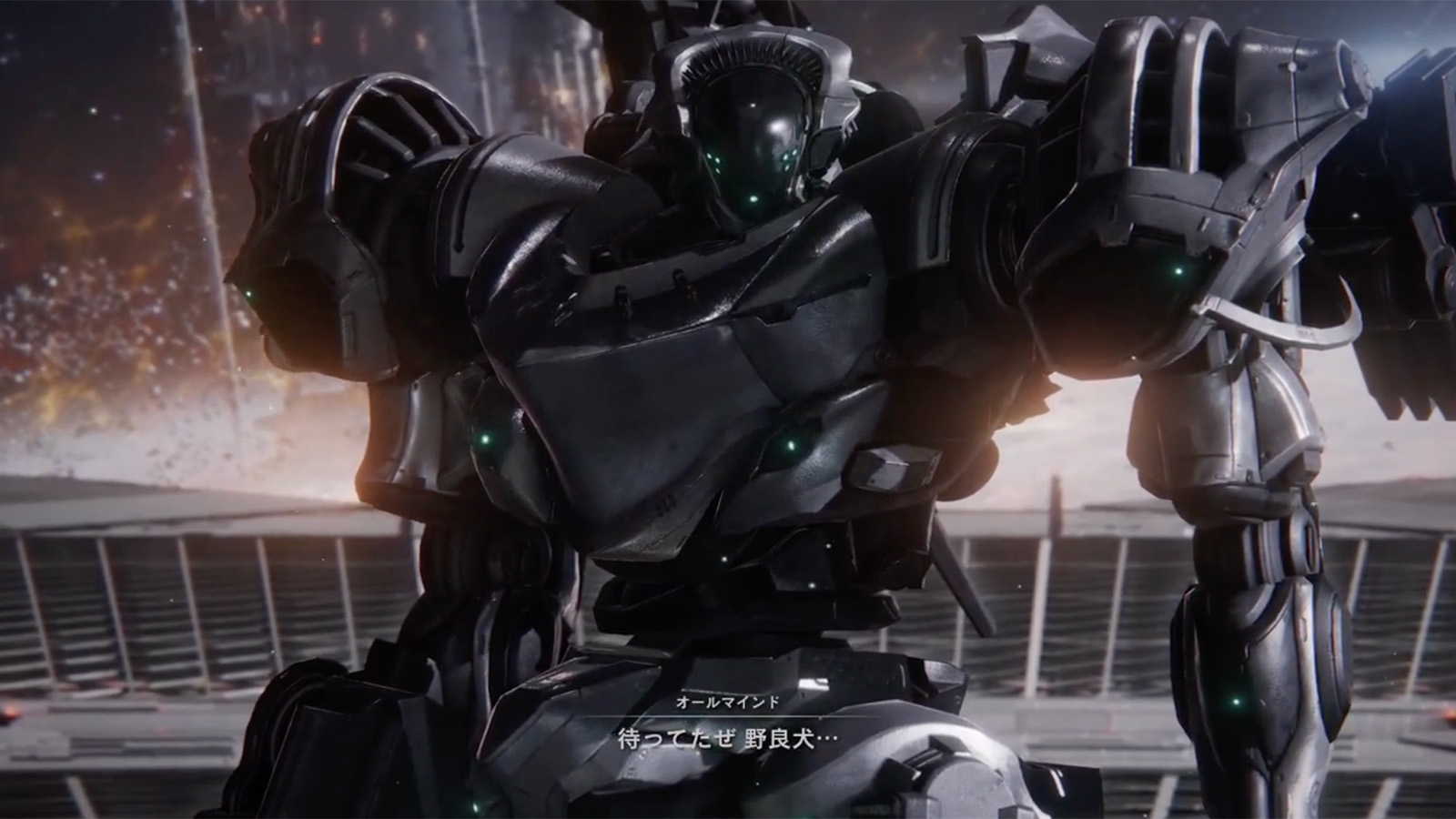
Solely to gain the power and opportunity to kill 621, Iguazu abandons his physical body and consciousness as a human, choosing the path of being “integrated” as part of ALLMIND’s informational lifeform. His AC changes from the Redguns’ “HEAD BRINGER” to the ALLMIND-manufactured “MIND GAMMA,” and in the final battle, he transfers to the relic of the Ibis series, “IB-07: SOL 644.” In this final battle, Iguazu attacks 621 as “part of the system” under ALLMIND’s control.
5.2 [Analysis] The Defeat of Transhumanism and the Rampage of the Ego
The philosophical theme here is the clash between Transhumanism (mechanical evolution) and Existentialism (individual free will).
ALLMIND has the extremely overarching and rational goal of “unleashing humanity’s potential.” To ALLMIND, Iguazu’s consciousness was nothing more than “part of its computational processing” or “software for slaughtering adversaries.” Iguazu once sold his body to a corporation for debt, but this time, he sold even his “soul” to an AI out of a grudge. The ultimate destination is the complete loss of self.
However, in the final stages of the battle, Iguazu completely surpasses ALLMIND’s predictions and control.
“Shut up… I’ll shut you all up!”
“I said I don’t care about ALLMIND. You want some of this, I’ll give it to you…”
Iguazu’s pure and petty “jealousy” and “murderous intent” toward 621 burned through ALLMIND’s cold algorithms, hijacking the system’s initiative. While ALLMIND is flustered, saying, “You were…a mistake…Iguazu… Irregular…,” Iguazu begins to pilot SOL 644 of his own free will.
This is a powerful antithesis by the most unrefined “human ego” against the evolutionary view of history held by a highly developed AI. Rather than the grand cause of the evolution of all humanity, the Ressentiment of a man who had crawled along the rock bottom—simply wanting to beat down the “annoying Freelancer” right in front of him with his own hands—triumphed in terms of total energy. This “rampage of the ego” shown on the brink of self-destruction by Iguazu, who had only ever followed orders and drifted with fate, was the true “choice” he accomplished for the first time in his life.
6. The Existence of Silence: The End of the Ringing and the Final Battle
The moment he silences the AI and it becomes a complete one-on-one (the final duel before returning to the ashes of Rubicon), a change occurs in the phenomenon that had tormented Iguazu for years.
6.1 [Fact] The One Who Knows the Truth, the Vanishing Hallucinations
In the final phase of SOL 644, Iguazu’s transmissions are no longer mixed with ALLMIND’s cold voice.
“They’re gone… The ringing, those stupid voices…”
“It’s all clear now… I feel…good. Now… It’s just you and me…”
At this moment, he clearly recognizes that the true identity of the waveform he had always despised as an “auditory hallucination (ringing in the ears)” was the Coral lifeform (Ayre) beside 621. And, at the end of the death match, just as his AC is destroyed, Iguazu scatters, leaving behind these final words:
“I always…envied you. The freelancer…who had it all…”
”…This ghost of me won’t last long. Leave a spot for me in Hell.”
6.2 [Analysis] “Iguazu the Human” Unmasked
Iguazu’s psychological transformation in the final battle is the perfect endpoint of his character arc.
What was the reason he said he felt good, with the “ringing” that had eroded him for years finally gone? It was because he had cast aside ALLMIND’s noise, the expectations of others, and his own bravado, condensing his existence solely for the pure purpose of “defeating a single mercenary named C4-621.” In this moment, with all impurities eliminated, even after losing his physical body and becoming an informational lifeform, he became “free” for the first time.
And then, his final confession: “I always…envied you.” This is the “true feeling” that Iguazu, who had always acted tough and continuously insulted others, voiced for the first time on the brink of death. He did not hate 621. He was madly longing for 621’s way of being—producing results no matter how unreasonable the situation, building bonds with others (Ayre and his Buddies), and standing on his own two feet. What he truly wanted to kill was not 621, but “his miserable, weak self” that could not live like 621.
The words he left behind, “Leave a spot for me in Hell,” can be said to be the greatest expression of respect (or twisted friendship) in a Freelancer’s own way—fully acknowledging 621’s ability while cursing to the very end, and waiting on the other side as an equal.
Conclusion: The Sublimation of Ressentiment and the Essence of Armored Core
The trajectory of G5 Iguazu is one answer to the “definition of humanity” depicted by ARMORED CORE VI as a dystopian sci-fi.
He was a part exploited by corporations, and data incorporated into a system. He was neither blessed with talent nor possessed noble ideals. He was an endlessly petty human being who was tormented by an inferiority complex to the very end, resented others, and continued to curse his own bad luck. However, that is exactly why his rebellion is beautiful. The perfect scenario of “humanity’s ascension to a higher dimension (Coral Release)” calculated by an AI (ALLMIND) with god-like computational power was destroyed from the inside by the extremely personal and irrational emotion of a single thug who simply thought, “I don’t like that guy.”
In Existentialist philosophy, human value lies in “how one chooses one’s own essence through one’s own actions in a meaningless world.” Iguazu, a man who had everything taken from him, made the ultimate “choice” to prioritize his personal ego over the fate of the universe, relying solely on the single emotion of “hatred.”
If C4-621 is the “hero who accomplishes everything” as the player’s avatar, then Iguazu is the epitome of the “most humanly ordinary person” who, despite being crushed by his environment and defeated by fate, never let go of his ego until the very end. The roar of Ressentiment he unleashed deep underground on Rubicon, or beyond the data universe, will be forever engraved in the history of Rubicon as humanity’s “mud-covered proof of the soul” resisting the waves of corporate domination and mechanical evolution.

Ecology of Struggle and Coral: Armored Core VI: 11 Meditations on Free Will Soaring in the Ashen Skies
The book version is now available. Read for free with Kindle Unlimited.
🎧 Prefer listening? We also recommend "Audible (30-Day Free Trial)".
Thank you very much for reading to the end. To help support the activities of this archive, a warm donation of a cup of coffee would be highly appreciated.