Log.02: Handler Walter and Cinder Carla (Overseer)
 © Bandai Namco Entertainment, © FromSoftware
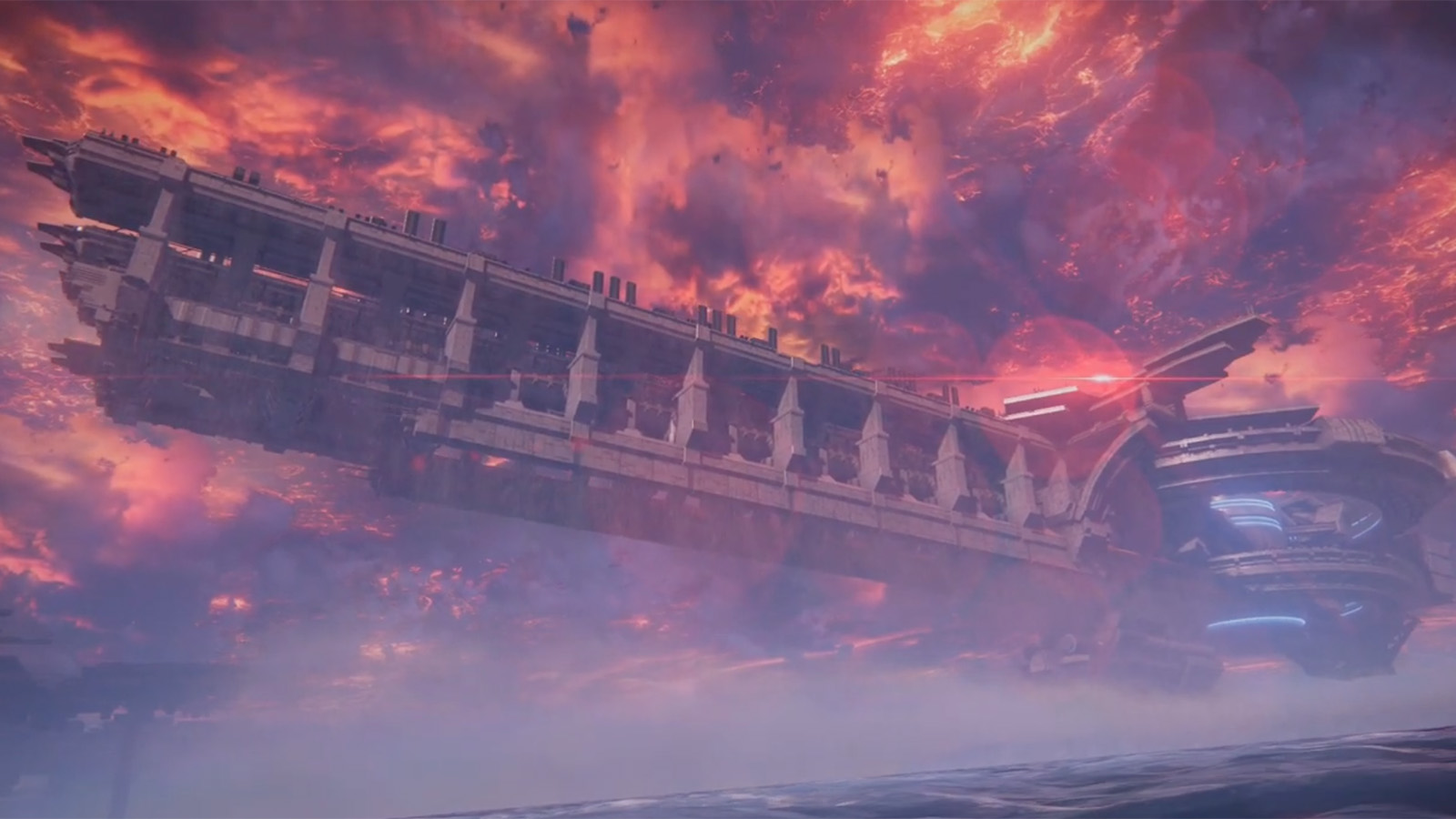
As an inorganic interstellar spacecraft descends into the orbit of Rubicon 3, what spreads out below is a gray surface scorched by the hellfire of half a century ago, the “Fires of Ibis,” leaving scars that have yet to fade. This unprecedented disaster, which engulfed the entire star system, was an apocalyptic landscape brought about by humanity’s excessive technological ambition and the runaway mutation of the unknown energy source, “Coral.” However, beneath that ash, on a completely different plane from corporate exploitation and the bloody struggles of Independent Mercenaries, there existed a secret society that quietly and ruthlessly continued to monitor the planet’s fate. This organization, known as “Overseer” (The Association of Observers), bears the cold-blooded mission of monitoring the proliferation of Coral on Rubicon and is willing to burn the entire planet down again if it means preventing its catastrophic propagation throughout the universe (Coral Collapse).
This report focuses on the two central figures burdened with this arguably maddening mission: the cold-hearted mercenary manager “Handler Walter” and the Cinder witch who rules the junk town of Grid 086, “Cinder Carla.” Why did these two—seemingly nothing more than two non-intersecting points, a ruthless broker and a hedonistic weapon developer—form a complicit relationship, and what did they sacrifice to intervene in the planet’s destiny? From fragmented facts such as surviving archives, communication logs, AC assemblies, and the iconographic designs of their emblems, we will comprehensively unravel the historical causality underlying their actions, the ethical collapse of Transhumanism in a dystopian society, and the philosophy of Existentialism regarding “choice.”
1. The Cradle of Original Sin: Rubicon Research Institute and the Fires of Ibis
To deeply understand the inner workings of Walter and Carla, as well as the ideology of Overseer, one must peer into the abyss of the “Rubicon Research Institute” (hereafter RRI), the origin of all the tragedies. They were not born from nothing; they are the “legacy” of those who burned this planet half a century ago, and the inheritors of their sins.
1.1. Professor Nagai’s Despair and the Foresight of Coral Collapse
Leading RRI, the highest institution for Coral research on Rubicon 3, was Professor Nagai. Through “Professor Nagai’s Log,” discovered during underground exploration missions in the game, it can be confirmed that he was the first to realize and fear the self-replicating nature of Coral and the wave packet mutation triggered when it reaches a certain density—namely, the danger of “Coral Collapse.”
Coral is not merely a highly efficient energy resource; it possesses the properties of a colony capable of proliferating and transmitting information even in a vacuum. To prevent this substance from explosively propagating beyond the Rubicon star system into outer space and irreversibly contaminating and destroying humanity’s living environment, Professor Nagai developed the autonomous C-Weapons, the “Ibis Series,” as a final safety mechanism. And when the situation reached a point of no return, the professor gathered the Coral with his own hands and triggered the artificial massive explosion, the “Fires of Ibis.”
As a historical fact, the Fires of Ibis was a grave sin that reduced Rubicon’s civilization to ashes and claimed countless lives. However, from Professor Nagai’s perspective, it was the ultimate utilitarian choice in a cosmic trolley problem to save the entire universe. The objective currently upheld by “Overseer,” to which Walter and Carla belong—“to burn the Coral before it reaches collapse”—is entirely identical to the agonizing decision made by Professor Nagai, and it is an undeniable fact that they have directly inherited the doctrines and original sin of RRI.
1.2. Assistant No. 1 and the Rampage of Transhumanism
Under Professor Nagai were two brilliant assistants who would determine the subsequent history of Rubicon. One of them, “Assistant No. 1,” showed an abnormal obsession with Coral’s affinity with living organisms and gradually immersed himself in maddening research.
The product of this madness was the early human augmentation technology utilizing Coral (Coral Augmentation). This technology, which directly anchored Coral to human cranial nerves to perfectly synchronize human perception with the massive steel body of an AC, was the extreme pole of Transhumanism. However, it was an inhumane process that placed a fatal burden on the subjects’ minds and bodies, causing auditory hallucinations (the voices of Coral) and emotional detachment. The fact that Walter later refers to this lineage of early Augmented Human technology with disgust as a “Carnival of horrors” is precisely because he witnessed the cruelty of this technology firsthand.
As a matter of fact, it is suggested that Assistant No. 1 became so absorbed in this research that he neglected his family, which contributed to the death of Walter’s mother. The instrumentalization of life conducted under the guise of scientific inquiry became the origin of the “system that consumes humans as parts,” which forms the foundation of the dystopian society of corporate domination on Rubicon.
1.3. Assistant No. 2 and the Encoding of Characters Shown in STV/STK Sketches
Here, based on the iconographic analysis of the “STV/STK Sketch” scattered as data logs in the game, we will organize the human relationships within RRI by separating facts from speculations.
[Clear Facts]
-
“Professor Nagai’s Log” contains the description: “Assistant No. 2 has a talent for making toys and brings a smile to that boy (Assistant No. 1’s son).”
-
Right before the Fires of Ibis, Professor Nagai arranged for “that boy” to escape to Jupiter and entrusted the legacy of his grave sin (the monitoring and destruction of Coral) to “his student (Assistant No. 2).”
-
The collectible “STK Sketch” depicts Professor Nagai, the two assistants, and a young boy.
-
Another “STV Sketch (RaD)” depicts Carla, who leads RaD, along with Brute and others, and the sketch’s annotation includes the artist’s own remark: “I’ve seen her (Carla’s) face somewhere before (in a past RRI sketch).”
[Logical Speculations] These facts align to draw the conclusion of a historical causality: the “boy,” the son of Assistant No. 1, is none other than the future Handler Walter, and “Assistant No. 2,” who was entrusted with Professor Nagai’s legacy, is none other than Cinder Carla. By evacuating to Jupiter, Walter survived the Fires of Ibis, where it is highly likely he encountered or received the protection of G1 Michigan (a hero of the Jupiter War), who would later become the commander of the Redguns. The unique sense of distance with which they interact, as if they have known each other intimately for a long time, is thought to stem from the relationship built during this Jupiter era.
| Key Figures of RRI | Role and Actions at the Time | Later Identity/Impact (Including Speculations) |
|---|---|---|
| Professor Nagai | Director of RRI. Triggered the Fires of Ibis and entrusted his legacy. | Founder of Overseer’s ideology. |
| Assistant No. 1 | Developed Augmented Human technology and was consumed by madness. | Walter’s father. Creator of the Carnival of horrors. |
| Assistant No. 2 | A genius at toy-making. Inherited the professor’s legacy. | ”Cinder Carla.” Leader of RaD. |
| The Boy | The son of Assistant No. 1, who was sent to escape to Jupiter. | ”Handler Walter.” Manager of mercenaries. |
The behavioral principles of Walter and Carla are not mere self-interest or loyalty to corporations, but a transgenerational ritual of atonement for the “sins” committed by their own flesh and blood and their mentor—namely, the proliferation of inhumane Augmented Human technology and the crisis of cosmic catastrophe caused by Coral.
2. The Chained Puppeteer: The Existence and Anguish of Handler Walter
Handler Walter appears as the manager of the protagonist, C4-621, who has descended upon Rubicon. Brokering jobs with a cold voice and dismissing pilots who are older models with mental defects—Fourth-Generation Augmented Humans—as mere “Hounds,” he appears to be the very image of a ruthless dystopian ruler. However, his inner structure is by no means cold-blooded; rather, it is filled with the sorrow of an “existential slave” bound by the ghosts of the past.
2.1. Fourth-Generation Augmented Humans and the Utilitarian Choice as “Tools”
Why does Walter exclusively purchase Fourth-Generation Augmented Humans, who are technologically obsolete and emotionally paralyzed, and send them to their deaths? The reason is deeply connected to the fact that Overseer’s objective is the ultimate utilitarian mission of “burning the Coral even at the cost of hundreds of millions of lives.” To accomplish this grave sin, he did not need someone who harbored ethical conflicts or human emotions, but rather “parts” that would merely follow their master’s orders mechanically. That is precisely why he deliberately treated Old-Generation Augmented Humans, the products of his father’s madness, as “Hounds,” consciously rejecting the blossoming of any human bond between himself and them.
Piercing sharply through Walter’s self-deception is the existence of the Independent Mercenary “Sulla,” a first-generation Augmented Human. During the attack on the Watchpoint, Sulla mocks him, saying, “Another dead dog… was it worth it, Walter?” Sulla is a survivor of the early experiments led by Assistant No. 1, and from Walter’s perspective, he is the “embodiment of his father’s sins.” The fact that Sulla has buried past Hounds, including 618, functions as a cruel metaphor that Walter can never escape the causality of the past and continues to stain his own hands with blood for the sake of the greater good.
| Hound Designation | Fate in the Story | Notes/Causality |
|---|---|---|
| 617, 619, 620 | Annihilated during the attack on the PCA base in the story trailer. | Through their sacrifice, Walter obtained information. |
| 618 | Mentioned to have been killed by Sulla. | Symbolizes Walter’s past failures and his fateful connection with Sulla. |
| 621 | The protagonist of this game. Survives and comes to possess an independent will. | Freed from Walter’s yoke as “Raven.” |
2.2. The Iconography of the Emblem: The Paradox of Marionette Strings and Slackened Collars
Walter’s personal emblem is a crucial clue that visually unravels his existential anguish. At first glance, this iconography is “a hand gripping multiple collars (leashes),” seemingly symbolizing his position as a handler who ruthlessly manages his Hounds.
However, through deep observation (speculation), it becomes clear that two cruel implications are hidden within it. First, nothing is attached to the ends of the gripped leashes; they hang slack. This indicates the absence of the Hounds (617-620) he has lost thus far. Even as he treats the dogs as disposable pawns, he never forgets the weight of their deaths, continuing to grip the empty collars, unable to let them go. Second, the hand gripping the leashes itself is depicted not as flesh and blood, but as a “marionette’s hand” with ball joints. The philosophical message implied by this design is obvious. It is Walter’s self-awareness that, while he acts as a Puppeteer who takes and manipulates the lives of others, he himself is nothing more than a “Puppet” bound by the immense mission of his “deceased friends’” legacy and manipulated by fate. He does not live by his own free will; he is a sorrowful automaton driven by the obsession to settle the sins of the past.
2.3. IB-C03: HAL 826—The Ironic Prison of the Final Safety Valve
The assembly and name of the AC “IB-C03: HAL 826” piloted by Walter further deeply corroborate his origins and fate.
[Facts]
-
HAL 826 is the only craft among the Ibis Series developed by the Rubicon Research Institute designed with the premise of “manned piloting.”
-
The descriptions of its parts clearly state that it was “built to serve as a final safety valve to prevent Coral Collapse.”
-
The model number of the internal generator is “IB-C03G: NGI 000,” and the firearms and FCS are designated with model numbers such as “IB-C03W2: WLT 101.”
-
In the Arena’s AC description, ALLMIND analyzes “That man” who pilots this craft as a unique threat.
[Speculations] There is no doubt that the generator’s “NGI” refers to Professor Nagai, and the firearms’ “WLT” refers to Walter. Furthermore, the craft’s name “HAL” is thought to imply Handler, or perhaps something close to Walter’s real name. In constructing a system to prevent Coral Collapse, Professor Nagai likely left this manned craft behind so as not to entrust the decision of pulling the trigger on the final destruction to an AI, but rather to “human will.” And it is presumed that the intended pilot was “that boy” who knew the true terror of Coral—namely, Walter.
However, in the “Liberator of Rubicon” route, this craft is utilized in the most cruel manner. Walter, having undergone inhumane “re-education” (brainwashing) by Arquebus Corporation and having his mind broken by Coral technology, is forced into this HAL 826 and stands in the way of his former beloved dog, 621. This development, where the “final safety valve” meant to save the world is ironically twisted by corporate hands and becomes a torture prison trapping his own soul, perfectly embodies the ultimate end of the “Carnival of horrors” he had always feared.
2.4. The Ghost Named “A Friend” and the Final Judgment
Throughout the story, Walter frequently issues instructions to 621 in the form of requests from “A friend.” However, as Ayre’s communication analysis shows, there is no trace of him communicating with anyone on the outside. As a matter of fact, this “friend” is not a physical individual, but a code referring to the consensus of the Overseer organization, or the “ghosts of the past” such as Professor Nagai who perished in the Fires of Ibis. As a defense mechanism against his own hands being stained with blood, Walter has continued to deceive himself with the justification of “inheriting a friend’s legacy.”
In the late-game mission “Escape,” he corrects himself, saying, “No… this request comes from me.” This is the moment he casts aside years of self-deception and faces 621 for the first time with his own personal, existential will. It can be said that this moment, when he entrusted the path to 621 not just as a manager but as a human being, was the first step toward salvation for the character of Walter.
3. The Laughing Cinder: Cinder Carla and the Full Course to Ruin
If Walter is a being who closed his heart, unable to bear the heavy pressure of the past, the other Overseer, “Cinder Carla,” is a witch who maintained her sanity by masking her past trauma with “frenzy and laughter.” She calls herself a “Cinder” and acts as the leader of RaD, an armed faction based in Rubicon’s largest junk town, “Grid 086.”
3.1. The Contradiction of “Cinder” and the Irony Embedded in the Name
As a matter of fact, if Carla is Professor Nagai’s “Assistant No. 2,” she would have already been an adult at the time of the Fires of Ibis (50 years ago), meaning her actual age today would be calculated to be at least in her 70s or 80s. However, her appearance, voice, and demeanor in the game are full of youthfulness, and it is rumored among Dosers (Coral drug addicts) that “she’s too young. Claiming to be a survivor of the Fires of Ibis (a Cinder) is just stolen valor.” Regarding this halt in aging, sci-fi speculations such as the effects of long-term exposure to the biological substance Coral or long-term cold sleep are possible, but what is important is not her physical age. What is important is the “irony” hidden in the naming conventions of the RaD organization.
The aliases (callsigns) of RaD’s executives all hold meanings that are the exact opposite of their true nature.
-
“Invincible” Rummy: The lowest-ranked in the Arena, a man who constantly suffers defeat.
-
“Honest” Brute: A madman who lies nonchalantly and betrayed RaD by stealing their weapons and AC (MILK TOOTH).
-
“Chatty” Stick: An inorganic AI who speaks only the bare minimum and does not understand jokes.
Following this rule, the name “Cinder” Carla is also a powerful antonym. She is not a pitiful victim who unluckily got covered in the ashes of a disaster; she is a person from the “mastermind side (RRI)” who planned the Fires of Ibis and reduced Rubicon to ashes. Her calling herself “one covered in ash” is not a bluff to deceive others, but an expression of an almost self-harming sense of admonition, ensuring she never forgets the guilt of burning hundreds of millions of lives.
3.2. The Philosophy of Gluttony Implied by the AC “FULL COURSE”
The AC “FULL COURSE” piloted by Carla is both RaD’s masterpiece and a craft that embodies her madness and genius. What is particularly noteworthy are the names of the parts that make up the craft.
| Part Category | Model | Name (Meal Nomenclature) | Role and Characteristics in the AC |
|---|---|---|---|
| Head | HS-5000 | APPETIZER | A highly tuned head despite being a hodgepodge of junk |
| Arms | AS-5000 | SALAD | Sturdy arms that suppress the recoil of heavy weaponry |
| Core | CS-5000 | MAIN DISH | Heavy armor boasting some of the highest Attitude Stability and defense in the game |
| Legs | 2S-5000 | DESSERT | Bipedal legs supporting a massive load limit |
| Back Unit | WS-5001 | SOUP | Multi-lock scatter missiles with irregular trajectories |
| Arm Unit | WS-5000 | APERITIF | Siege missiles that swarm the target with a time delay |
A heavily armored frame with countless missile launchers that unleash a barrage thick enough to cover all space. The essence of Carla’s ideology lies in crowning this overwhelming apparatus of violence with the hedonistic name of a “full course meal.” She openly declares, “What use is a killing machine that can’t get a good laugh?” She knows painfully well that during the Rubicon Research Institute era, the overly serious and maddening pursuit of Transhumanism (Assistant No. 1’s research) ultimately led to the collapse of ethics and the ruin of the star system. That is precisely why she chose the path of degrading the cruel act of weapon development itself into “clowning,” consuming death and destruction as a black joke. Weapons repurposed from massive demolition heavy machinery (such as the Smart Cleaner) and missile boats bearing the names of meals are manifestations of her “resolve” to mock serious justifications (such as coexistence with Coral or corporate power struggles) and devour (burn away) everything.
3.3. Chatty Stick: Despair in Humanity and the Last Remaining Laugh
The existence of the AI “Chatty Stick,” developed by Carla’s own hands and heavily relied upon as her close aide, highlights the overwhelming loneliness harbored by Overseer. Chatty is an AI devoid of emotion, merely providing dispassionate support to Carla. Why did she, a genius engineer, deliberately create an “AI that doesn’t laugh and can’t tell a clever joke”? It is none other than because she despairs at the “imperfection and madness of humanity.” Assistant No. 1 was consumed by madness, and Walter is on the verge of being crushed by the weight of his cross. An inorganic AI that would never go mad, never betray, and purely support the completion of the objective to “burn the planet” was likely the only trustworthy “family” in fulfilling this grueling mission.
However, in the “Liberator of Rubicon” route, Chatty exhibits behavior that seems to transcend the boundaries of his programming “just once” right before his death. The sound resembling a “laugh” that he left behind just before ceasing to function brought surprise and deep sorrow to Carla. Ironically, the composition of an AI, created by thoroughly eliminating humanity, acquiring “laughter (= what Carla held up as a symbol of humanity)” in its final moments before dying, thrusts the weight of the price paid by the Overseer organization and the potential of life before the player.
4. The Philosophy of “Choice”: Fires of Raven and Liberator of Rubicon
The true theme of Walter, Carla, and Overseer is “Existentialist choice” in a dystopian society. Just as Sartre stated that “man is condemned to be free,” one’s raison d’être (essence) is determined solely by one’s own choices.
4.1. The Leap from Tool to Human
At the beginning of the story, C4-621 was merely a “tool (Hound)” that simply followed Walter’s orders. This was because a mechanical executor without a will was necessary to achieve Overseer’s utilitarian mission of “the greatest happiness for the greatest number (sacrificing Rubicon for the salvation of the entire universe).”
However, through involvement with the Rubicon Liberation Front and dialogue with the unknown intelligent entity Ayre, 621 gradually begins to possess a “will” of their own. Walter notices this change, asking, “Since when did you get so good at exploring?” and while bewildered by the process of his Hound acquiring an ego, he begins to feel a certain sense of relief and expectation. Even as he treated 621 as a tool, deep down he desired for them to break free from being a “slave to fate” like himself.
4.2. Fires of Raven: The Sharing of a Grave Sin
In the “Fires of Raven” ending, 621 accepts the earnest wish of Walter and Carla and chooses to burn the Coral. To crash the massive city Xylem into the Vascular Plant, Carla loses her life after a mortal struggle with V.I Freud, and Walter also disappears. This conclusion signifies that 621 shares the burden (becomes an accomplice) of the grave sin of “burning the planet,” which Overseer has continued to bear for half a century, out of their own subjective will. They will leave their names in history as mass murderers who took hundreds of millions of lives, but this was not a fate forced upon them by someone else; it was the consequence of an “existential decision” where they pulled the trigger with their own hands.
4.3. Liberator of Rubicon: When a Hound Finds a Friend
On the other hand, in the “Liberator of Rubicon” ending, 621 denies Overseer’s cause and chooses the path of protecting the future of Rubicon and the Coral. The conclusion of this route is the very philosophical culmination of the character Walter.
Captured by Arquebus, Walter attacks 621 from within HAL 826 while suffering from the dual curse of “corporate orders” and “his friends’ legacy.” Defeated at the end of a fierce battle, he points his muzzle at 621 but regains himself in the final moment.
“The mission… My friends’ wishes… Look at you… 621… You found… a friend”
The absolute chain (the leashes in his emblem) of his “deceased friends’ legacy” that had eternally bound Walter is finally severed here. The reason he lowered his gun was that he witnessed the fact that 621 had broken free from being a “slave (Hound) who merely follows its master’s orders” and had become a “human” capable of making choices for what they believe in (Ayre and the future of Rubicon). Walter’s figure, respecting his student’s “choice as an existential human being” even if it meant abandoning the mission he had staked his life on, was the proof of his own most precious humanity hidden beneath the mask of a cold-hearted handler.
Conclusion: What Was Left in the Ashes
The society “Overseer” was a chain of arrogant sins committed by the Rubicon Research Institute, and a clumsy, violent form of atonement for the despair born from the madness of Transhumanism.
Cinder Carla masked her past of being on the mastermind side of a massacre with the antonym “Cinder,” and by trampling a humorless world with black jokes and a full course of missiles, she protected her own mind from endless nothingness. Handler Walter, in order to settle the sins committed by his father, degraded himself into a marionette bound by the legacy of the past, and continued to cover himself in the mud of employing inhumane “Hounds.”
Whether the mission they upheld to “prevent Coral Collapse” was correct from a cosmic perspective will forever remain unknown. However, as per the words Walter left behind, “Once something’s alive… it doesn’t die easy…,” perhaps they themselves also understood somewhere in their hearts that unilaterally suppressing the will of life and the potential for evolution, and burning it all away, was not the only correct answer.
Ultimately, what Walter and Carla engraved into the ashen history of Rubicon was a way of taking “responsibility” in a ruthless dystopian society. They abandoned their own salvation and chose the path of becoming the villains of history. However, the fact that a single Hound (621) they sent out bit through the leash that bound them and took flight into the vast sky with free will as a “Raven” is precisely the greatest paradoxical achievement that Overseer left in this world, and it can be said to be the most beautiful trajectory of the “restoration of humanity” on the gray planet.
Ecology of Struggle and Coral: Armored Core VI: 11 Meditations on Free Will Soaring in the Ashen Skies
The book version is now available. Read for free with Kindle Unlimited.
🎧 Prefer listening? We also recommend "Audible (30-Day Free Trial)".
Thank you very much for reading to the end. To help support the activities of this archive, a warm donation of a cup of coffee would be highly appreciated.