Tale.02: Nature Worship and Kurosawa Mode
Introduction: Tsushima as a Lyric Epic Smeared in Blood and Mud
In the late 13th century, Tsushima, a remote frontier of Japan, was exposed to the unprecedented historical threat of the Mongol invasions. The narrative set on this isolated island transcends the boundaries of a mere historical action game, structured instead as an elegy to death, rebirth, and fading beauty. Flowing ceaselessly at the foundation of this work’s worldview are the spirit of “Syncretism of Shinto and Buddhism,” representing traditional Japanese views on life and death; “Animism” (nature worship), which posits that deities reside in all things in nature; and the philosophy of “kinetic cinematics” extracted from the period dramas of the legendary director Akira Kurosawa. The existence of a Samurai is constantly adjacent to death, bearing the ethical proposition of what meaning to find in that death. This work allows the environment itself—the whispering of the wind, the swaying of vegetation, and the stagnation of the sky—to speak to this proposition, rather than relying solely on textual explanations.
From the perspective of reconstructing the philosophical background of the narrative, this report thoroughly dissects how “Samurai Honor” as a public identity and “personal guilt and trauma” as private conflicts are depicted through the natural environment and visual aesthetics. While logically separating the factual relationships explicitly stated in the game from the insights inferred from context and circumstantial evidence, this report highlights the process by which a single human being, Jin Sakai, discards Honor and falls to become “The Ghost,” through the winds and foxes of Tsushima and the madness swirling on the island of Iki. The beautiful natural world is indifferent to the gruesome conflicts of humanity, yet simultaneously, it sometimes nestles close to them and at other times reflects the shape of their souls like a mirror. In the beautiful killing fields of Tsushima, nature is not merely a backdrop, but reigns as a silent witness and judge.
1. Impermanence and “Mono no aware”: Environmental Expression as a Beautiful Killing Field
At the root of the landscape design in this work is “Mono no aware,” a uniquely Japanese aesthetic consciousness that has continued since the Heian period. This philosophy signifies a deep empathy for the fact that all things are constantly changing and destined to eventually fade away (the concept of impermanence), the quiet sorrow born of that transience, and a profound affection for the subject. Within the work, this “Mono no aware” transcends its role as mere background art, functioning as an ideology that drives the very theme of the narrative.
As a matter of fact, the name of the trophy awarded to the player upon completing the main story is “Mono No Aware,” explicitly indicating that this concept is the official theme for interpreting the conclusion of the protagonist’s journey. The sight of cherry blossoms and ginkgo leaves dancing in the wind embodies the traditional Japanese value that they are beautiful precisely because they fall in a matter of days. At the same time, it serves as a symbolic metaphor for how Samurai honor and life itself scatter all too easily amidst the fires of war. The flashback scenes of a peaceful Tsushima before the Mongol invasions, inserted throughout the narrative, evoke a nostalgia for a past that will never return, emphasizing a sense of sorrow for what has been lost.
As an insight derived from these depictions, Jin Sakai’s journey can be positioned as a process of letting go of his attachment to the supposedly immutable ideology of the “Samurai” (Honor) and accepting change. His choices signify the “death” of the old, traditional way of life and moral values, but they are also an adaptation for survival that brings about the dawn of a new era. The burned-down farmhouses and blood-stained fields of pampas grass are facts demonstrating the tragedy of destruction, while simultaneously presumed to be depicted as a painful initiation (rite of passage) for accepting “change as the only eternity.” As everything is in flux, the people of Tsushima cannot be saved while remaining bound by old codes. The process of Jin transforming from a samurai into The Ghost carries the tragedy of losing his own identity, and this is the very essence of “Mono no aware” depicted in this work.
The island of Tsushima is broadly divided into three regions, and the changes in these landscapes are perfectly synchronized with Jin Sakai’s internal changes as the narrative progresses, as well as the wavering boundary between Bushido and the path of The Ghost. As an analysis based on circumstantial evidence and the landscape depictions within the work, the following table organizes the transition of these mental landscapes.
| Region Name | Factual Characteristics of the Landscape | Narrative Progress and Facts | Interpretation of the Mental Landscape Based on Lore Analysis |
|---|---|---|---|
| Izuhara | The most beautiful and colorful region, featuring golden forests, abundant water sources, and vibrant flower fields. | The early stage of the story, where Jin gathers allies across the land with the goal of rescuing his uncle, Lord Shimura. | ”Hope and Purity” A mental landscape where optimism and purity remain strong, still believing in Samurai pride and that Tsushima can be saved through his own strength and the unity of his allies. A state where the locus of justice is unwavering. |
| Toyotama | Colors become muddied, with more desolate lands such as vast wetlands, deep muddy swamps, and dim forests. | The middle stage, where he reunites with Lord Shimura, but conflicts over tactics deepen, and he begins to fully engage in the methods of The Ghost (poison and Assassination). | ”Conflict and Mire” The path of the Samurai (Lord Shimura) or the path of any means necessary (The Ghost). It shows Jin’s deep hesitation and the muddying of his ethics as he steps into the quagmire of ideals and reality. |
| Kamiagata | A freezing, white, barren wasteland covered entirely in snow and ice. The colors of nature are intentionally and completely lost. | The final stage, where he parts ways with Lord Shimura, is stripped of his Samurai status, and abandons everything to pursue Khotun Khan. | ”Isolation and Nihility” The absolute loneliness of Jin, who has lost both Honor and family, transforming into a “demon” solely to save the people of Tsushima. It represents a state where passions have frozen solid into a ruthless resolve. |
Upon reaching Kamiagata, the once richly colored natural beauty is intentionally stripped away. This pure white world represents the “nihility” resulting from Khotun Khan dividing the Samurai and cornering them both physically and mentally. At the same time, it suggests that Jin has frozen any emotional turmoil, becoming a cold, calculating blade that reaps everything in its path. The very process of the once-beautiful world gradually fading and transforming into a harsh environment eloquently narrates the attrition of the human heart caused by the fires of war.
2. The Philosophy of “Motion”: Kurosawa Mode and the Landscape as an Accomplice
It has been publicly stated by the developers that the visuals and narrative presentation of this work draw immense inspiration from the period films of director Akira Kurosawa (particularly Yojimbo, Sanjuro, and Seven Samurai). Going beyond a mere visual homage, the development team obtained official permission from Akira Kurosawa’s estate to thoroughly study the depth of blacks, the brilliance of whites, and the film grain unique to black-and-white cinema, implementing this into the game as “Kurosawa Mode.”
A notable fact is that in this mode, not only is a visual filter applied, but “the strength of the wind is intentionally amplified,” and “audio processing mimicking the acoustics of 1950s televisions, megaphones, and radios” is implemented. This is a technical approach to translating the texture and atmosphere inherent to the medium of film into an interactive gaming experience.
As film critic Tony Zhou pointed out, the greatest legacy of Kurosawa’s films lies in the composition of “movement on screen” (Composing Movement). Even in scenes filled with tension between stationary individuals, rain is always falling, wind is howling, and dust or smoke is swirling in the background. The fact that this work shows an extraordinary obsession with particle expressions such as wind, dead leaves, and embers is to inherit this “philosophy of motion.” As an insight derived from this, it can be said that the natural environment of Tsushima is not merely a painted backdrop, but functions as an “accomplice” witnessing the moments where life and death intersect. When human emotions are stretched to their absolute limits, the movements of the natural world intensify as if to speak on their behalf.
The composition of the duel (Standoff) scenes in the game captures both combatants and the vast natural environment in a wide shot, before masterfully cutting to localized close-ups of their eyes or the hilts of their swords. This camerawork brilliantly recreates the extreme tension and the momentary release of death, much like the final strike in Sanjuro. A Standoff beneath scarlet autumn leaves or in the mud of a raging storm is permeated by a cruel aestheticism that treats the spray of blood and scattering petals as equal forms of “beauty.”
This cruel aestheticism reaches its zenith in the final battle of the story, the duel with Lord Shimura. It is an explicitly stated fact that this battle takes place beneath a massive red maple tree where the Sakai clan cemetery is located. As a contextual analysis of this scene, the interpretation holds that the scattering bright red leaves symbolize “blood” and the “curse of the clan (Honor)” itself. Lord Shimura, who attempts to martyr himself to his public duty as a Samurai and must strike down his nephew according to the code, and Jin, who, despite holding private affection, has already chosen to discard Honor and live as The Ghost to save the people of Tsushima. The natural environment watches over this decisive clash of ethics and tragedy between the two, dyed in red. The duel, where all BGM is eliminated and only the sound of the wind and the rustling of dead leaves echo, is the ultimate embodiment of the “overwhelming premonition of violence dwelling in silence” pursued by Kurosawa Mode.
3. The Father’s Wind, the Mother’s Bird: Animism and Personal Reminiscence
In this work, the natural environment is not merely a physical phenomenon, but functions as a supernatural navigator with a clear will. In the Shinto concept of Animism, deities (Kami) are believed to reside in all things, and this work fuses this ancient belief with the deeply private emotion of the protagonist Jin Sakai’s “reminiscence of his family.” The “Guiding Wind” system, which eliminates on-screen user interfaces (such as minimaps) and indicates the destination by the direction the wind flows, is an innovation in game design and simultaneously a crucial piece of lore that constructs the abyss of the narrative.
As a fact explicitly stated in the work, Yuriko, the wet nurse of the Sakai clan, clearly tells Jin in a flashback to his youth, “your father is the wind at your back, and your mother the birds in the trees.” Furthermore, in the DLC Iki Island, it is revealed that the Samurai of the Sakai clan, led by his father Kazumasa Sakai, were called “Lightning in the storm” due to their overwhelming violence and ruthlessness.
As a lore-based analysis derived from these facts, the Guiding Wind and the Golden Bird can be interpreted as symbols of a duality that present different philosophies to Jin, continuing to support him even as they tear his spirit apart.
| Symbol | Associated Person | Role and Characteristics (In-Game Facts) | Philosophy and Internal Influence (Analysis from Context) |
|---|---|---|---|
| Guiding Wind | Father, Kazumasa Sakai | A strong air current that physically pushes the player toward main destinations, unexplored lands, or battlefields. | ”Strict Duty and Battle” The dying wish of a ruthless Samurai who sometimes did not hesitate to use heartless methods. The pressure and driving force that propels Jin from behind into ceaseless battle and his mission (repelling the Mongols). |
| Golden Bird | Mother, Chiyoko | An entity that guides the player to hidden places of healing and beauty, such as hot springs, scenic spots for composing Waka (Haiku), and vanity gear. | ”Affection and Mental Tranquility” The love of a mother who taught harmony with nature and self-worth, and who passed away from illness at a young age. A maternal salvation attempting to repair Jin’s spirit, worn down by battle, through the beauty of nature. |
Within Jin’s heart, “the father’s wind urging him to the battlefield” and “the mother’s bird prompting him to stop and touch the beauty of nature” constantly coexist. This duality is precisely the factor that barely tethers the “human emotion” of composing poetry and admiring nature within Jin as he falls into becoming the cold-blooded assassin, The Ghost. His father’s will makes him swing his sword, while his mother’s affection gives him the time to wash away the blood. His progression through nature is nothing less than an endless dialogue with his deceased parents.
Furthermore, the foxes that inhabit all of Tsushima and guide Jin to Inari Shrines are also an embodiment of Animism. As a fact, there are 49 Inari Shrines in the game, and by finding them, Jin gains the power of stronger charms. In Shinto, foxes are the messengers (divine servants) of the god Inari, considered to be boundary entities connecting the mortal world and the divine realm. The interaction where Jin can pet them is considered a metaphor for Jin himself transforming into a unique entity walking the boundary between the “living (Samurai)” and the “dead (The Ghost).” The sacred natural world, far from condemning Jin’s actions that deviate from the Samurai code (such as Assassination and the use of poison), instead grants him divine protection by guiding him to the shrines. This can be interpreted as proof that the nature of Tsushima itself accepts the actions of The Ghost, who seeks to eliminate foreign enemies from its own body (the land), as “right.” While authorities of human society like Lord Shimura reject him as a heretic, the indigenous gods welcome him as a part of the providence of nature.
4. The “Storm” Named The Ghost: The Moral Downfall Narrated by the Weather System
One of the most notable narrative expressions in this work, which encapsulates deep philosophical meaning, is the “weather system” that changes according to the player’s playstyle and the progression of the story.
As a fact explicitly stated by the developers, Creative Director Nate Fox mentioned in an interview that “the more the player takes actions as ‘The Ghost’ (such as Assassination, the use of poison, and killing from behind—acts contrary to the path of the Samurai), the more frequently the weather in Tsushima is scripted to become a storm.” Although the player can arbitrarily manipulate the weather (clear, fog, rain, storm) by playing the Shakuhachi, the default weather environment gradually worsens, reflecting the karma of Jin’s playstyle.
It is inferred that this system contains a dual metaphor where historical background and literary techniques intersect. The first metaphor is “Divine Wind as a historical allegory.” The historical Mongol invasions are known for the Mongol fleet being destroyed by two massive storms (later called the “Divine Wind”), which saved Japan. However, in this work, supernatural storms do not directly destroy the Mongol army. This work depicts the process by which the very existence and actions of the individual Jin Sakai transform into a raging “Divine Wind = storm” to save Tsushima. The weather turning rough every time the player slaughters an enemy is a suggestion that Jin himself has become the eye of the storm bringing calamity.
The second metaphor is “moral downfall and the resonance of nature (Pathetic Fallacy).” In a feudal society, deviating from the path of the honorable Samurai means the destruction of public order and the corruption of one’s own soul. Every time he engages in the private and cruel survival strategy of Assassination, the sky grows dark and stagnant, and thunder roars. This is a phenomenon where the guilt and moral conflict Jin harbors internally are directly projected onto the natural environment of Tsushima. Nature is not judging Jin’s actions from a divine perspective; rather, it is mourning alongside him the tragedy of his soul being drenched in blood and falling to a point of no return, resonating with his anger and sorrow. The storm is the tears of Jin, who has lost his pride as a Samurai, and simultaneously a cruel protection from the natural world that hides the traces of his actions.
The “Honor” of a Samurai is not merely an ethical norm, but a public ideology for maintaining the collective. The teaching preached by his uncle, Lord Shimura, to “look your enemy in the eye and die with grace,” is a virtue in times of peace or in battles between those who share the same values, but in the face of an overwhelming difference in military strength and unknown tactics (Mongol gunpowder and poison), it is reduced to mere collective suicide (Dogma). The essence of the personal guilt Jin harbors arises at the end of an ultimate ethical trolley problem: “Protect Honor and let the people of Tsushima be annihilated,” or “Discard Honor to save the people, and fall to become a demon oneself.” When he uses the poison of The Ghost, it is merely an imitation of the violence originally employed by the Mongol army. The moment he incorporated the enemy’s immoral methods into his own tactics, Jin murdered the public entity “Samurai Jin Sakai” and birthed “The Ghost” as a private avenger and defender with his own hands. The heavy burden of this self-contradiction and self-sacrifice is the true nature of the trauma eating away at his spirit from the inside, and it is his inner scream externalized in the form of a storm.
5. Iki Island: The Purple Poison Unveiling Private Trauma and Inner Darkness
The DLC Iki Island takes a sharp turn from the “public cause (Samurai vs. Mongols)” depicted in the main Tsushima story, thoroughly focusing on the psychological abyss of Jin Sakai’s “private guilt and trauma.” The natural environment of Iki Island contrasts with the pure and beautiful landscapes of Tsushima, embodying a melancholic and mystical “beauty of decay” with dense jungles, ruined structures shrouded in deep fog, and rampant, eerie purple plants. This is the landscape of Jin’s deep psyche itself, where the sins of the past he has turned away from stagnate.
5.1 The Eagle’s “Sacred medicine” and the Urge for Self-Destruction
The greatest enemy on Iki is not only the physical Mongol soldiers, but the darkness nesting in Jin’s own heart. As a matter of fact, the Mongol shaman, The Eagle (Ankhsar Khatun), administers a hallucinogen, the “Sacred medicine,” to the islanders and the captured Jin. Due to the effects of this poison, Jin’s vision is dyed an eerie purple, and flashbacks are forcibly drawn out: former formidable foes (Khotun Khan and Ryuzo), those who have died, the phantom of Lord Shimura condemning him, and the gruesome scene of his father’s death.
The key to a crucial psychoanalytical insight here is the fact that, during a conversation with his ally Tenzo in a certain quest, Jin realizes that “the condemning voice of The Eagle echoing in his head is actually his own deep-seated thoughts (his inner voice) manifesting through the form of her voice.”
In his hallucinations, Jin is urged to let go and jump while climbing a sheer cliff, or sees a vision of slitting his own wrists while soaking in a hot spring. This is not merely the effect of The Eagle’s psychological torture. It can be analyzed as the manifestation of the “Survivor’s guilt” nesting within Jin, and an intense “self-loathing and urge for self-destruction” directed at himself for continuously breaking the Samurai code (Honor). In the values instilled in him from a young age in Samurai society, the only way to settle dishonor is through self-disembowelment (Seppuku). He discarded Honor for the great cause of saving the people of Tsushima, and while superficially justifying himself, subconsciously he was in a state of extreme stress, constantly craving his own death and seeking to punish his own sins—a fact brilliantly proven by these hallucinatory depictions. The Eagle’s poison did not manipulate Jin’s mind; it merely unlocked the desire for ruin he kept hidden.
5.2 The Truth of “The Butcher of Iki” Kazumasa Sakai and the Generational Curse
Another massive theme in the story of Iki is the truth behind the death of his father, Kazumasa Sakai, and the confrontation with the bloodstained legacy he left behind.
As a historical fact recounted in the work, during his life, Kazumasa Sakai mercilessly suppressed the pirates of Iki and was deeply hated by the islanders as “The Butcher of Iki.” During his childhood, when Jin accompanied the expedition to Iki, he witnessed right before his eyes the moment his father was trapped and assassinated. The fact that his legs gave way from fear at that moment, rendering him unable to rush to his father who was calling for help, has become the greatest trauma in Jin’s life. Furthermore, as background regarding Kazumasa, there is a past where he suffered from severe clinical depression after losing his beloved wife Chiyoko to illness, did not know how to raise his son Jin, and continuously maintained an emotionally cold and strict attitude.
The analysis regarding the karma and blood curse arising from this is extremely heavy. If his uncle Lord Shimura in the main Tsushima story symbolizes the idealized Samurai Honor (Rising Sun) as a “yang” fatherhood, then his biological father Kazumasa, as a “yin” fatherhood, symbolizes the madness of war, a rationality that chooses any means necessary, and ruthless violence (Lightning in the Storm). The brutal tactics of “The Ghost” that Jin chose in Tsushima are, ironically, extremely close to the violence of his biological father Kazumasa, which he feared the most and simultaneously subconsciously rebelled against.
In the land of Iki, Jin is forced into a destiny where he must fight alongside the raider Tenzo, the very person who killed his father. When he learns Tenzo’s true identity, Jin draws his blade, but ultimately makes the decision to sever the bloodstained chain of Samurai karma known as “revenge.” He chose to end in his own generation the “Generational pain” stemming from the fears and flaws they harbored—namely, his father Kazumasa failing to subjugate the island through military force, and his uncle Lord Shimura driving soldiers to their deaths through the dogmatism of Honor. While denying his father’s history of violence, he understands the existence of his clumsy father’s sorrow and love, and continues to walk forward, receiving that dying wish (Guiding Wind) upon his own back. The story of Iki pushes the “parting with Honor” from the main Tsushima story even further, and can be said to be an extremely sophisticated internal drama that fully depicts spiritual independence from the blood curse and the acceptance of trauma.
6. The View of Life and Death in the Syncretism of Shinto and Buddhism, and the Destruction of Ethics by the Fires of War
Indispensable when discussing the lore of this work is the depiction of Shinto and Buddhism, the twin pillars of Japanese religious views, and how they are destroyed by the abnormal situation of war.
The traditional Japanese view of life and death is described as “born Shinto, die Buddhist,” and has been rooted in society since ancient times in the form of the Syncretism of Shinto and Buddhism. As a fact, in this work as well, the vitality and guidance filling the natural world (Inari foxes, the wind, the Golden Bird) are beautifully depicted as the realm of Shinto, while the mourning of the dead, funerals, and the concept of Karmic retribution are heavily depicted as the realm of Buddhism through monks (such as Norio and Junshin).
As an analysis through the environment, the invasion of the Mongol army brings about not merely physical destruction, but the destruction (Desecration) of the spiritual and religious landscape. Mongol soldiers burn down the shrines (Shinto) of Tsushima and occupy the temples (Buddhism). The fact that bridges spanning the paths to shrines on steep mountain peaks are burned down everywhere is presumed to be an intentional severing of Japanese culture and spiritual pillars by the Mongols, while simultaneously being the heartbreaking traces of islanders themselves setting fire to them to protect the sanctuaries from the defilement of the enemy.
War forcibly “defiles” Shinto “purity (undefiled nature)” with blood and corpses, transforming the beautiful island into a crucible of Buddhist “Samsara and Avici hell (endless suffering).” Jin’s decision to become The Ghost means voluntarily discarding Shinto purity (the white-robed innocence of a Samurai, fighting fair and square under the sunlight) and throwing himself into the mud- and blood-smeared “Asura Path (the darkness of Buddhist causality).” Every time he decapitates an enemy from behind or poisons them to cause suffering, he chips away at the purity of his own soul. Presented here is the ruthless reality that in the face of the absolute violence of war, personal ethics and religious purity are fragile, and to survive, one must take that defilement into oneself.
Conclusion: The Ghost Walking the Beautiful Killing Field
Tsushima, and the island of Iki, depicted by Ghost of Tsushima, are not mere historical open-world sandboxes. They are a massive mirror reflecting the spiritual pilgrimage of a single man, Jin Sakai, and his poignant losses.
A journey that begins in golden forests, passes through mud-smeared swamps, and leads to snowfields where everything freezes. It was a path where an innocent Samurai faced the cruelty of reality, losing everything: the dogma he believed in, his beloved family, and even his own pride. The philosophy of “kinetic cinematics” inherited from Akira Kurosawa’s films brilliantly expresses, through howling storms and scattering autumn leaves, how wordless nature silently watches Jin’s solitary battle and moral downfall. Every single petal dancing in the dueling grounds functions as a metaphor for a lost life.
Furthermore, his father Kazumasa’s “wind,” his mother Chiyoko’s “bird,” and the “past sins and urge for self-destruction” thrust upon him on Iki Island proved that he is not merely an invincible hero, but a fragile human being who sacrifices himself for the people while being deeply torn by contradictions and trauma. Having lost the divine protection of the gods and Buddhas, and having severed the curse named Honor, Jin ultimately chose the path of becoming the very “Divine Wind (storm)” that rages across Tsushima.
“Mono no aware”—everything is in flux, and nothing lasts forever. The absolute era of the honorable samurai, and the once-pure heart of Jin Sakai, scattered and fell helplessly amidst the harsh fires of war. However, it is precisely in that moment of ruin that an irresistible beauty exists, and the “true will as a human being” that sought to protect others even at the sacrifice of his own soul becomes a violent storm, blowing across the land of Tsushima. On this island where nature worship and the cinematic aesthetics of death intersect in perfect equilibrium, the legend of The Ghost will be passed down eternally in the wind as an elegy smeared in blood and mud.
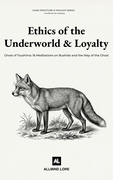
Ethics of the Underworld and Loyalty: Ghost of Tsushima: 16 Meditations on Bushido and the Way of the Ghost
The book version is now available. Read for free with Kindle Unlimited.
Thank you very much for reading to the end. To help support the activities of this archive, a warm donation of a cup of coffee would be highly appreciated.