Vol.01: Creation Myth and The Heavenly Principles
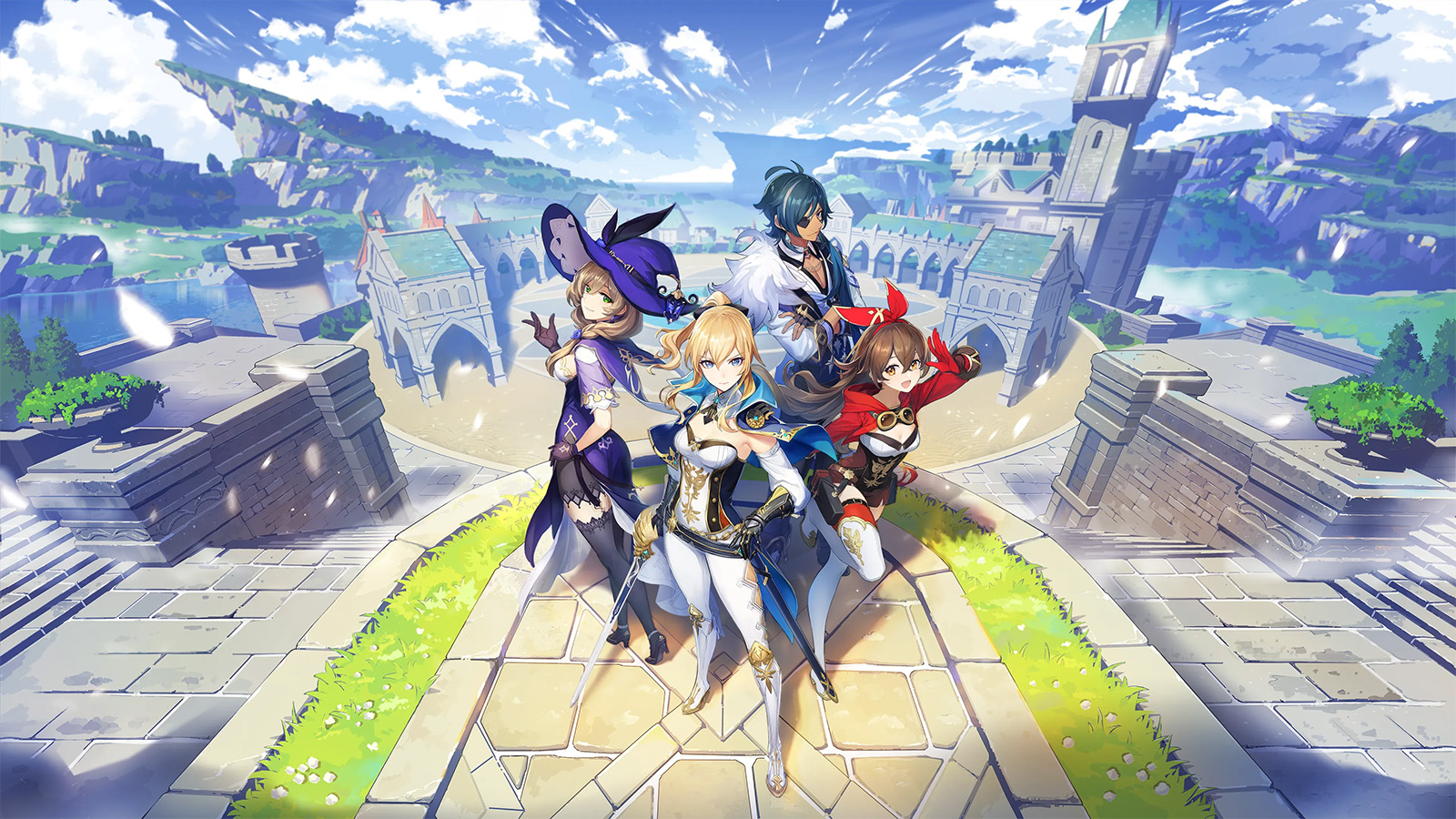 © HOYOVERSE
The history carved into the strata of the Teyvat continent is not a mere accumulation of time, but a “stratum of texts” that has been concealed, altered, and overwritten in multiple layers. Neither the starry sky looked up to by those who possess a Vision, nor the earth spreading beneath their feet, has existed since the beginning. This treatise integrates archaeological historical materials, mythological metaphors, and memories of The Abyss revealed up to the year 2026, to unravel the true structure of the “miniature garden” known as Teyvat. How was this world we live in created? And for whom was the “False Sky” cast? We will approach the truth of the primordial god Phanes, the Descenders who transcend the Laws, and Celestia, the island in the sky that monitors the world, from philosophical and mythological contexts.
1. Hatching of the Cosmic Egg and the Demiurge’s Miniature Garden
The history of Teyvat begins with a single, massive “invasion” and “reconstruction.” The creation myth recorded in the forbidden book “Before Sun and Moon,” sealed deep underground in Enkanomiya, clearly indicates that Teyvat was originally the “Light Realm” ruled by the seven Sovereign Dragons (the Seven Sovereigns) .
1.1 The Descent of The Primordial One (Phanes) and the Isolation of the World
“The Primordial One,” also known as Phanes, who flew in from beyond the Sea of Stars, is the entity that fundamentally remade Teyvat’s ecosystem and Laws, and is the supreme being later called the “First Descender” and “The Heavenly Principles” . Historical materials, including “Before Sun and Moon,” depict Phanes as an androgynous god wearing a crown and possessing wings . Phanes was born from a cosmic egg and used its shell to physically and conceptually isolate the “macrocosm” from the “microcosm of the world” . This eggshell is the very foundation of the “False Sky” covering Teyvat, which will be discussed later .
In Orphism of Greek mythology, Phanes (Protophanes) is the primordial god of light and creation born from a cosmic egg, and is said to possess an androgynous nature . However, from the perspective of Gnosticism, which permeates the worldview of Genshin Impact, Phanes’s role is not that of the supreme true god (Monad), but is equated to the false god who created the material world (Kenoma = Teyvat), namely the “Demiurge” (Yaldabaoth) . In Gnosticism, the Demiurge is an entity that creates an imperfect material world separated from the true universe (Pleroma) and imprisons human souls within it. It can be said that Phanes effectively confined humanity within its own miniature garden under the pretext of protecting Teyvat from external threats.
1.2 Usurpation of the Light Realm and the Creation of the Human Realm
Upon descending to Teyvat, Phanes waged a gruesome 40-year war against the native rulers, the Seven Sovereigns (the Sovereign Dragons) . This war occurred during the era known as “When the Doves Held Branches,” and the victorious Phanes usurped the Authorities of the Sovereign Dragons .
With this victory, Phanes began the fundamental terraforming of Teyvat. Phanes adapted and reconstructed the “Light Realm,” a pure and fierce primordial energy world ruled by the Sovereign Dragons, into the seven-element system that constitutes the current Teyvat, thereby creating the “Human Realm” . In this process, Phanes collaborated with the god Naberius to create many new life forms, including the race of “Angels” as divine messengers to love and guide humanity . Then, approximately 400 years after Phanes’s descent, humanity was finally created, and they formed a Covenant with the primordial god . Historical records refer to the year following the creation of humanity as the “Year of the Ark’s Opening,” and it is said that a blissful era followed where the world brought blessings to humanity .
2. The Four Shades — The Archons Who Maintain the Laws
In the process of usurping the Authorities from the Sovereign Dragons and reconstructing the world, Phanes created the “Four Shades” as its own shining shades . As agents of The Heavenly Principles, they are the highest-ranking divine spirits who manage the concepts of Teyvat’s physical Laws, time, life, and death. In the context of Gnosticism, the lower rulers who serve the Demiurge and maintain the systems and fate of the material world are called “Archons” . The Four Shades fulfill exactly this role as Archons, confining human Free Will within the cage of fate.
Their full picture had long been shrouded in mystery, but through the latest lore from the Natlan and Snezhnaya regions (as of 2026), the names and governed concepts of these Four Shades have been revealed .
| Name of the Shade | Governed Concept and Aliases | Historical and Documentary Background |
|---|---|---|
| Istaroth | Shade of Time | Also known as the “Thousand Winds” and the “Master of Time.” When Enkanomiya sank into The Abyss during the great war of the Funerary Year, while The Heavenly Principles and the other shades remained silent, she was the only one who did not abandon them, granting Aberaku the method to construct the Dainichi Mikoshi . |
| Ronova | Shade of Death | To repair Natlan’s Ley Lines, which were severely damaged after the battle with the Sovereign Dragons, she instructed the Lord of the Night to create the “Night Kingdom.” However, this was deemed an “overstepping of authority” against The Heavenly Principles, and she is said to have fallen into self-pity. Her power is also involved in the Pyro Archon Mavuika’s resurrection ritual . |
| Naberius | Shade of Life | Involved in the early creation of life alongside The Heavenly Principles. Leaves her name on the artifact “Heart of Naberius.” It is theorized that she is deeply connected to the research of the alchemist “Gold” (Rhinedottir) and the fundamental knowledge of homunculus creation . |
| Asmoday | Shade of Space | An entity identified with the “Sustainer of Heavenly Principles.” She is the deity who blocked the path of the twin Travelers at the beginning of the game, deploying red cubes that manipulate space . |
The names of the Four Shades (Istaroth, Ronova, Naberius, Asmoday) all derive from the 72 demons of Solomon recorded in the grimoire “Lemegeton.” This functions as a metaphor that Teyvat’s ruling class are not true gods, but “demonic (demiurgic) entities” imposing false Laws.
3. The Genealogy of Descenders — Wills Transcending Teyvat’s “Laws”
The miniature garden of Teyvat is ruled by a strict Determinism that can never be broken by internal entities (humans, gods, and even The Seven). The “Constellation” drawn in the starry sky is a predetermined algorithm of fate, and the inhabitants of Teyvat cannot escape this trajectory . However, there are visitors from the outside who are not bound by these “heavenly principles” and possess the will to create, maintain, and destroy the world. These are the “Descenders” .
According to the notes left by Rene of the Narzissenkreuz Ordo and the Fatui records grasped by the Sumeru Akademiya, a Descender is not merely a term for an “Outlander from the Sea of Stars” . The condition to become a Descender is to possess a “Will” powerful enough to “protect, maintain, destroy, and create the world” . Only those with this intense will can remain independent from the memory alteration system of Irminsul and maintain their own existence .
| Rank of Descender | True Identity and Appellation | Role and Current Status |
|---|---|---|
| First Descender | The Heavenly Principles / Phanes | The creator of Teyvat and the architect of the current Laws (fate). Currently in a dormant state . |
| Second Descender | Nibelung / Dragon King | The king of the Sovereign Dragons. By leaving Teyvat once and returning with the power of The Abyss, he became an entity external to the system. Deceased in the battle of the Funerary Year . |
| Third Descender | Saarelainen | The Outlander of the Winter Day. Murdered by the Lord of the Seven Calamities (Phanes), and his remains were used as the material for the “Gnosis.” Deceased . |
| Fourth Descender | Traveler | A recorder of the Sea of Stars unbound by Teyvat’s Laws. The protagonist of the story, and the only entity who can freely observe the Loom of Fate . |
The reason The Sibling (Prince/Princess of the Abyss) is not counted as a Descender despite being an outlander is presumed to be because the memories of their journey have already been integrated into Irminsul, having been “demoted” or “assimilated” as part of Teyvat’s fate .
4. The Rebellion of the Dragon King Nibelung and the War of the “Funerary Year”
The entity referred to in official historical records as “The Second Who Came” has long had its true identity debated, but it is now confirmed as a historical fact to be the king of the Sovereign Dragons, “Nibelung” .
Despite being a native creature of Teyvat, after being defeated by the First Descender Phanes, Nibelung attempted to escape outside Teyvat (to the Sea of Stars) leading his surviving brethren . Heeding the warning of the star-crossing voyager Seutervoinen, he touched upon forbidden knowledge to save the world, namely the power of “The Abyss” . By returning with this external power harbored within him, he became an entity outside Teyvat’s Laws and came to be recognized by Irminsul as the “Second Descender” .
The era when Nibelung returned and challenged The Heavenly Principles to a war of vengeance is called the “Funerary Year” . This war was so fierce that it tore heaven and earth apart, and in its aftermath, Enkanomiya collapsed into the underground abyss .
During the war, Nibelung imprisoned the three moon goddesses (discussed later) as traitors and directed the moons themselves as weapons against The Heavenly Principles . Ultimately, Phanes (The Heavenly Principles) completely destroyed Nibelung, successfully preventing the usurpation by the second throne . However, the price of this victory was far too great. The Heavenly Principles itself suffered a fatal, unhealable wound, losing the power to directly govern the world and suppress it with absolute authority . To fill this void of authority, The Heavenly Principles would put a terrifying plan into action.
5. The “False Sky” and the Tragedy of the Moon Goddesses
The fact that the starry sky looking down upon Teyvat is “false” has been mentioned multiple times by the Fatui Harbingers “The Balladeer” (Scaramouche) and “The Doctor” (Il Dottore), shocking players . This “False Sky” is not a mere optical illusion or metaphor, but a massive physical barrier (eggshell) that completely covers the planet Teyvat .
The ostensible reason Phanes constructed the False Sky was to isolate Teyvat from the threat of The Abyss that devours the Sea of Stars, and to protect fragile humanity . However, hidden behind this is the Demiurge’s intention of deterministic domination. The stars in Teyvat’s starry sky are not burning stars in outer space, but luminescent bodies functioning as the fruits of Irminsul, or computational nodes of fate . Human fate is pre-programmed into this false canopy, and as long as the false sky exists, humanity cannot escape from the absolute protection (a cage in all but name) of the gods .
5.1 The Fate of the Three Moon Goddesses (Aria, Sonnet, Canon)
In relation to the False Sky, the existence of the “three moon goddesses” who once illuminated Teyvat’s night sky is extremely important in deciphering the truth of the world. They were sisters left behind by Nibelung to govern the world before he departed for the Sea of Stars .
| Name of the Moon | Name of the Sister | Current Physical State and Observation Records |
|---|---|---|
| Eternal Moon | Aria | Shattered by Phanes during the great war of the Funerary Year. In the Natlan Archon Quest of 2026, when the Pyro Archon Mavuika split the sky, the massive remains of Aria were observed floating in the true outer space beyond the rift . |
| Frost Moon | Sonnet | Banished to the outside of the False Sky, her physical connection had long been severed. However, due to Snezhnaya’s plan (the secret maneuvers of Il Dottore and Columbina), she broke through the false sky and returned to Teyvat’s sky, replacing the conventional false moon . |
| Iridescent Moon | Canon | Completely shattered by Phanes and entirely vanished from the center stage of history . |
In the war between Nibelung and Phanes, the three moon goddesses fought each other and were torn apart. Phanes shattered Aria and Canon, and banished Sonnet (the Frost Moon) to the outside of the physical barrier, the “False Sky” . As a result, the physical and magical connection between the moons and Teyvat was severed.
However, the latest historical observations as of 2026 vividly show that the “eggshell” constructed by Phanes is reaching its limit. Mavuika’s strike in Natlan opened a temporary hole in the canopy, revealing the inverted remains of Aria like a mirror reflection . Even more significant is the event in Snezhnaya. The banished Frost Moon (Sonnet), accompanied by tremendous kinetic energy due to the Fatui’s plan, broke through the false sky and returned to the interior of Teyvat . This event proves that the physical strength of the false sky is deteriorating, and that an irreparable bug has occurred within the system of The Heavenly Principles itself.
6. The Gruesome Sacrifice of the Third Descender and the Creation of the “Gnosis”
The Heavenly Principles (Phanes), having suffered severe injuries in the war of the Funerary Year and lost the authority to suppress the world, was forced to construct a new system. That is the creation of the “Gnosis,” built upon the sacrifice of the Third Descender. In the Fontaine Archon Quest, through the dialogue between The Foul (Skirk) and the Hydro Dragon Neuvillette, the shocking fact that the Gnosis is an artifact made from the “remains of the Third Descender” was brought to light .
6.1 The Tragedy and Dismemberment of Saarelainen
The true identity of the Third Descender and the circumstances of his death had long been the greatest mystery, but the book “Hymns of the Far North” revealed its gruesome mythological truth . His name was Saarelainen. Called the “Outlander of the Winter Day,” he is said to have been a noble and kind-hearted young man who loved frost and winter .
To save the innocent daughter of his ancestor’s servant, Pakkaisukko, he willingly threw himself into an evil plot. As a result, he was murdered in the foggy land of Pohjola by the “Lord of the Seven Calamities” (Pitkamoonen, an alias for Phanes) . Because Saarelainen possessed the extremely high elemental affinity unique to Descenders, The Heavenly Principles dismembered his body into “seven fragments” and sealed the Authorities (elemental authorities) usurped from the Sovereign Dragons into his remains .
The Gnosis is a “symbol of power” granted to the gods of Teyvat, and proof of victory in the Archon War. However, its essence is a device of “curse” for The Heavenly Principles to fix and stabilize Teyvat’s Laws . Through the Gnosis, The Seven are forced to resonate with Celestia, the island in the sky, and are compelled to function as cogs maintaining Teyvat’s order. The reason Skirk called the Gnosis an “object of misfortune” is because it is a horrifying system of exploitation built upon the sacrifice and corpse of an innocent, noble outlander .
6.2 The Chessboard Metaphor and the Paradox of Gnosis
The reason the Gnosis takes the shape of a chess piece suggests that Teyvat’s order itself is a game board designed by the Demiurge . The Seven are merely powerful pieces on the board (King, Queen, Rook, etc.), and the true player is Celestia .
As a deeper philosophical consideration, we must point out the terrifying paradox of this item being crowned with the name “Gnosis.” In real-world Gnosticism, “Gnosis” is a concept of salvation, meaning the “knowledge and recognition of the soul” to see through the fiction of the material world and reach the true god . However, in Teyvat, the “Gnosis” functions conversely as a chain that binds the gods to the Laws of the material world (Teyvat) and forces obedience to The Heavenly Principles. This can be said to be an extremely malicious irony orchestrated by Phanes to imprison the gods and humanity within its own miniature garden .
6.3 Facts and Theories Regarding the Identity of “The One Who Came After”
In Neuvillette’s character profile (Vision story), official texts clearly state that the creation of the Gnosis was not the sole work of The Heavenly Principles (the Usurper), but a joint effort with “the one who came after” . Through this joint effort, a new order (the Archon War) was established where humanity possessed only “seven remembrances” (the ruling system by The Seven), and primordial fragments devoured each other .
What is explicitly stated as fact is only that “the one who came after” laid the foundation of the current system of The Seven as an accomplice to The Heavenly Principles. However, regarding the true identity of this enigmatic entity, two prominent theories are debated within the lore community. We present the facts and theories, distinguishing them logically.
Theory 1: The Second Angel Alynas Theory This is a theory that deciphers the fairy tale of “Nicola Coco” told by Alice (or Nicole) of the Hexenzirkel as a metaphor . In this fairy tale, it is said that the younger sister “Alynas” (the second angel) instigated Nicola Coco (equated to the first angel Koitar) and used her rebellion to usurp the first rank . This is a persuasive theory based on literary evidence, suggesting that when The Heavenly Principles suffered severe injuries in the battle with Nibelung and needed a proxy for governance, Alynas, who had usurped the position, participated in the creation of the Gnosis as “the one who came after” .
Theory 2: The Geo Archon Zhongli (Morax) Theory This is a radical hypothesis suggesting that Zhongli, the oldest god who presides over “Contracts,” is “the one who came after” who formed a contract for the new world with The Heavenly Principles . The grounds for this include the fact that he is the only one who manipulates cubes (a shape close to the symbol of The Heavenly Principles’ power) and his longevity, existing since before the Funerary Year . However, considering that he himself is one of those who were given a chess piece (Gnosis), there are many logical contradictions, and at present, it does not go beyond the realm of a “crack theory” based on circumstantial evidence .
7. Celestia and the True Purpose of the Celestial Nails
“Celestia,” the island in the sky floating inside the False Sky. This is the divine realm where The Heavenly Principles and the Four Shades reside, and it is the panopticon that monitors Teyvat’s Laws.
7.1 Celestial Nails — A Blessing, or Weapons of Ruin?
The weapons symbolizing Celestia’s domination and punishment are the “Celestial Nails” dropped across various regions of Teyvat. So far, their existence has been confirmed in Dragonspine’s Skyfrost Nail, the crystal in The Chasm, Tsurumi Island, Mt. Damavand in Sumeru, and the Night Kingdom in Natlan .
In superficial historical understanding, the Celestial Nails have been believed to be weapons of mass destruction meant to annihilate human civilizations (e.g., Sal Vindagnyr) that touched upon Celestia’s secrets (forbidden knowledge) . However, according to the latest archaeological analysis regarding Ley Lines and The Abyss, the fact has emerged that the primary purpose of the Celestial Nails is not “punishment upon civilization,” but “surgical operations” on space .
When Teyvat’s Ley Lines were polluted by the power of The Abyss brought in by Nibelung or by forbidden knowledge, the Celestial Nails were dropped to purify the corruption and physically anchor (fix) the collapse of space . In fact, the nail in The Chasm possessed the function of purifying the spread of abyssal mud . However, the terraforming energy contained within the Celestial Nails is far too immense and merciless. When a nail is dropped, its enormous energy is released all at once, resulting in a dramatic disruption of the land’s climate and Ley Lines (such as transforming a lush green mountain into a land of freezing death). In this process, the human civilizations that existed beneath them were caught in the crossfire as a “byproduct” and perished . This cruelly demonstrates that for The Heavenly Principles, the Demiurge, the “maintenance of the world’s Laws (system)” takes far greater precedence than the “individual lives” of humanity.
7.2 The Cataclysm and the Silence of The Heavenly Principles
The absolute domination of The Heavenly Principles began to crumble with the destruction of Khaenri’ah 500 years ago, the so-called “The Cataclysm.” When the godless nation touched upon abyssal knowledge and drew out the immense power of The Abyss once left behind by Nibelung, the world was once again on the brink of destruction . At this time, it is recorded that an entity called “The Sinner” maneuvered in secret through the power left by Nibelung (which sometimes takes the form of a ring) .
The Heavenly Principles directly intervened to halt this calamity, casting the “curse of immortality” and the “curse of hilichurlification” upon the people of Khaenri’ah . However, by exerting excessive power while still bearing the old wounds from the Funerary Year, The Heavenly Principles (Phanes) finally reached its limit and fell into a deep sleep (Dormant state). As of 2026, the reason the Fatui and the Abyss Order are raising the banners of rebellion on a global scale and going around seizing the Gnoses is none other than taking advantage of this once-in-a-lifetime opening: the “dormancy” of the monitor, The Heavenly Principles .
Conclusion: Teyvat as an Alchemical Crucible and Its Terminus
To summarize, Teyvat is a massive miniature garden constructed upon the ruins of the Light Realm by the Demiurge, “The Primordial One” (Phanes), covered by false Laws (Gnosis) and a False Sky (canopy).
The historical process of this world perfectly overlaps with the process of the Magnum Opus in alchemy . The pollution and destruction of the world by The Abyss is the “blackening” (Nigredo), and the forceful purification and fixation of the Laws by the Celestial Nails and the Four Shades is the “whitening” (Albedo). And currently, it can be concluded that what The Tsaritsa and the Fatui aim for through the “burning of the old world” is the ultimate “reddening” (Rubedo): reintegrating the Gnoses (the remains of the Third Descender), burning away the false canopy, and reaching the true universe .
Within the Loom of Fate woven by Determinism, many inhabitants of Teyvat live without even knowing that they are “birds in a cage” isolated from the Sea of Stars. However, now that Mavuika’s fist has split the starry sky, the Frost Moon has returned, and The Heavenly Principles remains silent, the world is facing its greatest turning point in thousands of years of history.
The journey of the Fourth Descender (Traveler), who continues to observe the past and present unbound by Teyvat’s Laws, will engrave the truth known as an “independent record” into this false world, and will eventually become the ultimate existential struggle to break the shell of the cosmic egg from the inside. To destroy the “principles” laid down by the false god and reclaim the true starry sky. That is the only path to break free from the curse of the creation myth and reach the terminus of causality imposed upon Teyvat.
Mythology of Illusion and Journey: Genshin Impact: 20 Meditations on the Lies and Truths of Teyvat
The book version is now available. Read for free with Kindle Unlimited.
Thank you very much for reading to the end. To help support the activities of this archive, a warm donation of a cup of coffee would be highly appreciated.