File.10: Mr. Door (Warlin Door)
Introduction: The Master of the Boundary Between Fog and Neon
Bright Falls, Washington, located in the Pacific Northwest. The silence of this rural town, shrouded in dense coniferous forests and fog, contrasts with the “Dark Place,” a cold, absurd, neon-flickering imitation of New York. Standing at the boundary of these two conflicting realities, straddling both—and perhaps many more dimensions—is a certain entity. That entity is Warlin Door, also known as “Mr. Door.”
This report aims to unravel the full picture of Warlin Door, one of the most important and enigmatic entities in the Remedy Connected Universe (RCU), by synthesizing classified files from the Federal Bureau of Control (FBC), lost manuscripts, and multidimensional clairvoyant visions (echoes). He is not merely a character in a story. He is a walker in the abyss of the “Collective Unconscious” proposed by Carl Jung, and a surreal, metaphysical “guide” and “observer” reminiscent of the “inhabitants of the Red Room” in David Lynch’s cinematic world.
While the creator, the writer Alan Wake, is trapped in his own story and struggles within a self-referential “Metafiction nightmare,” Door coldly oversees the situation from outside the narrative, or perhaps omnipresently across every page of the story simultaneously. Understanding him is nothing less than unraveling the philosophical judgment upon the “causality of reality alteration” and the “ethical sin” of rewriting another’s story in this work.
1. The 1988 Lightning Strike Incident and the Causality of Bloodlines
Regarding the origins of Warlin Door, the most concrete physical trace currently remaining in the records of the FBC and local police is a supernatural disappearance that occurred in Bright Falls in 1988. This incident was not a mere missing persons case, but a contract of blood and sacrifice forged between the incarnate beings of Norse mythology and a dimension-crosser.
In 1988, on a cliff overlooking the dark waters of Cauldron Lake, a paranormal confrontation occurred between Thomas (Tor) Anderson and Odin Anderson, members of the rock band “Old Gods of Asgard” bearing the names of gods, and a mysterious “dark shadowy man.” This event was later written down in Alan Wake’s manuscript “Return 7: Odin Loses an Eye” and solidified as reality. According to the manuscript, amidst roaring thunder, Tor demanded of the man, “Help us, and stay away from our family.” The man replied, “Yeah, until you all come to me,” and snatched Odin’s right eye as “collateral” for the contract. Immediately after, the man was struck by lightning and vanished into the rift between dimensions with a flash of light. At this time, bleeding, Odin cursed, “That bastard took the wrong eye.”
This scene, full of Norse mythological metaphors, is highly symbolic. In mythology, Odin sacrificed his own eye as the price for gaining wisdom at Mímir’s well. However, in this 1988 incident, it was not the well of wisdom that took the eye, but Door, who lives in the rift between dimensions. It is presumed that Odin calling it the “wrong eye” signifies the intervention of an irregular entity like Door against mythological fatalism (a predestined sacrifice). This missing man was none other than Warlin Door, a resident of Bright Falls. When Sheriff Tim Breaker’s sketch, drawn from dream memories, was cross-referenced with the 1988 cold case files by his predecessor, Sheriff Sarah Breaker, it confirmed that Warlin Door, a resident of the physical world, and Mr. Door of the “Dark Place” are the same person.
Behind Door casting himself into the darkness of Cauldron Lake, even transforming himself into “one who stands in between,” lies a deep causality of bloodline with the Anderson family. The fact that he had a deep relationship with Freya Anderson, Tor Anderson’s daughter, and is the biological father of FBI Special Agent Saga Anderson is corroborated by multiple pieces of circumstantial evidence and manuscripts. Saga Anderson is estimated to have been born around 1988, which perfectly coincides with the time of Door’s disappearance. Furthermore, when Saga asked her grandfather Tor about her father in her mental sanctuary, the “Mind Place,” Tor avoided answering by using an intentional metaphor: “Some doors are best left closed.” Tor continued emphatically, “Your old man was a complicated guy, always thinking several steps ahead,” and “There was trouble, and he vanished.”
In the FBC’s classification, the aptitude of a “Parautilitarian” is considered to have strong genetic factors. It can be concluded that Saga’s power as a “Seer” and her ability to construct the mental sanctuary “Mind Place” and interfere with the minds of others manifested as a result of the intersection between the Anderson family bloodline (the power of madness and prophecy linked to Norse mythology) and the bloodline of “Door (the family of doors)” that oversees dimensions. It is strongly suggested that the true meaning of the “collateral” Door exchanged with Tor and the others in 1988 was a self-sacrificing deal to keep his beloved Freya and his young daughter Saga away from the “Dark Presence” lurking in the lake.
2. Oceanview and the Proof of “Multidimensional Omnipresence”
Inevitable in understanding the entity known as Door is the fact that he is not a character confined to a single world (Alan Wake’s narrative world), but a conceptual singularity that exists simultaneously across countless parallel universes (the multiverse). This nature resonates deeply with the supernatural phenomena handled by the FBC and events occurring in other dimensions.
The FBC’s documented records contain testimony about a vision seen by Dylan Faden (the younger brother of current FBC Director Jesse Faden) when he was corrupted by The Hiss. Dylan stated that he met a “dark man named Mr. Door” in a “Dark Place.” In Dylan’s dream, Door spoke of a multiverse theory, saying that “countless worlds are side-by-side, on top of each other, and some inside of others,” and revealed that he himself “exists in all of them at the same time, constantly shifting.” Dylan asked for his cooperation to spread the destructive resonance known as The Hiss across multiple dimensions, but Door flatly rejected it, saying he “didn’t like the idea.” This testimony indicates that Door is a kind of “dimensional immune system” or neutral administrator who despises chaotic destruction and the selfish disruption of dimensional boundaries.
Furthermore, in the anomalous space observed by the FBC, the “Oceanview Motel,” there is a row of doors with symbols connecting to various dimensions and powers. Alongside the inverted pyramid (The Board) and the Spiral (Alan Wake’s Dark Place), a specific symbol (two intersecting shapes) is presumed to lead to Door, indicating that he is a conceptual entity governing the “Threshold” itself. He belongs to the “Family of Doors,” and the ability to cross boundaries may not be his personal mutation, but a bloodline trait woven into the fabric of the universe.
Here, we must present the most compelling theory derived from circumstantial evidence. It is the theory that Warlin Door is a multidimensional variant of “Martin Hatch” in another dimension (another temporal singularity), or another aspect of the same concept. Beyond meta-level rights issues (corporate circumstances), enumerating the commonalities between the two from a narratological perspective is an essential task for peering into the abyss of the RCU.
| Conceptual Characteristic | Martin Hatch (Alternate Dimension) | Warlin Door (Primary Dimension) |
|---|---|---|
| Definition of Existence | A “Shifter” who discovered a fracture in time and exists in all times simultaneously. | An entity that exists in all dimensions simultaneously and is constantly shifting. |
| Name Similarity | Martin Hatch (Hatch = a door in a floor or wall) | Warlin Door (Door) *Inverting the ‘W’ in “Warlin” and removing the crossbar of ‘l’ makes it closely resemble “Martin”. |
| Conceptual Declaration | ”I stand in between” | Show title “In Between With Mr. Door” |
| Intervention with Others | Discovers Jack Joyce as his successor (disciple). | Guides Tim Breaker as an “unwilling disciple.” |
| Soul of the Actor | Played by Lance Reddick. | Originally intended to be played by Lance Reddick (David Harewood inherited the will due to his untimely passing). |
On the whiteboard left by Sheriff Tim Breaker in the Dark Place, synonyms such as “Door, Gate, Portal, Port, Opening, Access, Window” were listed with abnormal obsession. This is equivalent to a state of semantic satiation (Gestaltzerfall), where human reason places a burden on the mind in an attempt to comprehend a “single concept omnipresent across multiple dimensions.” Interpreting Door and Hatch as a “single conceptual entity projected differently by dimensional walls” is the correct epistemology within this RCU.
3. The Symbolic Realm of the Talk Show — Jungian Psychology and Lynchian Darkness
After vanishing from the physical world due to the lightning strike in 1988, Door arrived at the conceptual space known as the “Dark Place.” It is a world where physical laws collapse, and the minds and fears of its inhabitants shape reality. When Alan Wake constructed a noir nightmare of New York through his writing (the manuscript “Initiation”), Door manifested in that world as a “late-night talk show host.”
The structure of Door appearing before Alan as the host of the talk show “In Between With Mr. Door” is extremely similar to the surrealistic approach seen in David Lynch’s works (especially “Twin Peaks”). Just as the “Red Room” in Lynch’s works is a waiting room deep within the subconscious where good and evil, life and death intersect, Door’s studio is also a “Threshold” where countless dimensions intersect. The space, where neon signs flicker and a jazz band (musicians played by the Old Gods of Asgard) plays music, functions as an extremely eerie safe zone that conceals unfathomable cosmic horror within the framework of artificial entertainment.
From the perspective of Carl Jung’s analytical psychology, this role of a talk show host is a “Persona (social mask)” intentionally worn by Door. To escape his own guilt, madness, and his “Shadow (unconsciously repressed destructive urges)” known as “Scratch,” Alan Wake unconsciously craved a space where logical dialogue was possible. Door exploits Alan’s craving, translating and presenting his entire being (an unknowable entity omnipresent across multiple dimensions) into the approachable Persona of a “TV show host.”
For Alan, the talk show was a ritual to hold onto his sanity, but for Door, it is merely a stage for observation, sneering at Alan’s assumption of the “rules of writing.” On the show, Door behaves extremely amicably and appears to be assisting Alan’s escape, but beneath that, the ruthlessness of a ruler with absolute power can be glimpsed. He is a representative of the audience consuming Alan’s suffering as “entertainment,” while simultaneously playing the role of a “breakwater” to prevent Alan’s mind from completely collapsing in order to fulfill his own objectives.
4. The Collapse of Metafiction — The Reversal Phenomenon of Narrator and Character
The central philosophical theme of the narrative surrounding Door is a powerful antithesis to the “ethical sin of Metafiction in postmodern literature.”
Alan Wake forcibly drags real people into his story (a horror novel) in order to rewrite the darkness and escape from reality. Bound by his self-imposed literary rule (Archetypes of Horror) that “the horror genre requires victims,” he turns innocent people into monsters (Taken) and makes them suffer. This is nothing less than the gravest “ethical sin” committed by a creator: depriving others of their lives and freedom of choice, and consuming them for one’s own survival and purposes.
Towards the end of the story, Door finally sheds the “Persona” of the amiable talk show host, baring his anger and threats toward Alan. The words uttered from Door’s mouth were a scathing impeachment of the structure of Metafiction.
“Your endless, convoluted Loop you insist on. Do you know how lucky you are? […] There’s an army of people out there helping you. Your wife. But she’s in danger because of you. And someone important to me as well. Because you brought them into this story. You keep opening doors, peeking in, reaching out to get what you want.”
The “someone important to me” Door mentions refers to his daughter, Saga Anderson. Door, the observer of dimensions, feels intense anger that Alan arbitrarily cast Saga as the “hero” of the story, dragging her into the horrors of the Dark Place.
Even more decisive is the reversal phenomenon of the power structure between narrator and character, recorded in the manuscript “Door Traverses The Dark Place.” In Alan Wake’s world, normally, “reality is altered exactly as the writer writes it.” However, Door transcends that absolute law. The manuscript in question records an astonishing fact that shatters the framework of Metafiction from its foundation.
“Warlin sensed his steps were being observed (being watched by Alan). Recorded in the story. He allowed it. This one time. For this one reason. To be delivered by his unwilling disciple, to be read at the right time.”
What this description means is not that Alan wrote Door’s actions with his own creative power, but merely that “Door ‘allowed’ Alan to record information to help his daughter (Saga).” In a narrative world where the author (narrator) is supposed to be an absolute god, a character (Door) oversees the author and conveniently uses the author’s pen. Alan firmly believed that “he was controlling the story,” but in reality, he had been reduced to a mere clerk forced to write an “instruction manual” for rescuing the daughter, dancing in the palm of a higher entity known as Door.
5. The “Unwilling Disciple” and Branching Realities
In Door’s plan, an extremely important role was assigned to Bright Falls Sheriff Tim Breaker. His existence is the greatest key to deciphering Door’s multidimensional behavioral principles.
Early in the story, the moment Sheriff Tim tries to hand Saga an important manuscript page (the very page of “Door Traverses The Dark Place”) in the morgue, he is suddenly swallowed by a dimensional rift and spirited away to the “Dark Place.” At first glance, this appears to be a hostile abduction by Door. However, unraveling the causality reveals a completely different truth. Door took Tim away in order to completely control the “timing” of when Saga would read the manuscript.
If Saga had received the page at that point in the morgue, it would have meant nothing to her, as she did not yet understand the structure of the Dark Place. The page needed to be kept safe until the very moment Saga, utilizing her “Mind Place” to approach the truth, was finally cast into the “Dark Place” by Scratch. Tim was chosen as the perfect messenger to hand it over at the “right time and place” when Saga needed the page the most—that is, as the “unwilling disciple” described in the manuscript.
Furthermore, Tim Breaker is also in the midst of a Metafiction-like resonance phenomenon, just like Door. He is played by Shawn Ashmore (who played Jack Joyce, the protagonist of the alternate dimension story “Quantum Break”). “Tim Breaker” is a mutation of “Time Breaker,” and it overlaps terrifyingly with the conclusion where Jack Joyce manipulated time and ultimately had no choice but to walk the path as Martin Hatch’s “disciple.”
In the episode “Time Breaker” of the DLC “Night Springs,” this multidimensional hunt is depicted starkly. Door (Master of many worlds) hunts variants of Tim (Actor, Branch, etc.) across the multiverse, and in a retro arcade game space in one dimension, he tempts Tim, saying, “You are the chosen one, join me and we will rule the world.” This is a complete reenactment of the deal Martin Hatch offered to Jack Joyce.
However, there is a trap in this portrayal of Door as an “evil multidimensional ruler” in this DLC. In the final dimension, it is revealed that the story of “Time Breaker” itself is a script written by Alan Wake (an episode of Night Springs). In other words, the madness of Door depicted in this DLC is not Door’s actual behavior, but merely a “Shadow of Door” born from Alan Wake’s fear and imagination. It is presumed that the real Door tolerates Alan’s childish script depicting him as a villain as a “nice distraction,” while placing Tim, an “entity with the aptitude to cross dimensions,” under his own protection, nurturing him in preparation for an upcoming multidimensional transformation.
6. Judgment on Institutional Madness — The Federal Bureau of Control (FBC) and Threshold Experiments
Door’s secret maneuvers and raison d’être are not limited to rescuing Saga or intervening in Alan’s personal story. His multidimensional influence casts a deep shadow over the activities of the FBC (Federal Bureau of Control), a US government agency, and the institutional arrogance they harbor.
In the DLC “The Lake House,” at the FBC facility at Cauldron Lake investigated by Agent Kiran Estevez, an abnormal experiment (Threshold Linking Experiment) conducted by Dr. Jules Marmont and Dr. Diana Marmont triggered a catastrophe (AWE: Altered World Event) where the entire facility was swallowed by paintings and monsters from the Dark Place. The FBC maintained secrecy even by encrypting specific numbers like “180738” and “1988” into computer passwords, attempting to control and weaponize “dimensional Thresholds” through scientific approaches.
This madness of the FBC (Dr. Marmont and others) shares the exact same root as Alan Wake’s egoism of “trying to control reality using stories.” They attempted to twist naturally occurring dimensional rifts with the power of human science and bureaucracy. As can be seen from Door rejecting Dylan Faden’s proposal to “spread The Hiss across multiple dimensions,” Door fiercely despises chaotic destruction and the selfish disruption of dimensional boundaries.
The FBC’s arrogant experiments and Alan’s egoistic “convoluted Loop” are, from Door’s perspective, nothing more than unpleasant noise disrupting multidimensional harmony. While those belonging to the “Family of Doors” cross dimensions naturally, human institutional approaches inevitably bring ruin. Door coldly observes these “abusers of reality alteration,” and by occasionally making minimal interventions according to his own rules (vanishing via lightning strike, abducting Tim, allowing the writing of the manuscript), he prevents the multidimensional structure from facing a fatal collapse. He is not a god, but rather the cold system itself functioning as the universe’s immune system.
Conclusion: Illuminate the Light and Oversee the Framework of the Story
The entity known as Warlin Door is the ultimate “antithesis” in the RCU (Remedy Connected Universe) and a ruthless mirror reflecting self-deception.
Alan Wake feared facing his own dark side (Scratch) and could only interpret the world by forcing his battle with reality into the genre of “horror.” Alan unconsciously continued to commit the “ethical sin” of depriving humans of their free will and consuming them as cogs in his story. On the other hand, the FBC attempted to dominate dimensions through a madness called scientific rationalism, and destroyed themselves.
In contrast, Door, as one who stands on the “boundary,” oversees all phenomena. While he possesses a deeply human and passionate motive to save his beloved daughter (Saga), the means to achieve it are extremely cold and based on cosmic-scale calculations. Rather than emotionally scribbling stories like Alan, he corrects the world by “observing, allowing, and having his unwilling disciple cast the smallest stone at the appropriate timing.”
“Do you even know who is under the mask?”
This single remark, delivered by Door in the final phase of the talk show, is a decisive pointing out of “self-deception” in Jungian psychology. Alan is terrified of the “Shadow” called Scratch that he wrote, covering himself with the “Persona” of a tragic genius writer, but Door sees right through that comical one-man show.
To complete the story, creators (writers and researchers) must discard their egos and face the true reality outside the narrative. Mr. Door continues to watch from the rift between dimensions those immature minds who can only fight reality by writing nightmares (horror). As the RCU draws a new “Spiral” in the future, Door will be omnipresent across all layers. He is neither god nor devil. He is merely a “door.” And as a cold scale measuring the ethics and mental maturity of those who attempt to open that door, he waits with a smile in a dark studio where neon lights flicker.
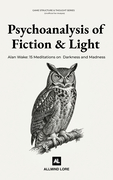
Psychoanalysis of Fiction and Light: Alan Wake: 15 Meditations on Darkness and Madness
The book version is now available. Read for free with Kindle Unlimited.
Thank you very much for reading to the end. To help support the activities of this archive, a warm donation of a cup of coffee would be highly appreciated.