File.01: The Absolute Laws of Cauldron Lake and the Dark Place
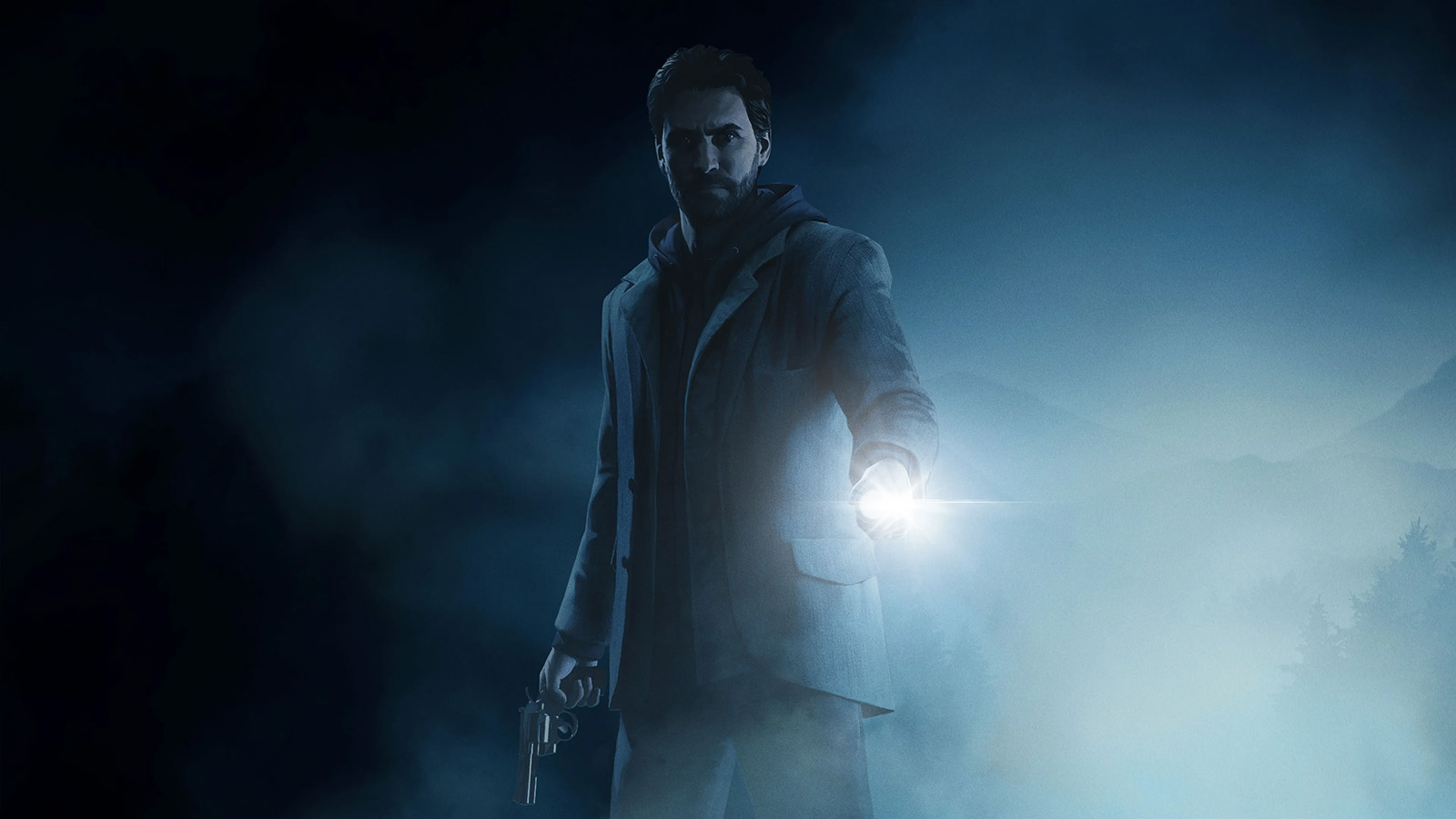 © Remedy Entertainment Plc
Bright Falls, Washington, a foggy rural town in the American Pacific Northwest. Enveloped by dense evergreen forests and crisp, cold air, this place superficially maintains an idyllic yet bizarre tranquility akin to David Lynch’s Twin Peaks. However, at the bottom of the massive caldera lake, Cauldron Lake, located at its center, gapes an event horizon where humanity’s Collective Unconscious erodes the laws of physics. In this land, the boundary between reality and fiction ambiguously melts away, and the creative energy of art possesses the power to literally rewrite the world.
This article is a comprehensive analysis that exhaustively integrates the classified files of the Federal Bureau of Control (FBC), scattered manuscripts, paranormal echoes (apparitions), and records of related facilities to unravel the structure of the geographical singularity that is Cauldron Lake and the Dark Place expanding in its abyss. It describes the full scope of this paranormal phenomenon from the perspectives of the “causality of reality alteration” behind the events, the accompanying “psychological conflict,” and the ethical sins of Metafiction in postmodern literature.
1. The Geopolitics and History of Cauldron Lake as a Geographical Singularity
1.1 [Fact] The Geological Cover-up of the Caldera Lake and the 1970 Altered World Event (AWE)
Cauldron Lake is a volcanic caldera lake located in the mountains near Bright Falls. Considered the eighth deepest lake in the world (with Crater Lake in Oregon serving as its real-world geographical and geological model), its surface bears an eerie green tint, but diving just a little deeper envelops one in complete, pitch-black darkness. Long feared by local Native American tribes as a “gateway to the underworld,” it also retains the folklore of the “Witch of Cauldron Lake,” derived from the nearby Mortar Falls.
On July 10, 1970, a devastating “volcanic earthquake” occurred with its epicenter at this lake. This earthquake caused the surrounding deep mine tunnels to collapse and flood, claiming 32 lives and bringing a complete end to the mining industry, which had been the core industry of Bright Falls. However, according to the classified files of the FBC, this earthquake was not a natural disaster. It was a massive Altered World Event (AWE) triggered by the poet Thomas Zane, and the geological explanation of volcanic activity is merely an unofficial cover story disseminated by the FBC to conceal the paranormal truth from the general public.
In 2010, a second massive AWE occurred when the writer Alan Wake visited this area. Taking the situation seriously, the FBC indefinitely sealed off the area around the lake under the pretext of “toxic volcanic gas emissions,” establishing monitoring stations and the Lake House (Research Facility WA-03) to set up a surveillance system for paranormal events.
| Year | Event Name | Ostensible Cause (Cover Story) | True Cause (FBC Classified Information) | Scale of Damage and Results |
|---|---|---|---|---|
| 1970 | Bright Falls AWE (First) | Mine collapse due to a volcanic earthquake | Sealing of the Dark Presence and the disappearance of the island (Diver’s Isle) by Thomas Zane | 32 dead. End of the mining industry. Zane and the Dark Presence confined to the Dark Place. |
| 2010 | Bright Falls AWE (Second) | Emission of toxic volcanic gas | Reality alteration through the writing of Alan Wake and the invasion of the Dark Presence | Complete lockdown around Cauldron Lake. Establishment of a surveillance system and the Lake House by the FBC. |
1.2 [Analysis] The Liquefaction of the Collective Unconscious and the Metaphor of “Water”
Cauldron Lake is not merely a body of water. In Carl Jung’s depth psychology, “water” and “deep lakes” are symbols of the unconscious. The black water of Cauldron Lake is presumed to be the very liquefaction of humanity’s Collective Unconscious, leaking into physical space.
Strong evidence supporting this hypothesis is the behavior of the Anderson brothers, the heavy metal band formerly known as the Old Gods of Asgard. They brew an extremely potent Moonshine using unfiltered water from Cauldron Lake as the main ingredient. Those who drink this Moonshine are protected from memory rewrites caused by reality alteration and become able to “see” the forgotten truth. Ingesting the lake water, an extract of the unconscious, functions as a shamanistic ritual that artificially removes the boundaries of the ego, allowing direct access to the abyss of the unconscious. The lake water is a catalyst that dissolves the superficial Persona of reality, revealing the truth (or madness) at the root of events.
2. The Physics and Absolute Laws of the Dark Place
2.1 [Fact] Subjective Reality and Fluid Structure
Cauldron Lake is not just a lake; it is a paranormal Threshold connecting to another dimension, the Dark Place. According to FBC investigations and the descriptions in the manuscripts left by Alan Wake himself, this realm operates on metaphysical laws entirely different from the physical laws of the real world.
The Dark Place lacks a fixed physical space; it is a dimension of “conceptual and subjective fluid” that constantly transforms in response to thoughts, emotions, memories, and imagination. If the normal world is a small “island” floating in the vast ocean of the universe, the Dark Place can be likened to the infinite “dark ocean” surrounding that island. Within this realm, floating words physically exist in the air, and by interacting with them, the objects or situations those words represent materialize.
2.2 [Analysis] Noir York and the Projection of the Mind
The Dark Place where Alan Wake is trapped takes the form of “Noir York,” a city where cold, absurd neon lights shine and rain falls incessantly. This city is not the real New York. It is a highly subjective labyrinth of nightmares constructed as a result of projecting the setting of the hardboiled novel series Alex Casey written by Alan himself, along with fragmented memories of the past television show Address Unknown, using his psychological conflicts as a catalyst.
The Dark Place reflects the inner world of the humans existing within it like a mirror. For Alan, New York was a symbol of success, immense pressure, and the solitary struggle of writing. The back alleys, with their flickering neon lights and the scent of blood, are the manifestation of his own subconscious guilt and anxiety (Shadow) taking the form of a city.
2.3 [Fact] The Laws of Drama and the Price
The most important and absolute rule in the Dark Place is the Laws of Drama. In this dimension, human “artistic creation (writing, painting, music, film)” possesses the power to rewrite physical reality, but it is not an unlimited, omnipotent power.
To alter reality, strict “narrative consistency” and “poetic balance” must be maintained. A “deus ex machina” that unconditionally produces a happy ending out of nowhere is not permitted; for a story to take root as reality, the characters’ hardships, logical causality, and developments consistent with the genre (in the case of horror, fear and sacrifice) are essential. To obtain light (salvation), one must always pay an equivalent amount of darkness (a price).
2.4 [Analysis] The Ethical Sins of Metafiction
The Laws of Drama serve as a metaphor illustrating the ethical limits of Metafiction (a structure where the narrative erodes reality) in postmodern literature. The act of treating real people and events as characters in a story and rewriting them for one’s own convenience is an “absolute sin” that strips away the free will of others’ lives and choices. The universe (or the Dark Place) demands a severe price from the author themselves to correct that ethical distortion.
The fact that Alan Wake confined himself in the Dark Place to free his wife, Alice Wake, is not mere self-sacrifice. It was a logical and dramatic settlement to satisfy the “balance” required for the ending of a horror novel. An author is not allowed to toy with the fates of others from a safe place; reality cannot be overwritten unless they too bleed as a cog in the story.
3. Ontological Horror: The Shadow and the Dark Presence
3.1 [Fact] The FBC Designation “The Shadow” and the Taken
Lurking in the abyss of the Dark Place is an evil, hostile entity officially designated by the FBC as “The Shadow (Paranormal Entity A-010).” This entity does not possess the ability to interfere with the physical world or create stories on its own. Therefore, to invade the real world, it has schemed to deceive and exploit imaginative artists (such as Zane and Wake), attempting to have them “write” it into the story of reality.
The Dark Presence possesses the dark parts of the human mind, transforming them into the Taken (FBC Designation: Shaded Individuals). Those possessed lose their ego, becoming violent beings that merely repeat fragments of words they spoke in life or phrases from Alan’s manuscripts meaninglessly. The psychologist Emil Hartman, once Zane’s assistant, was also consumed by this Dark Presence, and by further mingling with the resonance of The Hiss that attacked the FBC headquarters, he mutated into an unspeakably hideous monster (Shaded Hartman).
3.2 [Analysis] The Manifestation of the Repressed Self in Jungian Psychology
The fact that the FBC deliberately adopted the highly psychological designation “Shadow” rather than the abstract name “Dark Presence” strikes at the essence of this phenomenon.
In Carl Jung’s analytical psychology, the “Shadow” is the totality of the unacceptable aspects of the self, violence, fear, and inferiority complexes that humans have repressed deep into the unconscious in order to live socially (to maintain their Persona). The Dark Presence is highly likely not an alien or demon from outer space, but rather the psychological voids, regrets, and self-destructive impulses of Alan Wake and Thomas Zane themselves, which have “manifested as an independent entity” through the paranormal power of Cauldron Lake—their own Shadow.
The existence of Alan’s evil doppelgänger, Mr. Scratch, further reinforces this theory. Scratch is the embodiment of Alan’s violence and sadism. The Dark Place is not a battlefield against the outside world, but a psychological arena for facing one’s inner abyss and achieving integration with the repressed self. When we gaze into the abyss, the abyss also gazes back at us, taking the form of our own darkest Shadow.
4. The Lake House and the Federal Bureau of Control’s (FBC) Parafiction Research
4.1 [Fact] Corporate Madness and Two Experimental Projects
To scientifically control and elucidate how art rewrites reality, the FBC established the Lake House (Research Facility WA-03) on the shores of Cauldron Lake in Bright Falls. Under the direction of the married lead researchers, Dr. Jules Marmont and Dr. Diana Marmont, large-scale experiments were conducted using two contrasting approaches.
-
Project Arbutus: Led by Diana Marmont. An attempt to induce reality alteration through a mechanical and quantitative process by imitating Alan Wake’s writing style using an Automatic Typing Device (ATD) and algorithms.
-
Project Rhamnus: Led by Jules Marmont. An attempt to control the Threshold of Cauldron Lake through the paintings of Rudolf Lane, a painter and former patient of Emil Hartman, by confining and medicating him in the facility.
As a result, the mechanical approach of Arbutus yielded no success whatsoever. On the other hand, Project Rhamnus achieved “success” in the worst possible way. Rudolf Lane, whose mind was completely shattered by years of inhumane experiments, confinement, and abuse through medication, painted a despair- and hatred-filled “The Painting” using his own blood, and then committed suicide. This painting, imbued with extreme negative emotions, opened a direct Threshold to the Dark Place within the Lake House, devastating the entire facility. Furthermore, the fragments of the painting spawned unknown hostile entities called The Painted, which nullified bullets and light, brutally murdering numerous FBC staff, including the Marmonts.
4.2 [Analysis] “Raw Negative Emotion” as a Catalyst for Art
The FBC’s fatal failure lay in misjudging the essence of art and reality alteration. As Project Arbutus proved, grammatical imitation by soulless algorithms or AI does not change the world one bit. To trigger a massive paranormal phenomenon capable of twisting the paradigm of reality, “raw negative emotions” such as deep human trauma, despair, and hatred are indispensable.
The fact that Rudolf Lane’s bloodstained The Painting opened a Threshold indicates that the Dark Place resonates extremely strongly with human “Shadow” (dark emotions repressed in the unconscious). The very attempt by a bureaucratic and cold-hearted organization like the FBC to industrialize and manage the highly subjective and emotional process of art was an act of immense arrogance. The fate of Diana, who plotted the “safe generation of stories” by machines, and Jules, who abused an artist as an “output device,” can be said to be the most gruesome example of the “rebellion of the unconscious” in Jungian psychology.
4.3 [Fact] The Nursery Rhymes Experiments and Localized Reality Alteration
In parallel with the tragedy at the Lake House, the FBC’s Parafiction Research Department (led by Dr. Eugene Campbell) had set up numerous field testing sites using “Nursery Rhymes” across various locations in Bright Falls and Watery. This was an experiment to observe what kind of paranormal changes a ritual using simple children’s rhymes (fiction), symbolic chalk drawings, and carved wooden dolls would bring to the real environment.
Every time FBI Agent Saga Anderson solved these puzzles (by placing the dolls in the correct positions), localized reality alterations were confirmed, such as the surrounding environment instantly changing, new evidence or charms appearing, or hostile Taken being summoned.
Dr. Campbell monitored Saga’s actions via radio from the Witchfinder’s Station, but when Saga solved the final puzzle, making a fatal interference with the causality of the story, a dimensional door opened, resulting in Dr. Campbell himself being dragged into the Dark Place (or caught up in a paranormal phenomenon).
| FBC Experimental Project | Leader | Medium and Subject Used | Nature of Approach | Experiment Results and Damage |
|---|---|---|---|---|
| Project Arbutus | Dr. Diana Marmont | Novel (Automatic Typing Device) | Mechanical and algorithmic generation | Failure. No reality alteration occurred due to a lack of emotion. |
| Project Rhamnus | Dr. Jules Marmont | Painting (Rudolf Lane) | Psychological repression and inhumane abuse | Success (catastrophic). Intense hatred opened a Threshold, destroying the facility. Numerous casualties. |
| Nursery Rhymes Experiment | Dr. Eugene Campbell | Poetry (Nursery rhymes and dolls) | Symbolic placement in the environment and rituals | Localized reality alteration confirmed. Ultimately became uncontrollable, leading to Dr. Campbell’s disappearance. |
4.4 [Analysis] Sympathetic Magic and the Limits of a “Story Without Sacrifice”
The Nursery Rhymes experiment is a paranormal application of “Sympathetic Magic” in cultural anthropology. The attempt to manipulate real people and events by moving dolls (symbols) is akin to Voodoo sorcery. However, here too, the Laws of Drama stand in the way. Dr. Campbell tried to avoid the price of the story by treating Saga as a lab rat while secluding himself in a safe observation post (Witchfinder’s Station). As a result, the universe did not permit this imbalance and claimed Campbell himself, the architect of the experiment, as a sacrifice. Those who drive a story cannot remain bystanders.
5. The Collapse of the Threshold and the Nonlinearity of Time: The Twilight of the Federal Bureau of Control
5.1 [Fact] The Encounter Between Kiran Estevez and Dylan Faden
Amidst the tragedy at the Lake House, FBC Special Agent Kiran Estevez, who breached the facility, encounters an unexpected spatial distortion while exploring the interior where the Dark Place and reality intersect. Through the ritualistic act of pulling the “Lightswitch Cord,” she is temporarily transported to the Oceanview Motel. Then, passing through a specific door there (a door engraved with the symbol of Control 2), she steps into the Panopticon (containment facility) within the FBC headquarters, the Oldest House, far away in New York.
There, Estevez exchanges brief words with Dylan Faden (the younger brother of current FBC Director Jesse Faden, and a powerful Parautilitarian corrupted by The Hiss), who is contained in a highly secure glass cell.
5.2 [Analysis] Time Dilation and Visions of a Parallel Future
This encounter is not a mere spatial intersection (teleportation). It is extremely crucial evidence demonstrating the “nonlinearity of time” inherent in the Dark Place. In the real timeline, the FBC headquarters should have been under complete lockdown for an extended period due to the invasion of The Hiss, and external agents like Estevez were dealing with the anomalous situation in Bright Falls in isolation, completely cut off from support or communication from headquarters.
However, the Oceanview Motel is an “intersection connecting all realities and dimensions” and is not bound by specific physical rules. Furthermore, because time does not flow linearly in the Dark Place (a state where past, present, and future exist simultaneously overlapping), the figure of Dylan that Estevez witnessed is highly likely not from the current timeline, but a vision of the future after the lockdown of the FBC headquarters is lifted, or from a parallel event horizon.
This indicates that the organization known as the FBC is conversely having its spatial and temporal continuity invaded by the paranormal power (the Threshold of Cauldron Lake) that it believed it could scientifically manage and control. The rules of a human-made bureaucracy are powerless before cosmic horror that transcends dimensions.
6. The Reversal of Author and Character: The Paradox of Thomas Zane
6.1 [Fact] The Contradiction Between Poet Zane and Filmmaker Seine
In 1970, the poet Thomas Zane lost his lover and muse, Barbara Jagger, in a drowning accident. Driven by deep sorrow and the instigation of Emil Hartman, he attempted to use the lake’s power to resurrect her as a story. However, what returned was the Dark Presence, which had taken over Barbara’s body. Realizing the gravity of the situation, Zane carved out Barbara’s heart with his own hands and, to confine the Dark Presence, wrote a master poem (the ultimate poem) to “erase all related events, including himself, from reality,” and sank to the bottom of the lake. However, as a stepping stone for Alan Wake to counter this power in the future, he wrote a fail-safe rule stating that “only what is left inside a Shoebox is exempt from being erased from reality.”
On the other hand, in Alan Wake 2, the Zane that Alan meets in the Dark Place introduces himself as “Thomas Seine, a filmmaker who immigrated from Finland in the 1960s,” and claims that the poet Thomas Zane is merely a fictional character appearing in his film Tom the Poet.
6.2 [Analysis] The Ouroboros of Metafiction
This decisive contradiction surrounding Zane’s identity vividly illustrates the terror of Metafiction in the Dark Place. Was the filmmaker Seine truly a real existence, and the poet Zane a fiction he created? Or did Alan Wake retrospectively rewrite Zane’s background from “poet” to “filmmaker” as a stepping stone for his own escape?
Because time does not flow linearly in the Dark Place, paradoxes where the “cause (writing the story)” and “effect (past reality)” are reversed become the norm. Zane writes Alan, and Alan writes Zane. They are trapped in an endless Ouroboros loop, each describing the other as a character in their story. This is the ultimate terror depicted by postmodern literature: the “absence of the author” and “fiction defining reality.” There lies the absurdity that even one’s own identity is entrusted to the tip of another’s pen (or typewriter).
7. The Observer Ahti and the Universe’s Self-Cleansing Mechanism
7.1 [Fact] The Janitor Ahti and the Mop Bucket
The mysterious Finnish janitor Ahti, monitored by the FBC as “Entity A-001,” is one of the few, or perhaps the only, beings capable of freely traveling between the Dark Place and the real world (the Oldest House and Watery) completely unscathed. He always carries a cassette player, humming while mopping, and shows absolutely no interest in the collapse of the world or monster attacks occurring around him.
In the game, the switching of consciousness between reality and the Dark Place for Saga and Alan is performed by peering into the puddle of “Ahti’s cleaning bucket and mop” placed in the break rooms.
7.2 [Analysis] The “Puddle” from the Perspective of a Higher Being
Ahti is presumed not to be a mere human, but a higher-dimensional entity bearing the traits of Ahti, the god of the sea in Nordic mythology, or Mímir, the giant guarding the well of wisdom. The phrase “It’s not a lake” appears in the manuscript descriptions.
For Alan and the FBC, Cauldron Lake is a massive dimensional Threshold capable of destroying the world, an entrance to an infinite dark ocean. However, from the perspective of a higher-dimensional being like Ahti, it is suggested that there is an overwhelming difference in ontological hierarchy, where Cauldron Lake is literally nothing more than “water in a mop bucket for wiping the floor.” Even the ocean of humanity’s Collective Unconscious, when viewed from a cosmic scale, is merely a cleaning tool or a small puddle for washing away the filth of the universe (the Dark Presence and madness). Ahti’s act of spilling the bucket’s water onto the floor functions as a metaphor for opening interdimensional doors and prompting the self-cleansing mechanism of the world.
Conclusion: Embracing the Abyss to Ascend the Spiral
The essence of Cauldron Lake and the Dark Place expanding at its bottom is not merely a physical alternate dimension. It is a “fluid of concepts” where the human mental world (the unconscious) surpasses the laws of physics and erodes reality. The decisive cause of the FBC’s failure in their experiments at the Lake House lies in their overconfidence that they could control the process of reality alteration by trivializing it into scientific algorithms and bureaucratic procedures.
The Dark Place will not activate unless catalyzed by deep “negative emotions” accompanied by an artist’s bleeding psychological conflicts, sense of loss, and madness. The tragedy caused by Rudolf Lane’s bloodstained The Painting is a bloody lesson proving this.
And, as the endless tragedy of Thomas Zane and Alan Wake demonstrates, the act of rewriting the reality (lives) of others using the power of Metafiction is accompanied by ethical sins. The Laws of Drama are ruthless, demanding the “price” of the writer themselves plunging into eternal darkness in order to bring light to the world.
Escape from the Dark Place cannot be achieved through spatial movement. Only by facing one’s own Shadow head-on, settling the egoism one has committed (the domination of reality through stories and the sacrifice of others), and completing a perfect dramatic arc, can one break the infinite Loop and ascend the Spiral one step higher.
“It’s not a loop, it’s a spiral.”
As these words indicate, the abyss of Cauldron Lake is an infinite alchemical crucible for artists to fight reality while chipping away at their own souls, in order to reach a higher self (the Jungian Process of Individuation). We can only overcome our own Shadow by writing stories. In the next report, we will step further into the abyss regarding the Federal Bureau of Control (FBC), which attempts to act as humanity’s shield against this paranormal threat, and the overall structure of the Remedy Connected Universe.

Psychoanalysis of Fiction and Light: Alan Wake: 15 Meditations on Darkness and Madness
The book version is now available. Read for free with Kindle Unlimited.
Thank you very much for reading to the end. To help support the activities of this archive, a warm donation of a cup of coffee would be highly appreciated.