Photo.01: Butterfly Effect and Philosophical determinism
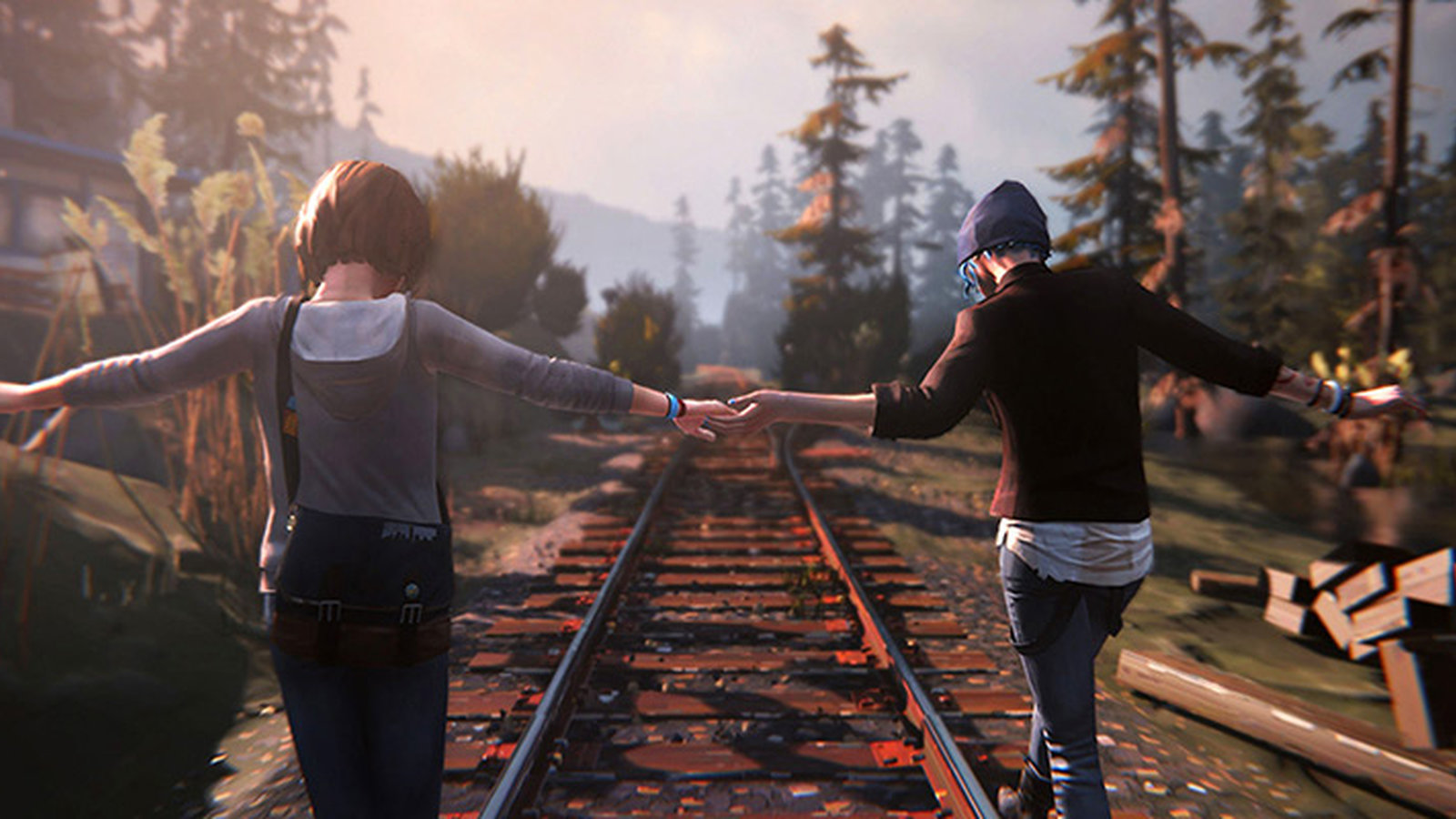 © Square Enix , DONTNOD Entertainment
Introduction: The Twilight Town and the Demise Heralded by the Fluttering Blue Butterfly
Arcadia Bay, a fictional rural town in Oregon swept by the cold sea breeze of late autumn. Once flourishing with rich fishing and forestry industries, this declining city, now characterized by rusted signs and shuttered storefronts reminiscent of the “Rust Belt,” exudes a sense of desolation and stagnation akin to a locked room. Amidst this suffocating atmosphere, Max Caulfield, an 18-year-old photography student, unexpectedly acquires the supernatural ability to “rewind time.”
Narrated to the strumming acoustic guitar melodies of indie folk, this work appears at first glance to be an emotional ensemble drama depicting the Moratorium of youth, Identity Diffusion, and the melancholy of adolescence. However, at its core—particularly within the mechanics that form the foundation of the narrative—the extremely ruthless and philosophical themes of the “Butterfly Effect” and “Philosophical determinism” are secretly yet surely interwoven.
This report, as the “first installment” of a 12-part project to systematize the worldview of Life is Strange, delves vertically and to the utmost limit solely into the themes of the Butterfly Effect and Philosophical determinism. Starting from a single Blue Butterfly fluttering in the girls’ bathroom at Blackwell Academy to the giant storm that engulfs Arcadia Bay, it thoroughly elucidates the spiral of causality from the perspective of micro-data scattered throughout the game (graffiti, diaries, BGM lyrics), Chaos Theory, and a deterministic view of the universe.
1. Chaos Theory and the Metaphor of “Sensitive Dependence on Initial Conditions”
1.1 Edward Lorenz’s Thesis and the Flutter of the Morpho Butterfly
The “Butterfly Effect,” a core concept of this work, refers to the “sensitive dependence on initial conditions” in Chaos Theory proposed by meteorologist Edward Lorenz. It is a phenomenon in deterministic nonlinear dynamical systems where a slight difference in the initial state produces an extremely large and non-negligible difference in the outcome over time. The metaphor that “a minute perturbation, such as the flutter of a distant butterfly’s wings, can affect the path and details of a hurricane weeks later” is the origin of its name.
In the game’s first episode, “Chrysalis,” just before Max awakens her ability to rewind time, a blue morpho butterfly lands on the sink in the girls’ bathroom. Immediately after Max takes a picture of this butterfly with her Polaroid camera, an incident occurs where Nathan Prescott and her childhood friend Chloe Price get into an argument, resulting in Chloe being shot to death. Witnessing this tragedy, Max unconsciously rewinds time and saves Chloe’s life.
This Blue Butterfly is neither merely a beautiful subject nor just a mascot. It is the absolute symbol of “initial conditions” in Chaos Theory. Max’s “flutter” (intervention in time) to save Chloe becomes the decisive cause that triggers the massive tornado (an EF6 class tornado) that later strikes Arcadia Bay. In the in-game text, her science-majoring friend Warren Graham explicitly points out this series of abnormal weather and chain of events as “pure cause and effect, maybe Chaos Theory.”
1.2 Physical Intervention and Environmental Anomalies: The Echo of the Anthropocene in Arcadia Bay
Every time Max alters time, inexplicable environmental anomalies occur in a chain reaction in Arcadia Bay. Unseasonal snow, a sudden solar eclipse, a mass of whales washed up on the beach, and dead birds falling from the sky. According to Warren’s speculation, the very act of reversing time and artificially rewriting the original timeline triggers a chain reaction that extends even to the environment.
It has been academically pointed out that these environmental anomalies metaphorically represent the ecological horrors of the “Anthropocene” in modern geology and environmental science. Just as excessive human technological intervention brings unexpected and destructive consequences to the global environment, the personal and minute intervention of a single teenager, Max, wanting to “save a friend,” distorts the providence of nature (causality), eventually suffering an ecological retaliation in the form of a storm that destroys the entire town.
| Environmental Anomaly | Timing and Context | Chaos Theory / Deterministic Interpretation |
|---|---|---|
| Unseasonal Snow | End of Episode 1. Right after Max saves Chloe’s life and realizes her power. | The first minute distortion caused by altering initial conditions. A sign of the nonlinear collapse of the weather system. |
| Unscheduled Eclipse | End of Episode 2. The period when she begins to overuse her ability to rewind time. | Interference with the absolute deterministic system of celestial mechanics. The exposure of unpredictability and a cosmic-scale warning. |
| Mass Death of Birds and Whales | Episodes 3-4. The period when she attempts to alter the rigid fate of Chloe’s past (her father’s death). | The complete collapse of the natural ecological balance. The global environment’s rejection response to the forceful twisting of causality. |
| Giant Tornado (The Storm) | Episode 5. The endpoint of all alterations and the stage where the Ultimate Choice is forced. | The final result of the Butterfly Effect in a chaotic system. The catastrophic consequence brought about by minute interventions. |
These abnormal situations function not merely as a panic-movie-like direction, but as a philosophical device that confronts the player with the “responsibility of actions” and the “irreversibility of the natural world.” Every time the player makes choices based on their own ethics and attempts to find the “optimal solution” by rewinding time, the world presents its structural unraveling as ominous signs such as snow and corpses.
1.3 Warren Graham’s Hypothesis: The Intersection of Science and Fate
Warren Graham, a science geek, plays an important role in this work by attempting to interpret the abstract concept of “fate” through the objective framework of Chaos Theory. During a tense conversation at the diner in Episode 5, when Max asks, “Did my rewinding time cause the storm?”, Warren answers as follows:
“I’m not a real scientist, even though I play one at school, but this seems like pure cause and effect, maybe Chaos Theory…”
He further speculates, “For every action, there is a reaction… Every time you reversed or altered time, you might have triggered a chain reaction even in the environment.” This dialogue suggests that the supernatural phenomena in this work are not magic or divine wrath, but rather an extremely physical and logical “self-correcting function of a deterministic universe.” Max’s time travel is the act of forcibly unraveling the rigid fabric of causality and reweaving a different pattern. However, just as pulling a single thread distorts the entire cloth, the result of saving the single thread named Chloe led to the tearing of the entire fabric that is Arcadia Bay.
2. The Illusion of Free Will in a Deterministic Universe
2.1 The Philosophical Trap of “This action will have consequences”
When playing this game, the flickering UI message “This action will have consequences” that frequently appears in the top left corner of the screen is more than a mere game system notification; it is a kind of philosophical thesis. This message gives the player the illusion that “I have the Free Will to influence the outcome.”
Through Max, the player redoes past choices and seeks better outcomes (optimal solutions). They help classmates, stop bullying, and save a friend’s life. At first glance, this seems to signify the complete victory of “Free Will” over determinism. It creates the illusion that the existentialist dramatic space proposed by French philosopher Sartre, where “the primacy of free will overcomes the power of destiny,” has been realized through the interactive medium of a game.
However, as the story progresses, the situation reverses. Even if one rewinds time and temporarily avoids a micro-level tragedy, it ultimately triggers another tragedy on a macro level. The more the player redoes their choices, the more complexly intertwined the situation becomes, accumulating energy toward the final catastrophe. The cruel reality is revealed that “Free Will” in this game is actually nothing more than the freedom to choose “which path to take to arrive at the inevitable tragedy,” and it possesses no power to rewrite the ultimate fate.
2.2 The Gravitational Pull from Pop Culture: The Butterfly Effect and Donnie Darko
The logic of time travel in this work is not an idyllic and convenient one like in the movie Back to the Future, where modifying the past simply overwrites and erases an inconvenient future. Rather, this work adopts a deterministic and dark view of the universe that is extremely close to movies like Donnie Darko and The Butterfly Effect.
The “similarity to Evan Treborn” (the protagonist of the movie The Butterfly Effect), frequently pointed out in community discussions, is essential for deeply understanding this theme. Evan alters the past multiple times to save the people he loves, but each time it leads to unexpectedly worst outcomes—someone goes to prison, someone loses their limbs, someone becomes mentally ill. Max’s trajectory is exactly the same.
No matter how desperately Max tries to save Chloe, the situation only worsens, and Chloe continues to face the danger of death in different forms in alternate timelines. This is a powerful metaphor for Philosophical determinism, where “the universe is telling Max, ‘That attempt won’t work. Fate is already written.‘“
2.3 Chloe Price as an Artifact of Fate
From a deterministic perspective, the existence of Chloe Price can be interpreted as an artifact (a relic or singularity) whose “death” is predetermined in the causality of the universe. The moment she was shot by Nathan in the girls’ bathroom in Episode 1, Chloe’s lifespan was originally meant to end there. Because Max forcibly prolonged it, the universe attempts to eliminate Chloe by any means necessary to restore the lost equilibrium.
In fact, Chloe is exposed to the danger of death multiple times throughout the story: gunfire, getting her foot caught in train tracks, a self-inflicted accident from a ricochet, and ultimately, murder by Mark Jefferson. This is not merely a series of misfortunes, but the manifestation of “the universe’s self-repairing action attempting to return to its original determined state (Chloe’s death).”
This dynamic can be understood as a fusion of determinism—like “Laplace’s demon” in physics, where if the initial state of the universe is known, the future is completely determined—and Chaos Theory, where minute interventions invite entirely unpredictable catastrophes. Max attempts to become Laplace’s demon, but she is powerless before chaos that exceeds human cognitive abilities, and ultimately, she is forced into a binary choice: either succumb to the “coercive force of fate” or pay the ultimate price of “sacrificing the entire town.”
3. Traces of “Inevitable Fate” Engraved in Micro-Data
A notable aspect of this work is that macro-philosophical propositions like the Butterfly Effect and Philosophical determinism are implicitly indicated and function as foreshadowing through a teenager’s everyday micro-data (diaries, posters, graffiti).
3.1 Bathroom Graffiti and the Echoes of Twin Peaks
The girls’ bathroom at Blackwell Academy, which became the starting point for Max awakening her ability. On the mirror here, the graffiti “Fire Walk With Me” is written. This is a clear homage to director David Lynch’s cult visual work Twin Peaks. Twin Peaks is also a story set in a dense rural town in the Pacific Northwest, depicting the disappearance of a beautiful girl (Laura Palmer / corresponding to Rachel Amber in this work), the hidden faces of the townspeople, inevitable fate, and supernatural phenomena.
The phrase “Fire Walk With Me” is a kind of incantation in Twin Peaks where an evil entity (BOB) possesses people and derails their fates. The fact that these words are written on the mirror of the bathroom—the very scene where Max commits the taboo against the natural world of “altering time”—is by no means mere background decoration. It implies that the ability to rewind time itself is a kind of curse and a gateway to an irresistible fate (Fire).
Furthermore, in the stalls of the same bathroom and the diner’s bathroom, there is malicious graffiti such as “Rachel Amber is a whore” and “Rachel A owes me a BJ.” This indicates the deceit and chaos harbored by the town of Arcadia Bay, and the complexity of the initial conditions left behind by Rachel, the “absent center,” and this stagnant atmosphere serves as the breeding ground for all Butterfly Effects.
3.2 Hole to Another Universe and the Absence of Truth
The graffiti written on the walls of Chloe’s room is also full of metaphors for determinism and the multiverse theory. The large text “Hole to another universe” drawn on the wall is presumed to be a quote from the work of American designer Dan Golden, but at the same time, it prophesies Max’s very ability to literally leap into “another timeline (another universe)” through photographs.
Even more noteworthy is the graffiti “Everybody lies, no exceptions,” also written in Chloe’s room. This is a quote from the MTV animated series Daria, but in the context of this work, it corroborates a chaotic and nihilistic worldview that absolute truth or a “single correct timeline” does not exist. Every time the past is altered, people’s testimonies, situations, and even their life or death are rewritten as if they were lies. This “fluidity of truth” is precisely the greatest terror brought about by Chaos Theory.
3.3 The Diary’s Foreshadowing of “The City on the Edge of Forever”
The greatest key to deciphering Max’s inner world and philosophy is the “diary” written by her own hand. In the text of the diary, the essence of the situation she is facing is spelled out candidly through quotes from literature and pop culture. For example, she borrows Ray Bradbury’s novel The October Country from Kate Marsh. This work is a collection of macabre tales depicting people facing death, loneliness, and bizarre fates, perfectly aligning with Max’s own situation of being tossed about by a bizarre fate in Arcadia Bay in October.
However, what most clearly foreshadows the deterministic tragedy is the reference in her Episode 4 diary to the historic episode “The City on the Edge of Forever” from the classic sci-fi drama Star Trek. This episode is a story where Captain Kirk time-travels to the past and faces the ultimate trolley problem (ethical dilemma) of “having to let die” the woman he deeply loved (Edith Keeler). If he lets her live, history changes, Nazi Germany wins World War II, and the world is destroyed. To save the world, he must silently overlook “her death (a traffic accident)” predetermined by fate.
Max writes in her diary: “It reminds me of that famous episode where he has to let the person he loves die so the Nazis don’t win the war… what a fucked up choice.” This single sentence perfectly foreshadows the fate ultimately thrust upon the player and Max (whether to accept Chloe’s death or witness the annihilation of the entire town). Max’s unconscious, or the god governing the scenario of this game world (the deterministic universe), has already secretly declared by the midpoint that the fatalistic conclusion of “the sacrifice of one or the sacrifice of the world” is unavoidable.
4. The Melody of “Fate and Loss” Played by Indie Folk
Supporting the emotional direction akin to indie cinema and highlighting the psychopathology of teenagers is a gem of a soundtrack centered around acoustic guitars and indie rock. The lyrics of these tracks transcend the boundaries of mere background music (BGM), endowing the ruthless themes of the Butterfly Effect and Philosophical determinism with the literary and psychological meaning of a youth’s “acceptance of loss.”
4.1 Syd Matters - “Obstacles”: The Inevitable Blizzard and the End of the Moratorium
The track “Obstacles” by the French indie band Syd Matters plays symbolically at the end of the game’s first episode and during the “Sacrifice Arcadia Bay” ending in Episode 5. This song sings of the end of innocent childhood and the pain accompanying the unavoidable transition to adulthood.
Someday we will foresee obstacles / Through the blizzard, through the blizzard
(Someday we will foresee obstacles / Through the blizzard, through the blizzard)
We played hide and seek in waterfalls / We were younger, we were younger
(We played hide and seek in waterfalls / We were younger, we were younger)
The “blizzard” in these lyrics is symbolically linked to the giant tornado seen in Max’s visions and the abnormal weather (unseasonal snow) falling on Arcadia Bay. Time marches on mercilessly, and one can never return to the innocent days of playing “hide and seek” in the past (the childhood spent playing pirates with Chloe). Max’s ability to rewind time is a Moratorium-like resistance against this “blizzard” (the fury of a harsh fate and the fear of growing up), but as the lyrics of “Obstacles” indicate, it is ultimately an obstacle that must be passed through. No matter how much one turns back time and tries to remain in the past, the rite of passage to adulthood dictated by society and the pain of loss are “destined (foreseen).“
4.2 Foals - “Spanish Sahara”: The Furies and the Self-Multiplication of Trauma
Another extremely important track is “Spanish Sahara” by the British band Foals, which plays during the “Sacrifice Chloe” ending in Episode 5. The origin of this song and its poignant lyrics brilliantly express the deterministic despair and the self-multiplication of trauma in this work.
Yannis Philippakis, the vocalist of Foals, spoke about the theme of this song as follows: “It’s a fictional place, like a nightmarish and desolate landscape. The whole song is about ‘overcoming the trauma that is there,’ but instead of the trauma fading away, a single fury multiplies into countless Furies (the Erinyes of Greek mythology), cursing families across generations.”
Forget the horror here / Leave it all down here / It’s future rust and then it’s future dust
(Forget the horror here / Leave it all down here / It’s future rust and then it’s future dust)
I’m the fury in your head / I’m the fury in your bed
(I’m the fury in your head / I’m the fury in your bed)
Max’s attempt to modify the past by fully utilizing the Butterfly Effect is aimed precisely at the “erasure of trauma,” namely the death of her best friend. However, what was produced as a result was an even greater sacrifice (the destruction of Arcadia Bay and Chloe’s further despair in alternate timelines). The trauma does not disappear; it multiplies endlessly like the Furies of Greek mythology, cornering Max’s psyche. The deterministic tragedy that struggling to escape fate itself ironically strengthens the curse of fate is ruthlessly declared by the gloomy and quiet beat of this indie rock.
4.3 Syd Matters - “To All of You” and Local Natives - “Mt. Washington”
“To All of You” by Syd Matters, which plays at the beginning of the game during the scene where Max puts on her earphones and walks down the hallway of Blackwell Academy, is also an ironic prelude to the deterministic tragedy lurking behind a peaceful everyday life.
American girls like dollies / With shiny smiles and plastic bodies
(American girls like dollies / With shiny smiles and plastic bodies)
This song sings of the “perfect image” of American girls glorified in pop culture, and the sense of emptiness and oppression behind it. It suggests that the environment surrounding Max (a seemingly peaceful and privileged high school life at a prestigious academy) is actually a fragile, plastic-like illusion where “Everybody lies.” And that illusion is destined to easily collapse with the flutter of a single butterfly’s wings.
Furthermore, the lyrics of “Mt. Washington” by Local Natives, which plays at the end of Episode 2, are also symbolic. This song expresses the feelings of loss and lingering affection, conveying that “you don’t want it now, but you know you will crave it later.” It brilliantly depicts the law of equivalent exchange—where Max alters the past and gains something, but inevitably loses something else—and the irretrievable thirst for lost time.
| Track Title | Artist | Metaphor of Lyrics and Theme | Connection to Butterfly Effect and Philosophical Determinism |
|---|---|---|---|
| Obstacles | Syd Matters | Blizzards, nostalgia for the past, unavoidable obstacles | The inevitability of chaotic situations (the storm). The fatalism that “growing up” and “loss” cannot be avoided even if you rewind time. |
| Spanish Sahara | Foals | Multiplication of trauma, the Furies of Greek mythology, dust and rust | The “tragedy of Evan Treborn” where altering the past multiplies further tragedies. The unpredictability of consequences and the acceptance of loss. |
| To All of You | Syd Matters | Shiny smiles and plastic bodies, fabricated perfection | The precariousness of the initial conditions of a peaceful everyday life. The fragility of a deterministic system that easily collapses with minute interventions. |
| Mt. Washington | Local Natives | Thirst for what is lost, irretrievable lingering affection | Attachment to the past and the powerlessness of human emotional resistance against a determined fate. |
5. The Boundary Between Fact and Speculation: What is the True Cause of the Storm?
To elucidate the depths of this theme more logically and academically, it is necessary to clearly distinguish between the “facts” explicitly stated in the game and the “speculations (theories)” inferred from community discussions and circumstantial evidence, and to verify the causal relationships of the events.
5.1 Established Facts: The Correlation Between Intervention and Collapse
The following points are presented as unshakable facts within the game:
-
The Chain of Triggers and Consequences: Starting with Max nullifying Chloe’s death (rewinding time) in the girls’ bathroom, abnormalities began to occur in the weather and environment of Arcadia Bay.
-
Warren’s Scientific Conclusion: Warren Graham, possessing scientific knowledge, receives Max’s confession and explicitly states that this phenomenon is “pure cause and effect based on Chaos Theory” and that “rewinding time itself caused the storm.”
-
The Inevitability of Side Effects: Just as drastically altering the past to save William Price (Chloe’s father) resulted in an entirely different tragedy where Chloe becomes quadriplegic, the act of rewriting time is always accompanied by unexpected and destructive side effects (the Butterfly Effect).
-
The Final Convergence of Causality: In the conclusion of Episode 5, only when Max undoes her “first intervention (the butterfly photo in the bathroom)” and allows the original history of Chloe’s death to occur, does the giant tornado not form, and the town is saved.
5.2 Speculation Based on Circumstantial Evidence: The Death of Rachel Amber and the “Paradox of Time”
On the other hand, a critical view that Warren’s theory—that “Max’s use of her power is the root cause of the storm”—is merely an inference within the scope of knowledge possessed by a mere high school student remains deeply rooted in the profound speculations of the fandom.
The greatest contradiction is the fact that even before Max awakens her ability to “rewind time” and takes the picture of the Blue Butterfly (during Mark Jefferson’s class), she has already seen a vision (daydream) of the Lighthouse and the giant tornado. If rewinding time were the true “initial condition” of the storm, foreseeing the storm before using the power is illogical in terms of causality.
Two hypotheses can be derived from this. One is the theory that the cause of the “storm” is not Max, but rather a supernatural revenge play triggered by the death of Rachel Amber, or her anger itself. In the prequel Life is Strange: Before the Storm, when Rachel sets fire to the forest, there is a depiction of the wind howling in response to her roar, and the wildfire spreading at an abnormal speed. This leads to the speculation that Rachel possesses some power to manipulate or resonate with nature, and that the “wrath of the earth” over her unreasonable murder by Jefferson and Nathan is the true identity of the storm.
The other hypothesis is Reverse Causality, where the flow of time is not linear, and “the effect determines the cause.” It is not that the storm occurred because Max resisted the “predetermined fate” of Chloe’s death, but rather that because the “determined future of a storm occurring to cleanse Arcadia Bay” already existed as the will of the universe, Max was given her power as a singularity of causality, and a situation forcing her into the “Ultimate Choice” was prepared.
If Rachel’s death or the will of the universe had planned the storm from the beginning, Max’s time travel is not even the cause of the Butterfly Effect; she was merely made to dance upon a “pre-written scenario of tragedy.” This “paradox of time” is precisely the pinnacle of the literary and philosophical profundity of this work, swallowing even the scientific approach of Chaos Theory.
Conclusion: Existence in the Determined Storm, or the Maturity of Letting Go of the “Butterfly”
As a summary of this report, the conclusion derived from the themes of the “Butterfly Effect and Philosophical determinism” is extremely poignant and existentialist.
As Chaos Theory demonstrates, the world is extremely sensitive to minute changes in initial conditions, and modifying the past through shallow human wisdom always invites unpredictable catastrophes. The “power to rewind time” that Max obtained is not magic that brings a sense of omnipotence to a youth, but merely a cruel miniature garden, or a trap, presented by a deterministic universe. The UI warning “This action will have consequences” was not a mere game system notification to the player, but the presentation of a universal truth that “no one can escape causality.”
The will of the universe (determinism) relentlessly trying to drive Chloe to her death, and Max’s love (Free Will) repeatedly intervening like the flutter of a butterfly’s wings. The desperate tug-of-war between the two ultimately becomes a giant storm, dyeing the sky of Arcadia Bay black and attempting to swallow everything.
Amidst the cold sea breeze of late autumn and the melancholic melodies of the acoustic guitar, what Max—and the player experiencing the world through her—must learn is the impossibility of completely controlling the past. Just as Captain Kirk in “The City on the Edge of Forever” had to overlook the death of the woman he loved, or as “Spanish Sahara” sings about the curse of trauma and future dust, we must sometimes endure the multiplication of trauma and accept the pain of returning the gears of fate to their “original cruel form” with our own hands.
The Blue Butterfly is the symbol of the beginning of everything, and at the same time, the symbol of the “past that must be let go.” The only way to break the chain of tragedies brought about by the Butterfly Effect is, paradoxically, to “stop one’s own fluttering”—that is, to face the cruelty of the determined fate head-on and accept it as one’s own pain. To let go of the sense of omnipotence and accept irretrievable loss. This is precisely the poignant record of the youths’ existence spun in the beautiful dead-end town of Arcadia Bay, and the most noble philosophy of decision-making for overcoming the unavoidable obstacles of growing up.
Causal Mechanics of Time and Choice: Life is Strange: 15 Meditations on Youth and Chaos
The book version is now available. Read for free with Kindle Unlimited.
Thank you very much for reading to the end. To help support the activities of this archive, a warm donation of a cup of coffee would be highly appreciated.