BD.01: The Illusion of Being "Special" and the Consumption Structure of Night City
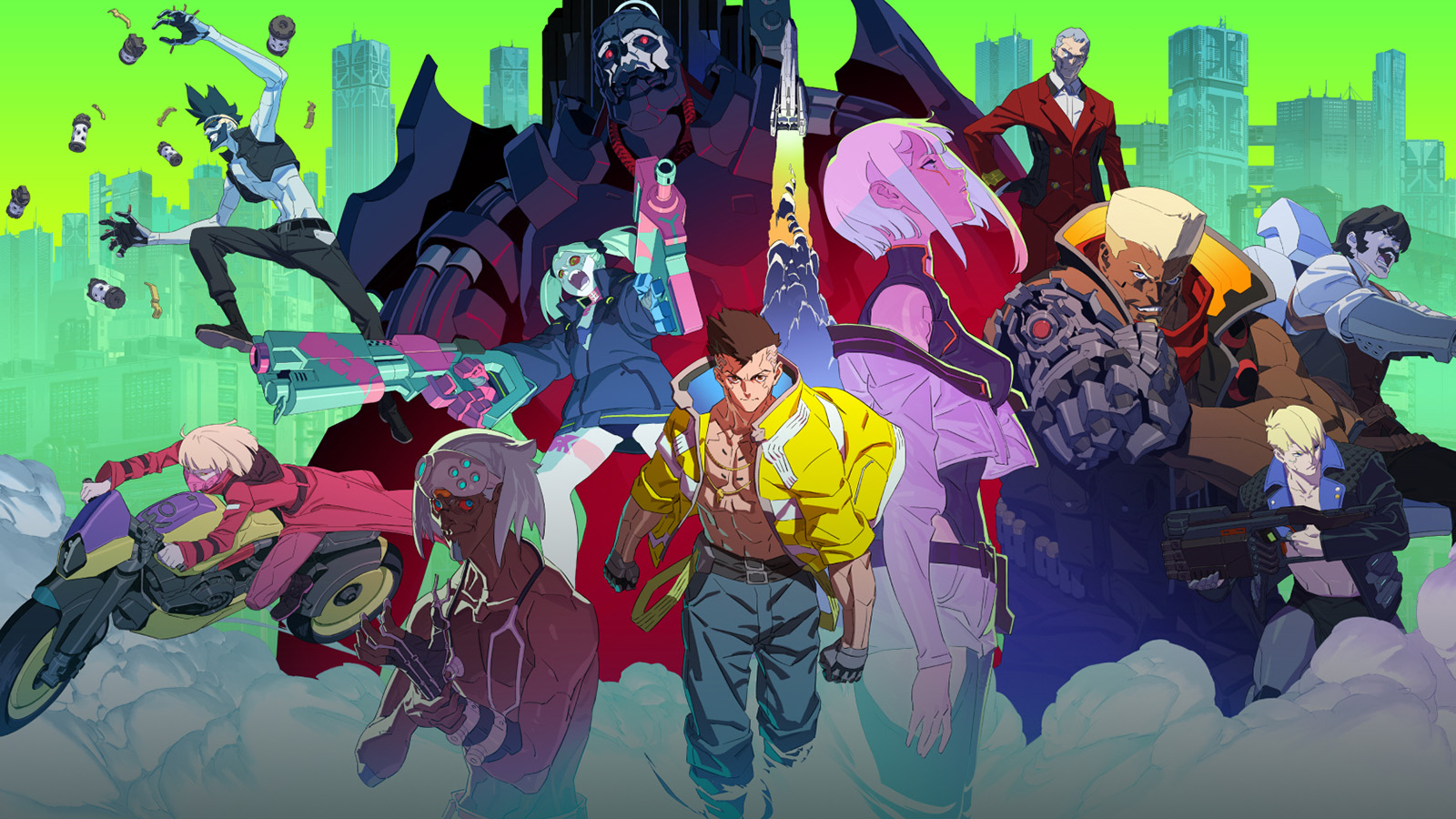 © CD PROJEKT RED × TRIGGER × NETFLIX
Introduction: Lives Consumed in the Shadows of Skyscrapers and the Zenith of High tech, low life
Towering skyscrapers, toxically beautiful neon lights, and streets where heavy bass constantly reverberates. Night City is a metropolis where Megacorporations control everything, and the social and economic disparity has widened to a point of despair. The setting of the anime Cyberpunk: Edgerunners, this city is not merely a narrative backdrop or a sterile stage set. It is depicted as a “colossal predator” of flesh and blood, operating continuously by devouring the hopes and dignity of its inhabitants. In this city, the benefits of technology are monopolized by a minuscule wealthy elite, while the lives of those living on the streets are consumed literally as disposable resources.
The trajectory of the protagonist, David Martinez, is not a cathartic heroic tale of a young boy rising through the ranks of the underworld. It is an exquisitely beautiful yet profoundly cruel tragedy from which one cannot look away—a story of a youth who, within a system of absolute oppression and exploitation, harbors the adolescent illusion of being “special,” and hurtles toward ruin while bearing the “curses” disguised as the dreams of others.
This article comprehensively analyzes David’s psychological transformation, the late-capitalist consumption structure enveloping Night City, and the unique visual direction (color design, bodily transformation) and musical expression of Studio TRIGGER, the production studio. What did they leave behind, and what was stolen from them amidst the city’s light and shadows? By unraveling its philosophical and literary significance, we will approach the true nature of the fundamental “sense of loss” left to us by the Edgerunners.
1. The Dystopia of the 2020s and the Loss of “Omnipotence”: A Paradigm Shift in Animation History
To gain a deeper understanding of the characteristics of David Martinez, it is necessary to compare the historical evolution of the “protagonist archetype” in Japanese animation with the context of the 2020s, the era in which this work was created. The gaping void within him is not a personal character flaw, but a reflection of the very social structure that produced him.
1.1. From the Omnipotence of the Bubble Era to the Survival Strategies of Late Capitalism
In the past, particularly in Japanese animation of the 1980s and early Cyberpunk works, protagonists were brimming with an unfounded sense of “omnipotence” and possessed an overwhelmingly positive energy. They unconditionally believed themselves to be “special” without a shadow of a doubt, and were able to charge straight toward grand “dreams” such as social success, self-actualization, or saving the world. This was closely tied to the myth of perpetual economic growth at the time and the optimism about the future that permeated society as a whole.
However, David in Edgerunners, created in the 2020s, is introduced as an existence entirely disconnected from such omnipotence or grandiose dreams. Night City, where he lives, is the ultimate destination of hyper-capitalism, where capitalism has advanced to its extreme and even state functions have been placed under the control of Megacorporations. In this world, social safety nets and welfare have completely collapsed, leaving the have-nots with no choice but to engage in grueling bottom-tier labor or throw themselves into the life of illegal gig workers (Edgerunners) who gamble their own lives as chips.
The table below compares and organizes the paradigm shift of animation protagonists in accordance with changing historical contexts.
| Comparison Item | Protagonist Archetype of the 1980s (Economic Growth/Bubble Era) | Protagonist Archetype of the 2020s (Late Capitalism/Hyper-Disparity Society) |
|---|---|---|
| Social Background | Economic prosperity, myth of perpetual growth, (illusion of) equal opportunity | Total domination by Megacorporations, extreme wealth disparity, rigid class stratification |
| Protagonist’s Psychology | Strong sense of omnipotence, overflowing confidence, positive foolishness | Lack of omnipotence, deep resignation toward the social system, chronic nihilism |
| Sense of Self-Worth | Unwavering conviction that “I am unconditionally special” | Extremely low self-esteem, believing “I have no value” |
| Purpose of Action | Realization of grand dreams, acquisition of social glory, saving the world | Basic survival, settling others’ debts or dreams (curses), securing a fleeting place to belong |
| Social Standing | Uniformed student, belonging to a socially recognized and respected group | Irregular worker, gig worker, back-alley criminal (Edgerunner) |
| Premise of Daily Life | A peaceful daily life exists and is threatened by external enemies | The world has been a “scorched earth” since birth, and daily life itself is hell |
From the very beginning, David is thrown into this “scorched earth” reality. He possesses no clear dreams or noble purposes of his own; he merely exists within the profoundly desperate framework of basic survival and escaping poverty, wishing only to slightly ease the burdens of his single mother.
1.2. Gamified Labor and Consumed Humanity
The structure of Night City in this work sharply critiques how human beings are consumed and ground down by the capitalist system. According to academic analysis, this work brilliantly visualizes the gamification of the “gig economy” (short-term contract labor) in modern society. The process of completing Gigs as an Edgerunner, “leveling up,” integrating more expensive and powerful Cyberware (Implants) into one’s body, and making a name for oneself as a legendary street Merc appears, at first glance, to be a journey of self-actualization and upward mobility.
However, the reality is entirely different. This system is nothing more than a process that quantifies human “Humanity” and “Empathy,” wearing them down as “currency” for hypergamy or class ascension. In this social structure, which could be called a grotesque mutation of the American Dream, humans are reduced to mere statistical data (stats) in the labor market, and the only “path to victory” to climb higher is set as exhausting oneself entirely as a high-priced consumer good (a legend).
The process by which David’s flesh is replaced by machinery episode by episode, losing his contours as a human being, serves as a metaphor for how capitalism exploits and consumes the human body and mind to the absolute limit as labor resources. The “power” he gained by selling off pieces of his own body was, in the end, nothing more than a shackle designed to make him serve the system as a more efficient apparatus of violence.
2. The Stratification of Life and the Collapse of the Medical System: The Meaning of Mother Gloria’s Death
The first tragedy that sealed David’s fate was the death of his mother, Gloria Martinez. By analyzing the circumstances of her death in detail, it becomes starkly clear how the value of life in Night City is stratified by capital.
2.1. The Polarization of Emergency Medicine and the Harsh Reality of “REO Meatwagon”
Gloria worked herself to the bone as an EMT for the emergency medical corporation “REO Meatwagon” in order to send her son to the elite Arasaka Academy. The medical system in Night City is completely polarized, and the public safety net has collapsed. The wealthy with abundant funds and Corpo elites contract with “Trauma Team,” a premium medical service that rescues patients fully armed. On the other hand, the impoverished and ordinary citizens who cannot afford Trauma Team’s premiums have no choice but to rely on public healthcare, which suffers from chronic underfunding and substandard facilities, or cheap private services like REO Meatwagon.
The reputation of REO Meatwagon is abysmal, with some on the streets even despising them as “no different from Scavengers.” In fact, to survive in this harsh working environment, and above all to earn the exorbitant tuition for David’s academy, Gloria had her hands dirty in a side hustle: secretly stripping expensive Cyberware from corpses at the scene and fencing it to Fixers on the black market. She was not merely a victim; she was forced to adopt the persona of a “low-rank Edgerunner (or Fixer)” just to crawl through the bottom of Night City.
2.2. Ashes in a Thermos and the Ultimate Deprivation of Dignity
The traffic accident caused by a gang shootout that David and Gloria were caught in is the scene that most bluntly illustrates the cruelty of Night City. Trauma Team was the first to arrive at the accident scene, but as soon as a scan confirmed that David and his mother were not their clients (lacking a sufficient insurance tier), they merely glanced at the dying pair, abandoned them, and flew off after retrieving only their wealthy client.
Subsequently transported to a substandard public medical facility, Gloria loses her life without receiving adequate treatment. What is even more despairing is the subsequent handling of her remains. Unable to pay the exorbitant medical bills and funeral (burial) costs, David receives his mother’s ashes cremated by a cheap automated processing machine and delivered in a “metal thermos” that looks like a coffee container.
This depiction of “ashes in a thermos” is one of the most cruel and literary expressions in this work. A mother’s love, her hardships, and human life itself are treated as equivalent to mere “combustible garbage” before the logic of capital, casually stuffed into an industrial container. It is a thorough deprivation of dignity. At this point, David fully comprehends the true nature of the world he lives in: without money (Eddies), humans are not even allowed to die properly; they are simply disposed of as trash.
3. The Fatal Illusion of Being “Special”: The Curse of Humanity and Empathy
Plunged into the depths of despair and poverty, David resolves to implant the “Sandevistan”—a military-grade Cyberware left behind by his mother, which she had intended to fence on the black market—into his own spine. From here begins the most powerful internal factor that drives him to ruin: the intense conviction that “I’m built different,” which is to say, the illusion of being “special.”
3.1. The True Nature of “Special Tolerance” and the Cruel Truth Hidden in the Rule System
The Sandevistan accelerates the user’s nervous system to the absolute limit, granting superhuman abilities to move as if time around them has stopped, but in return, it places an immense burden on the body and brain. For a normal human, using it just a few times a day would fry their brain cells, shatter their mind, and trigger “Cyberpsychosis.” However, David manages to use this Implant consecutively multiple times a day, suffering nothing more than a nosebleed. This extraordinary tolerance becomes the catalyst that makes him harbor the illusion that “I am special.”
However, unraveling the explanations by Mike Pondsmith, the creator of the Cyberpunk universe, and the rule settings of the original tabletop RPG reveals that this “specialness” is a complete illusion. In the world of Cyberpunk, there is no such thing as absolute immunity to Cyberpsychosis. Tolerance against its onset depends on a person’s numerical stats of “Humanity” and “Empathy.” Every time Cyberware is implanted into the body, these stats are chipped away, and the moment they reach zero, the human loses their reason and is reduced to a mere killing machine (Cyberpsycho).
David exhibited high tolerance not because he was a genetic superhuman. It was simply because, despite growing up in the harsh environment of the slums, he had received unconditional love from his mother Gloria, and retained a “high Empathy” and a “healthy mind” that allowed him to care for others and build human relationships with those around him.
The paradoxical and profoundly cruel truth is that precisely because he possessed a kind human heart, there was a “margin (stat buffer)” to implant more machinery into his body, which consequently granted him the “leeway” to whittle away his own Humanity to the absolute limit. His kindness itself became the fuse that would cause him to suffer longer and more deeply.
3.2. The Mirage Caused by Night City’s Abnormal Baseline
Furthermore, Pondsmith points out that the underlying reason David appears “special (a one-in-a-million talent)” to Arasaka Corporation and the viewers is the desperate inhumanity of the society that is Night City.
Having even one loving parent. Finding a lover or friends you can open your heart to. Meeting a mentor who guides you. In our real world, these are very standard, or perhaps modest, human conditions. However, in Night City, where betraying others and using them as stepping stones is an absolute condition for survival, the very existence of these things has become an extremely rare “privilege.”
Arasaka Corporation viewed David as the “perfect test subject for military Implants” not because he possessed unparalleled physical abilities, but because the vast majority of Night City’s residents have already lost their Humanity and ethics due to chronic stress and violence, and are mentally broken. According to Pondsmith, an ordinary person with a healthy mind in our modern world might even have the potential to tolerate Cyberware as much as, or more than, David.
In other words, the myth of David’s “specialness” does not prove his own superiority; rather, it is merely a mirage that highlights how the city ravages the human mind and abnormally lowers the baseline of standard Humanity.
Near the end of the story, Adam Smasher—the ultimate weapon of the Corpos, described by the creator as a “High-Functioning Cyberpsycho”—shatters David’s illusion of being “special” with cold-hearted words. Smasher’s sneer, “You think you’re special, you piece of scrap? Don’t make me laugh,” is the voice of the system itself. Before the logic of massive capital, an individual’s “specialness” is nothing more than an illusion to be easily consumed and trampled upon.
4. The Boy Who Wears the Dreams of Others: The Vacuum of Self-Worth and the Inheritance of Curses
At the core of David’s behavioral principles lies a fatal “lack of self-worth (lack of self-esteem).” Born and raised in an oppressive social structure, he is unable to find his own meaning in life or his own fundamental desires. Therefore, like a blank screen (projector), he projects the dreams and desires of others onto himself, making the achievement of those dreams and fulfilling others’ expectations his sole reason for existence.
The “dreams of others” he shoulders function as “curses” in the guise of love, eroding his body and mind. The table below illustrates the progression of the major curses he took on throughout the series.
| Stage | Entruster (Owner of the Dream) | Content of the Dream (Curse) | David’s Actions and Results |
|---|---|---|---|
| Stage 1 | Mother Gloria | ”To stand at the top of Arasaka Academy and reach the top of the tower” | Setback through expulsion and his mother’s death. He implants the Cyberware (Sandevistan) she left behind into his body and falls into the underworld. |
| Stage 2 | Mentor Maine | ”To survive the streets and become a reliable leader who guides the crew” | After Maine’s death, he inherits his role and Implants (Gorilla Arms), resorting to body modifications that exceed his own capacity. |
| Stage 3 | Lover Lucy | ”To escape Night City and go to the moon” | To eliminate the threat of Arasaka keeping her from the moon and to earn funds, he completely throws away his own life and Humanity. |
4.1. The Mother’s Curse and the Weight of the Mentor’s Dying Wish
The first curse, as mentioned above, is his mother Gloria’s dream of “standing at the top of Arasaka.” After his mother’s death, he takes a twisted approach to fulfill this dream by rising through the ranks of the underworld.
The second curse is the dying wish of Maine, the hulking Cyberpunk who raised him as an Edgerunner. Maine was a surrogate father to David and a mentor who taught him the rules of the street. However, Maine too could not withstand the burden of excessive Implants, developed Cyberpsychosis, and met a gruesome death, dragging his lover Dorio down with him. Ordinarily, Maine’s tragic death should have served as a clear and definitive warning (alarm bell) that “installing any more Chrome (Cyberware) will guarantee ruin.”
However, lacking self-worth, David literally inherits “my arms” and the “role of leader” from Maine. Completely ignoring his own aptitude and limits, he overwrites Maine’s unfulfilled dream of becoming a “strong and reliable leader” who can protect the crew as his own new curse. His rapid rise as an Edgerunner was not self-actualization, but an act of madness driven by atonement to the dead and obsessive compulsion.
4.2. Lucy’s “Moon” and the Tragedy of Crossed Love
And the most beautiful, yet simultaneously the most tragic, is the third curse received from the heroine, Lucy (Lucyna Kushinada). Lucy’s dream was “to go to the moon.” However, this did not merely mean space travel; it was the ultimate metaphor for “complete mental and physical escape and freedom” from Arasaka Corporation, which had exploited her as grueling labor and relentlessly hunted her since childhood, and from the blood-soaked Night City.
David loved Lucy deeply, but here too, his “low self-worth” creates a fatal misunderstanding. He becomes fixated on the material and financial goal of “earning the exorbitant ticket price to the moon and physically sending her there.”
For Lucy, true peace (freedom) was no longer the distant moon in space, but “living together with David” itself. Even though he himself had transformed into her “moon (salvation),” David could not possibly believe that “he, a nobody, could make her happy just by existing.” As a result, he whittles away his own life to buy her safety and dream with money and violence, rushing toward a “self-sacrifice” that gouges her heart most deeply in order to protect her. The cruel paradox that the deeper the love, the more they hurt each other, is completed here.
5. Visual Metaphors Depicted by TRIGGER: The Philosophy Told Through Color and Bodily Transformation
Studio TRIGGER, responsible for the animation production, eloquently expresses these complex psychological and social themes not only through dialogue and plot development but also through meticulous art direction and visual effects. Behind the dynamic action they excel at (such as exaggerated layouts typified by the Kanada perspective), lies profound meaning that cuts to the core of the story.
5.1. Implications of the Inner Self Through Color: Blue (True Self) and Yellow/Green (Madness and Rebellion)
According to theories and visual analyses by dedicated viewers in the community, there is a clear “color metaphor” in this work that indicates the characters’ inner selves.
When David activates the Sandevistan, the glow of his spine and the trajectory of his afterimages immediately upon activation emit a “blue” light in the early stages, representing his true self. However, it has been pointed out that as the story progresses and he sinks deeper into the life of a street Merc, that color gradually changes to “green” or “yellow,” representing his persona as an Edgerunner.
Blue symbolizes the kindness, pure Empathy, and inherent vulnerability as a human being within him. In contrast, yellow is the theme color consistently used in the key visuals of this work, and it is also the color of his mother’s keepsake, the “EMT jacket (the yellow jacket of REO Meatwagon),” which he always wears. Yellow is a color that signifies rebellion against Night City, the frenzy of the streets, and Caution. The process of him losing his blue trajectory visually represents the process of him killing his pure self and being completely swallowed by the yellow curses entrusted to him by his mother and crew.
5.2. The Visual Philosophy of Cyberpsychosis: Multiplying Eyeballs and the Terror of Glitches
In the worldview of Cyberpunk, Cyberpsychosis is not merely temporary madness or anger. It is a severe dissociative disorder where the boundary between self and others blurs, and one becomes unable to perceive flesh-and-blood humans as anything other than “mere objects or obstacles,” or “targets” on a HUD (Head-Up Display).
In the game Cyberpunk 2077, enemies suffering from Cyberpsychosis are depicted through maniacal laughter and abnormal physical abilities, but TRIGGER elevates this into an expression unique to animation. In the series, the onset of Cyberpsychosis and its severe warning signs are visualized by the subject’s “eyeballs” losing focus, the image distorting with noise (glitching), and the eyeballs being drawn as multiplying and splitting.
This indicates a state where the machine’s visual information (digital targeting scope) and the human brain’s processing capacity (analog reality perception) diverge, causing the mind’s perceptual system to undergo a meltdown. The eyes (vision) are the windows of the mind, showing “how one perceives the world.” The blurring and splitting of the eyeballs is a technique that thrusts upon the viewer, in an extremely intuitive and eerie manner, the sight of their Humanity (soul) collapsing as a system error, completely blinding them to Empathy for others.
5.3. Cyberskeleton and Anti-Gravity: The Complete Loss of Flesh and Humanity
The ultimate destination of bodily transformation is Arasaka’s anti-gravity prototype weapon, the “Cyberskeleton,” which appears at the end of the story.
| Stage | Physical Changes | Psychological State / Behavioral Principles | Symbolic Meaning of Implants |
|---|---|---|---|
| Early (Ep 1-3) | Mostly organic (only Sandevistan implanted) | Sense of powerlessness, lack of self-worth, fear of society | Escape from poverty and taking on the mother’s sins |
| Middle (Ep 4-7) | Mechanization of arms, legs, etc., abnormal hypertrophy of the body | Illusion that “I am special,” excessive sense of responsibility toward the crew | Maine’s arms (inheritance of violence and pressure as a leader) |
| Late (Ep 8-10) | Integration with the Cyberskeleton, loss of organic limbs | Complete mental collapse (Cyberpsychosis), ruinous self-sacrifice | ”Complete abandonment of Humanity” to protect Lucy |
The sight of David mounted in the Cyberskeleton gave many viewers a profound shock, physiological disgust, and deep sorrow. This is because David’s main body, sitting at the center of that massive and overwhelming military force, was no longer anything more than a “mere torso connected to machine sockets,” with his limbs severed and lacking even reproductive organs.
While mocking Adam Smasher as a “full-borg monster,” David himself had also lost his human form long ago. His figure floating in the air via the anti-gravity device indicates that his feet have already completely left the ground of Night City (real human society). Furthermore, the loss of his reproductive organs cruelly depicts that he has discarded the biological hope of passing life on to the future, reducing himself to an existence that merely serves the system as a pure “apparatus of violence.”
6. Loss and Prayer Told Through Music: The Despair Played by “I Really Want to Stay at Your House”
When discussing Edgerunners, an element as indispensable as, or perhaps even more so than, the visuals is the presence of the insert song “I Really Want to Stay at Your House” (sung by Rosa Walton). This track was originally a pop song provided for the radio in the main game, but through its incredibly striking usage in the anime, it transcended mere BGM and was elevated into the greatest anthem bearing the emotional core of this work. Furthermore, the ending theme “Let You Down” by Dawid Podsiadło also plays a crucial role in deepening the lingering resonance of the tragedy.
6.1. Ultimate Vulnerability and the Metaphor of “Toxic Dependency”
The lyrics of this song, which at first glance sounds like lighthearted electro-pop, are engraved with an agonizing vulnerability and the loneliness of humans who have no choice but to depend on others even while hurting each other.
“I really want to stay at your house / And I hope it’s all right.”
According to analysis, these lyrics are an expression of a somewhat toxic yet profoundly genuine love and vulnerability, conveying the sentiment: “Even if you are someone who hurts me, even if this relationship is heading for ruin, I still want to be with you seeking comfort.” In Night City, a city where no one can be trusted and where violence and betrayal reign as absolute rules, wishing to “stay at someone’s house (share a mental sanctuary with someone)” is the ultimate self-disclosure, equivalent to entrusting one’s lifeline and greatest weakness to another.
6.2. The Cruel Spatial Contrast Between the Top (Tower) and the Bottom (Street)
This song is used in two completely different, extreme scenes in the series. The first time is a romantic and quiet scene where David and Lucy share a virtual reality (Braindance) of the moon, filling each other’s loneliness. The second time is near the end of the story, a ruinous combat scene where David, on the verge of falling completely into Cyberpsychosis, massacres heavily armed enemies while shedding copious amounts of blood, ascending Arasaka Tower in madness.
The meaning conveyed by the contrast of this direction is heavy and despairing. To protect Lucy and to help her reach her dream of the “moon,” David climbs bloodied to the top of Arasaka Tower (the symbol of Corpo power, and the place his mother once wished for him). However, what Lucy truly desired was neither the top of the tower nor the physical surface of the moon, but simply to stay in “the house where David is (a modest daily life).”
The unbridgeable tragic irony that the higher he heads toward the top of the skyscraper, the further their hearts and wishes drift apart both physically and mentally, is emphasized to the absolute limit by this lighthearted yet heartbreaking melody. In order to protect the “house” of his beloved, he destroyed the very “house” to which he was supposed to return.
Conclusion: The “Meaningless and Beautiful Brilliance” Left by Edgerunners
To summarize the analysis, David Martinez was by no means a “special existence (a chosen one).” He is but one of countless victims in Night City—where capitalism has bloated to its extreme and even human lives are treated like junk—who was incorporated into a labor market gamified by the system, and who entirely consumed his own Humanity as the price for expensive Implants.
His youthful, omnipotent illusion that “I’m built different” was defeated before the cold medical and systemic reality of Cyberpsychosis, and was mercilessly ground down by the massive Corpo society (Arasaka) and walking despair (Adam Smasher). Donning the curses of others’ dreams one after another, losing sight of his original pure self (the blue light), and ultimately being reduced to a mere machine part (a torso), his life could be said to be a miserable failure from the perspective of social success.
Yet, despite all this, why does this work continue to intensely squeeze the hearts of viewers and leave a profound sense of loss and emotion among fans worldwide? It is because, at the root of his actions, he never let go of his “unconditional love for another (devotion to Lucy)” until the very end.
In Night City’s consumption structure, ruled only by profit, exploitation, and betrayal, that irrational self-sacrifice—willing to throw away his own life to protect the one he loved—was the proof of “true Humanity” that the system could never calculate. The sight he saw at his end atop Arasaka Tower was neither societal revolution nor his own glory. However, because the momentary flash that was him raced through the night city, at least one girl reached the moon, was freed from the gravity of the city of death, and was able to bathe in the light of the real sun.
David’s death changes nothing about the cruel consumption structure of Night City. The Megacorporations will rule the city again tomorrow, and new youths will scatter their lives in the back alleys. But that “meaningless, and therefore overwhelmingly beautiful brilliance” emitted by his life, consumed at the bottom of the pitch-black shadows of the skyscrapers, is the sharpest and most literary prayer that Cyberpunk: Edgerunners thrusts upon us today. In the afterimage of the yellow jacket he left behind, we find our own lost sense of omnipotence and a form of love that will never fade.
Orbital Theory of Gravity and Ruin: Cyberpunk: Edgerunners: 14 Meditations on Dreams and Collapse
The book version is now available. Read for free with Kindle Unlimited.
Thank you very much for reading to the end. To help support the activities of this archive, a warm donation of a cup of coffee would be highly appreciated.