Diary.01: The Underwater City of Rapture and Objectivism
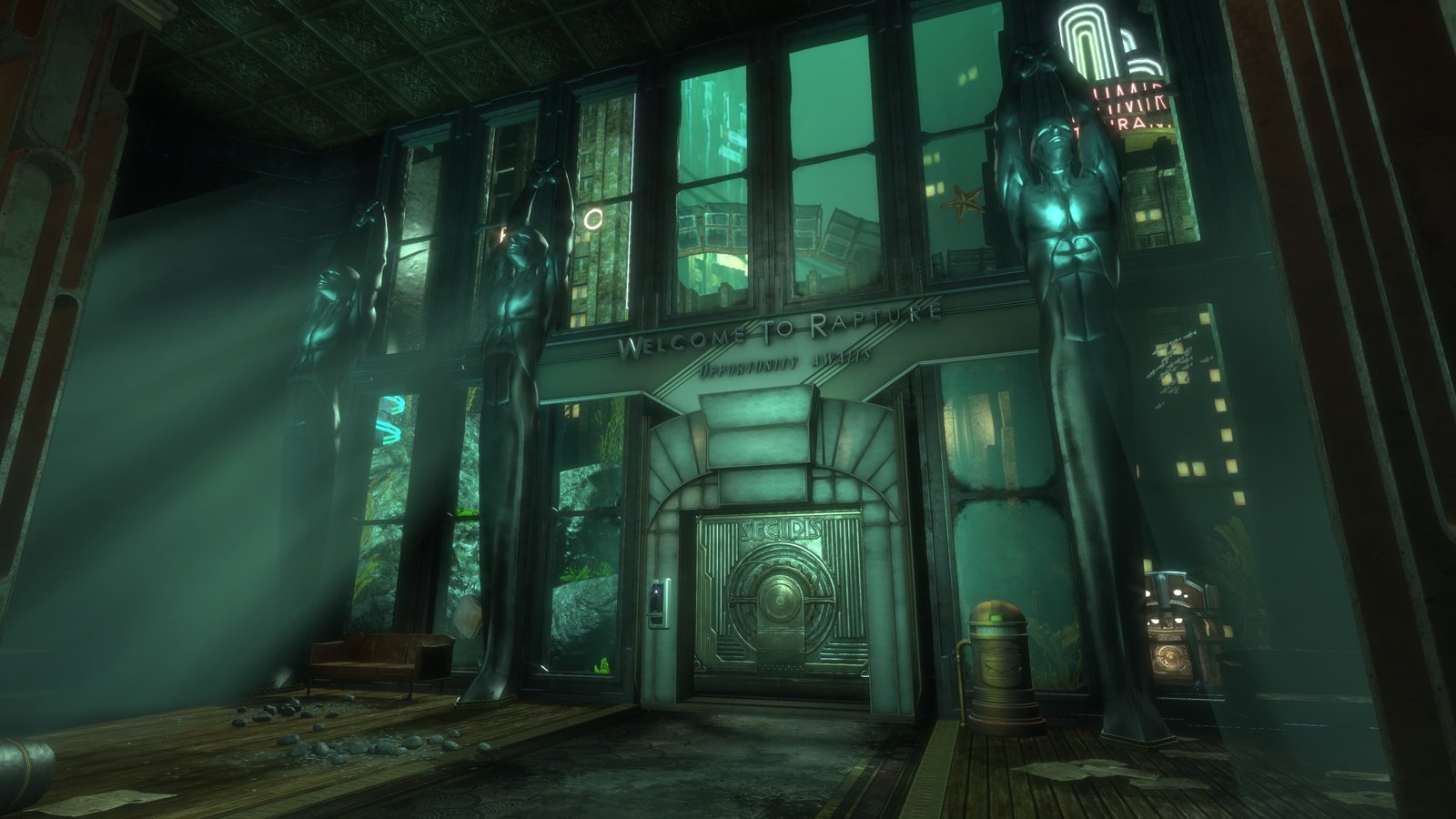 © Irrational Games
Introduction: Art Deco Skyscrapers Shining in the Dark Depths and a Cold War Escapism
In the dark, cold abyss of the Atlantic Ocean, enveloped by overwhelming water pressure and absolute solitude, a cluster of geometric skyscrapers and neon lights suddenly emerges on the seabed. This is the massive underwater city of Rapture, whose construction began in 1945 and was completed in 1951. This city, the setting of BioShock, is not merely a product of science fiction or a madman’s delusion. It is a grand “physical testing ground” for extreme philosophy, born from the historical context of the 1950s Cold War structure, the paranoia of global annihilation by nuclear weapons, and the ideological conflicts between superpowers.
The city’s creator, the billionaire Andrew Ryan, despised the Altruism and Collectivism that dominated surface society, and built his ideals into physical form in the deep sea. The Art Deco style of the 1920s and 30s that adorns the cityscape of Rapture is a visual celebration of human reason, scientific progress, and the myth of the “Self-made man.” The straight lines and symmetry, the brass and gold ornamentation, and the high-rise buildings that pierce the sky (or rather, aim for the sea surface) stand there as proof that human intellect has completely conquered the threats of nature. This space, where the ruthless darkness of the seabed coexists with an almost maddening aesthetic sense, is in itself a colossal ideological monument.
In this first installment of our series of reports, we will integrate micro-evidence such as the game’s environmental visuals, the remaining audio diary records, and the structural evolution of the city to thoroughly unravel the philosophy of Ayn Rand’s Objectivism that flows at the foundation of the city of Rapture. Without delving deeply into later events such as the runaway genetic engineering or class warfare, we will examine how a philosophy seeking absolute freedom and rationality took root in this deep sea, and what seeds of madness were pregnant “inside” that ideology. This article will dive vertically to the absolute limit into that ideological context and the inner depths of Andrew Ryan’s psychology to uncover the full picture.
1. The Original Landscape of Founder Andrew Ryan: The Bolshevik Revolution and Cold War Trauma
To understand the raison d’être of the underwater city of Rapture, one must first logically elucidate the psychological depths of its creator, the individual Andrew Ryan, and the historical background that shaped him. According to facts explicitly stated in the in-game data, his real name is Andrei Rianofski, and he hails from the former Russian Empire.
He experienced being driven from his homeland during the Bolshevik Revolution (Russian Revolution). According to a lore scholar’s analysis deduced from this, the young Ryan must have witnessed the private property that his family and he himself had built through hard work, as well as individual dignity, being ruthlessly confiscated by the apparatus of violence known as the state, under the pretexts of the “dictatorship of the proletariat” and the “realization of equality.” There is no doubt that this gruesome formative experience decisively imprinted a powerful paradigm at the core of his mental structure: “Collectivism = a Parasite that strips away human dignity and the fruits of labor.”
Fleeing to America, Ryan amassed enormous wealth solely through his own brilliance. However, the United States of the late 1940s and 1950s, which he made his second home, did not appear as a utopia in his eyes either. What can be inferred from audio diaries and circumstantial evidence is the fact that Ryan, having witnessed the tragedy of the Holocaust in World War II and the atomic bombings of Hiroshima and Nagasaki, harbored extreme fear and despair toward the destructive power possessed by the massive collective known as the state. Furthermore, amidst the post-war Cold War structure, America’s inclination toward a New Deal-style welfare state and government intervention in the market (tax collection and tightening of regulations) were, to him, nothing less than a recurrence of the “exploitation” he had experienced in Russia.
In the audio diary “Impossible Anywhere Else,” Ryan records his fears and his decision as follows:
“To build a city at the bottom of the sea is madness. But where else could we be free from the clutching hand of the Parasites? Where else could we build an economy that they would not try to control, a society that they would not try to destroy? It was not impossible to build Rapture at the bottom of the sea. It was impossible to build it anywhere else.”
The fact indicated by this audio record is that Rapture was not built merely as a playground for the wealthy or a testing ground for science. For him, the extreme environment of the seabed was not only a physical isolation but also an absolute bulwark—the armor of Mother Nature in the form of water pressure—that the ideologies of the surface “Parasites” could not penetrate. To escape the paranoia of the Cold War, he rejected the world itself and chose to literally “sink” away from it.
2. Ayn Rand’s “Objectivism” as the Ideological Foundation
The absolute dogma that defines the political and social structure of Rapture is an extremely pure cultivation of the philosophy of Objectivism, advocated by the real-world Russian-American author and philosopher Ayn Rand. Although Ayn Rand’s name is never directly mentioned in the game, Andrew Ryan’s ideology, the structure of the city, and the process of Rapture’s collapse serve as a vivid homage to her works (especially Atlas Shrugged), and simultaneously as a scathing critical thought experiment on that philosophy.
The core of Objectivism lies in the concept of “viewing man as a heroic being, with his own happiness as the moral purpose of his life, with productive achievement as his noblest activity, and reason as his only absolute.” In this philosophy, Rational Egoism is the supreme virtue, while conversely, sacrificing oneself for others, or forcing self-sacrifice upon others—Altruism—is regarded as the ultimate evil that corrupts the human spirit.
The city of Rapture can be said to be the underwater version of “Galt’s Gulch,” the utopia that appears in Ayn Rand’s novel. It is a society of pure Laissez-Faire capitalism, where all obstacles that hold back individual talent—such as government regulations, taxes, moral censorship, and labor unions—have been eliminated.
Below is a comparison between the paradigm of the surface world (Collectivism/Altruism) and the paradigm of Rapture (Objectivism).
| Components of Ideology | Values of The Surface | Values of Rapture |
|---|---|---|
| Ultimate Foundation of Morality | Altruism, Self-Sacrifice, Compassion | Rational Egoism, Individual Happiness |
| Economic System | Mixed Capitalism, Socialism, Communism | Pure Laissez-Faire Capitalism |
| Driving Force of Society | State Power, Religious Authority, Courts, Welfare Systems | Individual Reason, Productive Achievement, Market Principles (The Great Chain) |
| Definition and Value of Man | Part of a Community, God’s Creation, a Cog in Society | An End in Himself, a Heroic Being |
| Attribution of the Fruits of Labor | Belongs to the Poor, God, or the State (Everyone) | The Absolute Private Property of the Individual Who Sweated for It (The Producer) |
As an analysis inferred from the community and circumstantial evidence, the greatest characteristic of Rapture’s social system is that it completely trusted the essence of human beings as “rational economic men (Homo Economicus).” Ryan fanatically believed that if all humans acted solely according to their own reason, society would achieve infinite progress while maintaining harmony. However, this very “excessive trust in human reason” becomes the fatal blind spot that later leads the city to its ruin.
3. “No Gods or Kings. Only Man.”: The Denial of Three Authorities
The process at the beginning of the game, where the player boards a Bathysphere from a solitary lighthouse floating on the Atlantic Ocean and descends to the seabed, is an initiation signifying a “severance” from all ideologies of the surface world. And when the massive underwater city reveals its full form, the commanding voice of Andrew Ryan echoes from the screen inside the Bathysphere. This speech is the founding philosophy (or declaration of independence) of Rapture, expressing the thesis of Objectivism in its purest form.
“I am Andrew Ryan, and I’m here to ask you a question. Is a man not entitled to the sweat of his brow? ‘No!’ says the man in Washington, ‘It belongs to the poor.’ ‘No!’ says the man in the Vatican, ‘It belongs to God.’ ‘No!’ says the man in Moscow, ‘It belongs to everyone.’ I rejected those answers; instead, I chose something different. I chose the impossible. I chose… Rapture. A city where the artist would not fear the censor, where the scientist would not be bound by petty morality, where the great would not be constrained by the small!”
In this oath explicitly stated in the game, Ryan calls out and denies the three massive authorities that dominated the surface world at the time.
-
Washington (America’s New Deal Policies / Welfare Statism): The phrase “It belongs to the poor” refers to the redistribution of wealth through progressive taxation and social security systems. To Ryan, the act of taking the wealth of the strong by law and distributing it to the weak was institutional exploitation that sapped the producers’ will to work and their dignity.
-
The Vatican (Christian Altruism / Religious Morality): The phrase “It belongs to God” is a denial of religious authority that treats wealth and talent as loans from God and preaches self-sacrifice and love for one’s neighbor. In Objectivism, morality that forces self-sacrifice is nothing but a poison that degrades humans into spiritual slaves.
-
Moscow (The Soviet Union’s Communism / Collectivism): The phrase “It belongs to everyone” is an expression of anger toward communism, which completely denies individual private property and places everything under state control. It is the most detestable ideology, from which Ryan directly suffered during his childhood.
The lighthouse that serves as the gateway to Rapture, and the massive banners hung throughout the city, bear the ultimate slogan of a city that has completely eliminated these three authorities:
“No Gods or Kings. Only Man.”
To clarify the factual relationships implied by these words, “Gods” refers to religious morality and supernatural overseers, while “Kings” refers to political dictators and big government (state power) that manages the citizens. In Rapture, there are no higher beings imposing laws or morals; it is a declaration of absolute individualism, where each individual takes complete self-responsibility for their own actions and consequences.
However, judging from the environmental visuals and the historical background discussed later, this slogan contains a profound irony. In Rapture, which supposedly rejected both gods and kings, massive bronze statues of Andrew Ryan were erected everywhere, and his ideology was ingrained into the citizens as absolute dogma. This vividly illustrates the psychological contradiction of his own attempt to reign as the “God” and “King” of Rapture.
4. “Human Reason” Spoken by Environmental Visuals and Architectural Style
In extracting the themes of Rapture, the in-game environmental visuals—especially its architectural style—speak of the philosophy of Objectivism more eloquently than dialogue. The cityscape of Rapture is unified by the Art Deco style that was popular from the 1920s to the 1930s.
There is a clear ideological reason for the adoption of Art Deco. Art Deco is a design style that affirms the machine civilization and mass production since the Industrial Revolution, celebrating rationality, progress, and urban culture. This style, which heavily utilizes streamlining, geometric symmetry, and metals (brass and aluminum) along with glass, stands in stark contrast to Art Nouveau, which favored the “imitation of nature.” It was physical proof that “human reason had conquered and controlled nature.”
In the environment of the deep sea, this architectural style holds special meaning. Against the dark ocean that seeks to crush the city with infinite pressure, the skyscrapers of Rapture stand tall and proud, shining with golden neon. Despite the ruthless world of death spreading outside the windows, the inside maintains a space where jazz plays, luxurious carpets are laid, and cigar smoke drifts.
This “extreme severance between the outside and inside worlds” is precisely the metaphor for the spiritual fortress of Objectivism. The architecture of Rapture is designed to constantly evoke a eugenic pride in its residents: “We are the chosen elite who have triumphed over the threats of nature (or the barbaric ideologies of the surface).” Furthermore, posters plastered throughout the city depict propaganda that fuels egoism, such as “The sweat of your brow is yours” and “Unleash your chains,” visually and continuously stimulating the citizens’ competitive spirit and individualism.
5. “The Great Chain”: The Absolute Deification of the Invisible Hand
Although Andrew Ryan denied the gods and governments of the surface, he did not condone complete anarchy. He introduced to Rapture a unique “divinity,” or a concept that could be called a fundamental law of the universe. That is “The Great Chain.”
This concept can be said to be a radicalized and religiousized version of economist Adam Smith’s theory of the “Invisible Hand” from the perspective of Objectivism. In the audio diary “The Great Chain,” Ryan clearly speaks of his faith.
“I believe in no God, no invisible man in the sky. But there is something more powerful than each of us, a combination of our efforts, a Great Chain of industry that unites us. But it is only when we struggle in our own interest that the chain pulls society in the right direction. The chain is too powerful and too mysterious for any government to guide. Any man who tells you different either has his hand in your pocket, or a pistol to your neck.”
In Ryan’s belief, the act of each individual purely pursuing their own self-interest was the sole power source that ultimately propelled society forward as a whole. Intentional wealth redistribution by the government or market intervention to save the weak were considered blasphemy against this perfect ecosystem (the chain), and were viewed as cancer cells that would invite the collapse of society.
This ideology was fanatically defended even when Rapture faced realistic crises. In the audio diary “Great Chain Moves Slowly,” Ryan demonstrates his stance of maintaining a cold-blooded Laissez-Faire approach even toward the rampage of Splicers (citizens driven mad by the abuse of genetic modification substances) and the spread of violence that was occurring within the city.
“Is there blood in the streets? Of course. Have some men perished by their own hand, through careless splicing? Undeniable. But I will issue no declarations, I will pass no laws. The Great Chain moves slowly, but with wisdom. It is our impatience that invites in the parasite of big government. And once you’ve invited it in, it will never stop feeding on the body of the city.”
The factual records show that even when faced with the realistic threats of deteriorating public security and public health crises in the city, Ryan prioritized his own ideology and refused to intervene. The psychological depth inferred from this is that Ryan’s philosophy had completely deviated from pure “rational rationalism” and transformed into a kind of cult that worshipped the ideology itself. While denying “God,” he entrusted the inorganic and merciless system of the “market” as an omnipotent deity, and tacitly approved of individual ruin and death as “legitimate offerings (natural selection)” to that god.
There were those who held a different perspective on this fanaticism toward “The Great Chain.” In the audio diary “Shackled to the Great Chain,” someone (inferred from circumstantial evidence to be someone who later held opposing ideologies) states the following:
“We weren’t pulling the Great Chain of progress like Ryan believed. We were shackled to it.”
The fact suggested by these words is heavy. In an absolute free market, only a few strong individuals with capital and power end up on the side pulling the chain, while the vast majority of the have-nots are destined to fall into being slaves (shackled), mercilessly dragged and ground down by the Invisible Hand.
6. The Dualism of “Man” and “Parasite”: The Sprouting of Maddening Exclusivity
The most characteristic and dangerous element in Andrew Ryan’s ideological structure is the extreme dualism that strictly categorizes the world into two: “Man” and “Parasite.” To him, humanity was not a continuous gradation, but an existence clearly divided into good and evil.
In the audio diary “A Man or a Parasite,” he formulates this elitist ideology as follows:
“What is the difference between a man and a parasite? A man builds. A parasite asks ‘Where is my share?’ A man creates. A parasite says, ‘What will the neighbors think?’ A man invents. A parasite says, ‘Watch out, or you might tread on the toes of God…’”
According to this thesis, only “productive individuals” such as scientists who generate new technologies, artists who pursue beauty, and businessmen who create wealth are recognized as having value as a “Man.” In contrast, workers who form labor unions to assert their rights, activists who demand consideration for the environment and ethics, religious figures who impose moral constraints, and the weak who rely on welfare are all classified as “Parasites” attempting to free-ride on the fruits of others’ labor.
The terror of this dualism lies in the fact that it completely eradicates “empathy for others.” In Objectivism, sympathy for the weak is not a virtue, but a vice that drags down the strong. Ryan’s use of the insectoid and pathological metaphor of a “Parasite” is not mere rhetoric. It functioned as a powerful “psychological indulgence” for him to designate those who defied him as subhuman entities and ruthlessly oppress and purge them when Rapture’s society later headed toward collapse.
By applying this ideological context, the reason why scientific research devoid of ethical constraints ran rampant in Rapture can also be logically elucidated. As a result of discarding moral constraints as the “nonsense of Parasites,” scientists followed only their own “Rational Egoism (the pursuit of intellectual curiosity and fame)” and plunged into inhumane human experimentation. The result of geniuses without ethics pursuing their own happiness to the absolute limit caused the tragedy of citizens turning into monsters due to the abuse of genetic modification substances (the details of this event will be left for the next report, but it is worth noting that its foundation lay in Ryan’s dualistic philosophy).
7. The Paradox of the Absolute Free Market: The Closure of Arcadia and the Privatization of Breathing
How does the “pure Laissez-Faire capitalism” championed by Objectivism run out of control in a physically enclosed space? The most symbolic example of this, which vividly illustrates the madness of Rapture, is the incident of monetizing the indoor forest facility “Arcadia.”
Arcadia was a vast artificial forest designed by botanist Julie Langford, and it was the sole source of oxygen in the underwater city of Rapture. On the surface, air is a common property (commons) given equally to everyone. However, in Rapture, where everything is traded as private property, even air was incorporated into the logic of capitalism.
In the audio diary “Arcadia Closed,” Langford records her bewilderment at Ryan suddenly restricting entry to Arcadia only to “paying customers.” She protests to Ryan that he has “turned a walk in the woods into a luxury,” but Ryan coldly counters:
“What’s wrong with a farmer selling his crops? What’s wrong with a potter profiting from his pots?”
Langford eventually convinces herself that “it’s better to be unemployed than a hypocrite” and complies with this decision.
The deep analysis as a lore scholar derived from this is the reality that in an extreme Objectivist society, even the “human right to life (the right to breathe oxygen essential for sustaining life)” is commodified, degrading into a transaction that must be purchased with one’s own “sweat of the brow (compensation for labor).” In Rapture, where the concepts of public goods and welfare do not exist, those without money are stripped even of the “right to breathe.” Ryan’s logic is completely consistent and holds no contradictions from the perspective of economic rationality. However, its logical conclusion was a spine-chilling dystopia that completely replaced human dignity with monetary value.
8. The Limits of Objectivism and the Trap of the “Dollar Auction”: Exploit or Be Exploited
The greatest structural flaw of the utopia designed by Andrew Ryan lies in his illusion that an ideal society would be established simply by gathering only the “elite (Man).” He ignored, as a philosophical blind spot, the existence of the “menial labor force at the bottom” that was essential for the city to continue functioning.
A fact that can be confirmed in the game is the rapid class stratification of Rapture. The workers who descended to the seabed believing that anyone could become a winner in “The Great Chain” quickly fell to the side of being exploited by the strong who possessed capital and talent. The one who saw through this situation most ruthlessly was Frank Fontaine, who would later become Ryan’s greatest political enemy. He sneers in the audio diary “Sad Saps”:
“These sad saps. They come to Rapture thinking they’re gonna be captains of industry, but they all forget that somebody’s gotta scrub the toilets.”
From the perspective of the workers, Ryan’s chain was nothing more than a “big iron ball around your ankle.” In a pure free market, the pursuit of self-interest inevitably regressed society into a survival of the fittest, an “exploit or be exploited” scenario.
What is noteworthy in the analysis is that the power struggle leading to the collapse of Rapture had fallen into the paradigm of the “Dollar Auction” in game theory. The Dollar Auction is a trap where the winner gets the prize, but the loser also forfeits their bid, causing participants to continuously and irrationally outbid each other to avoid a loss, ultimately resulting in both sides suffering catastrophic losses that far exceed the prize amount.
| Structure of the Dollar Auction | Application to the Power Struggle in Rapture |
|---|---|
| Auction Prize ($1) | Complete control of Rapture and enormous capital profits |
| Bidders | Andrew Ryan’s Faction vs. Anti-Establishment Faction (Frank Fontaine / Atlas) |
| Rational Bidding Behavior | Competitive strategies to maximize one’s own victory (profit) |
| Escalation Trap | Continuously adopting extreme measures that surpass the opponent out of fear of defeat (losing everything) |
| Catastrophic Conclusion | Mutual attacks completely destroy the city’s infrastructure and social structure, leaving a ruin with no winner |
Both Ryan and his adversaries acted believing themselves to be “rational Objectivists.” However, the “pursuit of self-interest” to defeat the opponent in the power struggle lost its brakes and escalated. Ryan began to adopt one after another the methods of the “dictator (King)” he most despised to suppress the anti-establishment faction. He nationalized (seized) opposing corporations under the guise of “public interest,” organized a secret police force, and secretly sent dissidents to prison camps. Ultimately, he went so far as to integrate Behaviorism-based mind control (pheromone technology) that stripped the residents of their free will into the city’s systems.
The city, built with free will and reason as its supreme values, was transformed by the hands of its own founder into a totalitarian dystopia that treated its residents as cogs in a machine. As a result of both factions continuing to bid for the “$1” of their own victory, the price paid was the “complete destruction of Rapture’s environment and society itself.” The fact that humans cannot always make rational choices, and that absolute freedom breeds extreme irrationality, was left here as bloodstained evidence.
Conclusion: The Logical Consequence of a Utopia and the Silent Deep Sea
To summarize this report, the theme of “Rapture and Objectivism” in the masterpiece BioShock goes beyond a mere fictional setting, functioning as a profound and suspenseful thought experiment on real-world political philosophy and capitalist economics.
The “Rational Egoism” and pure “Laissez-Faire” preached by Ayn Rand might paint a utopia on paper that promises perfect harmony and infinite progress. However, what the underwater city built by Andrew Ryan proved was the gruesome reality of how easily the desires, fears, and irrationalities inherent in human nature can tear that theory apart from the inside.
As a result of eliminating the “Parasite” of government and severing the “chains” of morality, what emerged in Rapture was not an ideal free market, but a violent jungle where the strong endlessly exploited the weak. Above all, the greatest irony of this story is the paradox that Ryan himself, who held absolute individual freedom as the supreme value, stripped others of their free will to maintain his power and the city’s ideology, degrading into the very “dictator (King)” he hated most.
The collapse of the underwater city of Rapture is a testament to how fragile a closed ecosystem is when it completely eliminates “external intervention (regulation) in the environment.” The city, isolated from the ideologies of the outside world by the physical bulwark of water pressure, ultimately collapsed under its own weight due to the extreme pressure of the egoism it contained within.
“No Gods or Kings. Only Man.”
This slogan, which once shone in gold, now lies vainly crushed amidst ruins steeped in the stench of madness and death. When man overestimates his own reason, becomes his own god, and becomes his own king, a hell at the bottom of the sea is created by man’s own hands. The Art Deco skyscrapers sunken in the dark abyss of the Atlantic Ocean continue to silently tell that ruthless truth even now.
Eugenics of Deep Sea and Free Will: BioShock: 15 Meditations on Philosophy and Madness
The book version is now available. Read for free with Kindle Unlimited.
Thank you very much for reading to the end. To help support the activities of this archive, a warm donation of a cup of coffee would be highly appreciated.